

A stable book, reserves under pressure
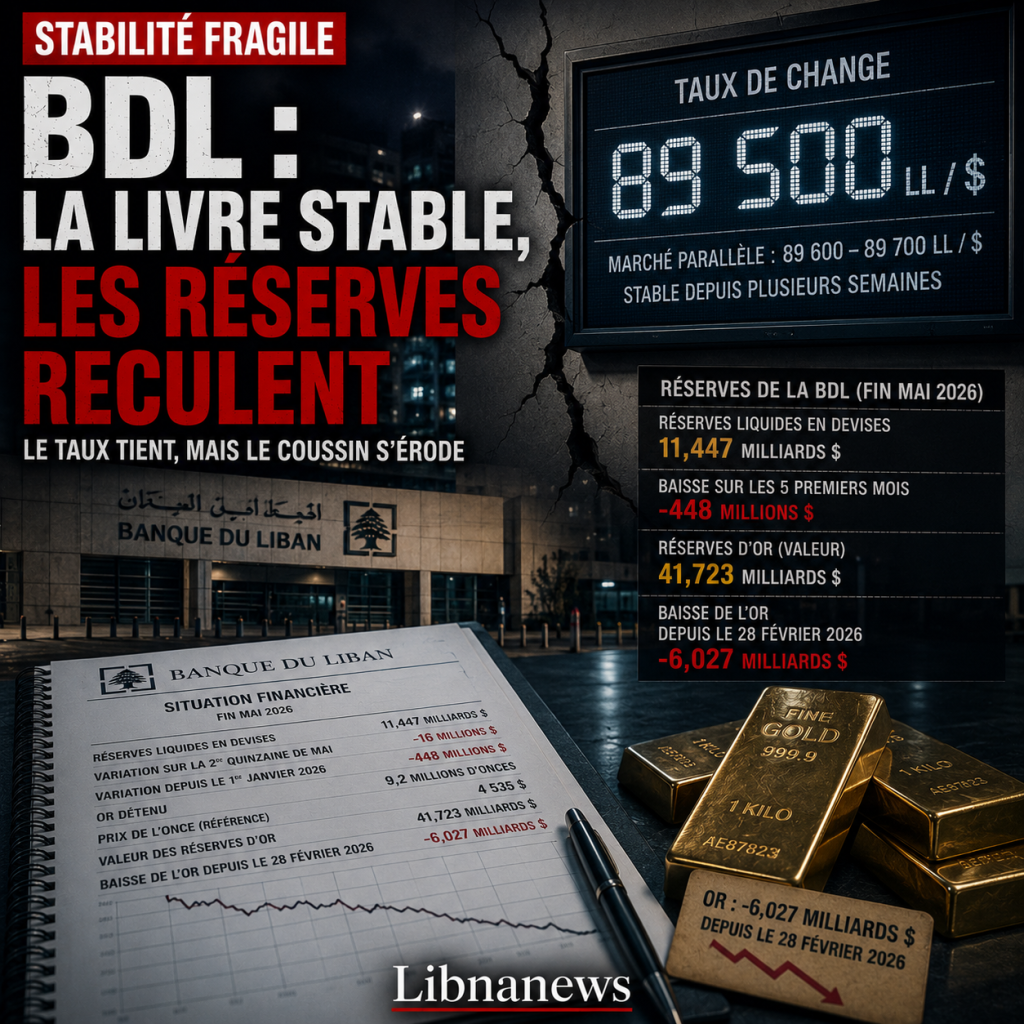
The BDL reserves give a misleading picture of stability. The Lebanese pound remains almost still on the parallel market, around £89,600 to £89,700 per dollar, and the official rate remains at £89,500. This apparent normality feeds the discourse of a return to monetary calm. But the figures published by the end of May 2026 tell a more fragile story. The Bank of Lebanon’s liquid foreign currency reserves have declined further, while the value of gold reserves has declined sharply since the outbreak of the regional war.
The problem is not only the amount of the decline in the second half of May. The Bank of Lebanon continues to play a role in the economy. The institution presents exchange rate stability as an asset. It suggests that a controlled rate is sufficient to measure monetary success. A central bank cannot confuse facade stability with financial strength. When liquid reserves decline, when foreign currency deposits continue to leave the banking system and when the restructuring of losses remains blocked, the exchange rate becomes an incomplete, almost political indicator.
The latest available data indicate that BDL’s foreign currency liquid assets reached $11.447 billion by the end of May 2026, up from $11.463 billion by mid-May. The decrease over two weeks is therefore $16 million. It seems limited. But the net decline is $448 million over the first five months of the year. This erosion occurs in a country in sovereign default, deprived of normal financing and subjected to war that increases foreign exchange needs. It is this context that makes the figure worrying.
Key BDL figures
| Indicator | Level or variation |
|---|---|
| Official rate | £89,500 |
| Parallel market | £89,600-89,700 |
| Liquid reserves at the end of May 2026 | $11.447 billion |
| Liquid reserves mid-May 2026 | $11.463 billion |
| Decline on the second half of May | $16 million |
| Decline over five months | $448 million |
| Gold reserves end of May 2026 | $41.723 billion |
| Gold reserves mid-May 2026 | $42.005 billion |
| Inmate | 9.2 million ounces |
| Price per ounce | $4,535 |
| Gold drop since 28 February | $6.027 billion |
Gold reserves add another source of vulnerability. Their value rose from $42.005 billion in mid-May to $41.723 billion at the end of the month, based on 9.2 million ounces valued at $4,535 ounces. Since the beginning of the war with Iran on 28 February 2026, their value has fallen by 6,027 billion dollars. This decline does not mean that Lebanon has sold its gold. It shows that one of the country’s main heritage cushions depends heavily on international prices, the dollar, US rate expectations and market tensions.
Lebanon here pays the price of a model that has long used reserves as a communication tool. Gold is presented as a national wealth. Liquid currencies are shown as proof of resistance. The stable exchange rate serves as a mastery symbol. But none of these elements replaces a complete monetary policy. A reserve can reassure if it protects a functioning banking system, a restructured debt and an economy capable of producing currencies. In Lebanon, it is mainly used to mask the absence of a comprehensive settlement since the collapse of 2019.
BDL: facade stability
The BDL can respond that exchange rate stability protects households. This argument is not false. A further drop in the pound would hit wages, prices, rents, medicines, fuel and food. After years of collapse, the population needs a minimum of predictability. But monetary stability cannot be achieved at the price of opacity. Citizens need to know how it is produced, how much it costs, what reserves are used, what flows support it and what limits it meets. Without transparency, stability becomes a slogan.
The monetary table at the end of May shows this ambiguity. On the one hand, the book remains stable in the parallel market. On the other hand, liquid reserves are declining, residents’ bank deposits are declining and foreign currency deposits are declining further. Resident deposits lost £2,710 billion in the week ended May 21. The decrease is mainly due to foreign currency deposits, down by £4,072 billion, or $45.5 million at the official rate. Book deposits are increasing, but mostly in the form of overnight accounts. It’s not a return of trust.
This combination is worrying. A stable currency, contracted foreign currency deposits and a central bank that loses reserves are a fragile balance. It is not based on credit recovery, a massive return of capital, or successful restructuring. It is based on scarcity, informal flow control, prudence of economic agents and the absence of immediate shock. It is stabilization by compression, not reconstruction. It can last a while. It is not enough to revive an economy.
BDL reserves should therefore be read as a limited stock, not as a solution. The $11.447 billion in liquid reserves cannot finance both foreign exchange stability, essential imports, humanitarian needs, reconstruction and the restoration of bank confidence. The country faces war losses that would exceed $20 billion and could approach $25 billion if the conflict continued. More than 61,000 homes were reportedly damaged. Real needs far exceed available margins.
The trap of a shield central bank
This disproportion makes the role of the Bank of Lebanon even more sensitive. The institution cannot become the silent financier of all emergencies. It cannot compensate for the lack of a credible budget, the absence of bank reform and the absence of debt restructuring. Yet it is the classic Lebanese trap. Whenever political power postpones a decision, the central bank is pushed to absorb the shock. It does so through circulars, interventions, rates, reserves or arrangements. The cost always comes back to depositors, currency or trust.
The recent past imposes a clear criticism. The Bank of Lebanon was at the heart of the system that allowed the accumulation of imbalances before 2019. It financed the state, attracted deposits with high yields, supported a parity that became unsustainable and maintained the illusion of lasting stability. Since the collapse, it has changed governance and instruments, but it has not yet restored the transparency necessary for a real break. Reserves are monitored, but their use, protection and articulation with bank losses remain insufficiently explained to the public.
Criticism must not ignore constraints. The BDL operates in a country at war, with a failing state, a paralysed banking sector, limited public revenues and a highly dollarized economy. It does not have a normal central bank environment. But this difficulty makes transparency even more important. The narrower the margins, the clearer the rules. Permanent exception management has already destroyed trust. The current period cannot be content with a reassuring exchange rate communication.
The case of gold illustrates this confusion. Gold reserves are a major national asset. Their book value may increase or decrease depending on global markets. This volatility should not be used as a political argument in the circumstances. When gold rises, some officials present it as proof of wealth. When it drops, they minimize the impact by reminding that ounces remain held. Both readings are incomplete. Gold protects the country only if its status is clear, if its possible use is strictly regulated and its value is not transformed into a substitute for reform.
No replacement for reform
The report refers to a decline in the value of gold linked to the strength of the dollar, the expectations of higher rates in the US Federal Reserve and the tensions caused by the prolonged closure of the Strait of Ormuz. These factors recall that Lebanon suffers variables that it does not control. A fragile central bank in a small importing country cannot build credibility on volatile international prices. It must build credibility on its rules, accounts, audits and ability to refuse disguised political financing.
The stability of the pound is also based on a impoverished market. When credit no longer works, when imports are rationed by low income, when households spend with caution and when businesses reduce their investment, the demand for foreign exchange can be contained. But this contraction is not a victory. This is the symptom of a narrow economy. A stable rate in an economy that does not invest, does not lend and loses passengers at the airport does not indicate a recovery. He reports a pause in the crisis.
The same report shows that Beirut airport saw its passenger traffic fall by 34.2% over the first five months of the year. Arrivals fell by 40.2%. This decrease reduces the expenditure of the diaspora and tourism, two key sources of foreign exchange. It thus weakens external balances as the BDL seeks to preserve its reserves. A central bank cannot sustainably stabilize the exchange rate if the economy receives less dollars through normal channels. It can slow down the adjustment, not remove the constraint.
The danger lies in the confusion between reserve and trust. Reserves can support trust if citizens believe that the rules are sound. But in Lebanon, many applicants learned that official figures could hide unrecognized losses. They know that bank deposits are not equivalent to available dollars. They know that circulars can change rights. In this climate, announcing a level of reserves is not enough. It is necessary to explain who has access to these reserves, for what uses, under what control and with what priority.
Transparency or new monetary illusion
The Bank of Lebanon should publish more understandable information. The results exist, but they are not sufficient to inform the public debate. Regular data are needed on foreign exchange interventions, sources of foreign exchange entry and exit, conditional liabilities, relations with banks, the breakdown of liquid assets and the risks associated with the instruments used. Technicality should not be used as protection. A central bank managing a national crisis must make its choices legible, even when these choices are difficult.
The government also bears a responsibility. He cannot use the BDL as a political shield. Exchange stabilization should not exempt the cabinet and Parliament from dealing with bank losses, public debt, tax reform and the IMF programme. Moody This assessment echoes the message of the reserves: without structural decisions, the available stocks are consumed or devalued while the problems remain complete.
The risk is to repeat the scenario that preceded the collapse. For years, the stability of parity was presented as a success, while it was based on an accumulation of debts, deficits and hidden commitments. Today, stability around £89,500 must not become a new illusion. It can be useful if it accompanies a transition to reform. It becomes dangerous if it is used to further postpone the settlement of losses and to prolong an economy without credit, confidence and transparency.
The BDL’s reservations therefore do not say that Lebanon is stabilized. They say that he still has a cushion, but that this cushion s’erode. They say the exchange rate can remain calm while the financial foundations remain damaged. They say that gold can lose billions of value without the state moving forward on reform. They also say that the next step will depend less on monetary intervention than on a political choice: accept the truth of losses, protect the remaining assets and stop asking the central bank to mask the absence of a strategy.
Future BDL publications should therefore be carefully observed. The question will not only be whether the reserves fall by a few million dollars or whether the pound remains still for another week. The question will be whether the institution agrees to transform the stability displayed into verifiable transparency, while deposits, war, tourism decline and reconstruction needs continue to test the limits of its balance sheet.




