

By Nadine Sayegh, a Franco-Syrian university, she is the host of the charity « Al Sakhra » (The ROC) to help Syrians affected by the war. Contributorhttps://www.madaniya.info/the list of his contributions on this linkhttps://www.madaniya.info/author/nadine-saygh/
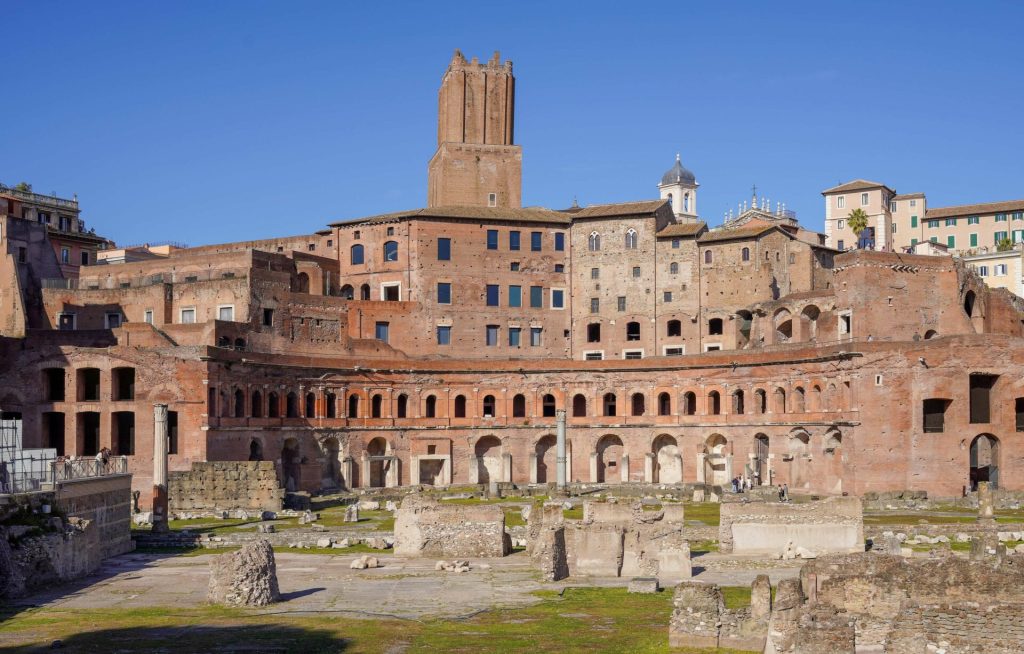
Trajans Markets, Rome
In the exhilarating landscape of ancient Syria, the cradle of cultures, knowledge and intellectual circulation, emerges a singular figure: Apollodore of Damascus. Architect, engineer and innovator, he was one of the brightest minds of the Roman Empire in the second century, to the point of becoming the architect appointed by Emperor Trajan. Yet his name is often eclipsed behind the monuments he has imagined and which continue, still today, to structure the Western urban imagination.
A Syrian in the Heart of Imperial Power
Born in Damascus, then cosmopolitan center where local traditions and Greco-Roman influences were mixed, Apollodore grew up in an environment where ingenuity was a necessity as much as art.
His mastery of military and civil engineering led him to join Trajan’s entourage, of which he became one of the closest technical advisers. His journey recalls how the exchanges between East and West were, far from the clichés of rupture, fertile dynamics carried by men and women capable of navigating between the worlds.
The genius behind the monuments
Apollodore leaves a deep mark on imperial Rome. He was awarded the Trajan forum, the largest of the imperial fora, a real feat of urban development. The Trajane column, a narrative masterpiece in stone, wrapping on its barrel the history of the conquest of the Dacia. Trajan Bridge on the Danube, long considered the longest arch bridge in the ancient world. The Trajan market, often described as the first shopping centre in history. Through these works, Apollodore has redefined the use of public space: a place of power, of course, but also a space of narrative and collective life.
Between innovation and vision
What distinguishes Apollodore is not only his technical talent, but his ability to anticipate the needs of a changing society. In its projects, architecture is never isolated.
It is part of a political, social and symbolic narrative. Son of the Levant, he was able to offer Rome a new architectural language, combining military rigor, classical elegance and oriental sensitivity. A dialogue of cultures whose stones still bear witness.
Today, as Syria goes through difficult times and its heritage has paid a heavy price, the figure of Apollodore of Damascus resonates with a particular force. It recalls that Syrian lands have given birth to creators capable of lasting influence over the world. Rediscovering Apollodore also recognizes Syria’s place in the global history of creation, thought and beauty!




