Naim Kassem fixes Hezbollah line
Naim Kassem fixed the Hezbollah line in the sequence opened by the regional agreement between Washington and Tehran. The party's secretary-general refuses any disarmament-related proposals as long as the Israeli army remains present in southern Lebanon. He accepted the idea of a national dialogue, but only after the Israeli withdrawal, the cessation of attacks, the return of the displaced and the reconstruction. This position strengthens the party in the short term, but also risks prolonging the Lebanese political deadlock.
Back to the South: villages in ruins
Returning to South Lebanon does not yet mean returning to normal life. After the announcement of the de-escalation, displaced families return to see the damage in their villages, recover property and assess the possibility of staying. But the houses destroyed, the lack of water and electricity, the schools affected, the dangerous roads and the persistent strikes show that the crisis continues. Reconstruction must be civil, social and security.
The war that did not change Iran, but could change the Middle East
The war between the United States, Israel and Iran did not transform Tehran, but could make lasting changes in the Middle East. Bernard Raymond Jabre analyses the transition from a world of empires to a world of networks, where sovereignty rests less on domination than on strategic diversification.
South Lebanon: Israel challenges Islamabad agreement
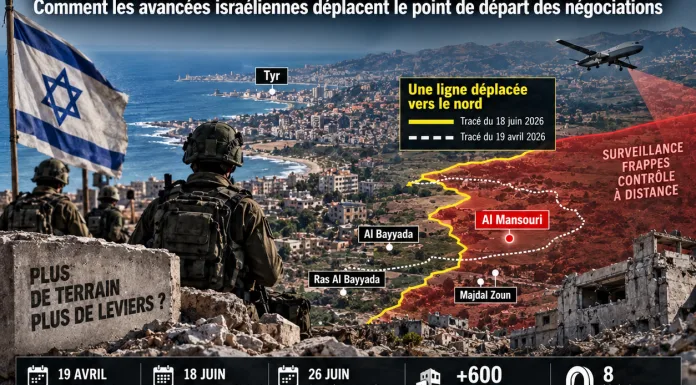
The publication by the Israeli army of a map designating a "security zone" in southern Lebanon occurs at the most sensitive moment in the diplomatic sequence opened by the Islamabad agreement. By displaying a military presence of up to ten kilometres within Lebanese territory, Israel seeks to impose a security fact, while the Washington-Theran text mentions the cessation of operations on all fronts, including Lebanon, and the guarantee of Lebanese sovereignty.
Israeli withdrawal: Lebanese test
The Israeli withdrawal from southern Lebanon has become the central criterion of the regional agreement between Washington and Tehran. A ceasefire will not suffice if Israel retains positions, a security zone or freedom of military action. For Joseph Aoun and Nawaf Salam, Lebanese sovereignty begins with the liberation of the territory and the deployment of the army. For Hezbollah, withdrawal must precede any debate on weapons.
Hormuz: the world economy under stress
The energy component of the agreement with Iran goes beyond the nuclear issue. It concerns the Darmuz Strait, US sanctions, Iranian exports, maritime insurance and world oil prices. Markets have reacted to the prospect of a gradual reopening of the passage and a return of Iranian crude oil, but the drop in the barrel remains fragile. For vulnerable countries such as Lebanon, the issue is measured in fuel, electricity and inflation.
Syria refuses Lebanese trap
Syria refuses to intervene in Lebanon against Hezbollah, despite Trump's calls, and leaves Israel trapped in the Lebanese front.
On the front page: Lebanon facing the US-Iranian agreement test
The Lebanese press on June 18 puts Lebanon in front of the American-Iranian agreement test. Between sovereignty displayed, pressure on Israel, the role of Hezbollah and the demands of the Group of Seven, Beirut seeks to impose the State as the only interlocutor in a regional negotiation that still exceeds it.
Gadi Eisenkot, the other general of Israel who dreams of becoming prime minister
Former Chief of Staff of the IDF, Gadi Eisenkot appears increasingly as a credible alternative to Benjamin Netanyahu. His security profile, his military career, his personal mourning in the Gaza war and his new Yashar party give him a unique place in a conflict-hardened Israeli society. The Islamabad accords, perceived by one side of Israel as a diplomatic defeat against Iran, reinforce this political dynamic.
JD Vance warns Israel about Lebanon
After the Israeli strikes on Beirut, JD Vance sent an unusually firm message to Israel. The US Vice President recalls that the interests of Washington and Jerusalem are not always the same, as the Trump administration seeks to preserve the memorandum with Tehran. This position places Lebanon at the centre of an arm between American diplomacy, Israeli security demands and Iran's conditions.
18 June: Lebanon, a discreet echo of de Gaulle
The appeal of 18 June was probably not heard directly in Lebanon, then under French mandate and under the control of the Levant authorities. However, French people from Lebanon and Lebanese have joined free France. The movement was limited in 1940, then more visible after the campaign of Syria and Lebanon in 1941. It combines military dissent, intellectual commitment, fidelity to a certain idea of France and hope for Lebanese independence.
When Versailles tells American history
Versailles is not the exact place where the treaty recognizing the independence of the United States was signed. It was concluded in Paris in 1783. Yet the castle remains a major symbol of American history. He embodied the French alliance, the European treaties that accompanied peace, Wilson's international ambition in 1919, and the patronage of the Rockefellers, which helped save the estate in the 20th century.
Islamabad Agreement signed in Versailles with Lebanon under guarantee
The night signing of the Islamabad memorandum in Versailles gives Lebanon an unexpected place in the settlement between Washington and Tehran. The first clause mentions the end of military operations on all fronts, including in Lebanon, and the guarantee of Lebanese sovereignty. This formulation opens a major diplomatic window, but its effect will depend on the final agreement, a Security Council resolution and verifiable mechanisms on the ground.
ال
الللبنانين البانين الللبنانين البن البين البنين بنهوب دراسههمي الللن اللبنانين البنان فين بنين باسههم في الب في فرنسالن ولن في مللن السفارلبنان في في بارير بنور وهير الن فير اللشون الالماعاعين الين الن الين النان فيان في بارور ونير الننير الون ابييي ال ن وفي 简لم体ه Whilst the [...]