

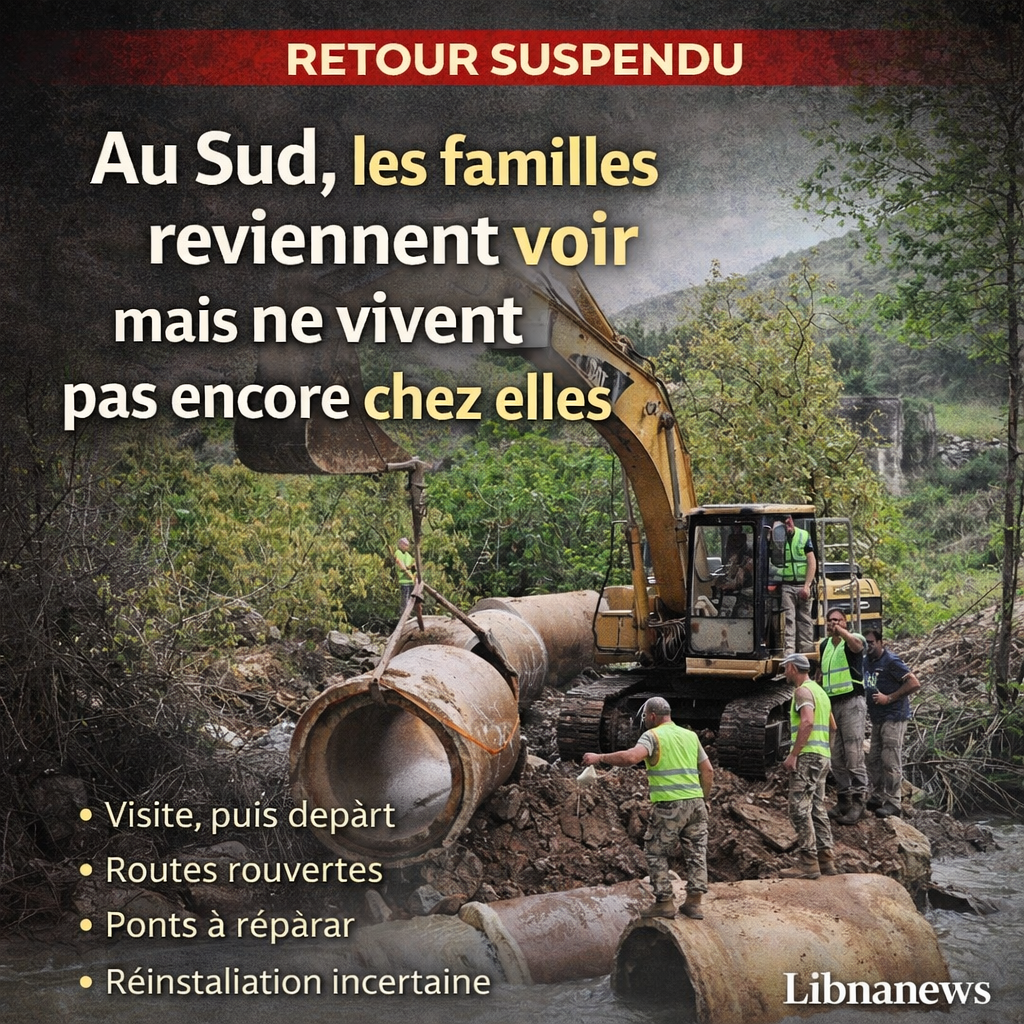
The return starts with a visit, not a resettlement
In the South, the ceasefire did not reopen a normal life. It only made possible a hesitant, almost nervous movement between the places of reception and the villages. Families come back, but first to see. They come to open a door, check a roof, enter a room for a few minutes, see the state of a wall, see if the windows have held, if the tank is still there, if the furniture has resisted, if the land around the house remains practical. Then they leave. This return is not yet a return to life. It’s an inspection, a reconnaissance, a way to look back at what we left without knowing if we can re-establish it.
In many localities, the scene repeats itself. A car arrives, bags stay in the trunk, the family goes down, circulates quickly, exchanges with a neighbor, picks up some things, takes pictures, sometimes sweeps briefly the entrance or opens the shutters, then resumes the road. The village ceases to be completely empty, but it does not become inhabited again in the full sense. He’s entering an intermediate state. Presences return, voices reappear, but without continuity. The houses are reopened without being reoccupied. Everyday doesn’t start again. He’s only trying to find his address.
This detail changes everything. In a real situation of return, families return with the idea of resuming a rhythm. They resettle the children, reopen the cabinets, shop, reorganize the journeys, ask when the schools will reopen, when the shops will restart, how the municipalities will organize. Here, the logic is different. Uncertainty still dominates. We don’t come with a long temporality. We’re coming with caution. We’re calculating. We’re evaluating. It is not known whether blankets, clothing, medicines, papers should already be brought back, or whether it is best to leave everything in the temporary accommodation where it is still sleeping.
The word back then becomes misleading. He suggests a complete displacement. But what many families in the South are experiencing is more like an oscillation. They’re not completely gone anymore. They haven’t completely returned. They’re caught between two lives. One is temporary, often more uncomfortable, sometimes more expensive, but considered even safer. The other is attached to the house, to the land, to the neighborhood, to the memory of the place, but remains threatened by military uncertainty, by the state of the roads, by destruction, by the fear of having to leave again. This oscillation is exhausting, because it forbids full resettlement in the present.
Living two places is living nowhere completely
Prolonged displacement profoundly transforms family life. It’s not just about leaving a house. It is a matter of having learned to divide its existence between several points, several rhythms, several degrees of attachment. Part of life remains in the village. Another one takes place in the reception place, with relatives, in an apartment rented in haste, in a shared accommodation, sometimes in a temporary structure. We sleep here, but we think there. We keep the important papers with you, but we leave some of the laundry in the southern house, in case. We’re shopping in the host city, but we’re watching the village’s new arrivals. All life begins to work on the double mode.
This double existence produces particular fatigue. You have to think of everything twice. Where’s the medicine? Where are the chargers? Where are the winter clothes? Where do we keep the school papers? Should we leave reserves in the original house or take everything away? Who will come back to check the premises if there is a new alert? Who will keep the children if one of the parents decides to go to the village for a few hours? Families become logistics units. They spend part of their energy not to live, but to distribute objects, tasks and presences between two spaces that no longer hold together.
For children, this life cut in half is particularly heavy. They hear adults talk back, but they keep sleeping elsewhere. They see parents preparing trips, going back and forth, speaking in a low voice about the situation, commenting on roads, areas still at risk, homes affected or spared. Their daily lives lose their simple landmarks. School may be further, or irregular. Friends are scattered. The rooms are no longer exactly their own. The home, which should be the most stable place, becomes itself uncertain. But a child does not only measure war through explosions. It also measures it through the disappearance of routines.
For adults, another tension is installed. We must hold materially and emotionally. We must reassure ourselves without lying. We need to talk about a possible return while keeping a reserve. Sometimes it is necessary to curb the desire to return, especially when it is carried by the older ones or by those who bear ill internal exile. Many want to return to their home not only for practical reasons, but because leaving longer gives the impression of gradually losing the place itself. But coming back too early can expose to a new rupture. Families therefore live in a permanent contradiction: protect their own, but do not consent too quickly to the idea that the house has ceased to be the centre of life.
Roads say better than speeches if return is possible
In the South, the reality of return is first read in traffic. An open or closed road is sometimes worth more than a press release. As long as the axes remain destroyed, replaced or uncertain, the return remains theoretical. We can return once, at certain hours, by a detour, for a quick visit. We can’t start living normal again. The repair of bridges, the opening of alternative routes, the rehabilitation of accesses are therefore much more than technical subjects. These are resettlement conditions.
A family can accept some discomfort in their home. She can sleep a few days with little electricity, with a reduced supply, with still incomplete repairs. It cannot endure an unstable access for a long time. If joining the village becomes a complicated route, if the road requires long detours, if it is feared that each trip will be blocked, then the accommodation, even if precarious, retains a decisive advantage: it allows at least to organize daily life. The safety of a family is not limited to the absence of strikes. It also includes the certainty of being able to circulate.
This is why work on roads and bridges has an immediate social impact. They tell the inhabitants that the territory is not abandoned. They show them that a return is not only desired, but prepared. They allow businesses to think about reopening, municipalities to anticipate a minimal recovery, families to imagine less uncertain routes. A repaired road is not just concrete or asphalt. It is the possibility of re-existing schedules, habits, visits, deliveries, care, courses.
However, return does not depend solely on infrastructure. It also depends on the feeling that such infrastructure will not be immediately rendered useless by a resumption of hostilities. That’s where fear comes back. Many families look at roads as a fragile promise. They see the works, the detours arranged, the passages reopen. But they immediately wonder how long it will last. Investing in a return is also a long-term investment. The duration remains precisely what is missing most.
Temporary housing becomes a second home that is not recognized as such
Long displacement produces another effect, more discreet and often painful. Temporary housing eventually settles in life. The objects accumulate there. Habits move. The children take their cues. Adults are now familiar with nearby shops, routes, neighbours, traffic hours. Gradually, the provisional increases in thickness. But this installation remains psychologically difficult to admit. Many refuse to treat the place of reception as a real home, because they are afraid that this recognition will further reduce the return.
So we live in a space that we build without assuming it. We buy a few items, but we don’t invest too much. We tidy up, but we don’t really settle down. It is said to be temporary, even when weeks accumulate. This restraint is not only material. She’s moral. It allows us to remain faithful to the house left. It protects against the impression of having given way. But it makes life heavier. For one never lives well in a place whose interior one refuses to make a place.
This tension appears in the simplest gestures. We keep some boxes closed. We leave bags ready. We don’t hang all the frames. The purchase of furniture, carpet, household appliances is postponed. A form of voluntary failure is maintained. This way of not settling completely is an emotional discipline. It allows us to continue thinking of the return as imminent, even when it moves away. But it has a cost. It really prevents the body and mind from resting. We live in a place without letting it become habitable.
In many families, this situation also creates silent disagreements. Some want to normalize a little life in the host, to protect children, to reduce fatigue, to regain a form of order. Others refuse, for fear of trivializing internal exile. There are those who say: you have to live where we are. And those who answer: living too well here is already getting away from there. This tension crosses couples, generations, fratries. It shows how much displacement is a matter of both intimate time and geography.
The neighbourhood survives, but in intermittent form
In a emptied village and then partially reopened, collective life changed in nature. The neighborhood is no longer a continuous fabric. It becomes a network of intermittent presences. We cross at random with a visit. One learns that a family came up this morning and left in the afternoon. We exchange news over the phone rather than at the doorstep. We check for those who can’t come. We’re looking at the house next door. We’re sending photos. We become the temporary guardian of a neighborhood that has not yet recovered its human density.
This form of solidarity is precious, but it does not replace normal life. A village doesn’t live only because it’s there. He lives because the rhythms re-install there. Kids play. Shops open. Calls from one balcony to the other resume. The times are getting better. Holidays, bereavements, visits, religious and social routines find their place. None of this has yet completely returned. What exists is a watchful sociability. We remain bound, but on the basis of mutual surveillance.
There is something very strong here. Southern families are not simply absent from their villages. They continue to live at a distance. They call, send, ask, monitor, comment, transmit information about the condition of the houses, about access, about the latest movements, about damage, about repairs. The village therefore continues to exist as a mental, moral and relational space. But it no longer exists as a space of full cohabitation. He is kept alive by scattered attention.
This form of remote presence says something of the connection to the place. You don’t really leave your village when you keep following him hour by hour. But we don’t live there anymore. Again, the return remains suspended. Not only infrastructure or guarantees are lacking. There is a lack of continuous human density, that which transforms a locality into a living world, not a point of passage full of emotion.
Come back, it’ll be a rhythm before you find a house
Return is often referred to as an event. In reality, it will be a process. It will not be enough for families to open their doors again. They’ll have to get back to a rhythm. The real return will begin when we stop counting the hours spent in the village. When a night on the spot is no longer worth a bet. When the children return to an identifiable school path. When a business reopens without wondering if it should close tomorrow. When journeys come back to habits, not calculations.
It will take time, even if the calm continues. A house can be repaired faster than a routine. A wall can be raised faster than trust. An axis can be reopened faster than a sense of safety. Families who today live between two lives already know this, even if they do not always say so. They feel that the return does not depend on a single decision. It depends on an accumulation of signs. It will require roads, bridges, guarantees, services, neighbours, schools, shops, simple gestures that become possible again effortlessly.
For now, they are moving forward in an unfinished time. They come back without coming back completely. They keep the house in mind, but keep the home in their daily lives. They refuse to give in to discouragement, but protect themselves from the illusion of a return too quickly proclaimed. They live in this grey area where attachment to the place remains intact, even though life has moved elsewhere.
The real drama of this moment is not just displacement. It’s the suspension. This time when nothing is yet permanently lost, but nothing has yet become fully habitable. The families of the South hold in this fragile space. They don’t want to leave the house or lie about reality. They advance between prudence and desire, between memory and logistics, between fidelity to the place and the need to protect their own. And this is perhaps the most accurate definition of their return today: a way to stay attached to life before it can still be taken back.




