

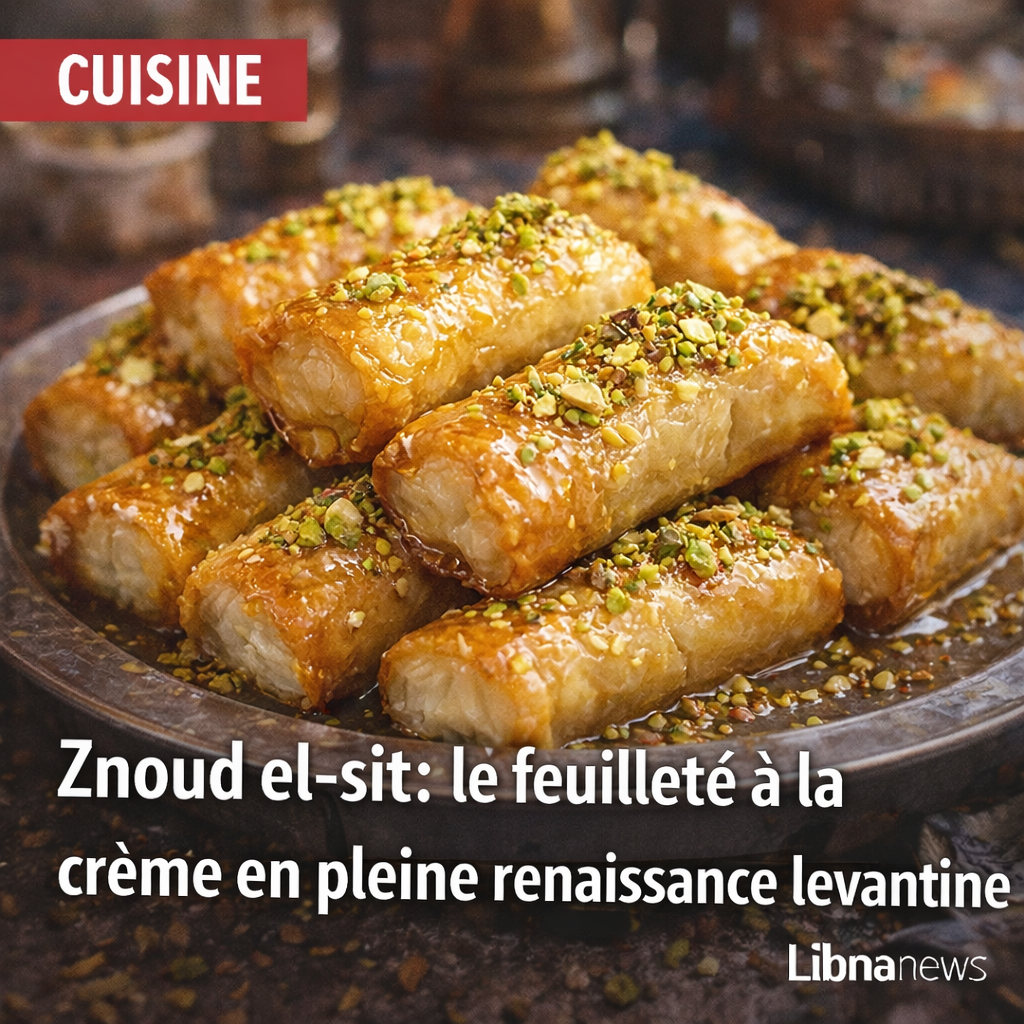
The oriental pastry, with its crispy textures and sweet flavors imbued with floral aromas, continues to seduce palates around the world. At the heart of this tradition, the znoud el-sit, these laminated rolls stuffed with cream and soaked in a scented syrup, embody an ancestral know-how that adapts to contemporary trends. Originally from the Levant, these delights, whose name poetically evokes the « arms of the lady », symbolize the hospitality and conviviality of family meals. In a context where Middle Eastern cuisine is becoming more visible through social networks and cultural exchanges, Znoud el-sit is being innovated, with lighter or merged versions that respect traditional essence while meeting current health and sustainability requirements. This article explores their history, preparation and recent developments, inviting them to rediscover these leaflets as a link between past and present.
A sensory legacy anchored in the Levant
The Znoud el-sit, often spelled znood el-set in some transliterations, represents a jewel of Syrian-Lebanese gastronomy. Their preparation is based on a filo paste spread in thin layers, wrapped around a creamy stuffing called ashta, a custard cream obtained by slow boiling of milk. Once formed, these rolls are baked or fried until they have a golden and crispy crust, then immersed in a simple syrup based on sugar, water and lemon juice, often raised with orange blossom or rose water for a subtle aromatic note. This combination offers an irresistible contrast between the external cracker and the inner smoothness, sometimes punctuated with pistachios or chopped nuts for an extra crisp touch.
Historically, these pastries date back to the Ottoman era, where Persian, Arab and Turkish culinary influences have intertwined in the kitchens of the Levant. Nineteenth-century chronicles describe banquets where similar desserts were served to mark festive occasions, highlighting their role in social rituals. In Lebanon and Syria, they are inseparable from religious celebrations, such as Ramadan or Eid, where they accompany mint tea after fasting. Traditional pastry makers, such as those in Damascus or Beirut, perpetuate orally transmitted recipes, insisting on the quality of the ingredients: fresh milk for l-ashta, clarified butter for the dough, and syrup prepared on low heat to avoid excessive crystallization.
Today, in February 2026, Znoud al-Sit enjoy increased popularity thanks to the globalization of flavors. Lebanese diasporas in Europe and North America have introduced these delights into urban pastries, where they are adapted to local tastes. For example, miniature versions are available in coffee shops in Paris, facilitating nomadic consumption without altering the basic recipe.
Science behind the perfect crisp
The success of the Znoud el-sit lies in a precise technical mastery. The filo paste, consisting of flour, water, salt and a little bit of oil, must be stretched up to almost diaphanous transparency, a step that requires patience and dexterity. Traditionally, artisans spread by hand on large floured surfaces, overlaying several leaves brushed with melted butter to create layers that separate during cooking, producing this aerial sheeting. In turn, the milk is prepared by boiling whole milk with a pinch of salt and a curd like vinegar or lemon, then draining the curd to obtain a cream that is dense and neutral in taste, ready to be sweet.
Recent culinary studies, conducted by institutes such as the Paul Bocuse Institute in France, analyse these processes to optimize textures. They emphasize the importance of the butter-to-paste ratio: about 200 grams of butter per 500 grams of flour, in order to ensure a waterproofing of the layers that prevents moisture from softening the crust. Frying, traditionally done in vegetable oil at 180°C, can be replaced by baking at 200°C to reduce fat intakes, an adaptation that is popular in the current context of balanced nutrition.
In 2026, technological innovations influenced domestic preparation. Pastry robots equipped with specific programs facilitate the stretching of the dough, making accessible what was once reserved for professionals. Mobile applications offer interactive tutorials, adjusting quantities according to the number of guests or dietary preferences.
Contemporary variations for all palaces
The versatility of the Znoud el-sit allows a multitude of variations. Traditionally stuffed with a natural or mastic flavour – a resin that brings a unique resin flavour – they now incorporate modern ingredients. A popular version in 2026 incorporates black chocolate melted in cream, mixed with coconut shrapnel, for a twist fusion that seduces younger generations. For lovers of salty flavours, adaptations exist with a stuffing with sautéed vegetables, such as spinach and feta cheese, transforming the dessert into an aperitif.
In the interests of public health, light revenues are emerging. Using skimmed milk for the ashta and a sweetened stevia syrup, these variants reduce calories without compromising taste. Expatriate Lebanese chefs, active on online platforms, are promoting vegan options: replacing the ‘ashta’ with a cream of soaked and mixed cashew nuts, and using vegetable margarine for dough. These developments reflect global trends towards an inclusive diet, with halal or gluten-free certifications that expand the market.
At the regional level, differences persist. In Syria, the Znoud el-sit are often more generously garnished with pistachios from Damascus, while in Lebanon, the water of orange blossom dominates for Mediterranean freshness. In Iraq, touches of cardamom add a warm spice, reminiscent of Persian influences.
Family and daily rituals
The making of the Znoud el-sit remains a Community act. In the rising homes, the women of the family gather to prepare large quantities, rolling the dough on wooden tables while exchanging anecdotes. This ritual, observed during marriages or births, strengthens intergenerational ties. Testimonials collected by culinary ethnographers describe how children learn how to seal rolls to avoid cream leaks, a skill that symbolizes cultural continuity.
In 2026, these practices export via virtual workshops. Platforms such as Zoom host sessions hosted by beyrouthin pastrymakers, where participants from around the world replicate the gestures. This preserves the legacy in the face of migration challenges, allowing diasporas to maintain traditions away from their homeland.
Practical tips for a home realization
To try the znoud el-sit at home, start with fresh ingredients: 500 grams of all-purpose flour, 250 millilitres of lukewarm water, 200 grams of clarified butter, and for stuffing, 500 millilitres of milk to prepare the house’s l’ashta. Stretch the dough to elasticity, rest it in the cool, then spread it in rectangles of 10 cm by 20. Place a dashta spoon in the center, roll tight, and seal with a water-flour mixture.
The oven, preheated to 190°C, lasts 15 to 20 minutes until golden. Immediately after, dip in a hot syrup (200 grams of sugar, 150 millilitres of water, lemon juice, cooked 10 minutes). Allow to absorb 5 minutes before sprinkle with crushed pistachios.
To avoid common traps, monitor ambient moisture that can soften the dough; work in a cool room. If the frying is chosen, drain well on absorbent paper to limit excess oil.
Integration into modern menus
The Znud el-sit are now in various contexts. In the fusion restaurants, they are served as a dessert with vanilla ice cream or as a sweet-salty starter. Nutritionists stress their calcium intake via l-ashta, while recommending moderation due to sugar. In 2026, studies on the benefits of floral flavours, such as rose water with antioxidant properties, enhance these pastries in Mediterranean diets.
Their presence in international markets, with Lebanese exports to Europe, is evidence of economic vitality. Handcrafted brands offer ready-to-mount kits, facilitating access to this tradition.




