

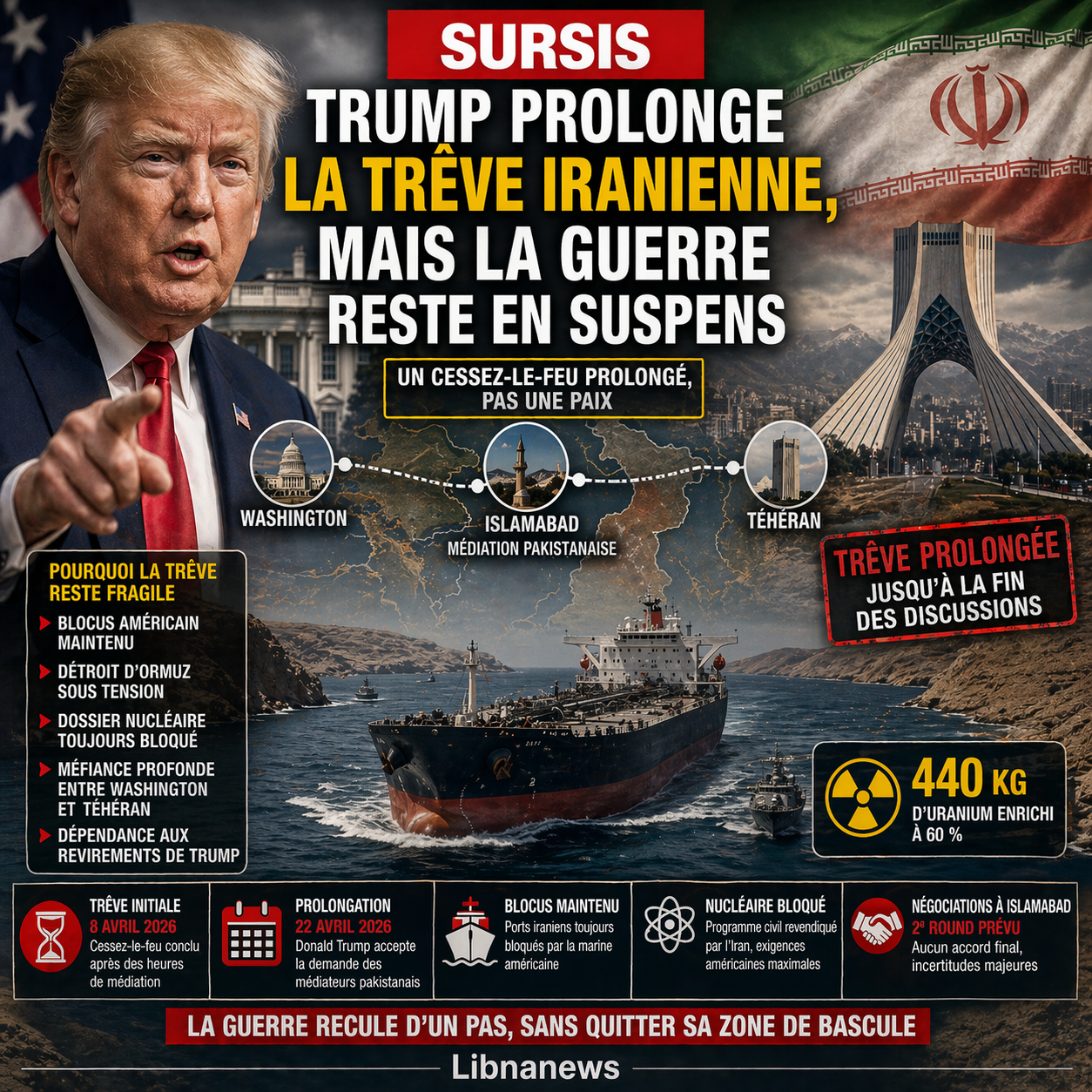
The ceasefire in Iran did not end on the night of 21-22 April. Donald Trump announced his extension until Tehran put forward a unified proposal and the discussions ended. On paper, this decision removes an immediate resumption of American bombings. In practice, it does not dispel political uncertainty, military tension or Iran’s mistrust of Washington. The truce is prolonged, but it remains suspended from an American president who alternates threats of strikes, promises of quick agreement and demonstrations of force.
This extension was far from being achieved. A few hours before changing positions, Donald Trump explained that he did not want to extend the break. He assured that the United States was in a position of strength and suggested that a resumption of strikes remained the natural option in the event of a rapid failure of the talks. Then, in a new turn, he accepted the request of the Pakistani mediators and announced that the attack on Iran would be suspended until the end of the discussions. This brutal transition from an ultimatum logic to an extension logic alone summarizes the current sequence.
The issue is therefore no longer just whether the war in Iran is entering a new diplomatic phase. It is to understand what kind of truce is emerging. For this prolonged ceasefire does not resemble a lasting cessation of hostilities or a fully negotiated de-escalation. Rather, it holds a conditional suspension, kept under pressure, where the White House maintains the military threat, retains its maritime blockade and continues to speak as if the adversary had no choice but to surrender.
An extension ripped out at the last moment
In Islamabad, where the new round of negotiations is to take place, uncertainty remains. Pakistan called for more time for discussions. His Prime Minister welcomed the extension of the truce and expressed hope for a comprehensive agreement. But this American announcement was not immediately validated by Tehran. Reactions relayed by the Iranian press denied Iran’s request for an extension. Officials close to power even suggested that Donald Trump’s statement could be a political manoeuvre, if not a trap.
This Iranian prudence is not secondary. It shows that the ceasefire in Iran is not a mutually stabilized mechanism. It is more like a diplomatic window opened by Washington, under Pakistani mediation, but the other part still challenges the terms, the timetable and especially the concrete conditions. A genuine truce implies a minimum agreement on its content. Today, however, the United States is talking about expansion, while Iran continues to denounce American actions as hostile acts incompatible with the very idea of de-escalation.
Why the ceasefire in Iran remains fragile
The first blocking point is maritime. Washington extended the truce, but at the same time maintained the blockade of Iranian ports by its navy. For Tehran, this choice almost emptys the gesture of its substance. A ceasefire that allows a direct hindrance to Iran’s trade to continue does not appear to be a neutral pause. It is seen as a war pursued by other means. The Iranian Foreign Minister described the blockade as an act of war. The formula is not just rhetoric. It indicates where the Iranian red line is now.
A blockade against détente
The Strait of Ormuz further reinforces this contradiction. Since the beginning of the conflict, this maritime space has become the economic centre of gravity of the crisis. The passage was, before the war, a transit route for about a fifth of the world’s oil and liquefied natural gas flows. However, traffic remains very disturbed. The latest data from the economic press show that only a few ships have crossed the area over the last 24 hours. While markets have welcomed the extension of the truce with some relief, oil remains at a high level, close to $100 a barrel for the Brent. The world economy does not yet believe in standardization.
It’s one of the reading keys of the moment. Donald Trump wants to present the extension of the ceasefire as a sign of control. It seeks to show that it keeps the initiative, that it can both stop the fire, maintain pressure and impose the pace of negotiations. But this combination of apparent restraint and continued coercion makes the truce very difficult to stabilize. Part of the problem is not just the strategic disagreement between Washington and Tehran. It comes from the method chosen by the US President, made of spectacular announcements, rapid change of course and contradictory messages.
Ormuz, economic lung still hampered
Since the beginning of the war, Donald Trump has accompanied military action by permanent communication. He repeatedly promised a higher agreement than in 2015, claiming that Iran had no choice, threatened further strikes on civilian infrastructure and suggested that it could close and reopen the military sequence at its convenience. This is not just a set. It modifies the calculations of all the actors. Iranians must interpret what is a matter of negotiation, intimidation or US domestic policy. The allies of the United States, on the other hand, must understand what line to take in the midst of this volatility.
This unpredictability has an immediate diplomatic cost. Negotiations with Iran do not involve a minor exchange. They concern the core of Iran’s nuclear programme, the future of the Strait of Ormuz, sanctions, frozen assets, the regional security framework and the possibility of a more lasting cessation of hostilities. This type of agenda requires continuity, discipline and legible signals. The US President’s statements give the opposite impression. They can reassure its political base in the short term. On the other hand, they complicate the work of negotiators, who have to turn announcement effects into elements of agreement.
Donald Trump, first factor of instability
The precedent of the first talks in Islamabad illustrates this difficulty. The meeting, the most direct meeting between American and Iranian officials for more than a decade, ended without breakthrough. Sources close to the file described long, tense, punctuated round-trip discussions, hopes of compromise and then brutal blockages. Pakistani mediators had to travel between delegations for hours to avoid the collapse of the dialogue. At one point, an agreement in principle seemed close. Then the differences on nuclear, Ormuz and access to Iranian assets refrigerated everything.
This memory weighs on the second attempt. No one can seriously describe the resumption of discussions as a formality. Yet this is the tone adopted by Donald Trump, who continues to speak as if the agreement was already almost achieved. This verbal overexposure has a double effect. It artificially swells American expectations. And it pushes Iran to be even more careful not to appear as an actor forced to surrender under pressure. In such a sensitive negotiation, perceived humiliation counts almost as much as the technical content of the text.
A negotiation blurred by announcements
The nuclear issue remains the central node. Washington demands that Iran never have access to nuclear weapons and grows for the release or strict control of its highly enriched uranium stocks. In particular, the discussions focused on about 440 kilograms of 60% enriched uranium, a much higher level than ordinary civilian uses and which, if still enriched, could be used for several weapons. One option would be to reduce this stock on site, under the supervision of the International Atomic Energy Agency. Another would go through a hybrid scheme with a partial transfer out of Iran.
For Tehran, the challenge is political as well as technical. The Islamic Republic reiterates that its nuclear programme is civilian and that, as a State party to the Non-Proliferation Treaty, it claims a sovereign right to enrichment. In this sense, accepting a definitive halt to enrichment, or transferring all of its strategic stock, would be tantamount to endorsing an American reading that it rejects. Iranian authorities can discuss modalities, levels, durations and controls. They want to prevent negotiations from turning into legal and symbolic accountability.
Nuclear power, the heart of the impasse
This is where the gap between the two lines remains immense. On the American side, several requirements relate to both nuclear, missile, regional environment and navigation in Ormuz. On the Iranian side, the priority is the opposite: to obtain a lasting ceasefire, guarantees against further strikes, a reduction in sanctions and the recognition of certain rights in the country. In other words, Washington wants an expanded strategic disarmament agreement. Tehran wants a framework of security and sovereignty that does not expose it to an endless cycle of pressure. As long as these two visions coexist without a clear meeting point, each advance will remain fragile.
440 kilos that block everything
Pakistan’s role deserves special attention in this context. Islamabad did not simply offer a forum for discussion. Pakistan’s power has established itself as an active intermediary, speaking in Washington, Tehran and several capitals in the region to prevent the breakup. According to several consistent accounts, Pakistani mediation had already played a decisive role at the time of the initial ceasefire, concluded on 8 April after hours of feverish contact. It is now in the same position: to avoid the absence of a final agreement automatically leading to the resumption of the strikes.
However, this mediation is subject to obvious limitations. Pakistan can relay proposals, provide a framework and delay. It alone cannot resolve the fundamental conflict between American coercive logic and Iranian sovereign demands. Nor can it force Israel, an ally of the United States in this war, to unreservedly validate an indefinite extension of the ceasefire. On this point too, the uncertainties remain. The most recent reports point out that it is not clear at this stage whether Israel like Iran formally accepts the extension announced by Donald Trump.
Islamabad keeps the door open
This ambiguity changes the very nature of the truce. A unilateral extension proclaimed by Washington has real political significance. It can prevent an immediate escalation if no one decides to challenge it with weapons. But it does not have the same solidity as a public agreement by all parties concerned. It looks like a temporary ceiling, not a base. That is also why the ceasefire in Iran remains so dependent on the US President’s reversals. When the stability of a front lies first in a reversible presidential statement, it remains vulnerable to the next inflection of tone.
Useful mediation, not decisive
Markets were understood before diplomats. After the announcement of the extension, oil contracts declined slightly, stock markets resumed a bit of breath and the dollar hesitated. But this movement has nothing to do with an enthusiastic verdict. Rather, it reflects a reflex of limited relief: the total war does not resume immediately, so the worst scenario moves away, at least for a few hours. This is not like a bet on a quick peace. Maintaining high energy prices shows that the economy continues to integrate a sustainable risk into Ormuz, regional supply and shipping costs.
This inner dimension is very important to Donald Trump. For several days now, the White House has given the feeling of monitoring oil prices and market reaction almost as much as military evolution itself. It’s not surprising. A prolonged war against Iran increases energy, fuels inflation, weakens consumption and exposes the US President to a direct political cost. Several analyses agree on this point: one of the engines of the truce is not only diplomatic or military, it is also economic. The extension of the ceasefire saves Washington time, avoids another brutal shock and hopes for a cheaper exit.
But this calculation creates another trap. The more the White House seems to be guided by the fear of an energy crisis or political sluggishness, the more Tehran may think that it still has a lever. Iran is not in a simple position. Its economy suffers, its maritime trade is under pressure and its military margins are reduced. Yet the country retains a major strategic asset: its ability to disrupt or threaten an indispensable energy corridor. It is this asymmetry that makes negotiations so difficult. The United States can impose heavier military costs. Iran can prolong costly instability for everyone.
A prolonged truce, not consolidated
The human and regional assessment also weighs on each decision. The war that began on 28 February has already caused, according to estimates relayed by news agencies, more than 5,000 civilian deaths in the region and displaced hundreds of thousands of people, mainly in Iran and Lebanon. As this cost increases, international pressure against renewed hostilities increases. The American threats to hit civilian infrastructure have also been explicitly condemned in the name of humanitarian law. In this context, extending the truce allows Donald Trump to loosen a bit of diplomatic power that began to close on his own rhetoric.
A central question remains: Is Donald Trump really looking for an agreement or only a position of strength that can lead, at any time, to a resumption of strikes? Recent signals are not clear. On the one hand, he reiterated his desire for an agreement higher than the previous nuclear framework and assured that Iran would eventually yield. On the other hand, it maintains the blockade, again threatens bombardments if the discussions do not succeed quickly and speaks of the ceasefire as a lever of pressure, not as a good in itself. This ambiguity maintains the idea that truce is less a commitment than a tool.
For the US negotiators themselves, the difficulty is considerable. They must convince Tehran that a technical compromise is possible, while entering into a maximumist presidential communication. They must defend red lines on nuclear power, without closing the door to intermediate formulae. They must reassure the regional allies, take into account the Israeli position and integrate the Lebanese factor, since Hezbollah was involved in the war. At each level, the slightest excessive message from Washington reduces the space available for a useful compromise.
On the Iranian side, internal fragmentation is no easier. Donald Trump justified his decision by explaining that he was waiting for a unified proposal from Iranian leaders. Behind this formula is the idea that Tehran does not yet speak with one voice, or that the arbitrations at the top are not completed. That can be true. But the argument also serves the American staging: if nothing goes ahead, the fault can be rejected on the adversary, judged confused, divided or unable to negotiate seriously. But this reading is risky. The more Washington publicly insists on Iran’s supposed weakness, the more Tehran has to tighten its posture to avoid confirming this story.
The prolonged ceasefire can therefore be read in two ways. The first, optimistic, sees the postponement of the deadline as an additional space to avoid the resumption of war and to convert a truce of circumstance into a more orderly diplomatic process. The second, more realistic for the moment, sees a simple shift in the calendar. The fire did not resume this night, but none of the major obstacles disappeared. The blockade remains in place. Ormuz is not standardized. The heart of the nuclear disagreement remains intact. And the U.S. president continues to blow the heat and the cold alternately.
That is why the day of 22 April does not mark a stabilisation, but a shift of risk. Yesterday, the danger was an immediate resumption of the American strikes at the end of the two-week truce. Today, the danger is different. It is due to an extension without clear architecture, in which diplomacy survives, but under permanent constraint, with limited credibility and a strong dependence on the statements of the White House tenant. The war in Iran did not leave its tipping zone. It has only gained a few days, perhaps more, to try to produce a text that neither Washington nor Tehran are yet ready to sign in the other’s terms.
In the meantime, everything is being played out on a very close articulation: an Iranian proposal still awaited, an American blockade still denounced as illegal, a Pakistani mediation which for the moment prevents the rupture, and an American president able, in the same sequence, to refuse an extension, then to announce it as if it were the most natural outcome. In the meantime, the real strength of the cease-fire in Iran is now being played out between the time given and the continued threat.




