

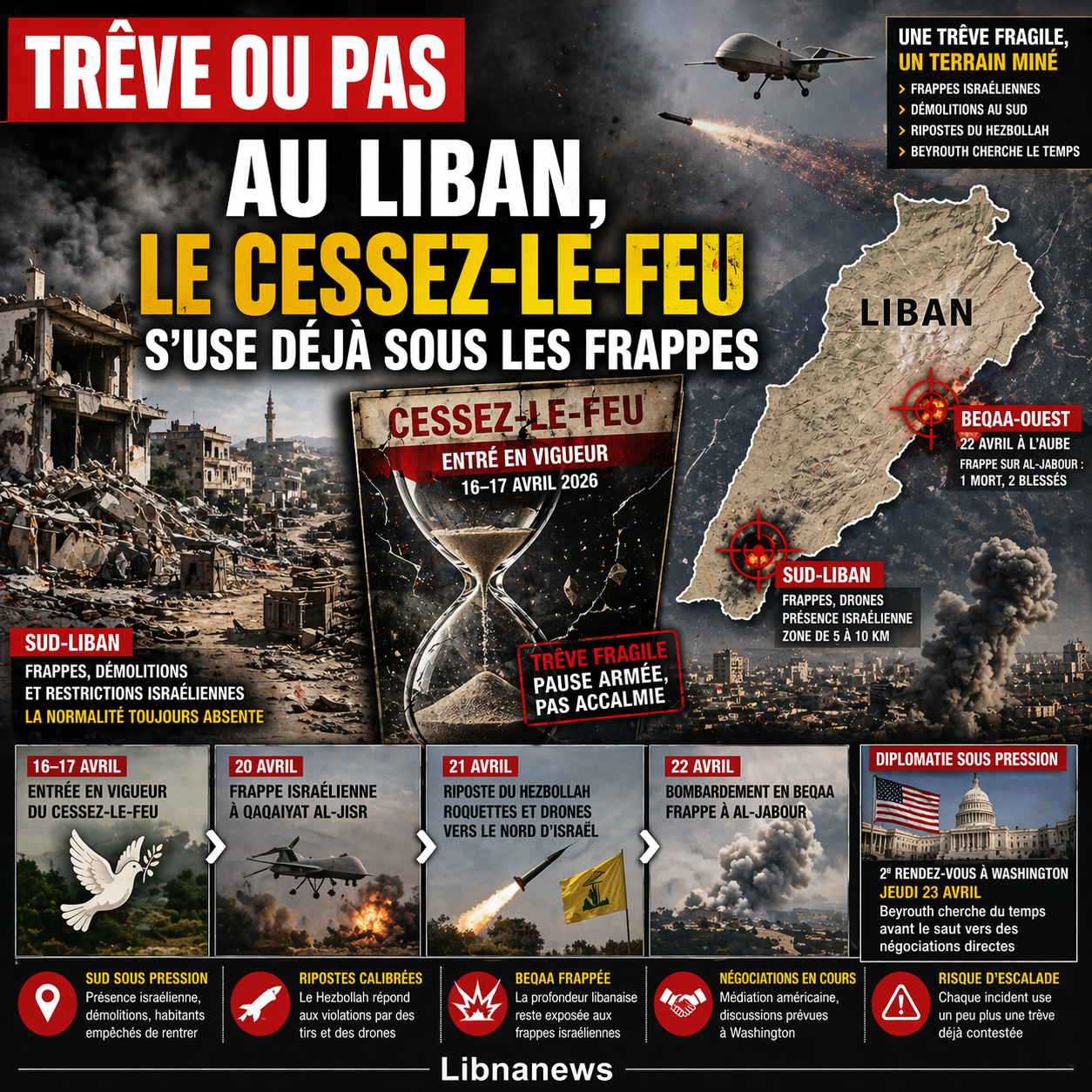
The cease-fire that came into effect on the night of 16-17 April 2026 was held only a few days as a real promise. In southern Lebanon, Israeli strikes, demolitions and restrictions fueled an incomplete truce. On 20 April, an Israeli attack in the South was presented by Israel as an action against Hezbollah fighters and lived side by side with Lebanon as an additional violation. On 21 April, Hezbollah responded by firing rockets and drones into northern Israel. On 22 April at dawn, a bombardment on the Beqaa recalled that Lebanese depth remained exposed. In less than three days, the sequence set up a clear impression: the truce in Lebanon does not collapse at once, it simmers in steps.
Three dates that changed the climate
On April 20, the fragile balance of the truce began to crack a little more. In southern Lebanon, a drone strike targeted the Qaqaiyat al-Jisr area near the Litani River, even though the ceasefire was supposed to reduce offensive operations. The human report from the Lebanese side reported injuries. At the same time, the Israeli army claimed to have identified and subsequently eliminated men identified as Hezbollah fighters in the Bint Jbeil and Litani areas, claiming that they were violating existing arrangements.
This difference in reading alone sums up the problem of the moment. For Israel, this would not be a breach of the framework, but an application of a margin of action that the Hebrew State considers to be maintained against any threat that it considers imminent or in preparation. For the Lebanese authorities, for Hezbollah and for part of the population of the South, these strikes confirm on the contrary that the truce in Lebanon remains asymmetric, since it does not prevent drones, targeted fire or destruction on the ground.
On the same day, several border localities reported further controlled explosions, demolitions and Israeli military movements. This counts as much as the strikes themselves. A ceasefire is not only assessed in the absence of massive bombardment. He is also aware of the possibility for the inhabitants to return home, to reopen a road, to return a field to culture, to recover property. However, in a part of the South, this normality has still not returned.
Since the break came into effect, the Israeli army has maintained a presence inside Lebanese territory in a band that it presents as a safe area. This depth, estimated in several reports at approximately 5 to 10 kilometres depending on the area, changes everything. On paper, the truce suspends the clashes. On the ground, it leaves an armed hold, a traffic map and a strike capacity. For the people of South Lebanon, it looks less like a crisis exit than a slow war.
On April 21, Hezbollah’s response to northern Israel
On 21 April, Hezbollah responded. The movement announced that it had fired rockets and launched drones to the north of Israel, explaining that it was acting in retaliation for Israeli violations of the ceasefire. The Israeli army confirmed fire at its troops operating in southern Lebanon and denounced a flagrant violation of the truce. Again, the two narratives are in frontal contrast, but they converge on an essential point: the truce no longer protects the front from a logic of response and counter-response.
The political scope of this response is important. Hezbollah is not only trying to reach an adverse position. He wants to mean that he refuses to find a new balance at his expense. If the targeted strikes, the demolitions of houses and the maintenance of Israeli troops in southern Lebanon become the permanent decoration of the ceasefire, then the movement considers that it would be locked in a posture of unilateral restraint. By claiming his fire, he sends the opposite message: no truce will be accepted as cover for Israeli freedom of action on Lebanese territory.
This logic explains the crescendo impression raised in recent hours. This is not yet a complete return to open war, with massive waves of strikes observed before the break. But the mechanics are becoming familiar again. A targeted strike is followed by a calibrated response. A response is followed by a new fire or interception. Everyone claims to act as a reaction, never as a pure initiative. And yet, this system of competing justifications produces the same result: the agreement loses its substance at each episode.
The choice of means used also says something of the military moment. Hezbollah has mixed rockets and drones, allowing it to maintain a symbolic and tactical pressure without crossing, at this stage, the threshold of a total escalation. Israel, for its part, continues to rely on its drones, artillery and rapid strike capabilities, including in areas where the civilian population is seeking to recover. Each adapts its violence to the restricted framework of the truce, but each one in the same movement.
Why the truce in Lebanon is so quick
The fragility of the ceasefire was visible from the moment it was born. The break, announced under American mediation, came into effect on the night of April 16-17. It has produced immediate relief in several parts of the country. In Beirut, in the southern suburbs and on some axes, the provisional end of the heaviest strikes was welcomed as a breath. But in the south, the first hours were marked by calls for caution, warnings to the inhabitants and accusations of violations.
The problem comes from the very nature of the agreement. This truce in Lebanon is not a peace. It does not regulate the status of the southern part of the country, the question of Israeli withdrawal, the fate of Hezbollah armament or the security architecture at the border. It only creates a partial suspension, in a military space that remains active. A suspension without a strong control mechanism quickly becomes a grey area. In a grey area, each camp tests the boundaries. That’s exactly what’s been going on for a few days.
Israel also released its own line of deployment within southern Lebanon. That’s not an unusual gesture. It means that the Israeli army does not consider its presence as a passenger detail, but as a strategic fact that it wants to display. Lebanese civilians have even received messages asking them not to cross certain areas and not to return to many localities. For an displaced population, this type of military order weighs almost as much as bombing: it transforms the ceasefire into conditional return.
This reality feeds local anger. In several villages, residents do not only know if they can return. They also do not know in what condition they will find their house, trade or land. Demolition has been reported in several sectors since the truce came into effect. The psychological effect is heavy. When we hear drones again, when we see warships or houses explode, the distinction between wartime and time of ceasefire becomes almost theoretical.
A short truce, a still militarized terrain
The ceasefire was also conceived in a highly unstable regional environment. The Lebanese front is not isolated from the rest of the Middle Eastern sequence. American mediation is part of a time when Washington is trying to contain several hotspots at once. This means that in Lebanon, the pause also depends on wider balances, which go beyond Beirut, the South and even the direct relationship between Israel and Hezbollah.
In this context, any regional degradation can blow up the locks. If the diplomatic channels spread, if the Israeli calculations change, if Iran believes that the pressure must rise, then the Lebanese front becomes a signal space again. This is one of the constant features of this crisis. Lebanon often pays the price of a ratio of forces that exceeds it, even though the destructions are strictly local and strike villages, roads, families and economies that are already exsanguous.
The announced brevity of the truce adds another difficulty. A 10-day ceasefire alone does not offer the depth necessary to restore confidence. On the contrary, it leaves each actor in a logic of armed waiting. Israel wants to check whether Hezbollah can be contained, weakened or pushed back more sustainably. Hezbollah wants to prevent a short break from being used to freeze a new military reality in the South. The Lebanese State is trying to prevent the national territory from being transformed into a simple buffer zone negotiated by others.
On April 22, Beqaa recalls the depth of the risk
On 22 April, at dawn, an Israeli strike on the outskirts of Al-Jabour in the West Beqa’a resulted in one death and two injuries according to the Lebanese official press agency. This episode changes the political atmosphere as much as it adds a human balance. The Beqaa is not the only possible scene of confrontation, but when it is struck in the wake of reprisals on the north of Israel, the signal is clear: the sequence is no longer limited to a tensioned border band, it again touches Lebanese depth.
The territorial scope of this strike is enormous. In a logic of de-escalation, one could imagine a concentration of incidents in the most immediate contact areas. But the bombing of the Beqaa reminds us that Israel retains the ability and will to strike beyond the southern border line. For Lebanese officials, this point feeds the argument that the ceasefire is emptied of its meaning if the operations extend or extend away from the direct theatre of the clashes.
The Beqaa also has a particular symbolic and military value. It is a key region for the country’s internal traffic, logistics networks, community balance and Hezbollah influence. When touched, the message is never purely tactical. He also says that pressure can go up inside Lebanon, not just on the southern border. This is one of the reasons why Wednesday morning’s strike was immediately read as another test for the truce.
What the Beqaa strike changes in the reading of the forehead
So far, some officials could still defend the idea of an imperfect but useful ceasefire, capable of containing the essential. After Hezbollah’s response and then hit her in Beqaa, this argument becomes more difficult to support. Not because the total war would have already resumed, but because the centre of gravity of the risk has shifted. The question is no longer simply whether the truce is strictly respected. The question is whether it really prevents the resumption of an offensive dynamic.
For now, however, the answer is no. Targeted Israeli strikes continue. Demolition in the South continues to be reported. Restrictions on the return of residents remain. Hezbollah, for its part, has reactivated its register of reprisals. Everyone remains committed to a ceiling pressure strategy. This ceiling still exists. But it gets closer as the incidents accumulate.
The main danger is that of an error in dosage. In this type of sequence, no actor is necessarily interested in the general explosion. But everyone wants to show that he doesn’t give in. Israel wants to prevent Hezbollah from relocating or taking advantage of the break. Hezbollah wants to prevent Israel from turning the truce into a new one-way game rule. The Lebanese State wants to preserve the diplomatic path without appearing powerless. However, three wills of simultaneous firmness rarely produce lasting de-escalation.
Beirut is still trying to save the diplomatic path
In the midst of this rising tension, the Lebanese authorities are trying to maintain a political course distinct from military logic. President Joseph Aoun presented the discussions with Israel as an attempt to end hostilities and occupation of parts of the territory in the South. Prime Minister Nawaf Salam, for his part, reiterated that the state was not seeking confrontation with Hezbollah, while ensuring that it would not be intimidated.
This line is narrow. On the one hand, Beirut wants to regain a share of diplomatic initiative and defend state sovereignty. On the other hand, the government knows that an internal confrontation on the issue of Hezbollah would be a factor in national rupture. The margin of manoeuvre is therefore reduced. It is all the more so since the discussions with Israel remain rejected by Hezbollah, which refuses to see in these contacts a sufficient framework to guarantee its interests or those of its environment.
A second round of ambassadorial discussions is scheduled for Thursday, 23 April, in Washington. The mere maintenance of this appointment shows that American mediators still want to prevent the changeover. But this calendar can also increase nervousness. As a diplomatic sequence approaches, each camp often seeks to improve its relative position. Strikes, threats, retaliatory fire and demonstrations of force can then be used to weigh on the table before it even opens.
A negotiation under the noise of drones
This is the paradox of the Lebanese moment. Diplomacy is moving forward, but it’s moving under drones. Capitals speak of de-escalation while southern localities count destruction, residents hesitate to return and the Beqaa wakes up under the strikes. This contradiction undermines the credibility of the ceasefire more surely than just one martial declaration. A truce does not only hold because it is announced. It holds because it becomes perceptible in everyday life.
However, this sensitive shift did not take place. People in the South continue to hear explosions. Villages near the front line remain suspended from military orders that they do not control. Displaced families do not know whether return is possible, prudent or simply illusory. As long as this reality prevails, the ceasefire will remain described as a diplomatic pause, not an effective return to security.
The central point, at the bottom, is there. The current crisis not only shows a threatened truce. It shows a disputed truce in its very definition. Israel wants to maintain freedom of action against what it presents as persistent threats. Hezbollah affirms that any strike, targeted assassination and destruction in Lebanon warrant a response. Between the two, the Lebanese state is trying to achieve a more stable framework without fully mastering the military tempo. Under these conditions, each day adds a layer to the crescendo impression, and the diplomatic meeting on Thursday, 23 April, is already busy with the Qaqaiyat al-Jisr events, the shootings to the north of Israel and the bombing of the Beqaa.




