

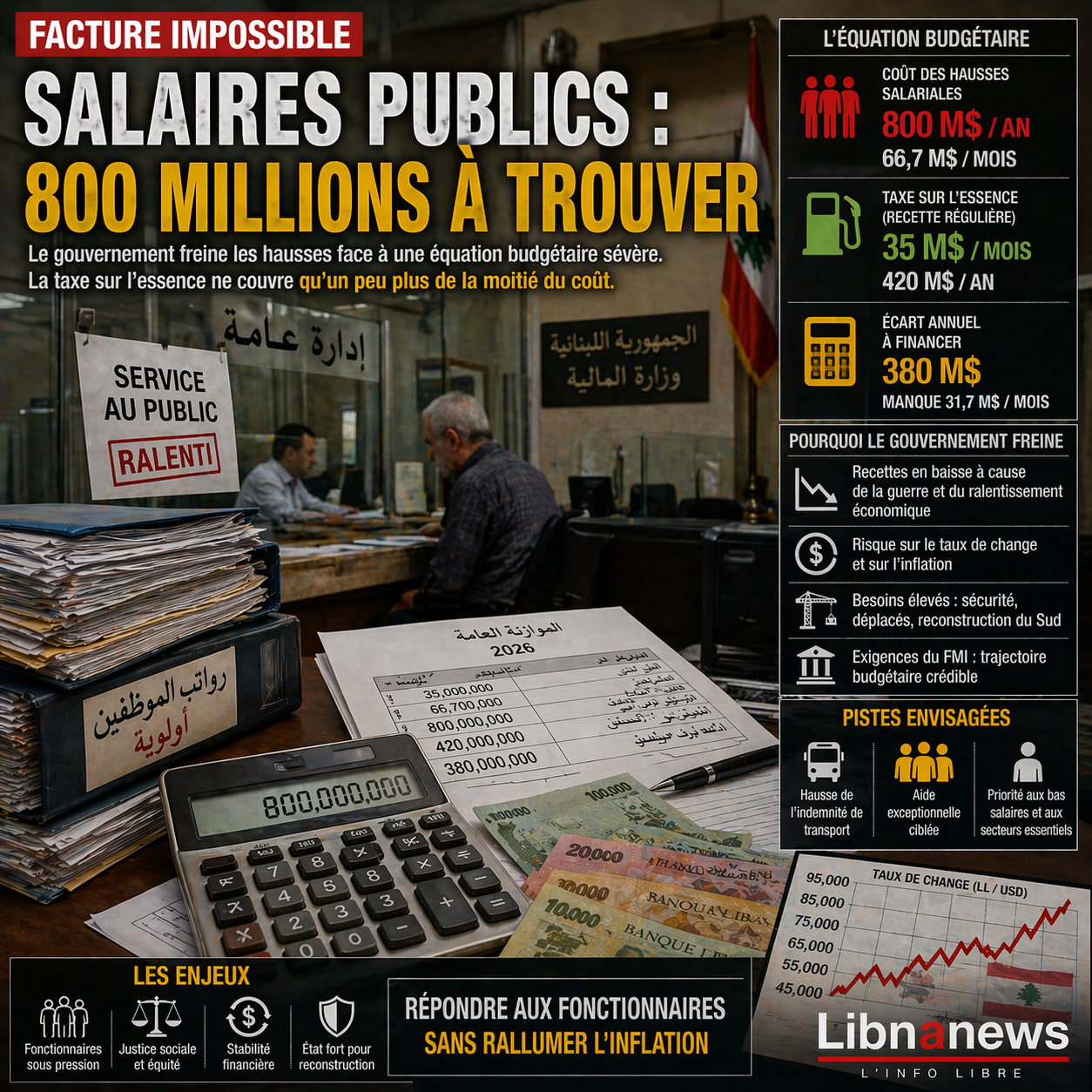
The rise in public wages is hampered by a simple and severe fiscal equation. The annual cost of the measure is estimated at approximately $800 million. This monthly expense represents nearly $66.7 million. On the other hand, one of the most visible regular revenues in the Consolidated Revenue Fund, the Gas Tax, earns about $35 million per month, or $420 million per year. Even if this recipe were entirely devoted to wages, it would cover just over half of the bill.
An annual expenditure of $800 million
The government does not stop the increases simply by political refusal. It faces a permanent expense. A wage increase is not a one-time aid. It repeats every month. It is entered in the State accounts for the current year and for subsequent years. That’s what makes the case sensitive.
An invoice of $800 million represents approximately $66.7 million per month. This amount must be paid in addition to existing expenses. It is not just about active wages. It can also create parallel demands for retirees, military personnel, teachers, administrative officers and other categories of the public sector. An increase in one category often results in pressure from others.
The state must therefore look at the total expenditure, not the immediate effect on a single grid. In a normal period, such an increase should be financed from new, stable and predictable revenues. In the current context, revenues are weakened by the war, the economic slowdown and the decline in some foreign exchange flows.
Gas tax is not enough
Gas tax earns about $35 million a month. Over 12 months, this gives about $420 million. The number is important. It shows that this tax has become a major resource for the Treasury. But it also shows the limit of available funding.
In the face of a salary bill of $800 million a year, approximately $380 million is missing if this expenditure is compared only with the annual revenue from the gas tax. The monthly return on the tax covers approximately 52.5% of the average monthly cost of the increases. In other words, in order to pay $66.7 million per month, the State has only $35 million with this resource. Thus, approximately $31.7 million is missing each month.
This comparison explains the Department of Finance’s caution. The gas tax cannot be considered as a complete solution. It helps to maintain cash flow. It does not allow financing alone a general and permanent increase in public wages.
Initial margin reduced by war
At the beginning of the year, the Department of Finance had a primary surplus of over $1 billion. This perspective could have given a more comfortable margin. But the war reduced the expected revenues. It has also increased the needs of the State.
The difference is great. A primary surplus of over $1 billion could, in theory, leave room for wage measures. But if this surplus is reduced sharply, the same measure becomes more risky. So the government is not just thinking about $800 million. He explains what remains really available after the decline in revenues, emergency expenses, assistance to internally displaced persons, security costs and reconstruction needs.
In a tense budget, a permanent expenditure must be covered by a permanent revenue. If it is financed by temporary entries, the state earns a few months but then creates a bigger problem. If financed by monetary creation or indirect pressure on the Bank of Lebanon, it may threaten the exchange rate.
Monthly cost is the key figure
The annual figure of $800 million hits minds. But the monthly figure of $66.7 million better explains the cash flow problem. The State must find this sum each month. It is not enough to announce a decision. Regular payment must be ensured.
The Treasury works with irregular returns. Some taxes arrive at specific dates. The value added tax can give an air bowl at the end of a month. Fuel taxes are more regular, but they depend on consumption and prices. Customs revenues may vary with activity and imports. War can reduce many of these sources at the same time.
The Department of Finance is therefore concerned about a mismatch between monthly salaries and revenues that do not keep pace. This may lead the state to seek dollars in the market or inject more Lebanese pounds. In both cases, the exchange rate may be affected.
The exchange rate remains the red line
Exchange rate stability is the government’s main argument. A wage increase financed without real resources can increase liquidity in Lebanese pounds. Part of this liquidity can then go towards purchasing dollars. The foreign exchange market reacts quickly, especially in a country that remembers the financial collapse.
If the demand for dollars increases, current stability can crack. A depreciation of the pound would raise prices. It would reduce the real value of the wage increase. Civil servants would receive more currency, but that currency would buy less. Social gain would then be absorbed by inflation.
The government wants to avoid this scenario. His logic is defensive. He prefers to curb an expected increase rather than take the risk of an exchange rate shock. This position is difficult to defend politically. However, it is based on simple reasoning: an unfunded increase can ultimately penalize those she wanted to help.
However, civil servants need an answer
Fiscal restraint must not mask the social crisis in the public sector. Public servants have suffered a sharp fall in purchasing power since the collapse of the pound. Many have lost the ability to live on their wages. Some combine activities. Others reduce their presence. Administrations are slowing down.
The human cost is real. Teachers, municipal officials, administrative staff, security forces, departmental employees and retirees live on income that no longer corresponds to the cost of living. The State cannot permanently ask its agents to hold without compensation.
But the answer must be funded. It’s the point of friction. The social need is increasing. Monetary constraint pushes towards prudence. The government is therefore between two risks. If he does nothing, the administration continues to empty. If he pays too fast, the exchange rate can be tightened.
Transport allowance as limited compromise
One of the tracks is to increase the transportation allowance. This solution targets concrete expenditure. Public officials must travel to work. The increase in fuel makes these trips more expensive. A higher allowance can therefore improve the presence in the administrations without changing the entire salary scale.
This compromise has the advantage of limiting the permanent burden. It can be adjusted more easily than a general increase in wages. It also responds to an immediate reality. When the price of fuel rises, some agents can no longer finance their daily trips.
But this answer remains partial. It helps those who move. It does not solve the basic income problem. It does not fully respond to retirees. It does not correct losses accumulated for several years. It is mainly used to keep administration in minimal operation.
Exceptional aid would cost less than a general increase
The government can also use exceptional assistance. This option avoids creating an annual charge of $800 million. It helps to support public households in an emergency, without including all expenditure in future budgets.
One aid of $100 million or $150 million, for example, would be heavy but less dangerous than a permanent burden of $800 million. It could be financed by a combination of one-off revenue, external support or limited budget margins. It would not solve the wage issue, but it would provide time.
The risk is to turn the exceptional into a habit. If the State pays one-off aid every few months, without any substantive reform, it creates an expectation. Agents do not find sustainable visibility. The budget remains subject to repeated decisions. The temporary solution should therefore not replace a wage strategy.
Retirees remain the most exposed
Public sector pensioners are in an even more fragile situation. They cannot always compensate for the loss of income through additional activity. They often incur higher medical costs. An increase in transport does not help them directly. A wage reform that forgets pensions would be socially incomplete.
But pensions also represent a sustainable expenditure. Any increase becomes recurring. It adds to the annual burden. The government must therefore arbitrate between social justice and financial capacity. Pensioners need a targeted response, but this response must be accurately calculated.
Targeted support for the weaker pensions could be more sustainable than a uniform recovery. However, it would require reliable data. It would also require an administration capable of identifying beneficiaries and avoiding duplication or injustice.
Military and essential services at the centre of the equation
Military, security forces, teachers and some essential services pose a particular problem. The country is demanding more from these sectors. The army must play a central role in the South. Security forces must maintain order in a period of displacement and tension. Teachers must prevent school collapse. Tax officers must collect revenue.
A targeted increase could therefore be targeted at key functions. It would be cheaper than a general increase. It would protect the priority tasks of the State. But it would also create tensions with other categories. Each jurisdiction can justify its importance. Targeting should therefore be explained and framed.
The government must avoid competition between public servants. Successful wage reform must distinguish emergencies without humiliating other agents. It must also be presented as a step, not as a political preference.
The reconstruction of the South creates a competing expenditure
War adds major fiscal pressure. Villages in the South will need reconstruction. Roads, schools, water systems, agricultural land and houses will need to be evaluated and repaired. Displaced persons will need help on their return. Municipalities must be supported.
These expenses compete with wages. The State cannot use the same margin twice. While it spends $800 million a year on salary increases, it reduces its ability to fund other priorities, unless new revenue arrives. Conversely, reconstruction without functional administration will be difficult to manage.
The budget must therefore link the two issues. Public services must be maintained to organize reconstruction. But enough resources must be preserved to repair the affected areas. A poorly calibrated wage increase can reduce post-war response capacity.
The Monetary Fund demands a credible trajectory
Discussions with international partners reinforce caution. Lebanon must show a credible fiscal trajectory. This means controlling spending, improving revenue, restructuring banks and dealing with financial losses. A significant wage increase can complicate this message if it is not funded.
External credibility matters. Without a broader financial agreement, the state will remain dependent on limited revenue and ad hoc decisions. It will have little room to support currency, finance wages, assist displaced persons and rebuild. The government therefore knows that a wage decision can have an impact on economic negotiations.
The problem is not to refuse wages in principle. It is to know how fast the country can cope. A gradual increase, conditional on real revenue, will be more defensible than a general increase without funding.
The most likely scenario: gradual, targeted, funded
The most realistic route seems to be a combination of measures. A party could take the form of a raised transportation allowance. Another party could be exceptional aid. A third could target low wages, the most vulnerable pensioners or key sectors. All of this should be linked to identified revenues.
This method will not satisfy everyone. It will be considered too slow by the staff. It will be considered too costly by advocates of budgetary discipline. But it would reduce the risk of currency shock. It would also give the government time to track revenues and adjust its decisions.
The total cost must remain below the available margins. It’s the central point. If the state can finance $200 million or $300 million without destabilizing the exchange, it can start with that. If he promises 800 million without financing, he takes a heavier risk.
Transparency becomes indispensable
The government must explain the figures. He must say how much each option costs. He must say what revenue actually exists. He must say what amount can be paid without pressure on the exchange. It must also specify what is involved in one-off aid and what is a permanent increase.
Without transparency, the debate will become political and emotional. Staff members will see a refusal. Citizens will see privileges. External partners will see a lack of discipline. Budgetary clarity can reduce tension.
The figures available already provide a basis. The increase costs $800 million a year. It costs 66.7 million a month. The gas tax pays 35 million a month. It earns 420 million a year. The annual variance is $380 million. These data must be at the heart of the public discussion.
A brake that cannot last without a calendar
To curb increases can be justified in the short term. But this brake cannot become a permanent strategy. The public sector cannot continue to operate with degraded incomes. The government must therefore present a timetable. It must say what can be paid now, what depends on the truce, what depends on value added tax, what depends on future revenue and what depends on a broader financial agreement.
The timetable must also be socially legible. The weakest categories must go first. Essential services must be protected. Vulnerable pensioners must be included. Permanent increases must be limited to what can be sustained.
The real challenge is not to choose between civil servants and currency. The real challenge is to prevent the defence of the currency from destroying the administration, and the defense of wages from destroying the currency. The government walks between these two dangers.




