

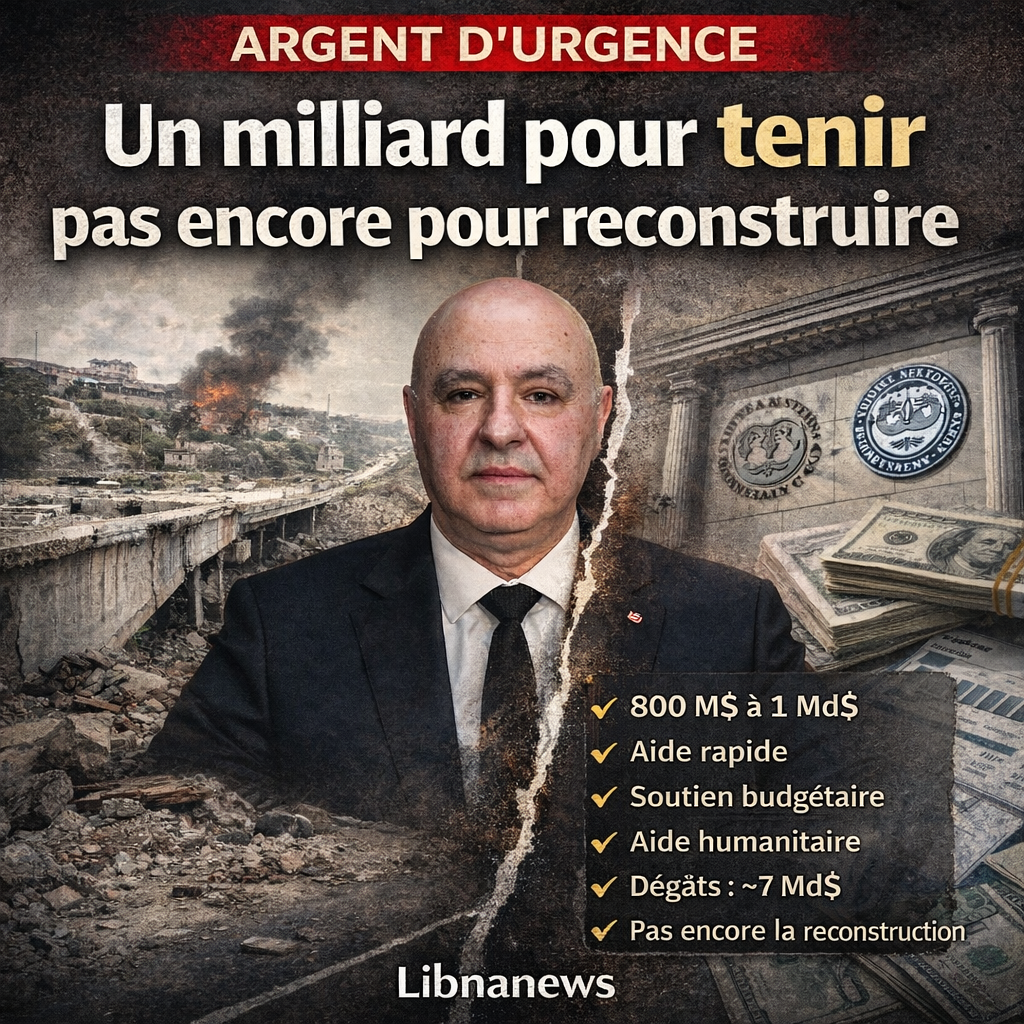
An emergency request, not a recovery plan
The number says almost everything by itself. A billion dollars. In a country that has already gone through the banking collapse, the meltdown of purchasing power, the erosion of public services and the paralysis of part of its administrative apparatus, such demand has nothing to do with a transformation project. It does not talk about a new economic model or an ambitious recovery. She talks about endurance first. She speaks of a state that tries to stand up as the war adds a new layer of fragility to an economy that has already been hurt for a long time.
That’s what makes this sum so revealing. Lebanon is not yet seeking to finance a return to growth in the classical sense. He’s trying to absorb the shock. It tries to cover immediate costs, limit damage, save time and push back the point where human, territorial and budgetary addition would become politically unmanageable. In another country, a request to an international financial institution could be part of a structured macroeconomic programme, with a clearly phased sequence of reforms and a promise to restart in the medium term. Here, the meaning is much rougher. The aim is to prevent a war crisis from adding to the collapse crisis without any buffer protecting society.
The most striking is that this demand does not intervene in an economy simply slowed down. It intervenes in an economy already reconfigured by survival. Much of the trade has long moved to informal circuits, to currency, to short-term arbitration, to family coping strategies. Public institutions, for their part, continue to operate, but on a thin, uncertain and often dependent basis on temporary arrangements. When war strikes such a country, it does not break a still robust machine. It strikes a structure that has already lost part of its absorption capacity.
That is why this billion must be read as a defensive figure. He doesn’t promise the next. He’s financing the present. It is aimed less at reconstruction than at slowing down degradation. It is the sum that a State asks when it knows that it no longer has enough room to cash alone a new cycle of destruction. One might even say that this is a figure of lucidity. It implicitly recognizes that Lebanon’s internal capacities, whether fiscal, budgetary or institutional, are no longer sufficient to manage the addition of conflict without external recourse.
The real cost of war is not limited to ruins
When we talk about war charges, we look first at destroyed buildings, roads cut off, bridges to be repaired, degraded land and areas that have become difficult to access. All this is real. But the economic cost of a conflict is never the image of ruins. It extends to entire functions of collective life that cease to function normally. A destroyed axis does not only prevent traffic. It disorganizes the supply chain, delays the return of residents, blocks agricultural products, slows down care, keeps students away from their schools and further reduces the ability of small businesses to restart.
The South of the country is now concentrating this reality. The return remains suspended. Residents cannot always settle permanently. Roads are sometimes replaced by temporary routes. Bridges become a political as well as economic issue, because they condition the possibility of even a local recovery. In an economy such as Lebanon, the local is very important. Daily life is not only carried by large groups or by central plans. It is based on a multitude of small units, short circuits, shops, municipalities, community solidarity and partial services. As soon as the circulation is damaged, it’s this fabric that squeaks.
The cost of lost time must also be added. A family that hesitates to return does not consume like a resettled family. A trader who does not know if he will be able to reopen in a week does not invest. A farmer who fears a resumption of strikes postpones his decisions. A craftsman works with caution, without stock, with no visibility and no prospect of expansion. On a large scale, this accumulated prudence produces a still economy. Even without spectacular destruction, the fear of the next day becomes a massive economic brake.
The State, for its part, must absorb additional burdens. It must open replacement roads, restore certain roads, accompany partial return, manage emergency needs, support already weakened local administrations and try to give signs of presence. But each of these actions costs money. It costs even more in a country where public spending has not recovered a solid base, where borrowing capacity remains limited, and where trust between the political centre and citizens remains fragile. The cost of war is therefore visible in the ruins, but it is even heavier in the disruption of ordinary functions.
A State short of resources, but no needs
The central question is not just that of need. It’s the source. Where can Lebanon find the money to absorb a shock of war when it has been struggling for years to restore credible taxation, legible public accounting and a stable financing framework? The country is now looking everywhere. It turns to donors, to foreign partners, to international institutions, but also to its own tax margins, however small they may be.
The search for new resources has taken on a central role in the debate. As soon as a subject like that of untaxed gold rises to the surface, it says something wider than its only technicality. It reveals the fundamental tension of the Lebanese economy. The state needs money, but it evolves in an environment where a significant portion of wealth flows in a partially protected, fragmented or difficult to grasp way. Any attempt at taxation, regulation or formalisation therefore immediately affects a balance of power. Who pays? Who’s escaping? Who has the means to move his wealth? Who supports effort without comparable protections?
This is where war complicates everything. In normal times, tax reform requires legitimacy and time. In a period of security tension, it becomes even more difficult. A weakened state that demands more without yet providing strong services is subject to immediate objection: what is the need for additional effort? Conversely, if he does not demand anything and does not seek any new resources, he locks himself in a growing external dependence. The country is therefore caught between two impasses. Taxing more without confidence can fuel rejection. Not expanding revenues makes external aid even more essential.
The $1 billion demand must be read through this dilemma. It does not mean that Lebanon renounces seeking internal levers. It means that he knows that these levers will not suffice, especially in the short term. The problem is less that of fiscal inventiveness than of the thickness of the available margins. After years of crisis, the margins melted. The state can try to recover, better manage and streamline. Maybe it can improve some circuits. But he can no longer act as if he had a sleeping treasure that would suffice to mobilize.
This also explains why discussions abroad now combine security, reforms and funding. Lebanon can no longer deal with these three subjects separately. Donors want institutional guarantees. The diplomatic partners want to know who really decides. And the economy needs money before it can even benefit from the promised reforms. Each file therefore returns to the other. A more credible state will be more easily supported. But this support is also necessary to enable it to function in a sufficiently credible manner.
War Reactivates a Survival Economy
Lebanon is often referred to as resilience. The word is practical, but it ends up masking the essential. What has been happening for years is not just resilience. It is a reorganization of economic life around survival. Households arbitrate as closely as possible. Companies are reducing their ambitions. Investments are deferred. Long-term projects give way to cash balances. The informal thrives where the state withdraws. Links with outsiders, diasporas, transfers, revenues from services or private channels partially offset the collapse of the public framework.
War reinforces this logic. It moves decisions even more towards the short term. It reduces appetite for risk. It makes it more difficult any bet on lasting improvement. In such an environment, even those who still have liquidity avoid getting too far. They’re waiting. They split. They look at front lines, diplomatic signals, regional blockages. The whole country starts breathing at the pace of emergencies.
The danger is that this survival economy will freeze. An economy can take an exceptional time if it knows that a more stable horizon returns. But if the exception becomes the norm, then behaviours adapt sustainably to instability. We’re not investing anymore. We’re protecting. We’re not building anymore. We’re holding on. We’re not planning anymore. We improvise. It ends up producing a society that stands still. The billion demanded then takes on another meaning. It is not only used to cover immediate charges. It is used to prevent the survival economy from becoming a fate.
The psychological effect of such a shift must also be measured. In a country where war is added to the monetary collapse, the border between emergency and normality disappears. Citizens end up integrating as ordinary what should be temporary: waiting, relative shortage, permanent arbitration, external dependence, institutional provisional. This is what the emergency money is trying to prevent. It tries to give a little air back to a threatened economy to reduce itself to the simple management of successive shocks.
The weight of Ormuz and the regional context
Lebanon does not only suffer from its own front. It is also affected by the regional context. The crisis in the Strait of Ormuz, the partial blockage of flows, the naval tension and the risk of an energy shock are affecting the entire region. For an importing country, which is vulnerable and highly dependent on the outside world, this pressure counts enormously. It affects costs, expectations, investor confidence and general risk perception. Even a country that would not be directly affected by material destruction would already suffer this atmosphere. Lebanon suffers in addition to unstable internal terrain.
This has an immediate effect on Arab and regional investment. The spectre of war remains present. Capital awaits more convincing signs of stabilization before committing. Without investment, projects and visibility on logistics chains, the very idea of reconstruction becomes blurred. One can speak of the South after peace, imagine tourist projects, development or reintroduction. But none of these scenarios will be robust as long as the regional environment itself remains suspended from a strait, fragile mediation or a possible break between Washington and Tehran.
Lebanon is therefore in a very special situation. He needs emergency money because of his own conflict. But its ability to prepare for the future also depends on a regional climate that it does not control. This double vulnerability makes the billion even more necessary, and paradoxically even more insufficient. Necessary, because the immediate shock must be cushioned. Insufficient, because there will be no emergency envelope that will permanently compensate for a regional environment where the risk continues to weigh on flows, energy and investment decisions.
The regional dimension also changes the political reading of financing. When a country asks for assistance in such a tense context, the implicit question becomes: is only damage financed, or is there also a bet on future stabilization? If external partners think that the crisis can get worse quickly, they will hesitate to go beyond strict relief. If they believe that a political window exists, they will be more inclined to support medium-term measures. Again, the economy depends on diplomacy as much as on numbers.
The state wants money, but it also needs credibility
The Lebanese application cannot be read solely as an accounting matter. It is also a credibility test. A lessor, an international institution or an external partner does not only look at the amount of damage. It also looks at the country’s ability to effectively absorb aid, prioritize its priorities and provide a minimum of policy coherence. The present moment makes this issue even more sensitive. Lebanon seeks to reaffirm a negotiating framework, restore a share of public authority and present itself as an interlocutor capable of carrying out what it announces.
In this context, emergency financing becomes inseparable from the return of the State as a decision-making centre. The more consistent the executive seems, the more he can defend his claim. The more the country gives the impression of being crossed by competing chains of command, the stronger the question of the absorption of funds arises. It is therefore not enough to prove that there is a need. We must also convince that there is an institutional recipient capable of transforming money into real stabilisation.
This is where foreign visits, discussions about reforms and the desire to link security and recovery take on their meaning. They do not constitute a diplomatic supplement to the economic issue. They are an integral part of it. Lebanon will not obtain lasting support if it appears to be a country demanding means without demonstrating that it knows where to drive them. Conversely, a firmer, clearer and more institutional political line can strengthen its position even in a very unfavourable context.
But this credibility is not only gained in foreign capitals. She also wins in the field. Every reopened road, every repaired axis, every framed return, every sign of public presence contributes to producing an operating state image. Conversely, every prolonged hesitation, every competition of messages and every inability to protect the time of the truce weakens demand. The economy and sovereignty are united here in a very concrete way.
Hold first, rebuild then
Perhaps the most honest thing is to make it clear: Lebanon is not yet in full reconstruction. He’s in maintenance. There is an attempt to prevent the war from opening an even deeper phase of economic decay. The requested billion does not bear a glorious account. He has a modest and harsh narrative. A country that knows that recovery will only make sense if it first avoids the breakup of too much.
This does not mean that there is no perspective. The South could become a space for circulation, activity, return and perhaps development. Projects can emerge. A peace dividend is conceivable. But it will only exist if the ceasefire becomes more than a suspension of fire. It will take time, guarantees, roads, money, clear decisions and a minimum of political confidence. We’re not there yet.
The figure of one billion reveals the real Lebanese moment. A moment when the priority is not yet to build the future, but to prevent the present from sinking further. A moment when the money requested does not finance ambition, but resistance. A moment when the economy speaks the most nude language of politics: that of a country that does not yet demand the means to prosper, but the means to last long enough to hope, one day, to start again.




