

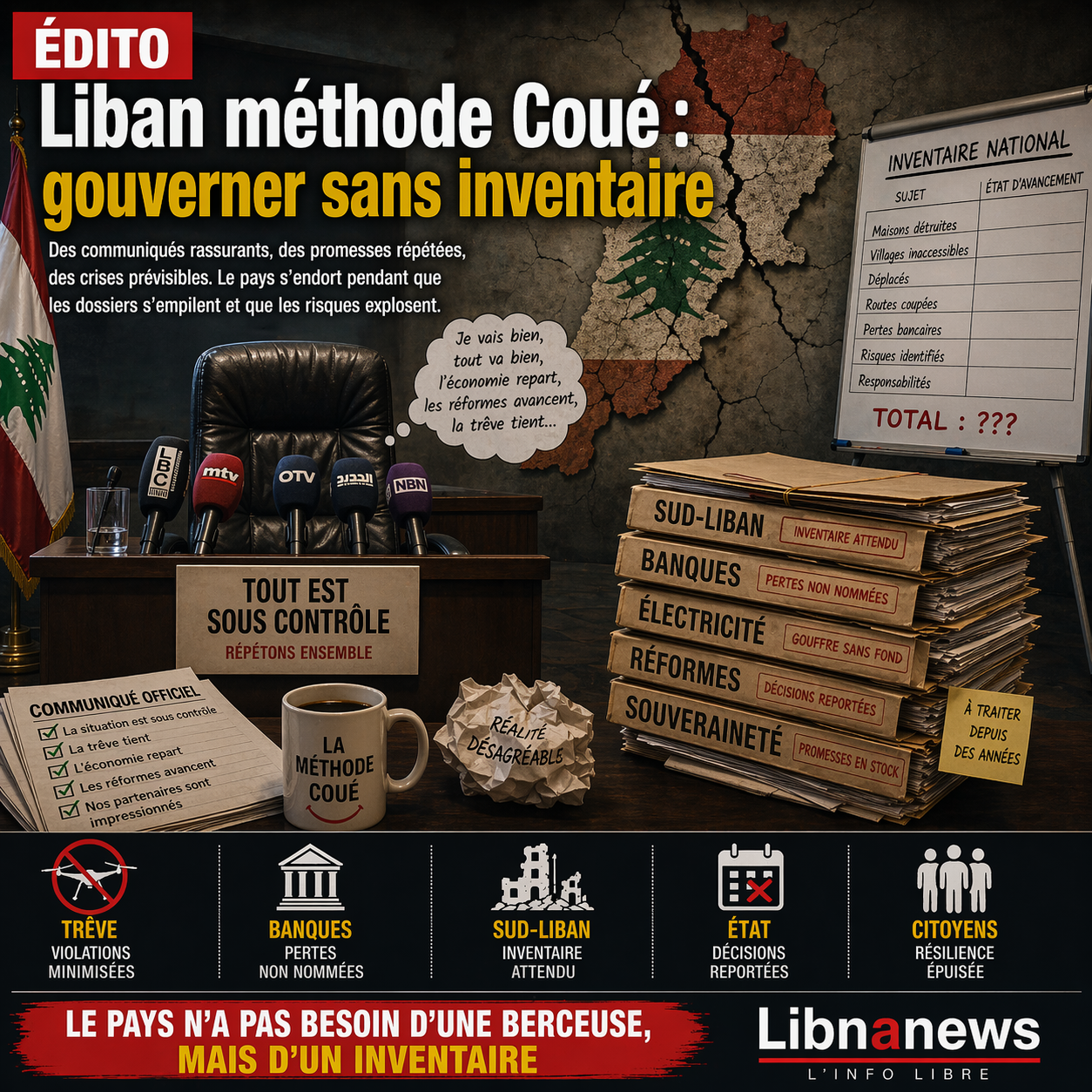
Lebanon has finally found its national doctrine. It is neither a defence strategy, nor an economic recovery plan, nor a reform of the state. This is better, it seems: the Coué method applied to an entire country. Every morning, it is enough to repeat that the situation is under control, that the truce is holding, that the economy is leaving, that the reforms are moving forward and that the international partners are impressed. Second, it is only necessary to avoid windows, banks, roads and bills.
The government must be given some consistency. Where other countries are suffering from inventories, diagnoses and calendars, Lebanon prefers the noble art of the reassuring phrase. Is there a crisis? We call it a challenge. An area collapses? We salute his resilience. A late decision? We’re talking about consultation. A risk has been known for years? We’re waiting for him to explode to announce a tracking cell.
This method has an advantage. It costs little on the budget. No need for complete statistics, serious planning or political courage. A press release is enough. Hopefully, it will be taken over by three officials, two ambassadors and a television panel. The country will not have changed, but it will have benefited from a new layer of varnish. It’s important, varnish, especially when walls threaten to fall.
The government of the national lullaby
The Lebanese Coué method is based on a simple conviction: the citizen sleeps better when he is sung a lullaby. He should not therefore be told that crises were foreseeable. He might get upset. He should not be told that the state has failed to anticipate. He could be holding an account. Above all, he should not be shown a complete inventory of damage, loss, risk and liability. He might find that the country is not only a victim of fatality, but also of lazy emergency management.
So the government prefers soft anesthesia. It is not said that the truce is broken like an old mountain road. They say she’s fragile. It is not said that the economy depends on cash, families and the diaspora. It is said that it shows encouraging signs. It is not said that deposits remain trapped in a banking system without a clear political outcome. They say the file is moving on. It is not said that the South is waiting for a real reconstruction plan. They say contacts are in progress.
This administrative language has a particular elegance. It allows us to talk for a long time without saying exactly where we are going. It turns the absence of a decision into responsible prudence. It gives the delay the appearance of wisdom. It gives officials a rare luxury: that of governing by explaining that everything is complicated, which is true, but rarely enough. The Lebanese citizen already knows the complexity. He pays her. He transports her in water cans, in generator bills, in family transfers, in secure depots, in hijacked trips, in children to be sent abroad, in abandoned villages under threat of drones. He can therefore be spared the lessons of patience. He obtained a PhD in patience, with prolonged survival mention.
Inventory, this subversive object
In a normally administered country, a government begins by compiling an inventory. How many houses were destroyed? How many villages are inaccessible? How many displaced people can’t go home? How many roads off? How many bank losses are recognized? How many public services are actually funded? How many risks were identified before the next crisis? In Lebanon, the inventory is almost a provocation, especially no forensic audits of public institutions, too many misappropriations and misappropriation of funds to hide. It forces us to move from the narrative to the column of numbers.
That’s probably why he’s scared. An inventory has a bad character. It does not respect community balance, party moods, bank sensitivities or optimistic press releases. He says coldly that such a house no longer exists, that such a bridge is unusable, that such a bank cannot render what it owes, that such an institution survives by inertia. Inventory is not nice. That is precisely what makes it useful.
The government often prefers emotional inventory. He recognizes suffering, salutes sacrifices, thanks partners, promises to leave no one behind. It’s beautiful. It’s even necessary sometimes. But a house is not rebuilt with a tribute. A road does not reopen with a statement. A deposit does not return because a minister has assured that the rights of depositors are sacred.
Lebanon suffers from a rare disease: it knows everything, but acts as if it discovered everything. He knew the banking system was sick. He knew that public electricity was a gulf. He knew the South was exposed. He knew that the absence of a state monopoly on arms would ultimately affect any negotiations. He knew that blocked justice would destroy trust. Then, when the crisis arrives, he puts on his most beautiful suit and announces that we must act quickly.
The foreseeable crises, these very occasional surprises
The country loves the surprises it has programmed itself. The banking crisis? Surprise, except for those who read the balance sheets. The collapse of electricity? Surprise, except for those who had already paid two bills for years. The blockage of reforms? Surprise, except for those who know the political system. The vulnerability of the South? Surprise, except for the people of the South. The cost of war? Surprise, except for anyone who has ever seen a war.
This ability to be surprised by the obvious deserves almost a national distinction. We could create an order for the Merit of Imprevision. He would reward those who ignored the warnings long enough to be able to open a crisis conference. The ribbon would be grey, administrative dust colour, with a small pin in the shape of an untreated folder.
However, prevention is less expensive than reparation. But it has a major flaw: it does not produce a major political scene. It requires discreet work, unpopular trade-offs, figures, priorities, budgets and those responsible who are able to be angry before the disaster. The repair offers field visits, solemn promises and photos in front of ruins. In communication, ruin is more photogenic than maintenance.
This is the whole cynical tragedy of Lebanon. He sometimes prefers to weep with dignity what he might have modestly prevented. He can produce ceremonies, delegations, condolences, committees and appeals for help. He knows less how to replace the culture of the last moment with the discipline of the first signal.
The economy of « it goes back »
Economically, Lebanon invented an original concept: the recovery without a system. Restaurants can be full, so economy is better. Prices can slow down, so the crisis is falling. The book can stop collapsing every morning, so stability comes back. Tourists can arrive in July, so the model breathes. It is a charming vision, especially if we avoid talking about deposits, credit, investment, electricity and poverty.
The truth is simpler. An economy can move without healing. It can consume without producing enough. It can survive thanks to the cash without finding a banking system. It can display some lively neighborhoods and leave entire areas in the scramble. It can give the illusion of a return to normal because Lebanese have become experts in the art of paying themselves what the state no longer provides.
The economic Coué method consists of taking each simmer for a trajectory. A lower price? That’s a relief. Is an international delegation coming back? That’s trust. Is a text adopted? That’s the reform. The problem is that a country does not rebuild from signs. It is rebuilt from mechanisms. Lebanon is accumulating signs and postponing mechanisms.
The bank record is proof of that. For years, everyone has been aware of the need to recognize losses, protect small depositors, restructure institutions, allocate effort and restore a credit function. For years, the country has revolved around this evidence like around a dangerous beast. We observe it, we name it, we describe it, then we slowly step back to not wake it up.
The truce, or the art of celebrating half-silence
In terms of security, the Coué method becomes more serious. A truce is prolonged, and we should applaud. All right. Every hour without total war deserves to be preserved. But there is truce and truce. A truce where drones continue to fly over the territory, where villages receive evacuation orders, where point strikes remain possible and where destruction prevents residents from returning is not a peace. It’s a pause under armed surveillance.
Israeli drone flights over Lebanon violate the ceasefire and sovereignty of the country. These are not details in the sky. These are military acts. They mean that airspace remains under threat. They mean that the Southern citizen can hear the war before it strikes. They mean that the cease-fire is already amputated by part of its substance.
The Lebanese government protested, demanded, insisted, recalled the right, called for withdrawal and refused buffer zones. He’s right. But the question is whether this position is accompanied by a complete public apparatus of documentation, pressure, information and preparation. To say that a violation is a violation is a beginning. Showing each violation, classifying it, transmitting it, making it politically expensive and linking it to negotiations is something else.
Diplomacy without inventory looks like a complaint without records. She can be fair. She can even be moral. But she’s less armed. In the face of an adversary who thinks in maps, positions, corridors, areas and deeds, Lebanon cannot be content with its legitimate indignation. It must oppose a State that counts, proves, documents and anticipates.
Sovereignty, the slogan that awaits its budget
Sovereignty is the great word of the moment. He is indispensable. It is also much less comfortable than it looks. For sovereignty is not just about saying no to Israel, not overflights, not buffer zones, not destruction, not de facto occupation. It also consists of saying yes to the army, yes to justice, yes to the public monopoly on arms, yes to serious public finances, yes to an administration capable of executing.
Lebanon loves verbal sovereignty. It gathers, it warms, it passes well in statements. Practical sovereignty is more ungrateful. It calls for paid soldiers, equipped units, repaired roads, supervised borders, protected magistrates, enforced decisions, combated smuggling, institutions not paralyzed by each partisan calculation.
They say the army needs to be strengthened. All right. With what means, timetable, missions, personnel, monitoring capabilities, logistics, coordination with UNIFIL or its successor, what presence in the liberated villages? If the answer is in three press releases and a press conference, it is not a plan. It’s a prayer in uniform.
The state monopoly of arms is presented as a Lebanese interest. That’s right. But the Coué method also threatens this file. Reiterating that this is a process may lead us to forget that a process must have steps. Otherwise, the word becomes a waiting room. The country cannot live indefinitely in the waiting room for its own sovereignty.
Foreign partners, after-sales service of denial
Lebanon has another talent: making the international community the after-sales service of its delays. When the crisis becomes too visible, the partners are called. The United States to weigh on Israel. France to support the army. European Union to discuss a mission. IMF to certify reforms. The World Bank to quantify the damage. The UN to see what the state sometimes struggles to impose.
We must not despise this help. Lebanon needs it. But we should avoid turning external aid into an internal alibi. Partners can support a state. They cannot want the state in its place. They can fund programs. They cannot replace the courage to say who lost the money, who has to pay and who has to be prevented from doing it again.
The diplomatic Coué method is to believe that an international meeting is equivalent to a national policy. We come out of a meeting, we talk about renewed support, strong commitment, close coordination and roadmap. The next day, the same blockages resume their place, as punctual as an official before an unnecessary form.
This dependence on the outside looks infiltrates the country. It creates the impression that validation always comes from elsewhere. The government sometimes seems to be waiting for an ambassador, mediator or financial institution to publicly state what Lebanese officials already know in private. This makes it possible to present a late decision as a foreign requirement, so not to assume it entirely.
The citizen, heroic adjustment variable
In this beautiful mechanics, the Lebanese citizen plays a central role: he pays. He pays the state when he can, the generator when public electricity is missing, the private school when the public school is tired, the hospital when the cover is not enough, the bank when he does not return his money, the war when his village is destroyed, emigration when the country no longer offers horizons to his children.
Then we explain to him that he is resilient. That’s nice. It’s even flattering. But resilience has become the polite word for organized abandonment. When a citizen has to compensate for all the flaws in the system, it is no longer resilience. It is a forced privatisation of survival.
The government should be wary of this endurance. It’s not infinite. It is transformed into a silent withdrawal, starting with cynicism, a parallel economy, a refusal to pay, a loss of confidence. A country may continue to operate externally while its social contract is emptying from within. Lebanon knows something about this.
It is often celebrated that Lebanese people always find a solution. But that is precisely the problem. They find a solution because the state does not provide it. They adapt because they have no choice. They sometimes smile because the alternative is to scream. To govern such a people with reassuring phrases is an almost artistic audacity.
The real courage would be to break the lullaby
The government can continue this way. It can extend the method. An incomplete truce will become a diplomatic success. Partial reform will become a historic turning point. An international mission will become a strong signal. Fragile stabilization will become a recovery. An absent inventory will become an ongoing work. The country will survive a little longer, which will make it possible to say that the method is working.
But surviving is not working. Lebanon holds because its citizens, its municipalities, its army, its associations, its diaspora and some residual institutions still bear the weight. It doesn’t hold because the system governs well. He’s holding in spite of him. It is a nuance that the press releases rarely forget by accident.
The real courage would be to break with the lullaby. To say that the truce was violated when an Israeli drone flew over the country. To say that the reconstruction of the South requires an immediate public inventory. To say that banking reform must name the losses and those responsible. To say that the budget is not enough if it does not finance real emergencies. Say sovereignty needs a plan, not a chorus.
Lebanon does not need to be reassured. He needs to be warned, informed, respected and governed. He doesn’t need to be told that he’ll be better. He needs to be told when, how, with what means and at what cost. The Coué method lasted long enough. The next useful statement will not say that the country is resisting. He will finally say what the State intends to do before the next foreseeable disaster.




