

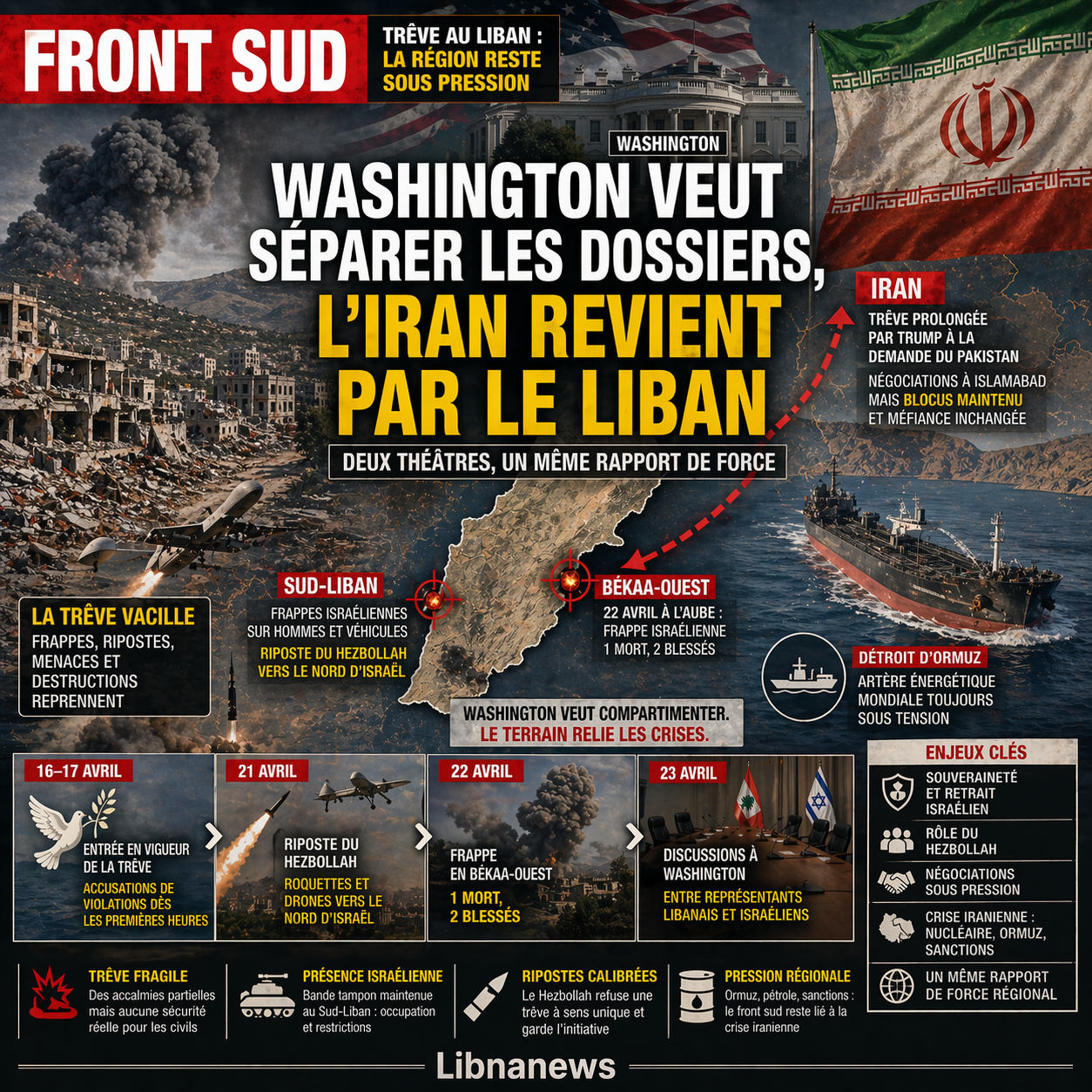
On Tuesday, 21 April, in Lebanon, many felt that the truce in Lebanon was ceding. Not by an official announcement, nor by a statement that the cease-fire no longer existed, but by a series of episodes that almost exactly reconstructed the mechanics of previous weeks. Israeli strikes targeted men travelling in the South and light vehicles. Hezbollah then responded to northern Israel by rockets and drones. Then, on Wednesday morning, 22 April, an Israeli strike struck the West Bekaa, killing one and wounding two. In Beirut, this sequence produced the same reading: the truce still holds in law, but it begins to give way in practice.
Perhaps the most important is not just the resumption of fire exchanges. This is the context in which they return. At the same time, Donald Trump announced the extension of the ceasefire with Iran, at Pakistan’s request, to allow more time for negotiations. In theory, this decision should have loosened some of the regional pressure. On the Lebanese front, however, the visible effect was reversed. The southern border has again become tense. The Bekaa was hit. And the discussions scheduled for Thursday, 23 April in Washington between Lebanese and Israeli representatives are opening up in an atmosphere where de-escalation remains proclaimed, but less and less felt.
The essential angle is there. Washington is trying to separate the Lebanese case from the Iranian case. United States officials want to treat Lebanon as a matter of local ceasefire, sovereignty, border security and the role of Hezbollah. They want to treat Iran as a broader nuclear, maritime and regional issue. On paper, this distinction is defended. On the ground, it appears increasingly artificial. The rising pressure on the Lebanese border is too closely following Gulf tensions to be seen as mere calendar coincidence.
A very Lebanese fear: the truce that jumps without saying
What many Lebanese people felt on Tuesday was not the certainty of a general war already relaunched. It was something more difficult to name and, for that reason, even more worrying. The impression that a ceasefire could die without anyone dared to declare him dead. The truce that came into effect on the night of 16-17 April had already begun under tension. Charges of Israeli violations had appeared in the early hours. Villages in the South reported intermittent strikes, overflights, traffic restrictions and destruction.
This fact prevented the truce from producing the political effect that a cease-fire should normally bring. A real suspension of hostilities is changing everyday life. She’s reopening the roads. She reassures the displaced. It changes the tone of those responsible. It creates a clear difference between wartime and time after. In southern Lebanon, however, this border has never been fully visible. Residents have seen some movement, sometimes families, sometimes rescue teams. But they also continued to hear the drones, see the damage and live under the threat of an immediate recovery.
The Israeli military presence in the south of the country strongly fuelled this sentiment. Israel has maintained its forces in a band of several kilometres within Lebanese territory, presenting it as a buffer zone necessary for the security of northern Israel. For Lebanese, the message is the opposite. A truce under partial occupation does not appear to be a stabilized truce. It looks like a pause imposed in an unchanged balance of power. As long as this military line remains in place, the people of the South understand that the ceasefire does not really suspend Israel’s ability to decide the pace of the terrain.
The demolitions observed in several localities further accentuate this reading. They hit homes, infrastructure and, above all, even the idea of returning. An displaced family does not only measure war to the number of shells fired. It measures it to the possibility of returning, of opening a door, of restoring a business, of finding a field or a workshop. When destruction continues during the truce, even in forms other than mass bombing, confidence does not return. The ceasefire then becomes a diplomatic word more than concrete experience.
April 21st, a level is crossed
21 April gave this anxiety a clearer military form. Hezbollah claimed rocket fire and drone launch to northern Israel. The movement described this action as a response to Israeli strikes and attacks on civilians and homes. Israel, for its part, denounced a violation of the ceasefire and claimed to have targeted the launcher used, as well as intercepted a drone.
This exchange marks a turning point because it resettles the logic of assumed reprisals. During the first days of the truce, everyone was still trying not to take over too explicitly a resumption of the military cycle. Israel continued its operations by describing them as defensive or targeted actions. Hezbollah denounced, threatened, observed. With the shootings of 21 April, the movement reached an additional stage. It means that he refuses to allow a one-way truce, in which Israel would retain the freedom to strike while he himself would remain under restraint.
This nuance must be taken seriously. Hezbollah did not, at this stage, choose maximum climbing. He did not reopen the front in the proportions of the most violent weeks. But he wanted to remind us that he retains his leadership and that he will not accept that a ceasefire will turn into diplomatic cover for continued Israeli military pressure. This type of response is calibrated. He carries a message as much as he targets a target. He tells Israel that the military cost has not disappeared. He told Washington that no discussion about Lebanon could be as if Hezbollah had already been neutralized. He also tells his environment that he did not enter into a logic of silent retreat.
In Beirut, this signal was interpreted ambivalently. Part of the government knows that a renewed fire complicates the ongoing negotiations with Israel and exposes Lebanon to further degradation. But many also understand what the idea of a truce emptied of its content means for Hezbollah. If the war slows down without stopping, if Israel keeps its hand, and if the Lebanese state talks that the balance of power remains militarily unfavourable, the movement considers that it would lose on all the tables if it did not at least respond in a measured manner.
The return of a well-known grammar
The main danger is not yet total war. The danger at this stage is the return of a well-known grammar. A targeted strike requires a calibrated response. A calibrated response calls for a counter-strike. Everyone claims to act in reaction. No one admits taking the initiative of the derailment. Yet, from sequence to sequence, the ceasefire loses its substance. Thus many truces fail in the region: not by a single founding act, but by the accumulation of exceptions, reprisals and ambiguity.
This mechanism is all the more dangerous as it articulates into a tight diplomatic calendar. On Thursday, 23 April, discussions are to be held in Washington between representatives of Lebanon and Israel at the ambassadorial level. These contacts are already rare in themselves. They also intervene at a time when the central question is no longer just to open a channel, but whether this channel is still talking to a front that is starting to warm up again. When the terrain is packed up, diplomatic discussions can either become a guard or become a mere decor.
The bekaa strike changes the signal scale
The Israeli bombing on Wednesday morning, 22 April, in Western Bekaa added an essential dimension to the sequence. When Lebanese depth is affected after a Hezbollah response to northern Israel, the message goes beyond a border incident. He says the pressure can move, go back inside the country, and no longer be limited to the immediate contact areas of the South.
The Bekaa occupies a special place in Lebanon’s strategic imagination. It is a region of circulation, territorial continuity, Hizbullah presence and national vulnerability. A strike in this area therefore weighs heavier than a simple tactical episode. It recalls that, despite the truce, Israel retains freedom of action over several depths of Lebanese territory. This immediately increases the political reading of the crisis. The ceasefire no longer appears only fragile in the South. It seems unable to prevent the spread of risk to other parts of the country.
This implicit extension of the pressure theatre comes at the worst moment in Beirut. The Lebanese authorities are still trying to present the diplomatic path as the only way to avoid both an open war with Israel and an internal confrontation over the role of Hezbollah. But this speech becomes difficult to deliver if, at the same time, the Bekaa is hit, destruction continues in the South and Hezbollah believes it must respond in order not to allow a new military state of affairs to settle.
A truce that does not produce security
The central point is simple. A truce is credible only if it produces a perceptible minimum of security. In Lebanon, however, the current agreement produces, for the moment, a partial suspension of the fire. It does not fully protect civilians, the depth of the territory, the return of the inhabitants or the ability of the State to take over alone. Under these conditions, each new incident weighs more than usual, because it confirms an already present intuition: the war has slowed down, but it has not really left the landscape.
This structural weakness is at the heart of the Lebanese problem. Beirut is negotiating in a context where the ceasefire does not offer it political time, internal space or real military stabilization. The government must therefore speak to Washington and Israel while knowing that a whole part of the territory remains subject to a rhythm of violence that it does not control. This dissociation between the diplomatic word and the reality of the ground gives rise to an impression of impotence which the strikes of 21 and 22 April brutally revived.
Trump’s extension does not relax Lebanon
At the same time, Donald Trump announced the extension of the ceasefire with Iran. This decision was taken after an insistent request from Pakistan, which plays a central mediation role in the Islamabad talks. Apparently, the announcement had to reduce the immediate regional risk. It ruled out the prospect of an instant resumption of the American strikes against Iran. It gave negotiators more time to try to deal with disagreements over nuclear, Ormuz Strait, sanctions and conditions for more sustainable de-escalation.
But the paradox is that this extension did not reassure Lebanon. On the contrary, it coincided with an increase in pressure on the southern border. This is primarily due to the very nature of the American announcement. Washington does not propose a neutral de-escalation. The United States extends the truce while maintaining the maritime blockade on Iran. They give time for discussion, but without lifting strategic pressure. This approach may seem rational from the American perspective. It is much less stabilizing seen from the region.
For Tehran, the message remains deeply ambiguous. Iran intends to be given a period of time, but at the same time as being kept against it a constraint deemed hostile. There is therefore no clear relaxation, only a readjustment of the balance of power. However, in this type of sequence, the Lebanese front quickly becomes a place of signal. If Washington wants to isolate nuclear and maritime negotiations from the Lebanese case, Iran and its allies have an interest in showing that this separation does not really exist on the ground.
Washington wants to compartment, the area connects
This is where the analytical core of the subject appears. The United States is trying to compartmentalize crises. Lebanon would be a local issue. Iran would be a global strategic issue. The first would be a process of border security, Israeli withdrawal, Lebanese sovereignty and Hezbollah’s place. The second would be nuclear, maritime, sanctions and regional safeguards. This approach allows Washington to believe that it can move forward on one front even if the other remains blocked.
But this diplomatic engineering comes up against the reality of the Middle East. Regional actors do not reason in tight compartments. Iran does not see Lebanon as a separate issue, but as one of the points of application of its power relationship with Israel and the United States. Israel, for its part, can use the Lebanese front to maintain pressure on the Iranian axis, even when the discussion with Tehran is officially prolonged. As for Hezbollah, it cannot accept that Lebanon should be treated as a simple local problem, while it is a direct component of regional balance.
This difference in reading explains a lot. Washington hopes that negotiations at the ambassadorial level between Lebanon and Israel can move forward on their own logic. Tehran considers that no serious arrangement can ignore the situation of its main ally on Israel’s border. Israel wants to gain on the Lebanese ground that it could then consolidate diplomatically. Hezbollah wants to prevent diplomacy from freezing its military weakening. Each actor claims to be working on a specific file, but all act as if the files communicated with each other.
A correlation more than a merger
However, we must remain precise. To say that the pressure on the Lebanese border is correlated with the tension in the Gulf does not mean that at every moment there exists a centralized and mechanical order linking Islamabad, Ormuz, Bekaa and Bint Jbeil. This would oversimplify much more complex decision-making chains. On the other hand, the political correlation is clear. When the American-Iranian negotiations waver, Lebanon becomes more vulnerable. When Washington kept pressure on Tehran despite the extension of the truce, Hezbollah had better remember that the Lebanese case could not be put in brackets. When Israel prepares to discuss with Beirut, it retains on the ground military levers that weigh on the very content of the discussion.
In other words, it is not necessarily a single front in the strict operational sense. It is the same regional power ratio, which is available on several scenes. Lebanon is not absorbed by the Iranian crisis. It remains a case with its actors, its fractures and its own objectives. But it is again embedded in a wider regional sequence, where decisions taken around Iran immediately alter the strategic climate in the Levant.
Lebanon negotiates under military pressure
That’s what makes Washington’s discussions so delicate. Officially, they must help consolidate the truce and perhaps prepare a more sustainable framework. In practice, they open under a fire that is not completely extinguished. Lebanon arrives at the table without having obtained a clear halt to the Israeli strikes, without complete withdrawal of Israeli forces from the South, without the safe return of all displaced persons and without internal consensus on the follow-up to the open sequence.
Nawaf Salam’s government is trying to keep a hard line. He does not want a confrontation with Hezbollah. Nor does he want to appear hostage to a logic of resistance that would deprive the State of any initiative. It seeks to defend Lebanese sovereignty, to protect civilians and to prevent the country from becoming deeply involved in regional war. This line is politically consistent. But it remains extremely fragile as long as the ground continues to remind us every day that Lebanese sovereignty is neither restored nor guaranteed.
President Joseph Aoun, too, is trying to turn the ceasefire into a starting point for more lasting agreements. Again, the intention is clear. Exit from the momentary stop of the fighting to move towards a more stable political architecture. The problem is that architecture is not built in vacuum. At the very least, it implies that the actors stop constantly testing the limits of the existing framework. This is precisely what is happening. Israel retains a military margin of action. Hezbollah maintains a response capability. The United States wants to dissociate what part of the region continues to link.
The risk of an imbalance imposed
Behind diplomacy, a deeper question emerges. Is Washington trying to resolve the Lebanese crisis, or to achieve sufficient stabilization to move forward on other regional priorities, including Iran? From Beirut’s point of view, the distinction is not academic. If Lebanon primarily serves as a secondary management space in a broader negotiation, then its interests may be treated as adjustment variables. If, conversely, Lebanon manages to impose that its sovereignty, Israeli withdrawal and the security of its civilians are central conditions, it can still transform the fragile truce into a political lever.
At the moment, there is no indication that this balance is being found. The facts of April 21 and 22 suggest the opposite. The southern border has been activated again. The Bekaa was hit. Hezbollah showed that it remained in the equation. And the American announcement on Iran did not produce any visible relaxation effect in Lebanon. This is the best indicator of the problem. Washington wants to separate the files. The terrain reminds them that they remain nested.
The real subject is no longer just the truce in Lebanon
The error would therefore be to ask the question in too simple terms. It is no longer just a question of whether or not the truce in Lebanon will officially hold in the coming hours. The real subject has become wider. It concerns the very function of this truce. Does it serve to reopen a Lebanese political space? Or is it primarily used to administer, under a lower level of violence, a regional power ratio that continues to express itself by force?
For many Lebanese actors, the answer is now in Washington’s ability to exercise a minimum of real leverage on Israel. Without this, no de-escalation architecture in the South will be credible. For Hezbollah, the answer is in its ability to prevent an imperfect ceasefire from turning into a unilateral wear and tear mechanism. For Iran, the answer lies in the refusal to completely dissociate the Lebanese front from the broader negotiation with the United States. And for Israel, the answer lies in the possibility of getting an advantage on the ground that it can then convert around the table.
This superposition of calculations explains the density of the moment. Lebanon is not only on the brink of a renewed war. It is at the point of contact between several calendars that encounter each other without yet melting. This makes the current sequence more dangerous than just a local outbreak. Every strike, every drone, every statement about Iran, every meeting in Washington now carries a meaning that goes beyond its immediate object. The southern border is no longer just a theatre. It becomes a language again.
This is also why the crescendo impression is so strong. It is not just due to the number of incidents. It comes from the fact that these incidents are all part of the same tension architecture, where diplomacy advances without completely neutralizing military pressure, where ceasefires are prolonged without being consolidated, and where Lebanon remains the place where, often before others, the concrete truth of regional power relations is revealed. On Thursday 23 April, Washington’s discussions may say whether this truce still retains a chance to be transformed into a political framework. But they are already opening with, behind them, the strikes of the South, the Hezbollah response and the brutal reminder from the Bekaa.




