

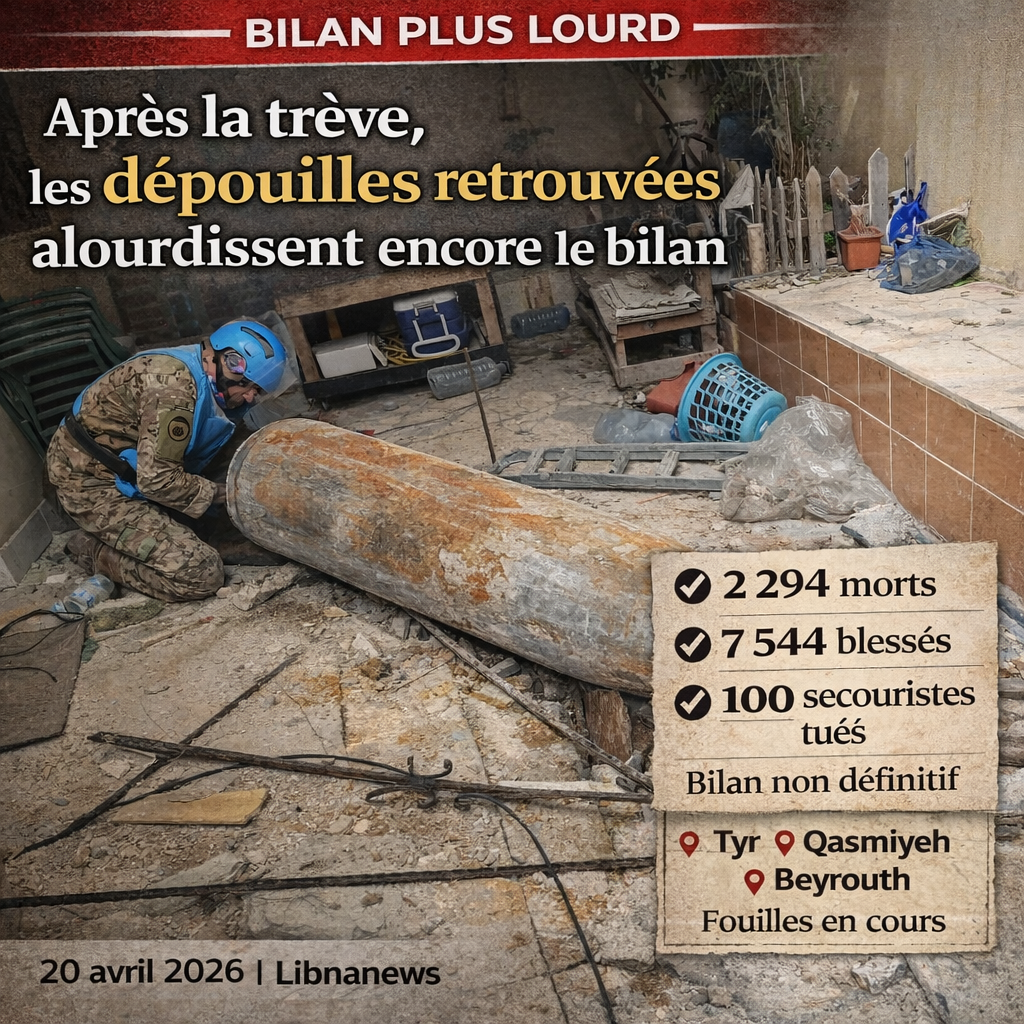
The ceasefire did not freeze the human impact of the war in Lebanon. On the contrary, it opened a sequence that now makes visible the deaths that the bombings, fires, collapses and the impossibility of access to certain areas had temporarily removed from sight.
Since the entry into force of the truce, relief teams, civil defence, municipalities, health relief associations and health services have been constantly removing rubble, buildings struck in the last few hours before the fire stopped, and even buildings or areas still difficult to explore.
The results are therefore getting worse after the strikes, not because a new wave of bombardments would have mechanically produced most of the losses, but because the country can finally count some of the deaths it had not yet reached.
It is this gap between the violence suffered and the possible accounting that is now striking. The figures published by the authorities and relayed by the National Information Agency are no longer just snapshots of the hour following a strike. They become products of slow, dangerous and methodical work.
It is necessary to clear the concrete, stabilize the slabs, secure damaged buildings, engage excavators, intervene by hand in some pockets of collapse, then transfer the bodies, identify them and sometimes carry out DNA tests. In a war where entire neighbourhoods have been sprayed, this phase transforms the ceasefire into a time of recovery of the victims.
The dispatches of the day and the period immediately after the truce give a clear picture of this reality. In Tyre, Kfar Melki, Qadmous, in the area of the Qasmiyeh bridge, but also in Beirut and other areas where the search for missing persons continues, the post-strike remains a time of search.
It must be made clear that the national balance sheet has not finished. The health authorities themselves have written black and white, stating that the final figure can only be stopped after the lifting of the rubble, the extraction of the remains, DNA tests and the identification of the victims.
An official balance sheet still provisional
The first figure to be used, and probably the most important one to understand the current sequence, is the one communicated by the Lebanese Ministry of Public Health and taken up by the National Information Agency: on 16 April, at midnight, the » ح.
Among them were 100 first aid workers and health personnel killed and 233 injured from these professions. This precision deserves to be emphasized, because it says two things at once: the magnitude of the overall human cost, and the fact that even this massive human cost is not yet fully consolidated.
The heaviest word in this press release is not necessarily the number. It is the reserve that accompanies him. The Ministry of Health has indicated that the final assessment will be announced only after the end of the rubble removal operations, body extraction, completion of DNA tests and identification of their owners.
In a country where war figures are often received as closed truths, this formula recalls that the official number is still open. Every site searched, every body found, every missing person identified can move the national accounts.
This administrative reserve has a very concrete human scope. It means that at the time the state is already announcing 2,294 deaths, it itself acknowledges that other victims have not yet been integrated. Some are under collapsed buildings. Others are still sought in partially accessible areas. Others have been found but not yet formally identified.
The balance sheet therefore increases in two stages. First by physical extraction of the bodies. Then by their official registration.
This is not a statistical detail. It is a central information about the nature of the war that has just struck the country. When a state has to wait for the extraction of remains and DNA tests to establish its own balance, this means that destruction has been so intense that not all deaths could be recorded at the time of the strikes.
The war produced invisible victims for several days, sometimes more. The ceasefire did not end this violence. It only allowed to measure it more fully.
In Tyre, numbers continue to move
Tyre concentrates much of this reality. One of the last major Israeli strikes before the ceasefire came into force targeted a residential area of the city. Very quickly, the first dispatches reported a heavy but still incomplete balance sheet.
On the morning of 17 April, the National Information Agency reported that the previous day’s raid, which took place a few minutes before the fire stopped, had gone up to 13 dead and more than 70 wounded, while the search for eight missing persons under the rubble continued.
These figures already say the essential. First, the strike hit a densely inhabited area. Second, the number of wounded far exceeds the only immediate circle of the dead, a sign of a wave of shock and a collapse in dense urban space.
Finally, eight people remained wanted after the first relief phase. This shows that the ruins were too massive to allow complete extraction in the emergency.
Another dispatch from the agency, published afterwards, stated that the rubble-lifting operations were continuing in the city, especially around the 12-storey Salameh building. The height of the building adds an important dimension here.
A twelve-storey building hit and then collapsed does not search like a single house. Crushing pockets, compressed floors and concrete mass require long, sequenced and technically heavy operations. When the National Information Agency reports the continuation of research in such a building, it indirectly says that the local balance sheet remains mechanically liable to evolve.
On 20 April, another dispatch reported the removal of an additional remains of the rubble of a building in Tyre. This point is crucial. It shows that several days after the truce, the city continues to deliver its dead.
The time of the bombing has passed, but the time of discovery of the victims is not. For families, this temporality is terrible. Some of the relatives first hoped for a rescue. Then, over hours and days, the wait turned into a body search.
The cease-fire has therefore not only brought silence. He has provided the gradual certainty of certain losses.
It should also be noted that the Lebanese press, quoting the official agency, continues to refer to the search in Tyre for eight missing persons in the same area. This means that at present local consolidation is still not complete.
The figure of 13 deaths published on 17 April served as the basis. But the excavations were not closed. The case of Tyre thus shows how a local balance sheet can remain mobile several days after the last strike.
A 12-storey building, symbol of a deferred balance sheet
The Salameh building, in the residential area targeted in Tyre, has become one of the symbols of this deferred balance sheet. The mere fact that the agency appoints him and specifies that he has 12 floors is enough to explain the difficulty of operations.
In this type of structure, the impact of a strike does not only produce immediately visible victims. It creates layers of collapse. Accessible survivors are evacuated first. The wounded who are trapped but can be located can then be extracted. Then come the slowest hours, those where the teams look in deep pockets.
The number of wounded, more than 70 according to the 17 April dispatch, also gives an indication of the violence of the episode. Such a magnitude means not only buried bodies, but also pressure on hospitals, ambulances, triage centres and rescue teams.
In a city where the deaths of previous days are still buried, the addition of dozens of wounded and missing persons turns the truce into an extension of the emergency. Tyre thus represents more than one local case. It gives a reading key for all of Lebanon bombed.
Each large site struck just before the truce may follow the same logic: an initial assessment announced in the following hours, and then figures that continue to rise as the excavations, identifications and subsequent dispatches progress.
Kfar Melki, Qadmous, Hayy al-Sellom: other sites that increase accounting
The South is not just Tyre. The dispatches of the National Information Agency show on the contrary a more diffuse geography of the deferred balance sheet.
In Kfar Melki, a dispatch reported the removal of three bodies and the evacuation of four wounded from the rubble of a four-storey building struck the night before. The details of the structure of the building still count.
It is not a simple damaged facade, but a building high enough to generate a pile of rubble and a search for several hours. The dispatch also indicated that the research had lasted a long time and had been carried out by the civil defence and health relief teams.
This point recalls that the balance sheet is not only an abstract health data. It depends on the operational capacity to stay on site, to work for hours and to remove victims and survivors in a degraded environment.
A few days earlier, in Qadmous, the National Information Agency reported the withdrawal of four bodies and the evacuation of three wounded from the al-Khodra compound, targeted by an Israeli strike. Again, the pattern is repeated: a civilian or residential site affected, several deaths, late-extracted wounded, and a local balance sheet that is not limited to the first minutes after the raid.
The fact that these figures relate to a complex adds a level of difficulty. A set of affected buildings requires more resources, more coordination and more time to complete the search.
In the southern suburbs of Beirut, Hayy al-Sellom, another agency dispatch announced the extraction of two bodies of a building targeted by an Israeli strike on the previous Wednesday. This point is particularly important because it broadens the focal point beyond the South Lebanon alone.
The deferred balance sheet is not only a matter of villages or localities close to the front line. It also concerns dense urban areas of the capital and its periphery, where buildings have been hit and where not all the disappeared could be reached immediately.
These cases should not be read as mere regional briefs. They show that the national balance sheet rises by adding local households, each with its own temporality. Three bodies here, four there, two elsewhere, an additional remains found several days after a first dispatch: this delayed addition mechanism is precisely what transforms the ceasefire into a period of dizzying balance sheet.
Qasmiyeh: The bodies sought in the river
The Qasmiyeh bridge case gives this sequence an even harder dimension. Here, the rescue not only searches buildings. They’re looking for bodies in the river.
Local authorities had announced the closure of the bridge from 9 a.m. to allow the search for two remains in the river. A subsequent dispatch from the National Information Agency reported that an Israeli drone was flying over the area during operations.
These two elements, put together, summarize an essential part of the situation. On the one hand, Lebanon is entering the search for victims who were not found at the time of the strikes. On the other hand, this phase is still under Israeli military pressure, visible in the sky above the site.
The ceasefire therefore does not create a fully secure space for humanitarian and death operations. It makes them possible without completely protecting them.
The number itself, two remains, may seem limited in comparison with the balance sheets of large collapsed buildings. It would be a mistake to minimize it. Each operation of this type reveals an irresolute disappearance until after the fire stopped.
Searching for two bodies in the water, under or around a bridge, means that the wave of war has moved the victims out of the immediately searchable scenes. Rescue work is no longer limited to removing concrete. You have to probe, dive, check currents, inspect deck piles, search banks.
Qasmiyeh recalls that the war has produced deaths that are not only buried in buildings. Some have been projected, taken away or made undetectable by the destruction of infrastructure and by the very conditions of the strikes.
This diversity of research scenes makes the final assessment even more difficult to determine. It also obliges us to think of the human cost beyond the collapsed buildings alone.
Research is also continuing in Beirut
The National Information Agency also reported a visit to search and rescue sites in Beirut, in the areas of Ain al-Mreish and Tallet al-Khayat. The main interest of this dispatch lies not in the announcement of a new one-off figure, but in what it says about the duration of the effort.
Several days after the strikes, searches for missing persons continued in the capital. The implicit message is clear: here too, everything has not yet been found.
This information complements the more spectacular figures from the South. It shows that the war left search sites behind on several territories at once. The balance sheet is not growing in a single city. It recomposes in different places, with different rhythms, sometimes in a media quasi-discretion compared to the great raids of the southern front.
It also recalls that the rescue chain remains deployed in many theatres at the same time. While teams in Tyre are continuing to search a 12-storey building, others are continuing operations in Beirut and others in the Nabatiyah and South Lebanon regions.
This means that the magnitude of the need far exceeds the treatment of a single major site. The country does not manage a single balance sheet. It manages a constellation of local balance sheets that are still incomplete.
Four buildings still under excavation
Another dispatch relayed by the agency, on the occasion of a tour by the Director General of Civil Defence, brought an important numerical element: in the governorates of Nabatiyah and South Lebanon, the teams continued to search for and lift the rubble in four destroyed buildings, with the aim of finding all the missing.
This figure, four buildings or structures still under search, helps to measure the residual extent of work. It means that the post-threat does not concern a single hot spot, but at least several pockets of destruction still active from the point of view of relief.
However, in each building, the number of potential victims varies, as does the difficulty of intervention. Some sites still reserve bodies. Others require heavy work before they can even verify if victims are still there.
The most useful information here is therefore not only the possible future total, but the confirmation that a significant number of sites have not yet delivered its full assessment. This explains why the authorities logically refuse to freeze a final figure.
As long as at least four buildings remain actively searched in these two governorates, and other sites in Tyre, Beirut or elsewhere continue to be searched, any statistical fence would be artificial.
The balance also increases because the bodies must be identified
There is another aspect, more discreet, but decisive: finding a body is not always enough to bring it immediately into the nominative balance sheet. The Ministry of Health explicitly mentioned the need to complete DNA tests and identify identities.
This indicates that some bodies are found in a state or under conditions that make immediate identification impossible. In air wars in urban areas, this reality is not exceptional.
Fires, collapses, compression under slabs and the length of time before recovery sometimes degrade bodies. Families therefore often expect two separate answers. First, was a body found? Then: can we confirm that it is the missing relative?
In the meantime, the state cannot always immediately stabilize its figures. This also means that the final assessment depends not only on the work of excavators and rescue workers, but also on forensic medicine, laboratories and identification procedures.
The country is thus going through a phase in which war descends from the sky to morgues, levies and administrative registers. It is another violence, less visible, but decisive to understand why the official number remains provisional.
What the figures already say about the scale of the disaster
Even provisional figures already draw a very heavy scale. A national record of 2,294 deaths and 7,544 injuries in about six weeks of conflict, including 100 rescue workers and health workers killed, places the sequence among the hardest that the country has known over such a short period of time.
To this mass is now added the deferred balance of the sites searched after the truce. In Tyre, a raid has already been credited with at least 13 deaths, more than 70 wounded and eight missing persons wanted.
In Kfar Melki, three people were killed and four injured from a four-storey building. In Qadmous, four dead and three wounded. In Hayy al-Sellom, two bodies were found in a building hit.
In Qasmiyeh, two remains are sought in the river. In addition, research is still under way in four demolished buildings in the south and the Nabatiyah region, as well as the reported excavations in Beirut.
Taken together, these figures do not describe a closed episode. They describe a national balance sheet that is still being developed.
The relationship between dead, wounded and missing must also be emphasized. When a single strike in Tyre results in more than 70 injured and eight still wanted, it means that the destruction far exceeds the number of bodies immediately visible. The missing are often the blind spot of the first hours.
The effect of the ceasefire is precisely to reduce this blind spot. It does not reduce the number of victims already caused. It simply allows them to be found.
A war that continues in the rubble
The formula may seem paradoxical, but it corresponds to the reality observed on the ground. The war continues in the rubble, not by the strikes themselves, but by the way they still force the country to seek its dead.
Families do not live out of the conflict. They are undergoing a transition from the moment of strike to the moment of certainty. As long as a relative stays under a building, in a destroyed complex, in a river or among unidentified bodies, the war is not over for them.
The rescue teams also live another temporality. They no longer operate solely in the urgency of the ongoing bombing. They work in endurance. Each hour of the search may lead to a discovery, but also to the absence of discovery, the need to reposition equipment, secure a slab or interrupt work because a drone is flying over the site, as in Qasmiyeh.
The human balance also depends on the country’s ability to maintain these operations continuously. This endurance is a central dimension of the moment.
In an already economically exsangued country, every search site mobilizes human, technical and logistical resources. Yet there is no other way. Without this work, the missing would remain without status. With him, they become counted, identified and returned to their loved ones.
The true sense of the increase in the balance sheet
To say that the post-ceasefire balance can give the misleading impression of post-ceasefire degradation. In reality, this increase reveals above all the extent of what the bombings had already produced. The number is now rising because the ruins gradually deliver what they contained.
This is not a contradiction of the ceasefire. This is one of its darkest consequences.
The country is therefore in a very special phase. Weapons are quieter than before, but the dead continue to come back in the news. The numbers no longer explode in the instant of a strike, they inflate during a search.
Violence is no longer only seen in the flames. It reads in the withdrawal of an additional remains in Tyre, in three bodies extracted in Kfar Melki, in four others in Qadmous, in two bodies in Hayy al-Sellom, in two remains sought under the Qasmiyeh bridge, and in the obstinate mention, by the authorities themselves, of a still non-final balance sheet.
As long as buildings remain searched, as long as missing persons remain wanted, until DNA tests are completed, Lebanon does not yet know the full number of its own loss. And that is probably what this sequence reveals most severely: the cease-fire did not close the count, it simply gave the country the painful time to discover, layer after layer, what the bombings had left under the ruins.




