





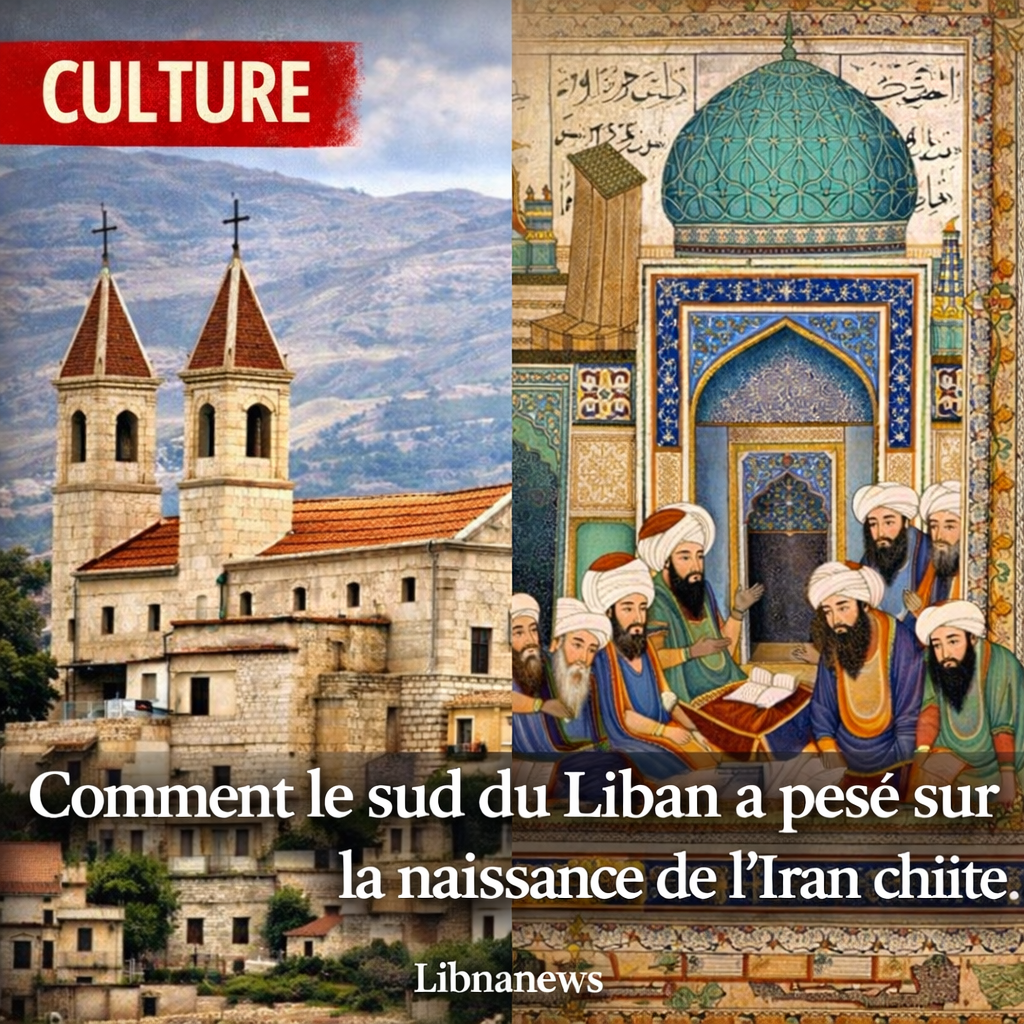
In Lebanon, the formula often comes back. Sometimes with pride, sometimes as a reminder of identity, sometimes as a way to highlight the seniority of Jabal Amel’s intellectual role in the history of Shiism. The idea is simple, striking, easy to memorize: Iran would have become Shiite thanks to missionaries from southern Lebanon. The formula has the advantage of slogans. She knocks. She values the South. It gives Lebanon a central place in imperial history. But it poses a major problem: it oversimplifies a much denser reality, much more political, and, in essence, much more interesting.
For Iran did not become Shiite because Lebanese preachers alone would have converted a foreign country. Iran’s shift towards duodecian chiism is first and foremost the product of a state decision. It is linked to the rise of the Safavid dynasty at the beginning of the 16th century, to the desire to build a sovereignty of its own, to the need to distinguish itself from the great Sunni empires neighbouring it, and to the establishment of a religious apparatus at the service of this transformation. The engine of change is therefore political before being missionary. It is the State that imposes, organizes and protects the new religious orientation.
But saying that is not enough. A state religion is not only decreed from a throne. It needs men, texts, judges, theologians, teachers, rites, courts, schools, doctrinal legitimacy. And that is where southern Lebanon enters Iran’s history in a decisive way. For at a time when the Safavids want to make duodecian chiism the religious spine of their kingdom, the Jabal Amel is not a periphery of any kind. It is one of the great learned homes of Arab Shiism. It has a strong intellectual tradition, lines of lawyers, schools, educational networks and an already established reputation.
Historical truth is neither the slogan nor its denial. Lebanon did not make Iran a Shiite country alone. On the other hand, Jabal Amel provided an essential part of the scholarly staff, doctrinal cadres and religious networks that enabled the Safavid project to hold, root and last. It’s less simple to say. That’s more accurate.
The starting point: Iran has not always been Shiite
We must start by breaking a retrospective evidence. Today, Iran is spontaneously perceived as the heart of duodecimain chiism. It seems almost natural. Yet this evidence is the product of a story. Before the Safavids, Iran was not a predominantly Shiite country. Shiite homes existed there, of course. Some cities, currents, religious or political elites already had Shiite affinities. But the entire Iranian space remained mostly Sunni.
That’s where the real turning point is. When Shah Ismail I founded the Safavid State at the beginning of the 16th century and seized Tabriz in 1501, he did not simply create a new dynasty. It transforms the religious matrix of power. He proclaims the Duodecian Shiism State religion. This gesture is not merely a pious preference. It has strategic significance. The new Safavid State needs a strong, differentiated, mobilising identity capable of distinguishing it from the Sunni Ottoman world and other rival powers. Shiism then becomes a political frontier as much as a religious doctrine.
We must be very clear on this point: Iran did not become Shiite by a slow, diffuse, purely popular slide. It became so because a central power decided to impose a new religious norm on the scale of a kingdom. This state dimension is fundamental. Without it, everything else becomes incomprehensible.
A political decision alone does not create orthodoxy
But a proclamation is never enough. Transforming a predominantly Sunni kingdom into a Shiite state presupposes much more than a decree. We have to produce orthodoxy. It must be said what is the right doctrine, what practices should be encouraged, what rites should be promoted, which courts should judge according to which legal school, which can speak in the name of religion, and how this religion should be linked with the royal power.
In other words, we need a scholarly infrastructure. And this is precisely what is lacking in safavid Iran at the time of the shift. Power has a will. It does not yet have, at the necessary scale, a duodecian clerical apparatus sufficiently dense and sufficiently recognized to give this will a stable form. It must therefore seek that competence where it already exists.
This is when the Jabal Amel becomes central. Southern Lebanon is not the origin of the Safavid decision. But it becomes one of the main reservoirs of religious knowledge mobilized to make it operational. Distinction is essential. Lebanon is not the main driver of change. He is one of the major suppliers of intellectual matter without which change would have had much more difficulty in rooting.
The Jabal Amel, an ancient home of learned chiism
To understand why the Safavids were able to rely on scholars from southern Lebanon, it is necessary to measure what the Jabal Amel was in the history of Shiism. This region, located in what is now southern Lebanon, was not just a rural margin. It had been imposed for centuries as one of the great homes of knowledge of Shiite duodecimain.
Shiism was long-standing. Teaching traditions were consolidated. Scholarly families had emerged there. Transmission chains, study practices, legal and theological works had taken shape. At a time when Safavids are looking for jurists and theologians capable of religiously guiding Iran, Jabal Amel has already gained a considerable reputation in the Shia world. The specialized sources even describe it, at the beginning of the sixteenth century, as the main center of Shiite knowledge of its time, producing and influencing hundreds of scientists beyond its immediate borders.
This point is crucial. It means that the Safavids did not find in Lebanon a simple godly community to mobilize. They found a region that was already functioning as a recognized intellectual center. They drew from a space that produced religious authority. The link between southern Lebanon and Iran is therefore not based on vague intuition or general religious affinity. It is based on a real hierarchy of knowledge in the Shiite world of the time.
The word « missionaries » is too weak and too misleading
This is where we need to correct the common language. Talking about missionaries from Lebanon gives a reductive image of what happened. The word suggests traveling preachers who would have travelled through Iran to convert a reticent or ignorant population. It’s not that. Men from Jabal Amel were not missionaries in the folkloric or popular sense of the term. They were mainly jurists, theologians, teachers, holders of dijazat, authors, doctrinal referees, sometimes high religious officials.
Their task was not simply to convince. It consisted of structuring. To be framed. To be codified. Making state chiism work. To give the new regime legal and religious basis. Teaching doctrinal cadres to an elite. To produce a continuity between the political proclamation of the shahs and the daily religious life of the kingdom.
In other words, the scholars of Jabal Amel did not create Iranian Shiism, but they helped build the institutions and justifications that allowed this state Shiism to last. It is deeper than a simple conversion mission.
The Safavids needed a competent and legitimate clergy
Why did the safavid shahs turn to scholars from elsewhere? Because Iran, at the time of the changeover, did not yet have a sufficient mass of duodecimain clerics capable of undertaking this transformation on a state scale. The government was therefore to attract already trained scholars to regions where scholarly chiism was well established.
The Jabal Amel wasn’t alone. The Safavids also appealed to scholars from Iraq and Bahrain. But the amilia contribution remained particularly strong in historical memory and in academic works. Why? Because she produced several major figures. Because it was durable. Because she touched the heart of the safavid doctrinal apparatus. And because these scholars have not merely held secondary positions: they have helped redefine the relationship between power, religious law and scholarly authority.
So this is not a detail. It’s a structuring element. The Safavid State needed to transform political will into a religious system. The Jabal Amel provided him with some of the men capable of this transformation.
Ali al-Karaki, hinged man
In this story, a name is immediately imposed: Ali al-Karaki, often called al-Muhaqqiq al-Karaki. For anyone who wants to understand the link between southern Lebanon and the Shiitization of Iran, this is probably the most important figure.
Karaki is native to Jabal Amel. He left the region, passed through Najaf, then entered the service of the Safavid power at the very beginning of the sixteenth century. The sources of the Encyclopaedia Iranica portray him as the first great amili jurist in the service of Shah Ismail and as a key figure of the legal and doctrinal changes introduced in Iranian cities by lawyers from Jabal Amel.
Why is his role so important? Because he is not content to be a prestigious teacher. It helps to define the articulation between the sovereignty of the shah and the religious authority of the Shiite jurist. But this question is central to the duodecimain chiism: in the absence of hidden imam, what legitimacy has temporal power? What space does scientists have? How should religious law be enforced by a State?
Karaki is precisely involved in this construction. It helps to give a doctrinal form to the safavid power. He did not convert Iran to himself, but he helped establish the legal and theological grammar of the new regime. It’s huge.
Karaki is not just an individual, he inaugurates a movement
One important thing must be added: Karaki is not an isolated case. He opens a cycle. Sources indicate that he inaugurates the emigration movement of scholars from Jabal Amel to Persia of the first safavid shahs. This means that it is not only a great name among others. It is the entry point of a wider dynamic, that of a partial transfer of ami religious capital to the safavid space.
This migration is not massive in the demographic sense. There is no talk of large-scale population displacement. We’re talking about a scholarly migration. What travels are religious families, lawyers, teachers, texts, methods and students. But migration of this kind can be very important. In a state that is in the process of confessionalisation, a few dozen key figures can have more effect than a large number of anonymities.
The link between southern Lebanon and Iran is therefore a religious elite link. That is precisely what gives it its depth.
The Jabal Amel provides men, but also methods
Reducing this phenomenon to a simple displacement of individuals would still be insufficient. For the amilis scholars do not only carry their personal erudition. They bring with them a culture of knowledge. A way to train students. A legal tradition. Intellectual hierarchies. A body of reference. Doctrinal discussion habits.
In other words, southern Lebanon does not only export men. It exports a learned style. Collective capital. A way to produce religious authority. This is what makes the influence of Jabal Amel so lasting in safavid Iran. It is not only about a few brilliant biographies. It is a tradition that can reproduce, teach, institutionalize and integrate into the functioning of a State.
It is also for this reason that the simplistic narrative of the Lebanese missionary is missing the essential. The real subject is not just conversion. This is the manufacturing of state orthodoxy.
Safavid patronage and ascent of amilis scientists
The relationship between the Safavids and the scholars of Jabal Amel was not unilateral. Iranian power needed them. But they too found in Safavid Iran a space of ascension and recognition. In their region of origin, these lawyers certainly had religious prestige, but they did not necessarily have access to a state machine capable of multiplying their influence. In Iran, they could obtain office, participate in the definition of official religious law, benefit from the patronage of power and exercise imperial authority.
This is often overlooked. The link between southern Lebanon and Iran is not only that of an altruistic contribution to a foreign religious project. It’s also an exchange of interest. Safavid power gained doctrinal legitimacy and religious competence. Amilis scientists gain status, means, ability to act and sometimes social influence.
This convergence partly explains the strength of the phenomenon. The scholars of Jabal Amel are not simply recruited; They fit into a structure that allows them to fully deploy their knowledge and make it a lever of power.
The other great figure: Sheikh Bahai
After Karaki, the other name that embodies this bridge between the amili and Safavid Persians is Baha’ al-Din al-Amili, better known as Sheikh Bahai. His journey illustrates the depth of the scholarly circulation between the Shiite Levant and the Iranian space.
Sheikh Bahai is not only a theologian. He is also a lawyer, astronomer, mathematician and major intellectual of Safavid Iran. The sources present him as active in the service of the Safavid State and as a defender of an expansion of the powers of the scholars. His itinerary shows that the amilia influence in Iran is not limited to religious jurisprudence alone. It also affects wider scholarly culture, intellectual production and the prestige of the safavid world.
Again, the link between southern Lebanon and Iran appears in all its wealth. It’s not just a confession. He is also intellectual and cultural. The Jabal Amel is not only a nursery for preachers; It is a home of complete scientists, able to occupy central positions in an empire.
The Jabal Amel triangle, Najaf, Iran
Yet it would be wrong to imagine a simple, direct and exclusive relationship between southern Lebanon and Safavid Persia. The Shiite world of the time works through networks. Najaf, Iraq, is a major crossroads. Many scholars study or stay in Iraq before joining Iran. The intellectual routes are transregional. Men travel between several centres. Knowledge moves through chains of masters and disciples, not within national boundaries, which, moreover, do not have the same meaning as today.
Najaf’s role in Karaki’s journey is a good illustration. This reminds one important truth: the link between southern Lebanon and Iran is part of a wider Shiite space. The Jabal Amel occupies a major but not exclusive place. It is part of a scholarly archipelago in which Iraq, Bahrain and other homes also play their part.
This precision does not diminish the role of the South. It makes him more intelligible. The Jabal Amel did not act alone, but it was one of the most powerful homes in this network.
Why the Safavid State could not settle for a popular chiism
Another aspect deserves to be stressed. The first Safavids originally supported religious and political fidelities that were not yet fully aligned with the learned duodecian chiism. There existed around the Safavid movement a more popular, more charismatic, sometimes more blurred doctrinally religiosity. To make such an environment a sustainable state chiism required standardization, codification and order.
This is precisely the type of work that the great jurists from the Arab scholarly homes, especially Jabal Amel, have brought. They helped transform a religiously marked but still doctrinally unstable power dynamic into more structured orthodoxy. They have, in a way, helped discipline the religious for the benefit of the state and discipline the state by means of the religious.
This is one of the deepest contributions of the link between southern Lebanon and Iran. It is not just about adding clerics to an existing device. The aim is to help give the diet its doctrinal spine.
What the South really gave Iran
To sum up the contribution of Jabal Amel to safavid Iran in practice, it is necessary to distinguish several levels.
The first one is human. Southern Lebanon provided lawyers, theologians, teachers and religious leaders.
The second is doctrinal. These men brought knowledge, norms, legal debates, works and methods of reasoning. They helped define what would now be considered for the proper doctrine of the regime.
The third is institutional. Their presence helped to structure religious justice, teaching, hierarchy of religious functions and the relationship between shah and scholars.
The fourth is symbolic. By relying on scholars from a prestigious home of Arab Shiism, safavid power gained religious credibility. He did not seem to invent an ex nihilo doctrine; It was a tradition already recognized.
The fifth is memorial. The fact that this story is still being invoked in Lebanon today shows that it has not remained confined to libraries. It has become an element of historical prestige for part of Lebanese Shiism.
The South did not convert Iran, but it helped frame it
This is the point to be hammered, because it avoids two opposing countersenses.
The first countersense is exaggeration. To say that Lebanon has made Iran a Shiite country is too strong. This erases the leading role of the Safavid State, Shah Ismail, political compulsion, rivalry with the Ottomans and the imperial logic of the process. This gives Jabal Amel an exclusive founding function that he did not have. Iran became Shia because a dynasty wanted, imposed and structured at the state level.
The second countersense is minimization. To say that the role of southern Lebanon was only marginal is equally false. The specialized work is clear: amilis scientists have played a very significant role in the religious and legal structure of the Safavid regime. They’re not a detail. They are among the important players in transformation.
The most just formula is therefore more demanding but also more solid: Iran has become Shiite by the will of the Safavid State, and this will has been supported by scholars from Jabal Amel to transform itself into a lasting religious order.
Why this story still has a political burden today
If this issue continues to circulate in Lebanon, it is not only out of historical curiosity. This is because it touches on issues of memory, identity and prestige. For a part of Lebanese Shiism, remembering that scholars of Jabal Amel have counted in the formation of Safavid Shiism amounts to re-engaging the South in a long, intellectually noble history that far exceeds contemporary Lebanon. That said: we are not only a poor and bombed periphery; We produced men who weighed on the religious construction of a great empire.
On the Iranian side, this story recalls another truth: Iranian state Shiism was not born in a vacuum. It relied on scholarly circulations and resources from the Arab Shia world. This dimension is important because it contradicts the over-national accounts of Iranian religious history. Safavid Shiism is indeed an Iranian state building, but it has drawn some of its learned cadres out of Iran.
A bond that doesn’t go away with the Safavids
History does not stop in the seventeenth century. Forms change, centers move, dynasties disappear, but the scholarly circulations between Shia spaces continue. The relations between Shia Lebanon, Najaf, Qom and modern Iran do not invent a closeness. They are part of a historical depth.
The case of Moussa Sadr is a striking illustration of this in contemporary times. Born in Iran to a family of Lebanese origin, formed in large centers of Shiite knowledge, he then settled in Lebanon and became one of the most important figures of the religious, social and political organization of the Lebanese Shiites in the 20th century. His journey obviously does not prove a linear continuity with the Safavids. But it shows that the exchanges between these spaces are neither accidental nor recent. They belong to a long history of families, seminars, religious legitimacys and intellectual circulations.
What history allows to say without cheating
When you clean up the subject of slogans, there remains a strong reality.
No, Iran did not become a Shiite because Lebanese missionaries would have converted from outside, as if it were an autonomous religious campaign from the South. The changeover began with a state decision taken by the Safavids in the early 16th century, in a context of imperial construction, centralization and geopolitical rivalry.
On the other hand, scholars from Jabal Amel played a major role in the religious, legal and doctrinal shaping of this transformation. They provided frameworks, texts, methods, networks and a scholarly authority that the Safavid State needed to stabilize its project.
The historical truth is therefore both less flattering than the slogan and more impressive than it is. Southern Lebanon did not convert Iran alone. But he helped give Iranian Shiism its scholarly support at a decisive moment when a dynasty wanted to make it the framework of a state.
And deep down, it might be stronger that way. For this means that a peripheral region of the Levant was able to weigh, not by arms or conquest, but by knowledge, on the doctrinal formation of an empire.
References
Encyclopedia Iranica,— on the role of Jabal Amel as a great centre of Shiite knowledge at the beginning of the 16th century and on its influence beyond Lebanon.
Encyclopedia Iranica,IN LEBANON— on the ancient implantation of Shiism in Jabal Amel and on the movement of amilis scientists to Safavid Persia.
Encyclopedia Iranica,KARAKI— on Ali al-Karaki, his departure from Jabal Amel, his passage through Najaf and his role as the first great amili jurist in the service of Shah Ismail.
Encyclopedia Iranica,— on Sheikh Bahai, his place in Safavid Iran and his activity in the service of the State.
Encyclopaedia Britannica,« Safavid dynasty »— on the establishment of duodecimain Shiism as a State religion and its importance in the emergence of a unified Iranian political consciousness.
Encyclopaedia Britannica,Islamic world – Safavids— the evolution of the Safavid movement and the transformation of Iran under the effect of state confessionalization.
Encyclopaedia Britannica,— on Shah Ismail I and the conversion of Iran from Sunism to Duodecian Shiism during his reign.
Rula Jurdi Abisaab,— on the appeal of the Safavid shahs to scholars in Iraq, Bahrain and Jabal Amel, as well as on the social and political integration of the amilis scholars in Iran.
Devin J. Stewart,— on the scientific friendly migration to and dynamics of safavid Iran.