

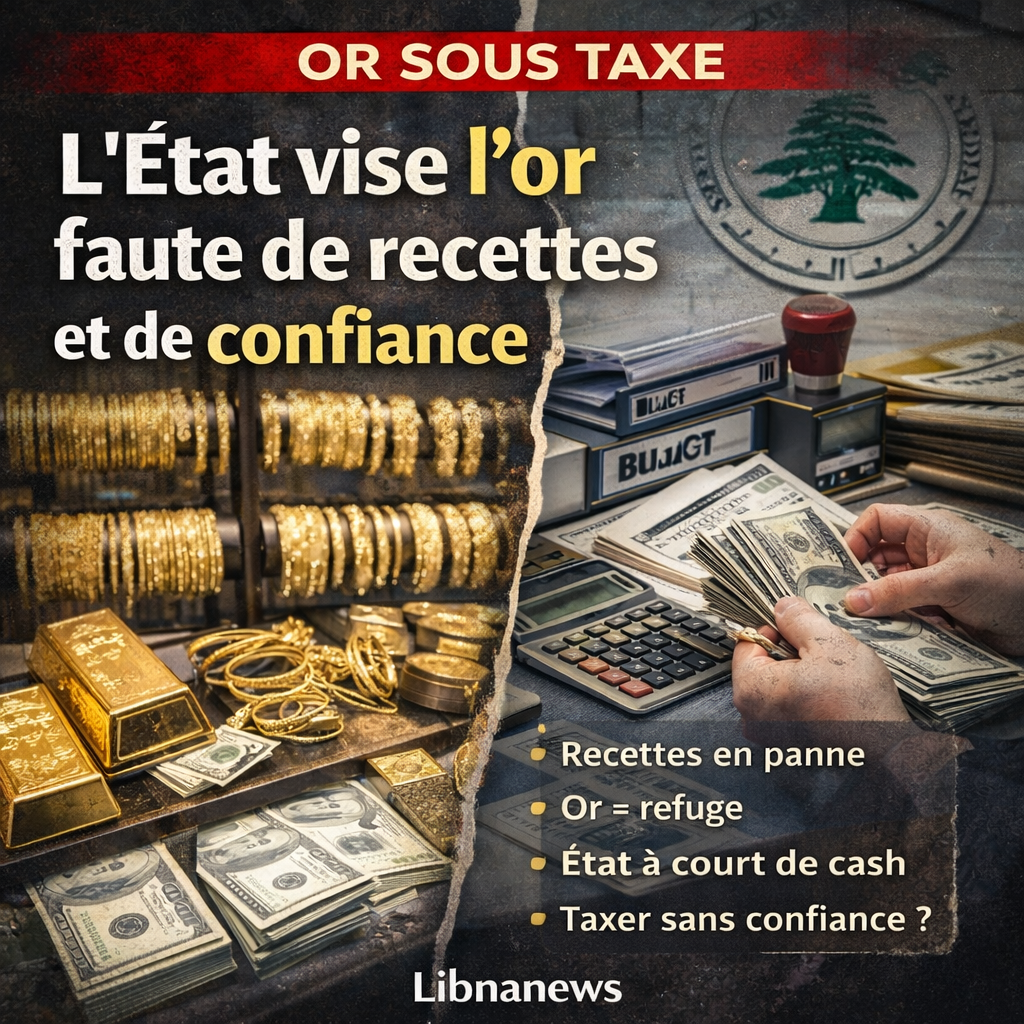
When the tax question goes up, it is that the urgency has changed in nature
In a country like Lebanon, tax debates never arise in a technical vacuum. They go back to the surface when the state lacks both money, legitimacy and time. The question of gold, its taxation, its circulation and the possibility of drawing more from it therefore says more than just a disagreement over a levy. It reveals the real state of the country. A state weakened by the financial collapse, caught up in the war charges and ordered to finance the emergency is turning to what it still escapes, or to what it has long allowed to flow without fully framing. When public finances reach this point of tension, each grey zone becomes a fiscal temptation.
In this regard, the role of the Court is particularly important. It is not any product. In the Lebanese imagination, he refers to protection, the reserve of value, family transmission, refuge against the fragile currency and circumvention of bank risk. It carries a very strong symbolic charge. Gold is often seen as what remains when institutions waver, when banks disappoint, when money loses credibility and when the state no longer offers stability. To tax, better control or control this sector therefore amounts to touching an economic object, but also to a deep-rooted private defence reflex.
That is precisely why the subject becomes explosive. On the one hand, public finances are expansive. The country is looking for resources wherever they can still be found. On the other hand, savings holders, traders, families and gold market players often regard this metal as one of the last areas of protection against widespread uncertainty. Where the state sees fiscal potential, many see a private security line. The revenue failure therefore does not encounter a neutral budgetary deposit. It meets a socially sensitive territory.
This tension summarizes one of the major Lebanese blockages. The state needs money, but the areas where money still exists are often precisely those that have developed because confidence in the state has declined. The more informal, semi-formal or protected sector becomes a refuge, the more tempting it is for the power to reach it. But the more power tries to reach it, the more the central question comes back: on what moral and political basis can a weakened state demand more from actors who have organized themselves without it, sometimes against it, often for lack of better?
A State seeking revenue after losing part of its base
The problem is not just the recent war. He’s older. For years, the Lebanese state has seen its tax base shrink, fragment or move. Part of the activity shifted to informal. Another one contracted under the economic crisis. Another one has been redeployed to foreign exchange circuits, partly outside the conventional radar of administrations. In this context, taxation no longer functions as a stable state. It becomes discontinuous, contested, partial, and more and more dependent on a few sampling pockets easier than others.
That is what makes every new tax debate so busy. We never talk about efficiency. It also speaks of injustice, hierarchy of efforts and selectivity of power. Who is really able to escape tax? Who, on the contrary, cannot avoid withholding, tax, duty or indirect levy? Who benefits from protection through mobility, networks or ability to move capital? And who remains captive to a territory, a trade or a visible income? These issues are ubiquitous as soon as the state seeks new revenue.
It follows this logic, but with a particular intensity. Because it circulates in a hybrid space. It affects jewellery, savings, resale, sometimes investment, sometimes social use. It may be part of the declared trade, but it also lends itself to more discreet forms of circulation. This makes it an attractive target for a state that lacks revenue. And that is also what makes any intervention in this market immediately suspicious in the eyes of those who fear that we are seeking less to organize than to capture.
Revenue failure does not mean that money is missing. It means that the traditional tax base is no longer sufficient. A state that was already struggling with a larger economy is now finding itself looking for resources in a fragmented landscape, where the still dynamic sectors are often those that are most wary of it. The Lebanese paradox is there. The longer the crisis progresses, the more the state needs to recover tax material. But the more he needs it, the more this material has already moved to forms of protection beyond his grasp.
It’s not just a metal, it’s a language of distrust
To understand the sensitivity of the subject, a purely budgetary reading is necessary. In Lebanon, gold is also a social language. He says the fear of depreciation. He says breaking up with the bank as a natural space of trust. He says the withdrawal on tangible, transmissible, discreet and understandable assets without intermediary. In a context where many have seen their deposits become inaccessible, where the national currency has lost much of its value and where the promise of a modern financial system has collapsed, gold has become more than a product. It has become a cultural response to economic insecurity.
This is what the state meets when it talks about taxes on gold. He meets not only traders defending their margins. It encounters a recent collective memory, made up of losses, bank blockages, withdrawal of trust and a switch to individual protection. For part of the population, the idea of increased taxation can then appear as a double shock. First because she strikes a shelter. Secondly, because it comes from a State that is at least partly responsible for the collapse that made this refuge necessary.
To this is added another element. In Lebanese society, L-Or also remains linked to old family and social practices. Jewellery is not only a sign of heritage. It can be an instrument of transmission, dowry, reserve mobilizable in case of emergency, of discrete capital held outside the system. A tax or regulatory measure in this area is therefore quickly perceived as an intrusion into the private economy of households. It is not only the merchant who feels targeted. It is also the family that fears that one may touch one of its last safety margins.
This explains why the gold debate can never be conducted as a simple technical adjustment. It affects the fundamental relationship between the state and society. In a country where confidence is low, taxation is never read as a balanced exchange between contribution and service. It is often read as an extraction. As long as this perception dominates, every new attempt to mobilize revenue comes up against an immediate suspicion: does the state really want to rebuild its capacity for action, or does it only seek to puncture what the citizens have saved without it?
War and the fiscal emergency make fiscal appetite more visible
The recent security crisis is still changing the situation. When the war adds to the collapse, the budgetary emergency becomes more nude. It is no longer just a matter of covering the ordinary expenses of a defaulting State. Alternative roads, bridges, access, emergency needs, public services under stress, weak local governments and a partial return of residents to affected areas must be financed. In addition, indirect costs include loss of activity, slowing down of trade, increased fragility of local authorities, need for ad hoc assistance and logistical pressure on all public apparatus.
In this context, revenue-seeking becomes more aggressive, or at least more visible. Power can no longer simply expect long-term reforms or a hypothetical spontaneous recovery. He must find money quickly. This is where the tax debate on the sectors still in the process is gaining in intensity. Not because a complete reform would finally be ready, but because the lack becomes too pressing. Tax appetite is not a sign of confidence in the state. It is the symptom of a cash flow that is spreading.
The problem is that this budgetary urgency can lead to bad choices. When a state acts under pressure, it may favour the most visible or politically accessible levies in the short term, rather than a coherent tax reconstruction strategy. It can target sectors that cannot easily escape, or those that give the impression of still containing mobilizable value. But this type of approach can produce limited yield, while increasing distrust. The immediate effectiveness is often overestimated, while the medium-term political cost is underestimated.
The case of gold illustrates exactly this risk. A State seeking rapid revenues may be tempted to increase taxation, better control circuits, reduce certain exemptions or review existing fees. But if he does so without a broader discourse of tax justice, without a visible reform of the administration, without a clear redistribution of effort, he will seem to act blindly, in accordance with the needs of the moment. The opinion will retain less the budgetary logic than the political gesture: we come to get the money where there is still something to take.
The real subject is not only gold, but the inability to produce a tax contract
All countries tax. The Lebanese problem is therefore not the existence of taxation. The problem is the growing lack of a credible tax contract. In a more stable system, tax can be contested, of course, but it remains in a clear logic: we contribute to a set that, in turn, produces services, infrastructure, a legal framework, security, continuity. When this circle breaks, the tax ceases to be perceived as a collective exchange. It becomes a puncture without horizon.
This is exactly where the difficulty lies. The Lebanese state continues to exist, but it no longer offers enough guarantees for the fiscal effort to be spontaneously accepted. Citizens see degraded roads, incompletely restored institutions, contested justice, fragmented services, weakened currency and a long-term discredited political class. In this context, the question is not just how much tax or where to tax. It is to know what to attach this request. What tax account is still possible?
Without an answer to this question, the debate on gold will remain trapped. The authorities can justify a measure by war, by urgency, by the need to mobilize all resources. But if the country does not at the same time see a fair effort, a clear hierarchy of priorities and a tangible return of the state to the ground, the measure will be experienced as one more episode in a long series of levies without identifiable counterpart. The tax problem then becomes a problem of political confidence.
It should also be noted that the absence of a tax contract favours the economy of avoidance. The more unfair the tax is considered, the more actors seek to protect themselves, circumvent, split, move or hide. The result is paradoxical. The state, seeing its base shrink, hardens its search for revenue. Taxpayers, seeing the state hardened without reform, are stepping up their efforts to escape. Taxation then ceases to be a mechanism of collective organisation. It becomes a struggle of position between a weakened public power and a society that has learned to survive outside of it.
Taxing more will not be enough if the plate continues to move
A common mistake is to believe that a revenue problem is solved mainly by raising rates or by extending taxation to a given sector. In reality, in an economy in deep crisis, the question of the base is often more important than that of the rate. If activity continues to move to informal channels, to foreign exchange channels, to forms of savings or trade that are difficult to control, then the return on an isolated measure will remain limited. The country may even lock itself in a series of dispersed, politically costly and economically inadequate budgetary actions.
Lebanon is already experiencing this problem. Part of the wealth is visible but mobile. Another is not visible but localized. Another is fragmented between very unequal actors in defence capabilities. In this landscape, taxation becomes almost a geography of the balance of power. Those who can move or opacify their wealth are better protected. Those who remain exposed more bear the burden. This is why any serious discussion of gold should be linked to a broader reflection on formalisation, transparency, tax justice and the gradual restoration of the base.
Otherwise, the debate will be reduced to a familiar scene. The State will announce a measure. The actors concerned will call for injustice or impracticability. The final performance will be below expectations. Trust has not progressed. And a few months later, a new tax target will appear, carried by the same urgency and received with the same distrust. This cycle should be broken.
At the moment, there is no indication that it can be broken quickly. War tightens constraints. Money is missing too fast. External partners talk about both funding and reform. Power is looking for room for manoeuvre. In such a context, the temptation of immediate removal is strong. But the truth remains: a state does not come out of a sustainable revenue breakdown by running only after residual value pockets. It comes out by rebuilding the relationship between tax, trust and public capacity.
Behind the gold, a broader question: who still finances Lebanon?
The current tax debate ultimately refers to a tougher question. Who really continues to finance the minimum functioning of the country? Is it classical taxation? Less and less. Is that outside help? In part, but it remains conditioned, intermittent and politically dependent. Is it the informal or semi-formal private economy? Often, yes, by substitution, by survival, by parallel networks. Is it diaspora, transfers, external revenues and service channels? Probably, too. Contemporary Lebanon therefore operates on the basis of fragmented funding, where the State is no longer the obvious centre of collection and redistribution.
In such a landscape, taxing gold also amounts to trying to refocus a little the circulation of value towards public power. The gesture therefore has an almost institutional meaning. He says the state wants to take over. But he immediately reveals his weakness, because if he wants to take it again now, it is precisely because he had lost it. Here we find the whole Lebanese paradox. Each sign of the state’s return is at the same time acknowledgment of its previous decline.
That is why the subject goes far beyond jewellery, commerce or entry fees. He touched on whether Lebanon could still rebuild a credible fiscal and fiscal centre, or whether there would remain a country where the State survived alongside the real channels of wealth without ever reorganizing them sustainably. It’s just one indicator among others. But it is a powerful teller, because it concentrates fear, memory of loss, private protection and public appetite.
Basically, the issue is not whether or not gold should be taxed more. The issue is in what political framework such a decision could be understood as legitimate, useful and equitable. As long as this framework is lacking, the revenue failure will continue to push the state towards visible, contested and sometimes insufficient measures. And each new measure will recall the same truth: a country that has lost confidence does not lack only money, it lacks the common narrative that would still allow to demand this money without reopening each time the question of its own legitimacy.




