






14 august 2006: war stops, 1701 begins
At 0800 hours on 14 August 2006, the cessation of hostilities under resolution 1701 ended thirty-three days of war between Israel and Hezbollah. But the new security framework is never implemented without violations. Israeli overflights of Lebanese airspace continue after the ceasefire and become a permanent dispute, while Hizbullah retains and then strengthens its arsenal. For almost 18 years, the resolution mainly avoids a new general war without resolving the root causes of the conflict.

Day to Day: August 12, 2006 Israel’s War Continues After 1701
On 12 August 2006, the Lebanese Government accepted resolution 1701 adopted the previous day by the United Nations Security Council. The text provides for the cessation of hostilities, the Israeli withdrawal, the deployment of 15,000 Lebanese troops to the South and the strengthening of UNIFIL. However, Israel continued its offensive until the ceasefire of 14 August at 0800 hours. The last 72 hours are mainly marked by the massive use of Israeli submunitions, some of which will remain dangerous long after the end of the fighting.

Day by Day: Israeli air attack on Lebanese villages on August 11, 1969
On 11 August 1969, an Israeli air attack struck several villages in southern Lebanon, causing civilian deaths and injuries. Beirut urgently seized the Security Council, denouncing a 1949 Armistice violation. The crisis led to resolution 270, condemning the operation.

Gilgamesh, Humbaba and the cedars of Lebanon: the old story of a sacred forest...
In Gilgamesh's epic, the king of Uruk and his companion Enkidu go to the cedar forest to face Humbaba, his guardian. The story is Mesopotamian, but its imaginary looks towards the high mountains of the Levant, where the cedar of Lebanon becomes both richness, divine symbol and stake of conquest. Before being a [...]

Beroe, the nymph of Beirut: when the city becomes daughter of Aphrodite and Adonis
Less known than Adonis in Byblos or Melqart in Tyre, Beroe gives Beirut a singular place in ancient mythology. At Nonnos de Panopolis, the city becomes a nymph, born of the love of Aphrodite and Adonis, disputed by Dionysos and Poseidon, and associated with the sea, beauty and the law. Beirut often [...]

Kavinsky, the last trip of the pilot of the Testarossa
With the disappearance of Kavinsky, French electronic music loses one of its most singular creators. Behind this pseudonym was Vincent Belorgey, a discreet artist who became a world reference thanks to an immediately recognizable universe made of analog synthesizers, neons, desert roads and Ferrari Testarossa launched in the night. His character, inspired [...]
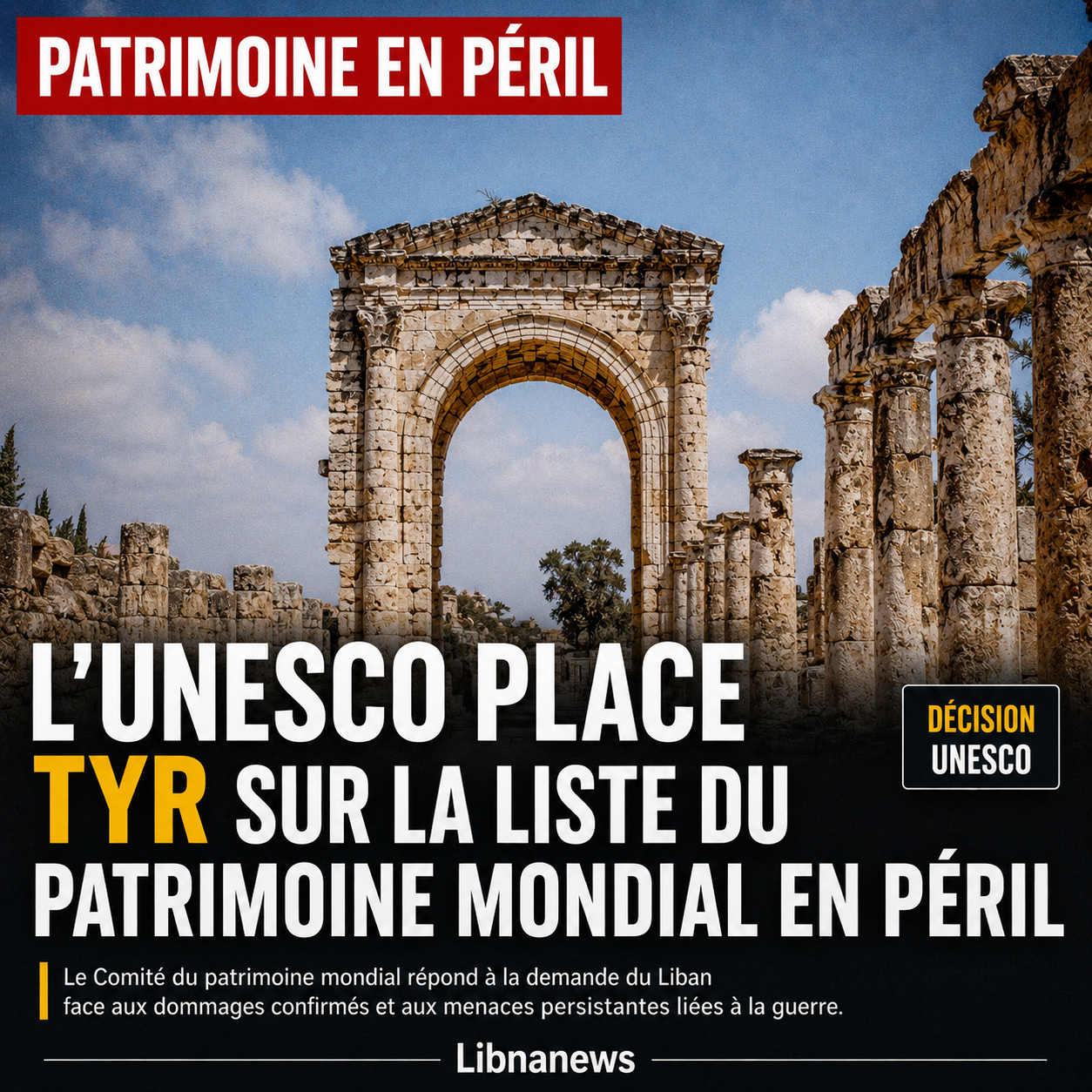
World Heritage-listed Tyre at Risk
The Unesco World Heritage Committee has placed Tyre on the World Heritage List at risk, at the request of the Lebanese government. This decision recognizes that the conditions necessary for the conservation of the site are no longer in place, owing to the damage already observed and the continuing threat of hostilities. The Minister of Culture, Ghassan Salamé, now hopes to mobilise Member States, obtain expertise and speed up safeguard measures.
Beaufort: Lebanese heritage again threatened
The Israeli plan to dynamit a network of tunnels in the Beaufort Ridge raises serious concerns for Qalaa al-Shaqif. Israel claims to be targeting a Hezbollah military infrastructure, but has not published any independent geological study or detailed risk assessment. This threat comes after a series of attacks on Lebanese heritage since October 2023, from Tyre to Baalbeck, including Nabatiyah, Chamaa, Mhaibib and several historic villages in southern Lebanon.
Beaufort: Lebanese heritage again threatened
The Israeli plan to dynamit a network of tunnels in the Beaufort Ridge raises serious concerns for Qalaa al-Shaqif. Israel claims to be targeting a Hezbollah military infrastructure, but has not published any independent geological study or detailed risk assessment. This threat comes after a series of attacks on Lebanese heritage since October 2023, from Tyre to Baalbeck, including Nabatiyah, Chamaa, Mhaibib and several historic villages in southern Lebanon.
Tyre, the floating islands and the burning olive tree: the myth of founding a...
Before being the great Phoenician power of the sea roads, Tyre was also told as a city emerged from a miracle: two floating rocks, an olive tree burning without burning, a snake, an eagle and the intervention of Melqart, the protective god of the city. In Tyre, history often begins with the sea. That makes sense. The [...]

The sarcophagus says of Alexander in Istanbul: the masterpiece of Sidon that did not...
Discovered in 1887 in the royal necropolis of Sidon, this Hellenistic sarcophagus is now one of the main pieces of the Istanbul Archaeological Museums. His name is misleading: he represents Alexander the Great, but he never contained his body. Some objects have a name that makes them famous, but betrays them. The sarcophagus says [...]
The sarcophagus says of Alexander in Istanbul: the masterpiece of Sidon that did not...
Discovered in 1887 in the royal necropolis of Sidon, this Hellenistic sarcophagus is now one of the main pieces of the Istanbul Archaeological Museums. His name is misleading: he represents Alexander the Great, but he never contained his body. Some objects have a name that makes them famous, but betrays them. The sarcophagus says [...]

Death of Sam Neill at 78
Sam Neill, a famous New Zealand actor for Jurassic Park, died in Sydney at 78. His family announces a sudden and unexpected disappearance.
Death of Sam Neill at 78
Sam Neill, a famous New Zealand actor for Jurassic Park, died in Sydney at 78. His family announces a sudden and unexpected disappearance.



