

A novel about transformed pain
Georges Al Maalouf’s new book, I will avenge myself of life, presents itself as a story of injury, anger and recovery. The book, available in France and internationally according to the elements transmitted, follows the journey of Alexander, a young man faced with the brutal loss of his father, the fractures of childhood and a difficult relationship with himself. From this intimate subject, the author builds a story on resilience, dignity and the possibility of transforming pain into strength.
The title strikes first by its tension. I will avenge myself of life could announce a book of resentment. Yet it opens up another perspective. The revenge we are talking about is not hatred, but creation, self-compassion and the will not to let the trials decide everything. This inversion gives the narrative its line of strength. It allows you to read Alexander’s journey like that of a man who learns to move his anger.
The book fits into a vein that is both romantic and introspective. It tells a personal trajectory, but it also seeks a wider echo. Grief, injustice, self-destruction, loneliness and the quest for meaning are not treated as abstract themes. They appear through the choices, silences, encounters and breaks of the character. The text thus takes the form of a journey, with its relapses, its resistances and its moments of lucidity.
A cover loaded with symbols
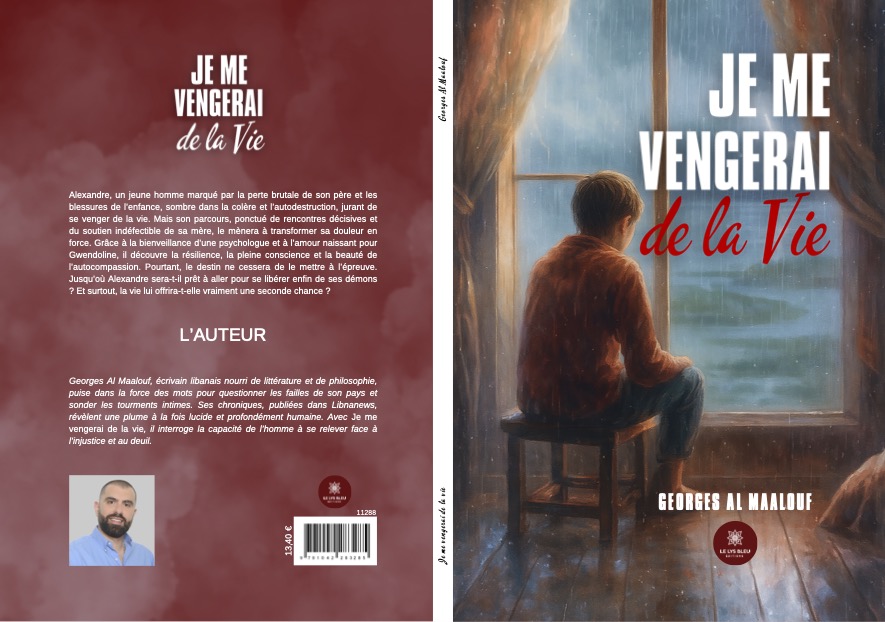
The cover already gives a reading key. She shows a young man sitting in a window, in an atmosphere of rain and cold light. The character looks outwards, without knowing whether this exterior represents a threat, a leak or an exit. The graphic emphasis is on waiting, closing and the possibility of a passage. The red of the title breaks this immobility. It installs a tension between the wound and the moose.
Georges Al Maalouf does not approach suffering as a mere dramatic spring. He makes it a field of questioning. What remains of a man after a brutal loss? How can a marked childhood continue to govern an adult life? When does anger protect again, and when does it destroy the one who hangs on it? These questions go through the book and give it its human density.
Alexander, a character facing his wounds
Alexander, the central character, carries a dark promise. He swears to revenge on life. This formula says less of a project than an internal state. It expresses the feeling of having received too early a load impossible to carry. It also reflects a revolt against the injustice of loss and the arbitrary trials. At home, the pain is not just passing through. She settles down, organizes her actions and influences her relationships with others.
The loss of the father occupies a structural place. It is not just a family event. It opens a loophole in the world order. For Alexander, the brutal death becomes a cut, but also an origin. He then tries to give meaning to what doesn’t. He struggles with an absence that alters his perception of love, trust and the future. Grief here acts as an underground force.
The novel also shows childhood injuries without reducing them to a single explanation. Alexander does not become what he is by one event. It is built in an accumulation of gaps, incomprehension and ill-formulated pain. This approach avoids simplisticness. It recalls that fragile existences are not just a cause. They often result from a series of shocks that end up drawing a way of being in the world.
The anger of the character then appears as a survival response. It allows him to move forward when everything seems to collapse. But she threatens him too. The story takes time to show this ambivalence. Alexander does not destroy himself because he would be weak. It destroys itself because it does not yet know how to deposit what it wears. Self-destruction becomes a language. She says what words are not yet able to organize.
Mother, psychologist and Gwendoline
In the face of this spiral, maternal support plays an essential role. The mother of Alexander does not erase the wounds. It does not alone resolve what is a matter of mourning, anger and relationship to the world. But it embodies a stable presence. She reminds the character that life is not reduced to abandonment. In a path marked by loss, this presence becomes an anchor point. It maintains a possibility of return.
The book also introduces the figure of a psychologist. This choice places the narrative in a reconstruction approach rather than in a mere fatality. Therapy is not presented as a magic solution. It appears as a space where injuries can finally be named. Alexander discovers a less violent, less defensive form of speech. He gradually learns that understanding his pain does not mean betraying her.
Full consciousness and self-compassion occupy a notable place in this journey. These notions could have remained theoretical. The book links them to the character’s experience. They become concrete tools to inhabit the present, recognize suffering without fully identifying it and stop treating itself as an enemy. The transformation of Alexander goes through this internal displacement. He doesn’t make a living. He learns not to get lost against her.
The meeting with Gwendoline adds an emotional dimension to this reconstruction. The nascent love does not present itself as a rescue. Rather, it opens up a space of vulnerability. Alexander must learn to receive without wary of everything, to love without turning every link into a threat, to accept that the other does not repair everything but can accompany a crossing. The novel thus avoids making love an easy way out. He makes it a trust test.
I will avenge myself of life, a double sense title
This progression gives the book a structure of passage. Alexander leaves a closed world, dominated by loss and rage, to gradually confront other ways of existence. The story does not deny relapse. He doesn’t promise linear healing. Rather, it shows that recovery is built in stages, often modest, sometimes fragile. Resilience doesn’t look like a slogan. It remains a job.
The title then retains its importance. Revenge of life doesn’t mean it’s a blow anymore. This means refusing that life, in what it has most violent, alone imposes its definition. Revenge becomes a form of dignity. It passes through writing, consciousness, the ability to rise up without removing wounds. This nuance gives the book its scope. It moves the reader of the revolt towards a reflection on inner freedom.
The book can reach a wide audience because it addresses common experiences without trivializing them. Many readers will recognize in Alexander part of their own struggles. The loss of a loved one, the feeling of injustice, the fear of not being able to live up to it, the temptation to retreat or the difficulty in asking for help belong to very different stories. The novel brings them together in a singular figure, without pretending to speak in place of all.
A Lebanese feather between intimate and universal
The Lebanese dimension of the author also gives a particular background to this text. Georges Al Maalouf is presented as a writer nourished by literature and philosophy, attentive to the flaws of his country and to the intimate torments. This double attention is reflected in the book’s project. It is not a political novel in the strict sense. But the relationship to injustice, loss and reconstruction resonates in a Lebanese society itself through crises, deed and departures.
Georges Al Maalouf’s columns published in Libnanews had already revealed a pen centered on the human, lucid and fragile existences. I will avenge myself of life seems to prolong this concern in a more narrative form. The passage from the chronicle to the narrative allows to install a character, a duration, relationships and silences. He gives the author another space to explore what, in pain, can become matter for speech.
The choice of an intimate narrative has an advantage. He avoids the general discourse on resilience. The drive does not enter a demonstration, but a trajectory. He observes a man struggling with his own contradictions. He sees how suffering can lock up, how encounters can move a look, and how a benevolent presence can change a decision. Morality does not precede history. It emerges from what the character is going through.
The book is published by Le Lys Bleu. The cover shows a public price of 13.40 euros. These elements place the work in an accessible editorial circuit, oriented towards a readership of contemporary novels and life stories. The publication in France and abroad, as presented by the author, also gives him a diasporic reach. It allows a Lebanese writer to address readers beyond the national framework, in a French language that remains a space for transmission.
In a media landscape saturated by urgency, war, economic crises and political breakdowns, a book like this recalls that the intimate remains a public matter. Personal injuries never separate completely from the era that goes through them. Readers of a media dedicated to Lebanon often know what it means to live with loss, fear or uncertainty. Alexander’s account can therefore find a particular resonance in them.
However, it is necessary to read the book for what he announces: a story of transformation, not a direct testimony about the author’s life. The presentation text speaks of a character, Alexander, and a Romanesque trajectory. This distinction protects the work. It makes it possible not to confuse the writer with his protagonist, while recognizing that literature often draws from a profound human experience. The intimate becomes material, but it passes through a narrative construction.
The heart of the book lies in this tension between confession and fiction. The text promises a close word, but it organizes this word through a character, encounters and progression. This form can give the reader a necessary distance. She avoids brutal face-to-face with naked pain. It allows you to follow a story, enter a movement, and then return to your own questions with greater clarity.
A story of reconstruction
The strength of such a work will depend on its ability to meet two requirements together. The first is emotional: making the weight feel loss, the thickness of an anger, the difficulty of reconstruction. The second is narrative: prevent suffering from becoming repetitive, give the character choices, contradictions and openings. The available presentation suggests that Georges Al Maalouf is precisely seeking this balance between inner intensity and recovery path.
I will avenge myself of life thus fits into a literature of trial, but refuses to lock up there. His subject is not just pain. Its real stake is what we do with it. The book asks a simple and demanding question: how to continue when life began by removing what seemed essential? The answer is not in a formula. She builds herself through Alexander, her mother, her therapist, Gwendoline, and this slow self-recovery.
At a time when stories of resilience are multiplying, the work of Georges Al Maalouf seeks its singularity in a strong formula and in a discreet moral promise. Life hurts, but it doesn’t always have the last word. The book invites us to look at what, in an affected existence, can still write, love, understand and stand. Perhaps this is where the real revenge announced by the title lies.
The publication of the cover on Libnanews, together with a presentation text, would therefore offer readers a simple entry into the world of the book. It would show the editorial face of a book built around mourning, anger and reconstruction. It would also recall that literature remains a place of inner resistance, including when current events seem to leave no room for silence, nuance or slowness in healing.




