

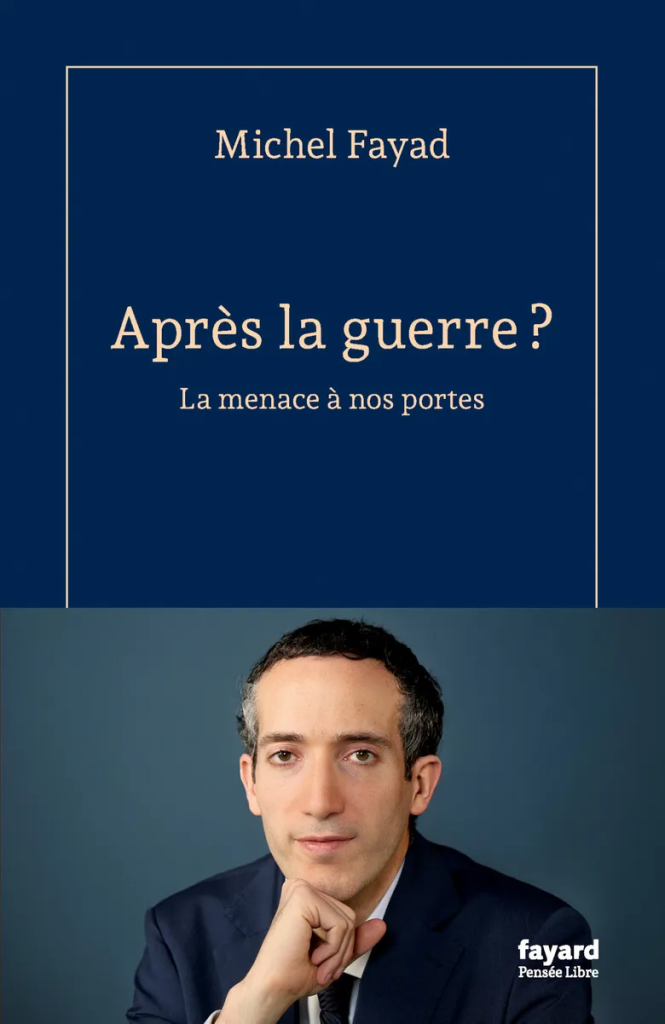
In this new essay published by Fayard in the Free Thought Collection led by Sonia Mabrouk, Michel Fayad gives a striking and courageous diagnosis of the strategic changes in the Middle East and their direct implications for France. Born in Lebanon, an experienced Arab-Muslim analyst, the author here signs his most ambitious and necessary work.
An emergency and intimate test
It’s a book of cold anger. Michel Fayad does not yield to easy controversy, but to the need for a true word about what the West too often refuses to face. From the first pages, he planted the frame with a goldsmith’s precision: on 28 February 2026, the United States and Israel launched massive strikes against the Islamic Republic of Iran. This is not a thunderstorm in a serene sky: it is the logical result of decades of tension that Western chancelleries have preferred to ignore or accommodate.
But « After the war? is not a hot comment book. It is a substantive work, structured into five chapters of relentless rigour, complemented by a conclusion that morally engages its author. Fayad has this precious singularity: he thinks as a historian, speaks as a geopolitical analyst, but feels as a man of Lebanon. His father Najib had taken up arms to defend his country. Michel Fayad chose the pen. The result is commensurate with the stakes.
Architecture of total geopolitical thought
The first merit of the book is its ability to embrace a strategic totality without ever losing the thread of accessibility. Fayad begins by decorating the internal architecture of the Mullah regime with clinical precision: the Guardians of the Revolution, the doctrine of « mosaic defense » of Mohammad Ali Jafari, the dynastic recomposition of power around Mojtaba Khamenei. We understand why the Iranian regime, even beheaded, does not die: it was designed to survive beheading.
Then he makes a decisive intellectual shift, one that distinguishes first-class essayists from simple commentators: he shows that the real question is not « and after Iran? » but « who will come to fill the void? ». His response, documented and argued, paints a striking picture of Sunni Islamism: Turkey of Erdoğan, Syria of Joulani, an Islamic Republic of Pakistan nuclear power, Gulf petromonarchies, Muslim Brotherhood, Salafists, Tabligh, al-Qaida, Daesh, etc. A « thousand head hydra », according to the title of his second chapter, whose ramifications reach the French suburbs.
The chapters on Lebanon and Israel are probably the most moving pages of the book. Fayad traces with pain contained the methodical destruction of what he calls the « two sacrificed ramparts »: two democracies, one Christian, the other Jewish, abandoned by a West blinded by its oil interests and those of its military-industrial complex as well as its short-term calculations. The thesis is strong: by sacrificing Lebanon and then weakening Israel, the West did not avoid war. He brought it closer to his own borders.
France targeted: a ruthless diagnosis
It is perhaps in the last two chapters that Fayad reveals its full scope. With objectivity documented by figures (the FIFG study of August 2025, statistics on arms contracts, parliamentary reports), it dissects France’s structural dependence on Arab petromonarchies. The word « supervision » is dropped, without emphasis but without concession: an economic, diplomatic, cultural trusteeship, which forces French freedom of action in the face of external Islamist financing.
The mapping of Islamist networks in France is rigorous and courageous. Fayad did not give way to the demonisation of all Muslims in France or to the complacency of reducing the phenomenon to its violent manifestations alone. Digital radicalization, religious voting instructions, the inverted generational gradient among young Muslims: as many realities as the French political class struggles to name without false leaks.
The final formula resonates as a solemn warning: « The real question is not: when will the war be won? It is: are we ready for a long-term fight — lucid, patient, determined — against an ideology that has declared war for decades? »
Writing at stake
Michel Fayad’s style is that of the great French essayists: dense without being heavy, learned without being pedantic. His mastery of the archanes of Middle Eastern politics never crushes the readability of the word. Each concept — Velayat-e faqih, the doctrine of mosaic defence, jizya, takfirism — is systematically defined and contextualized. The numerous and precise footnotes show a demanding documentation work.
The narrative structure, which intertwines the present time of war (February-May 2026) and the historical depth (from the 1979 Islamic Revolution to the Lebanon wars), gives the book a rare temporal density in the kind of geopolitical essay. Fayad does not just analyze the news: he gives it its roots.
Conclusion: an indispensable book
« After the war? The threat at our doors » is one of those books that we can see transformed. Not through the revelation of unknown information — the facts are public — but through the intellectual synthesis that Fayad uses: linking the points that fragmented mediatization of news usually prevents us from linking. His gaze as a Lebanese — from a man whose native country has been used as a laboratory to what Europe is barely beginning to perceive — gives the work a moral authority that no outside commentator can usurp.
It rarely happens that a political essay is both an act of memory, a history lesson and a strategic roadmap. This one is. At a time when Europe is looking for its words to name what is happening to it, Michel Fayad’s voice is the one she needs most. This book should be included in the library of every decision-maker, every journalist, every citizen who refuses that denial becomes a policy.
Bibliographic sheet
Author:Michel Fayad
Title:After the war? The Threat at Our Doors
Editor:Bookshop Arthema Fayard, Free Thought Collection (dir. Sonia Mabrouk)
ISBN:978-2-213-73625-9
Publication:June 2026 — 128 pages




