

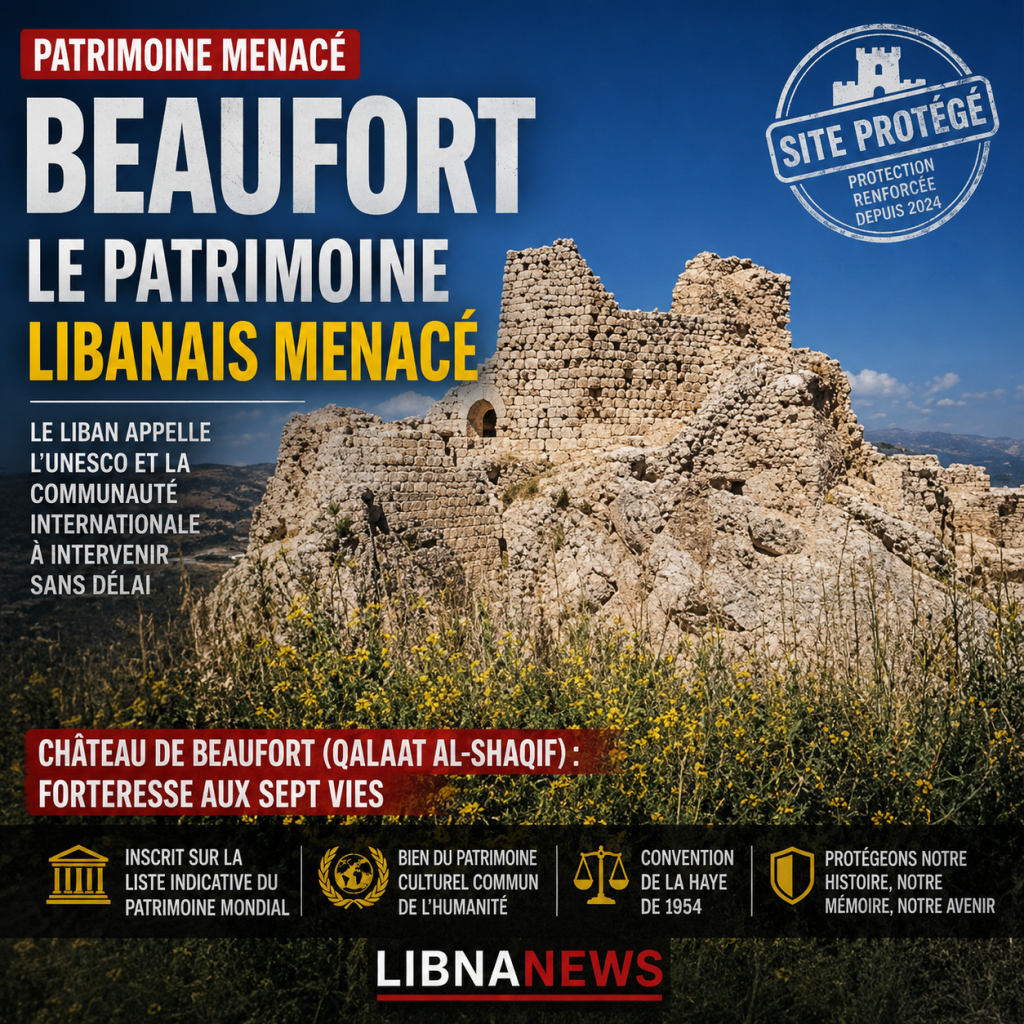
Beaufort Castle, known in Lebanon as Qalaat al-Shaqif, returns to the centre of a battle that exceeds the military dimension. The Ministry of Culture, by the Directorate General of Antiquities, called on the international community, Unesco and the bodies responsible for heritage protection to intervene without delay to ensure the preservation of the site and to remove it from any military action. The alert comes after Israeli media broadcast videos and maps claiming that the fortress or its immediate environment would house Hezbollah’s military infrastructure.
The Lebanese ministry rejects these claims. He sees it as a campaign designed to prepare or justify the occupation, militarization or exhibition of the monument to strikes. According to the Directorate General of Antiquities, the examination of the maps and sequences disseminated would show that the installations presented as military are at a significant distance from the fortress and its direct perimeter. The cultural authorities therefore claim that the archaeological site is not affected by these elements and that its use for military purposes is, in their view, misleading.
The file is sensitive because Beaufort is not an ordinary site. The fortress dominates the Litani Valley and the south-Lebanon axes. His position has given him an obvious strategic value over the centuries. But this geography is not enough to make it a military target. The Ministry insists on its heritage status, its inclusion in the indicative list of world heritage and its enhanced protection since November 2024 under the Hague Convention of 1954 and the Second Protocol of 1999. The question is therefore clear: can a protected monument be dragged into a war by a targeting story?
A historical monument taken from the military narrative
The Château de Beaufort occupies a special place in the memory of the South. Built on a rocky promontory, it bears traces of medieval periods, regional rivalries, occupations, civil war, Israeli presence and restoration work carried out after 2000. This long history explains its symbolic strength. She also explains her vulnerability. A site that dominates the landscape attracts the attention of the armies, but it remains a cultural asset when its use is patrimonial and civil.
This is precisely the argument of the Directorate-General for Antiquities. Since the Israeli withdrawal from southern Lebanon in 2000, the management of the castle has, according to the Ministry, been the responsibility of its departments. The administration asserts that it provides protection, supervision and maintenance by its official agents. She also recalled that she had worked to find funding to restore the fortress, preserve it and reopen it to visitors, researchers and tourists. The site is therefore presented by the Lebanese State as a cultural space, not as an operational position.
This clarification is legally important. International humanitarian law protects cultural property, but this protection can be weakened if a site is used for military purposes. Hence the seriousness of the accusations broadcast by Israeli media. If admitted without verification, they could move the perception of the castle. It would no longer be seen as a monument, but as a hostile infrastructure. The department seeks to prevent this slippage, which it considers unfounded.
Château de Beaufort: enhanced protection
The status of the Château de Beaufort reinforces this argument. The site is on the indicative list of world heritage within the framework of the castles of Mount Amel. This inscription does not apply to the world heritage. It states that the Lebanese State considers the site to be of potential universal value and that it can be presented at a later stage for full registration. In a country where many monuments have been damaged by conflict, this preparatory recognition already counts.
The enhanced protection granted in 2024 adds a more restrictive layer. The regime resulting from the 1954 Hague Convention and the 1999 Second Protocol is designed to protect cultural property in the event of armed conflict. It requires the parties not to attack them, not to use them for purposes that could expose them to destruction and to take safeguard measures. Enhanced protection is the highest level provided by this scheme. It does not make a site invulnerable. It reminds the parties that its infringement entails a particular responsibility.
In the case of Beaufort, this protection has a very concrete meaning. The fortress has already been damaged by successive wars. It experienced prolonged militarization during the Israeli occupation of the South. It was then restored to its heritage function. Any new military exhibition would erase part of this work. It could also transform a place reopened to the public into an inaccessible, monitored, suspicious and potentially destroyed vestige.
A Lebanese and Universal Issue
The department’s wording is significant. The fortress is not only described as a Lebanese monument. It is presented as a good of the common cultural heritage of humanity. This language corresponds to the spirit of international heritage law. Some sites, even in the territory of a state, carry a value that goes beyond national borders. Their destruction impoverishes a shared memory, not just the history of a village or region.
Beaufort concentrates this dimension. Its position, architecture, historical layers and its role in contemporary conflicts make it a place to read in southern Lebanon. The castle allows to understand medieval circulations, ridge lines, ancient power relations, and then modern wars. It is not only a picturesque ruin. It is a stone document. Its loss or degradation would reduce the ability of future generations to read this story in the landscape itself.
The danger also concerns local populations. Heritage protection does not compete with the protection of civilians. Both relate to the same saving logic. The inhabitants of Arnoun, Nabatiyé and nearby localities live with this monument in their horizons. It belongs to their daily memory. Its threat adds to the anguish of displacement, fear of strikes and uncertainty of return. When a heritage site is reached, it is not only an old structure that suffers. It is a collective landmark that disappears or deforms.
The precedent of 2000 and the return of militarization
The reference to the Israeli withdrawal of 2000 is not secondary. It marks, for the Lebanese state, the moment when the castle returned to the heritage field. After years of military presence and destruction, the General Directorate of Antiquities took over responsibility for the site. The work undertaken since then aimed to remove Beaufort from its status as a war position and re-integrate it into a logic of knowledge, visit and conservation. It is this shift that the ministry now considers threatened.
The reappearance of a military discourse around the castle thus reacts a painful memory. For part of the South, Beaufort evokes occupation, fighting, surveillance, fortified positions and Israeli departure. To put it back in a logic of target or military point is to erase two decades of effort to treat it as a heritage. War is not just about destroying the stones. It threatens to reassign to the site a front function.
That is why the General Directorate of Antiquities insists on the lack of a link between the fortress and the infrastructure shown in Israeli documents. The Ministry seeks to preserve the distinction between the monument and the broader military environment of the South. This distinction is sometimes difficult to maintain in an area where villages, roads, hills, positions, religious sites and historical remains are associated. It is only more necessary.
Unesco faced with a credibility test
The call to Unesco puts the organisation before a test. Heritage protection schemes cannot remain symbolic when fighting approaches sites. Lebanon calls for an immediate action. This can take several forms: public reminder of international obligations, communication to the parts of the coordinates of the protected sites, mobilization of experts, support for remote documentation, preparation of a mission when access is possible, or diplomatic intervention to obtain neutralization of the perimeter.
The context makes this action difficult. International organizations cannot always visit the country. Roads can be dangerous. Bombing can prevent any expertise. The information available may be contradictory. But inaction also has a cost. If a protected site is exposed to a narrative of militarization and the international community does not respond, enhanced protection loses some of its strength. It becomes an administrative reference rather than an operational mechanism.
Unesco has a technical and normative role. It does not replace the parties to the conflict. It does not deploy a protective force. But it can document, alert, qualify, mobilize and support national authorities. It may also recall that heritage should not be used for military operations or attacked when it retains its civil and cultural character. This reminder is essential when military information circulates through videos, maps and media comments.
A battle around the evidence
The continuation will depend largely on the evidence. The Ministry states that Israeli maps and videos do not link the alleged infrastructure to the archaeological site. Between this position and the accusations relayed by Israeli media, independent expertise is needed. It should examine the coordinates, distances, images, topography and actual state of the site. It should also distinguish the castle, its immediate perimeter and the more remote areas.
This requirement of proof is all the more strong as the military use of a cultural site constitutes a serious accusation. It cannot be launched as a mere media argument. It can have operational consequences. It may alter the behaviour of the armed forces. It can prepare the opinion to accept damage on a monument. It may also weaken the protection of the site. That is why the Directorate-General for Antiquities is firmly responding to the allegations of misleading and unfounded.
Lebanon, for its part, must document its own position. Management records, restoration work, inventories, photographs, plans, monitoring reports and official site coordinates must be mobilized. The protection of heritage requires an administration capable of proving civilian use, public administration and the absence of militarization. In a war context, this documentation can become as important as a wall or a restored door.
Neutralize the site, not just save
The central word of the communiqué is neutralization. The ministry does not only ask that the castle be not hit. He asks that he be kept away from any military action. This requirement applies to all parties. A protected site shall not be used as a position, repository, observatory, fire base or cover. Nor should it be transformed into a propaganda argument justifying an operation. Neutralization implies active abstention, not a mere declaration of respect.
This approach should guide Beaufort management in the coming days. Site coordinates should be recalled. Its perimeter must be identified. Military actors must be informed of its status. The Lebanese authorities must ensure, within their means, that the site remains exclusively heritage. International actors must demand that parties avoid integrating it into their operations. The media, too, must check images and maps before turning an allegation into an established fact.
The stakes go beyond Beaufort. In southern Lebanon there are other historical, religious and archaeological sites exposed to fighting. Tyre, Chamaa, ancient villages, places of worship and cultural landscapes are located in areas of strike or evacuation. While one of the most well-known monuments in the South can be associated without solid evidence with military infrastructure, other less visible sites will be even more vulnerable. The protection of Beaufort thus creates a precedent.
A memory to preserve during the war
The crisis around Beaufort finally recalls the place of heritage in Lebanese sovereignty. The state is weakened in many respects, but the General Directorate of Antiquities remains the competent authority for the management of archaeological sites. His intervention affirms a national responsibility. She says the castle is a cultural administration, not an armed actor. She also said that Lebanon intended to defend its heritage through the law, procedures and appeal to international mechanisms.
This must be pursued rigorously. The Ministry will have to publish the available technical elements, formally seize the relevant authorities, document any possible interference and prepare stabilization measures. It should also coordinate with municipalities, security forces, experts, universities and international organizations. The defence of a monument in wartime is not limited to a statement. It calls for an administrative and scientific chain capable of acting as soon as the terrain permits.
For the hour, the Château de Beaufort remains between two logics. The first is that of heritage, which requires neutrality, protection and proof. The second is that of war, which seeks to integrate every height, every image and every narrative into its field of action. The next few hours will say whether the Lebanese call leads to a concrete international intervention, or whether the fortress will remain alone, exposed to both strikes, suspicions and progressive erasure of its cultural status.




