

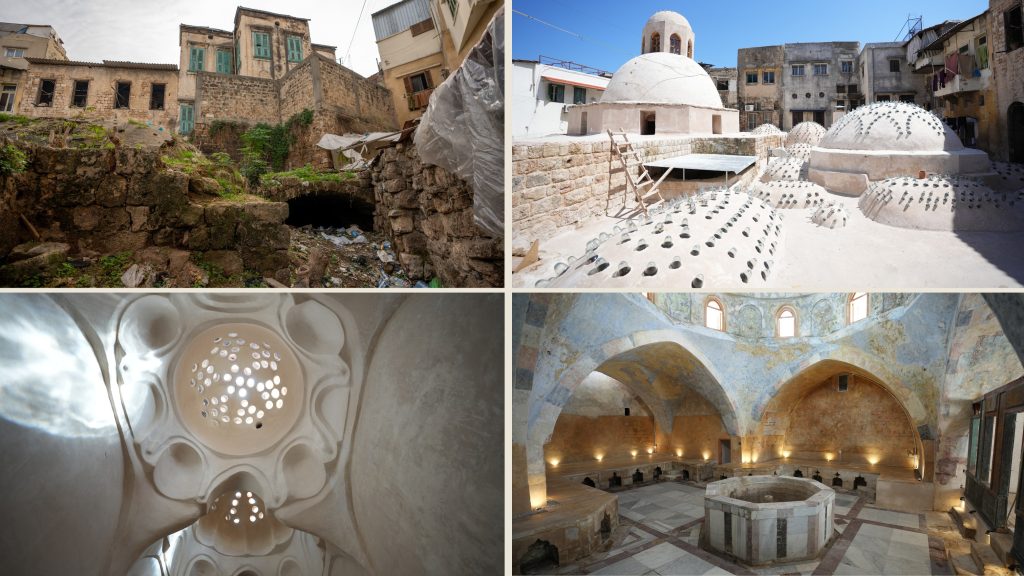
In Tripoli, the restoration of Hammam Al Nouri, the consolidation of the citadel of Saint-Gilles and the stabilization of several historic houses mark an important milestone for the Lebanese urban heritage. Inaugurated on 3 June 2026 under the patronage of the Lebanese Ministry of Culture, these ALIPH-funded projects combine conservation, vocational training, youth employment and social cohesion. In a city often reduced to its economic difficulties, these projects recall that heritage can also become a lever of local development.
Tripoli has one of the richest historical ensembles in the Mediterranean basin. Its souks, hammams, mosques, madrasas, old houses and citadel tell a dense urban history, shaped by the Mamluk, cross, Ottoman and modern periods. Yet part of this heritage remains weakened by lack of maintenance, economic crisis, structural risks and pressure on the old fabric. The rehabilitations opened this week do not solve all these challenges. However, they show one method: restoring monuments, training local skills and keeping people in the heart of the city.
The event brought together several Lebanese officials and international partners. Minister of Culture Ghassan Salamé, Minister of Tourism Laura Khazen Lahoud, Minister of Social Affairs Hanine Al Sayed, Director General of Antiquities Sarkis Khoury, and President of the Foundation Board of ALIPH Bariza Khiari took part in this day. Their presence underlines the cross-cutting nature of the case. In Tripoli, heritage is not only a matter of architecture. It concerns tourism, training, employment, urban security and the image of a city that seeks to develop its resources without removing its complexity.
Tripoli places its heritage in the center
The projects inaugurated are part of a practical safeguard logic. They were led by a number of Lebanese and international partners, including the Directorate-General for Antiquities, the Awqaf management in Tripoli, the European Institute for Cooperation and Development, through Seeds of Future, the Kofi Annan Foundation, Fight for Humanity and the Permanent Peace Movement. The main funding was provided by ALIPH, with the support of the TotalEnergy Foundation and the Principality of Monaco. This coalition reflects a shared conviction: conservation can no longer be thought of as an isolated site, entrusted only to experts.
In Tripoli, the restoration of the heritage directly affects the inhabitants. Old buildings are not frozen objects. They border still inhabited streets, house shops, structure daily routes and participate in the informal economy of the old city. When a facade threatens to collapse, it endangers passersby and residents. When a monument closes for decades, it gradually disappears from collective memory. When a historic house deteriorates, it is a part of the urban fabric that loses its coherence.
The choice to link work to youth training therefore responds to a social emergency. The Lebanese crisis has weakened employment, accelerated the brain drain and reduced the capacity of public institutions. In this context, training artisans, technicians and young professionals in the restoration of old buildings creates a local chain of skills. The site becomes a learning place. Heritage ceases to be an abstract cost. It becomes a sector where trades can be built.
Hammam Al Nouri regains its symbolic function
Hammam Al Nouri occupies a special place in this sequence. Located near the large Al-Mansuri mosque, it is one of the last large Mamluk hammams in Lebanon. Built in the 14th century, closed since the 1970s, it bore the traces of a long abandonment. Its restoration gives visibility to a monument that once belonged to the social life of the city. Hammam was not just a place of hygiene. It was a space of encounter, sociability and transmission.
The work was conducted by IECD-Semeurs d’Avenir, with the support of ALIPH and the TotalEnergies Foundation, under the supervision of the General Directorate of Antiquities and in partnership with the direction of the Awqaf in Tripoli. The project was not limited to the physical consolidation of the building. It also trained 46 young professionals in heritage restoration, including 15 women. This figure is important in an area still often perceived as masculine, especially when it affects masonry, coatings, stone or interventions at an ancient site.
The rehabilitation of Hammam Al Nouri therefore has a double scope. It saves a rare monument and transmits know-how. The officials present at the ceremony insisted on this dimension. Hazem Aych, for the direction of the Tripoli Awqaf, Marc De Kergariou, for the IECD, and Thibaud de Lisle, for TotalEnergies, stressed the importance of forming a new generation capable of maintaining the monuments, and not only of participating in a one-off project. Restoration thus becomes an investment over time.
A Mamluk monument in a living city
Hammam Al Nouri also recalls the Mamluk depth of Tripoli. The old town retains a heritage density that far exceeds the most famous monuments. Hammams, khans, souks and places of worship make up an urban landscape where water, stone and internal traffic have long structured collective life. The closure of the hammam since the 1970s had broken this link. Its restoration offers an opportunity to reconnect the memory of the inhabitants with a building that had lost its public service.
The question of future use will remain decisive. Restoring a monument is not enough to make it live. Openness, maintenance, visitation, cultural mediation and management will have to be defined. An old building can deteriorate rapidly if its operating model is not clarified. In Tripoli, the challenge is to avoid window restoration. Hammam Al Nouri will have to find its place in a heritage path, but also in the ordinary life of the old town.
Saint-Gilles, the citadel as a school of citizenship
The citadel of Tripoli, also called the citadel of Saint-Gilles, dominates the old town from its rocky promontory. It is the largest monument in the city. Its silhouette accompanies Tripoli’s visual identity and recalls the successive periods that marked local history, from Crusaders to Mamluks and then Ottomans. However, its physical condition requires heavy interventions. Recent consolidation aims as much to preserve a symbol as to secure a central Lebanese heritage site.
The Rooting for the Future project was implemented by the Kofi Annan Foundation, in partnership with Fight for Humanity, the Permanent Peace Movement, IECD-Semeurs d’Avenir and the Directorate General of Antiquities. It benefited from the support of ALIPH and the financial contribution of the Principality of Monaco. For nine months, one hundred and forty metres of the eastern façade was consolidated. The northeast corner has been stabilized. Rock foundations have been strengthened. The northeast tower has been restored. Watertightness and stormwater disposal have also been improved.
This work meets an obvious technical need. Infiltration, ground movements, fragile masonry and exposure to weather can accelerate the degradation of a fortified site. The citadel is not just a decor. It is a complex architectural complex, placed on a rocky base, with walls, towers, traffic, sensitive areas and public uses. Intervening on such a monument requires studies, arbitrations and close coordination among specialists.
Young people trained and associated with the story of the city
The social dimension of the project is equally important. Twenty young people were trained in conservation techniques. Fifty-nine participants participated in 26 dialogue sessions on heritage, peace and social cohesion. Four youth initiatives were also supported: GenT, Stories Without Barriers, Ruwaad al Kalaa and Kunoz Tarablos. Their aim is to raise awareness among the young people of Tripoli about the protection of their city.
This component distinguishes the citadel from a simple consolidation project. The idea is not just to repair stones. It is to make the monument a space for participation. In a city with social, political and economic divisions, heritage can provide common ground. It does not remove tensions. However, it can create a shared vocabulary around memory, public space and collective responsibility. The citadel then becomes a medium for dialogue.
The use of youth initiatives also gives a contemporary dimension to the project. A city does not protect its heritage only with decrees. It protects him when his inhabitants see value. Tripoli youth can play an essential role in this appropriation. They can produce stories, organize visits, document places, create digital media or mobilize their neighbourhoods. Their involvement makes it possible to move from an observed heritage to a lived heritage.
Old houses stabilized
Between the Hammam Al Nouri and the citadel Saint-Gilles, the participants visited six historic houses recently stabilized or rehabilitated with the support of ALIPH. These interventions were conducted by IECD and the Kofi Annan Foundation. They are less visible than a large citadel or a monumental hammam, but they touch at the heart of the urban problem. The old town of Tripoli is based on a continuity of houses, alleys, arcades, facades and courtyards. If these elements disappear one by one, the great monuments also lose their context.
The stabilization of old houses responds to a security emergency. In several historic areas of Lebanon, fragile buildings threaten the inhabitants, traders and passers-by. Consolidation interventions prevent collapse, protect families and maintain economic activities. They show that safeguarding heritage is not opposed to social needs. On the contrary, it can improve the security of residents and preserve the inhabited function of old centres.
This type of action requires a fine method. It is not a question of turning the old city into a museum, nor of expelling the inhabitants in the name of restoration. We must intervene without breaking the social balance, with appropriate work, structural diagnostics and an understanding of usage. Tripoli cannot preserve its heritage against its population. She must preserve it with her. This is one of the lessons learned from these projects.
From the Old Town to the Rachid Karamé Fair
The day continued at the Rachid Karamé International Fair, designed in 1962 by Brazilian architect Oscar Niemeyer. Listed on the UNESCO World Heritage List in 2023, this modernist ensemble represents another side of Tripoli. It is neither of the Mamluk past nor of the Ottoman era. It belongs to the history of Lebanese modernism, at a time when the country imagined great public facilities and an ambitious international openness.
ALIPH is currently supporting stabilization work on the site’s castle. This choice broadens Tripoli’s heritage reading. The city is not just about its old town. It also has a modern heritage, long underestimated, sometimes misunderstood, but now internationally recognized. The Rachid Karamé Fair is a major ensemble to understand the Lebanon of the 1960s, its promises of development, its architectural ambitions and its subsequent ruptures.
Connecting the citadel, the hammam, the old houses and the modernist fair allows to tell Tripoli in its continuity. The city is not a fixed setting in a single period. It juxtaposes historical layers. This plurality can become a tourist and cultural asset, provided that it is organised, reported and protected. It can also help people look at their city differently, not as a sum of difficulties, but as a territory of resources.
ALIPH, an enhanced presence in Lebanon
Since the explosion of the port of Beirut in the summer of 2020, ALIPH has supported 39 projects in Lebanon. Twenty-seven are already completed. The investment reached $5.7 million. More than 60 historic buildings have benefited from stabilization, protection or rehabilitation measures. These figures give a measure of the foundation’s commitment in a country where the State lacks the means to maintain an immense heritage.
ALIPH, founded in Geneva in 2017, is the world’s largest fund dedicated to protecting the heritage threatened by conflict, crisis, climate change and natural disasters. It intervenes in difficult contexts, often when local institutions no longer have the financial or operational capacity to respond alone. Since its inception, it has supported approximately six hundred projects in 64 countries. Its action in Lebanon is therefore part of an international strategy, but it takes on a very concrete dimension, building by building.
ALIPH support does not replace a Lebanese public heritage policy. He completes it and sometimes makes it possible. The Directorate General of Antiquities retains a central role of supervision, authorization and expertise. But its resources remain limited in response to the magnitude of needs. Partnerships then become essential. They provide funding, methods, training and international visibility. They also create an obligation to achieve results, as projects must be documented, delivered and transmitted.
Heritage, employment and local development
Heritage rehabilitation can become an economic lever for Tripoli, but this potential must be handled with caution. Cultural tourism does not automatically arise from a restored site. It involves legible paths, trained guides, opening hours, urban security, services, signage, cultural offer and coordination between public and private actors. Open projects lay the foundation. They are not yet a comprehensive strategy.
The training of young people is probably one of the strongest achievements. The 46 young people trained in Hammam Al Nouri, the 20 young people trained in citadel conservation techniques and the participants in social cohesion dialogues make up a first generation of local actors. Their experience can be reused on other sites. It can also create vocations in stone, restoration, cultural mediation or site management.
For Tripoli, this approach has a direct social impact. The city suffers from a shortage of opportunities for its youth. Too often, cultural projects remain far removed from economic needs. Here, conservation of the heritage joins the question of employment. It does not promise thousands of immediate posts. However, it opens up channels of competence and spaces for participation. In a city where the future of young people is a major challenge, this link deserves to be consolidated.
Bariza Khiari summed up this ambition by calling Tripoli a jewel of the Mediterranean basin. She emphasized the historic, cultural, spiritual and heritage richness of the city, while recalling the desire of ALIPH to remain alongside Lebanon. This formula comes in a difficult context. The country is facing a prolonged economic crisis, security tensions and a weakening of its institutions. Protecting heritage is therefore not a luxury. It is a way of preserving common landmarks.
The follow-up will depend on the capacity of local authorities, partners and communities to register these projects on a sustainable basis. Hammam Al Nouri must be maintained and open to consistent uses. The citadel Saint-Gilles will require regular technical follow-up. Old houses must remain inhabited and secure. The Rachid Karame Fair must continue to stabilize. In Tripoli, the heritage has just received several reparations. It now awaits a policy capable of transforming these restorations into sustainable urban dynamics.




