

Putting history in its place
The Levant is probably one of the few places in the world where history never died. It continues to live in languages, kitchens, religions, family memories, ports, alphabets and even in modern identity rivalries.
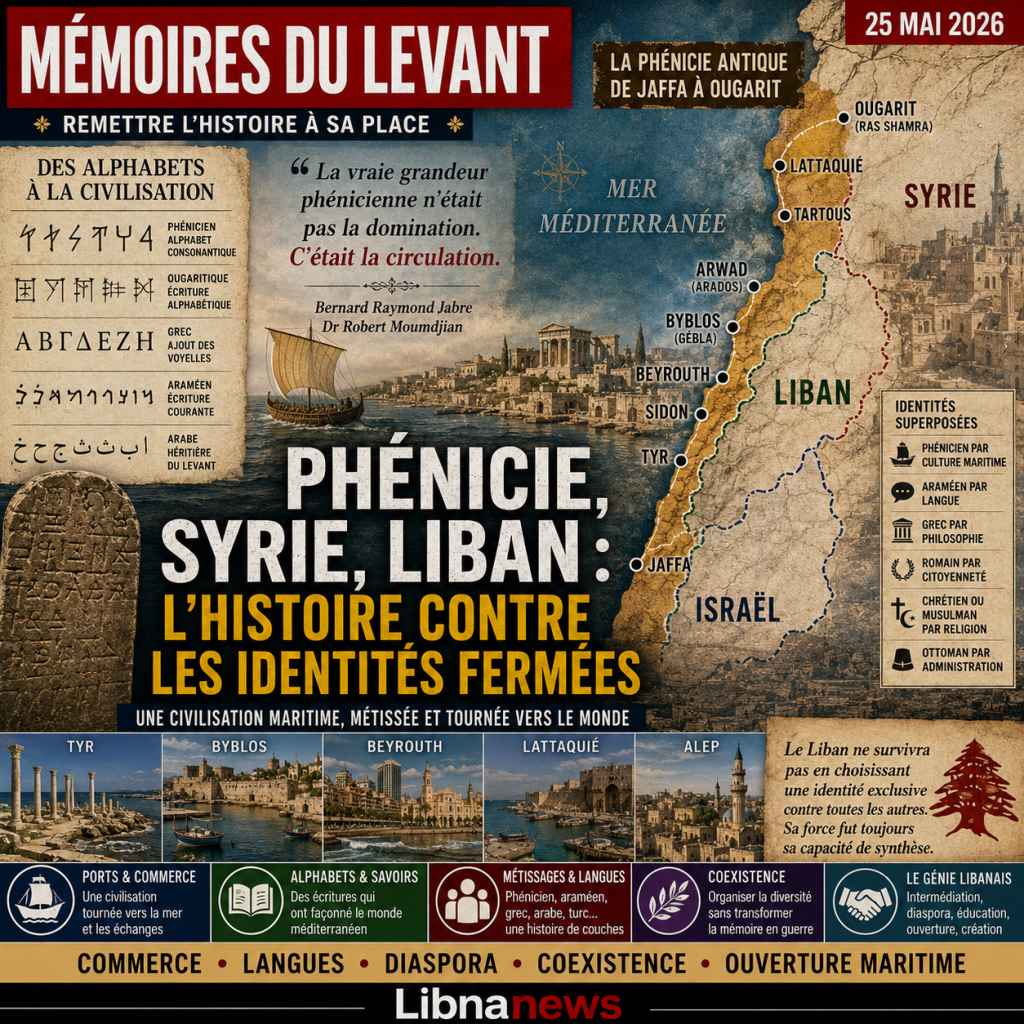
Ancient Phoenicia was a coastal civilization extending approximately from Jaffa in the south to Ras Shamra — the ancient Ugarit — in the north, near Latakia. This maritime space formed a civilizational continuity oriented towards the sea, commerce, alphabet, exchanges and cultural mixedness.
Today, this former coastal band is divided between Israel, Lebanon and Syria. It is historically incorrect to claim that the Phoenician heritage would belong exclusively to a single contemporary people.
The Syrian-Lebanese coast historically developed a Mediterranean, commercial, urban and relatively cosmopolitan mentality. This coastal culture was successively influenced by Phoenicians, Greeks, Romans, Byzantium, Crusaders, Ottomans and maritime exchanges with Europe.
The north-western Syrian region, including the Alawite region around Latakia and Tartous, historically has a cultural proximity to coastal Lebanon. This proximity does not mean absolute identity but a comparable Mediterranean sensitivity.
The Aleppo culture represents a civilizational summit of the Levant. Aleppine cuisine is probably one of the most refined in the Middle East, integrating Levantine, Armenian, Anatolian, Caucasian and Arab influences into an exceptional synthesis.
Concerning the alphabet, the proto-sinaitic scripts discovered in Sinai are anterior to the Phoenic alphabets. Writing in Ougarit is also a fundamental alphabetical step.
But it was the Phoenicians who spread the Mediterranean Consoniantic alphabet to Greece. The Greeks then adapted by adding vowels, giving birth to the Greek alphabet and then indirectly to the Latin and much of the Western alphabetical systems.
In the other direction, the Phoenician influence also participated in the evolution of Aramaic and then Nabatean scriptures that contributed to the development of Arabic writing.
The problem of the modern Levant is that he wanted to transform fluid civilizations into rigid nation states. But the Levantine history never worked that way.
For millennia, identities were superimposed rather than exclusive. One could be a Phoenician by maritime culture, Aramaic by language, Greek by philosophy, Roman by citizenship, Christian or Muslim by religion, Ottoman by administration, and nevertheless belong to the same human continuity.
Solving the Levant’s identity problem does not mean removing differences. This means learning to organize a coexistence between competing memories without turning each memory into existential war.
Lebanon will probably not survive by choosing an exclusive identity against all others. His historical strength was precisely his capacity for synthesis.
Lebanese genius has never been purity.
The Lebanese genius was intermediation.
Trade.
Languages.
Finance.
Education.
Diaspora.
Mediation.
Intellectual creation.
Maritime opening.
The true future of the Levant lies in the reconstruction of a Mediterranean area that is cultivated, educated, technologically advanced, economically open and intellectually free.
For the true Phoenician greatness was not domination.
It was traffic.
Bernard Raymond Jabre
Dr. Robert Mumdjian




