

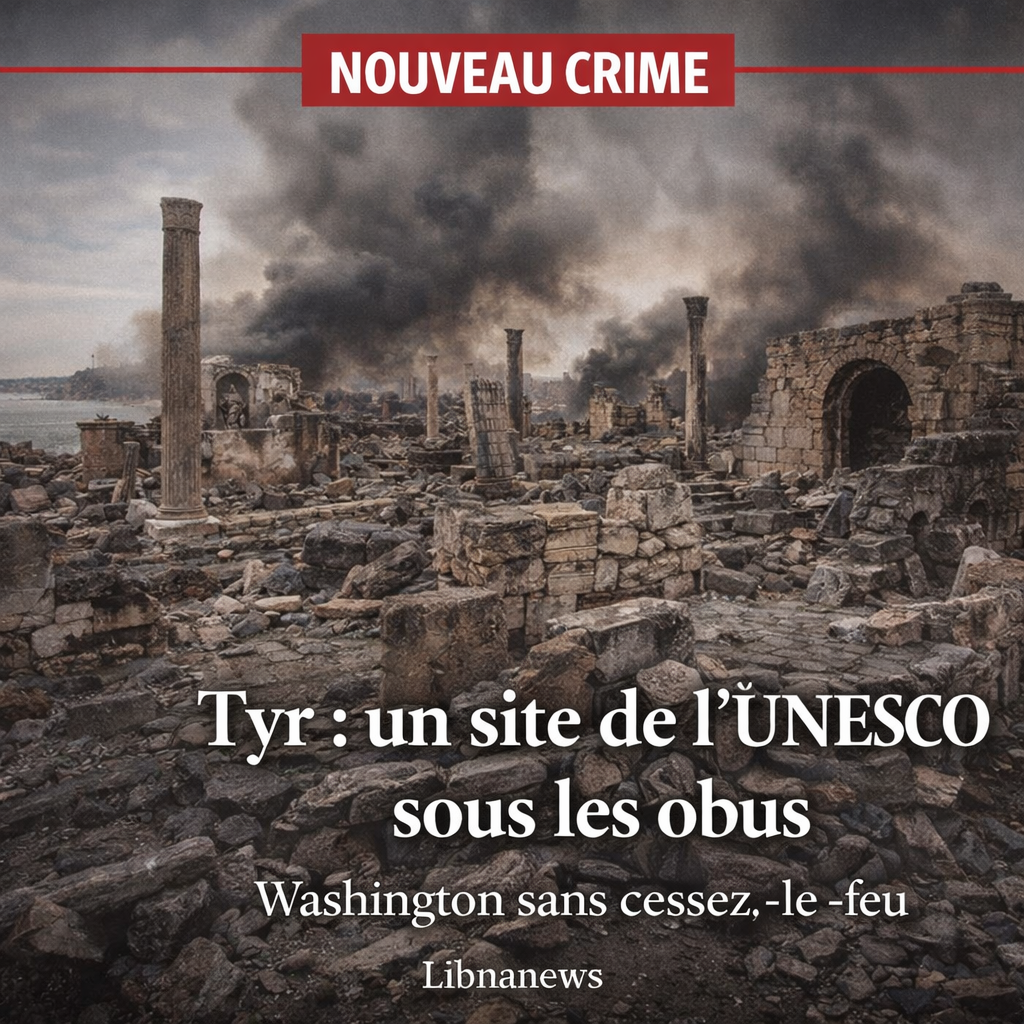
The bombardment reported on 13 April in Tyre does not only target a city already threatened by the strikes. According to the Lebanese public agency, it has touched the archaeological citadel of Tyre, a UNESCO World Heritage property. In a war where the thresholds of protection fall one after another, the attainment of such a site changes the nature of the observation: it is no longer only infrastructure, neighbourhoods or roads that are exposed, but a cultural property placed under an international protection regime.
A hit on a protected property
On Monday, 13 April, the war crossed a threshold beyond military logic. According to the Lebanese National Information Agency, a bombing hit the archaeological citadel of Tyre in southern Lebanon. Behind the dispatch of a few lines, the stake is immense: it is not an ordinary building or a simple local landmark, but a UNESCO World Heritage site. When such a place is reached, the reading cannot be limited to the immediate balance sheet. What is affected are entire strata of memory, archaeology, national narrative and common heritage. In a conflict already marked by strikes against civilian areas, relief and infrastructure, the attack in Tyre opens another front, that of the destruction of the long time. The city not only houses people caught under bombs. It also preserves a decisive piece of Mediterranean, Phoenician, Roman, Byzantine and medieval history. So saying that a UNESCO site has been bombed is not a spectacular formula. It is the description of a fact that involves a specific legal regime and a much broader political responsibility than that of mere material damage.
Tyre is not an isolated monument, placed away from the war as an ancient decoration. The archaeological site is part of the city’s urban and historical fabric. UNESCO recalls that Tyre, which has been a World Heritage Site since 1984, was one of the major Phoenician cities of the Mediterranean, directly associated with major stages in human history, from the expansion of the sea to the production of purple, to the Greek, Roman and crossed heritages still visible in its remains. This depth explains why bombing such a place can never be read as a secondary heritage incident. When a city like Tyre is reached, both a living population and an open-air archive are threatened. UNESCO also describes the good as a complex composed of several distinct areas, between the urban promontory and the necropolis of El-Bass. War does not distinguish between layers of stone and layers of meaning. It breaks the space, moves the inhabitants, interrupts excavations, prevents surveys, delays restorations and makes random monitoring of the remains. This is how modern conflicts damage the heritage: not only by the impact of a shell, but by the sustainable installation of insecurity around the sites.
A UNESCO site Tyre under enhanced protection
What makes the warning of this 13 April even more serious is that Tyre does not arrive naked before international law. The site has a dual protection regime. On the one hand, it is covered by the World Heritage Convention as a UNESCO property. On the other hand,Tyre archaeological siteson the list of cultural property with enhanced protection in Lebanon under the mechanism provided for in the Second Protocol of 1999 to the 1954 Hague Convention. In other words, we are not just talking about a prestigious or symbolic place. The term « cultural property » is referred to as one of the highest levels of protection in times of armed conflict. On 1 April 2026, UNESCO further recalled, with regard to 39 other Lebanese assets placed under enhanced emergency protection, that this regime constitutes the highest level of legal protection against attack and military use. In the same statement, the organization stated that it had already confirmed damage in the city of Tyre. The strike reported today does not fall into a documentary vacuum. It is part of a sequence where the danger to the heritage of Tyre was already identified, documented and formally reported to the international community.
This point changes the nature of the debate. Many damage to the heritage in wartime is presented after the blow as peripheral damage, breath effects, unfortunate but incidental consequences. The case of Tyre is not easily confined to this rhetoric. Firstly, because UNESCO, the World Heritage Committee and the bodies responsible for the protection of cultural property have already placed the site in a specific alert. Then because the area of Tyre has been targeted for weeks by repeated strikes. Reuters again reported on 8 April that Israel had ordered the evacuation of the city of Tyre before further strikes, stating that the American-Iranian ceasefire did not apply to Lebanon. On the same day, the United Nations denounced Israeli strikes of exceptional magnitude throughout Lebanon and recalled the need for independent investigations into possible violations of international humanitarian law. In this context, a bombardment that reaches a protected heritage site cannot be treated as a footnote to the military campaign. It becomes a test of how belligerents respect, or no longer respect, the limits set by law to war.
Hitting a classified site is not an ordinary damage
Legal scope is essential here. The 1954 Hague Convention requires States parties to respect cultural property situated within their own territory as well as that of other States parties, including by refraining from any hostile act directed against them. The International Committee of the Red Cross recalls the same logic in its statement on customary law: parties to a conflict cannot direct hostilities against cultural property and must avoid incidental damage to it. The law does recognize an exception related to imperative military necessity, but this exception does not erase the rule; It confirms on the contrary, as it is framed and exceptional. Simply put, the mere fact that a war is going on does not allow to hit a protected cultural site as one would hit any goal. It must be demonstrated that this property had lost legal protection due to specific military use, and that the attack met the strict requirements of the law of armed conflict. Failing this, the hit turns to the side of the violation. This explains why every strike on a classified site calls something other than an outraged statement: it calls for a qualification, then an investigation.
The Rome Statute of the International Criminal Court makes this requirement even clearer. Article 8 of the Convention considers it a war crime to intentionally direct attacks on buildings devoted to religion, art, science, for charitable purposes, against historical monuments, hospitals and places where sick and wounded persons are gathered, provided that they are not military objectives. This threshold is important to avoid simplification. A serious journalist cannot write that a war crime is established before any investigation. On the other hand, he can say, and must say, that a strike against a UNESCO site with enhanced protection immediately puts the criminal issue on the table. Law is not only concerned with the number of human victims or the supposed military effectiveness of an attack. It also protects what humanity considers irreplaceable in its material memory. Bombarder Tyre, if the facts are confirmed and no lawful military justification is established, would therefore not be a cultural accident without consequence. This would fall into a category of serious violations explicitly provided for in the texts.
Tyre, between living memory and front line
We must also measure what Tyre represents for Lebanon in the present. In a country where war destroys houses, emptys cities and pushes people on the roads, heritage is not a luxury time of peace. It serves as a collective anchor. It recalls that the territory is not confined to the front lines or the armed affiliations of the moment. To destroy a site like Tyre, or to damage it repeatedly, is to weaken a common narrative already experienced by massive displacements, repeated violence and instability of institutions. UNESCO used very clear words on April 1st: when heritage is destroyed, moral norms weaken, social cohesion erodes and the resilience of societies is threatened. This sentence applies particularly to Lebanon. In a country where official history remains disputed and where institutions struggle to hold, heritage is one of the few spaces still able to connect generations other than by wounds. Breaking these places is much more than touching ancient stones. It is to reach the material supports of an already very fragile national continuity.
The precedent of the last weeks confirms that the heritage alert is not abstract. In early March, several reports have already reported strikes at or near the archaeological site of Tyre. UNESCO then confirmed damage in the city. The World Heritage Committee, in its Decision 47 COM 7B.176, expressed its concern at the damage suffered on and near property as a result of hostilities, while encouraging Lebanon to undertake, where possible, urgent repair work, detailed structural assessments and monitoring of archaeological structures. This language is diplomatic, but it’s not annoyed. When an organ of this nature speaks of damage to the good and in its vicinity, it already recognizes a concrete degradation of the site. The strike reported on 13 April does not therefore occur as the first signal. It adds to a chain of attacks and threats that lengthens. In other words, the heritage of Tyre is no longer only threatened by war. He has already entered the area where war produces verifiable material effects on the remains.
An attack that concerns far beyond Tyre
The bombing of a classified site finally produces a political effect that goes beyond Lebanon alone. The 1954 Convention is based on a simple idea: any damage to a cultural good, whatever the people to which it belongs, reaches the heritage of all humanity. This means that a strike on Tyre does not concern only the inhabitants of Tyre, or even the Lebanese. It affects a good that the international community has considered important enough to place it under a collective protection regime. This principle is not rhetorical. It establishes the obligation for States and international organizations to document, alert and demand accounts. It also establishes the need not to allow discussion to dissolve in general military justifications. As soon as a site of this nature is affected, the burden of explanation increases. What exactly happened? What was the target? What means have been used? What precautions have been taken? Had the site or its surroundings been militarized? Without a precise answer to these questions, the story of one single strike among others no longer holds.
The other risk is that of habituation. Since the beginning of the war, Lebanon has been living at the pace of human flows, targeted relief centres, evacuated neighbourhoods, cut roads and displaced families. In such a flow of violence, damage to heritage may seem secondary to the deaths and injuries. That would be a mistake. Contemporary wars at the same time destroy bodies, infrastructures and symbols. They attack what makes a society present and what allows it to project beyond the present. When a site like Tyre is reached, you don’t just lose stones, columns or walls. Future opportunities for knowledge, transmission, education, research and symbolic reconstruction are being lost. Every undocumented damage, every cracked structure, every disturbed archaeological layer can produce irreversible losses. That is why heritage should not be relegated to the margins of the war narrative. It is part of the heart of disaster, because it concentrates both historical value, material vulnerability and the question of meaning.




