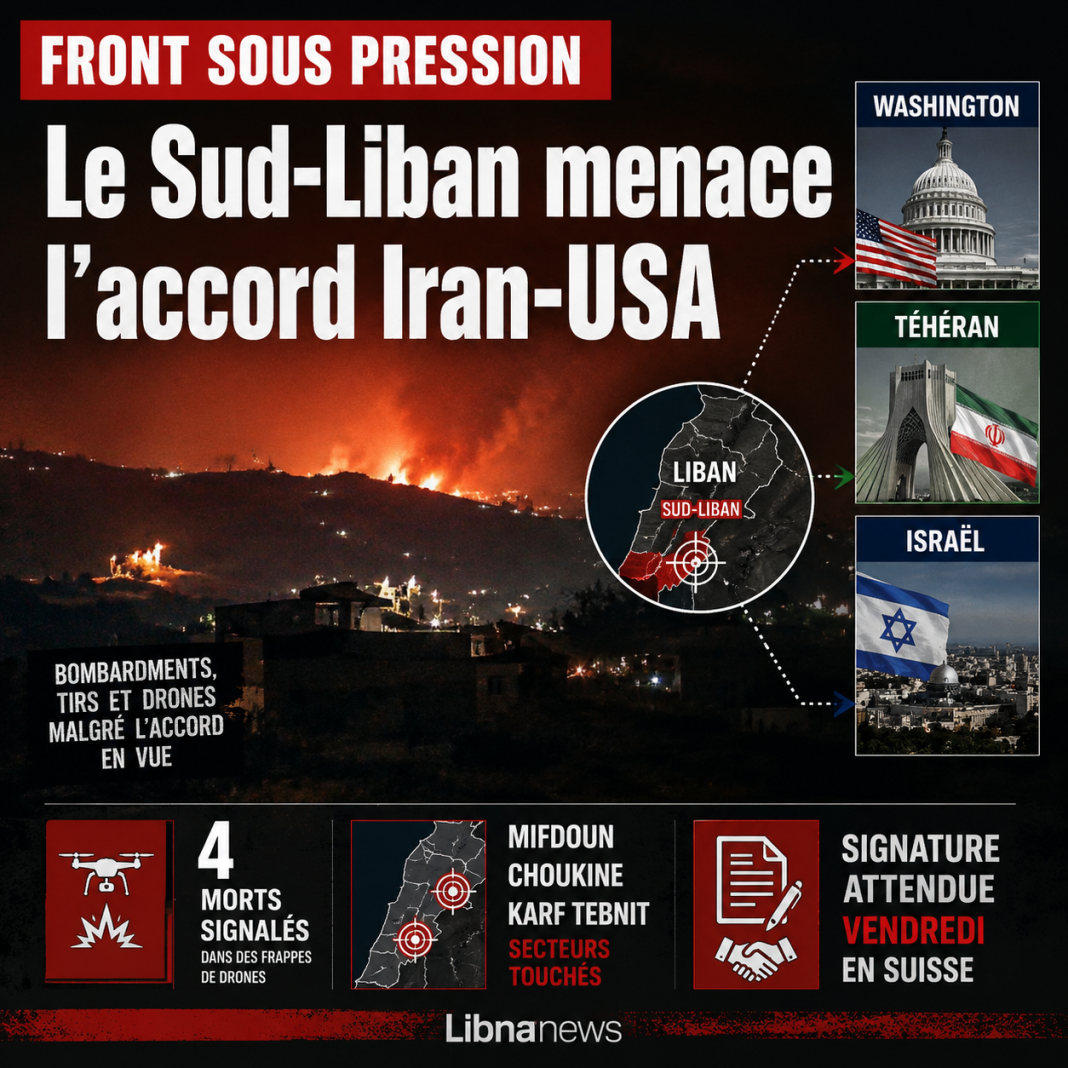






From the perspective of Lebanon, the question arises with new brutality: does Israel seek escalation in southern Lebanon to weaken the agreement in preparation between the United States and Iran? Israeli strikes, incursions and the maintenance of military positions are taking place at a time when Washington is trying to tear a signature in Tehran. In this Lebanese reading, the southern front is no longer just a military theatre. It becomes a political lever, at the risk of spreading the relationship between Benjamin Netanyahu and Donald Trump.
An interrogation from Lebanese ground
In Lebanon, the hypothesis is no longer formulated in a low voice. It circulates in political circles, in the media and in villages in the South. Would Israel want to cause enough instability in southern Lebanon to make the American-Iranian agreement impossible, or at least to empty its reach? The question is not neutral. It is based on a fact experienced by the Lebanese: bombardments resume when negotiators announce a breakthrough, drones remain in the sky when civilians speak back, and the Israeli army maintains positions as Iran calls for their withdrawal.
This perception is not based on single evidence. There is no public document showing a written Israeli strategy to sabotage the agreement between Washington and Tehran. But the accumulated facts fuel suspicion. Strikes hit Mifdoun, Choukine, Kfar Tebnit, Nabatiyah and several southern roads. Artillery fire was reported towards Rihane. Drones targeted civilian or supposed military vehicles. Hezbollah claims to respond to occupation and attacks. Israel claims to preserve its freedom of action. Between these two lines, Lebanon cashes.
The Lebanese question also arises from a calendar. The United States needs an agreement with Iran to close an expensive military sequence, reopen the Strait of Ormuz, limit the nuclear risk and avoid prolonged regional war. Israel, for its part, is entering a decisive election year. Benjamin Netanyahu has to deal with an Israeli opinion marked by war, worried for the north of the country and unwilling to accept a withdrawal perceived as a concession to Hezbollah.
South Lebanon: a front used as a signal
In southern Lebanon, each strike now has a double meaning. According to Israel, it targets Hezbollah fighters, infrastructure or movements. But it also sends a political message. It states that the Israeli army does not consider itself bound by a negotiated agreement between Washington and Tehran. It recalls that the Israeli government wants to keep its hands on the ground, even if the White House seeks to impose regional de-escalation.
This dynamic can be seen in the succession of events. After the announcement of a memorandum between the United States and Iran, fighting decreased, but they did not stop. Southern localities have been hit again. Residents who had begun to return discovered a reality less reassuring than diplomatic announcements. The ceasefire exists in the communiqués. On the ground, it remains blocked by raids, overflights, fire and alerts.
In Lebanese perception, this continuity is not a mere slippage. It looks like a way to test American boundaries. Israel strikes, then observes Washington’s reaction. If the reaction remains verbal, operations continue. If it becomes harder, Israel can reduce the pace without abandoning its objective. This tactic allows us to maintain the military initiative without publicly assuming a break with the United States.
Hezbollah obviously exploits this reading. The Shiite movement claims that the Israeli withdrawal must be a direct consequence of the sequence opened by the agreement with Iran. It links Lebanese sovereignty to the regional balance of power. But this reading now exceeds Hezbollah alone. For part of Lebanese opinion, including beyond its electorate, the priority is simpler: to stop the strikes, to get a withdrawal and to prevent Lebanon from remaining the ground for adjustment between Israel, Iran and the United States.
Washington wants a deal, not a new war
The United States no longer hides its need for an agreement with Iran. Donald Trump wants to present the sequence as a diplomatic victory. After months of strikes, sea tensions, energy disruption and regional escalation, the White House is looking for a legible result. The immediate objective is to transform the war into a negotiation, with a ceasefire period, an Iranian nuclear framework and reversible economic measures.
In that context, Lebanon was becoming a practical problem. If Israel continues its operations in southern Lebanon, Iran can say that the agreement does not really stop the war. If Iran signs despite the strikes, it exposes itself to the criticisms of its allies. If Washington does not retain Israel, Tehran may doubt the American ability to guarantee the text. The Lebanese front is therefore becoming a credibility test for the United States.
Donald Trump has already expressed his irritation. He criticized Israeli strikes in Lebanon and called on the parties to stay away from a further escalation. That language counts. He does not break the covenant with Israel. However, it shows that the US President does not want Benjamin Netanyahu to become the main obstacle to his agreement with Iran. For Trump, the priority is no longer to give Israel complete freedom of action. It is to conclude a sequence that he can sell as a regional peace.
American gestures go in the same direction. The announced withdrawal of part of the American refuelling aircraft stationed in Ben Gurion reduces the visibility of a device associated with long-range strikes. Reports of a easing of the blockade of Iranian ports also point to a logic of relaxation. Washington does not say that he abandons Israel. Rather, he says that he does not want to be drawn into direct military confrontation with Iran to prolong Israeli tactical choices in Lebanon.
Netanyahu facing the trap of his own camp
Benjamin Netanyahu is in a more constrained position than he shows. He must preserve his image as warlord. He must reassure the inhabitants of northern Israel. He must hold a coalition where the toughest parties refuse any concession. It must also prepare an election deadline in a climate of distrust. A number of recent polls show a stronger opposition and a right-wing base that requires a firmer line, especially against Hezbollah.
This internal pressure explains part of the Israeli posture. A withdrawal from southern Lebanon could be presented by its opponents as a failure. A truce negotiated by the United States and Iran could be described as a Hezbollah victory. A reduction in strikes could give the impression that Washington imposed its views on Israel. For Netanyahu, each of these scenarios has a political cost.
Itamar Ben Gvir embodies this constraint. The Minister of National Security denounced the agreement between Trump and Iran, saying that it does not bind Israel. His position expresses a hard line on the government. It does not define the Israeli strategy alone, but it draws it towards escalation. It also recalls that Netanyahu does not rule in a strategic vacuum. He governs under the supervision of allies who may threaten his coalition if they think he gives in too much.
The paradox is there. To save his relationship with Israel’s most mobilized opinion, Netanyahu may deteriorate his relationship with Donald Trump. This relationship has long been a major asset. Trump supported Israel in key moments. He made choices that other US presidents would have avoided. But he can also turn against an ally if he believes that he threatens his own political victory.
The risk of an arm with Trump
Trump’s relationship with Netanyahu remains strong, but it is no longer frictionless. The US President wants an agreement with Iran. The Israeli Prime Minister wants to maintain his freedom of action in Lebanon. These two objectives can coexist only if Israeli operations decrease enough not to threaten signature. If the strikes continue at the same pace, the political conflict will become more visible.
For Trump, the Iranian deal has an internal and international value. He can present it as proof that he knows how to wage war and then impose peace. He can also point out that he contained Iran without engaging the US troops on a lasting basis. A failure caused by Israel would weaken this account. He would give the image of a president unable to discipline his closest ally. In the trumpian logic, that would be difficult to accept.
Israel therefore takes a risk. By continuing climbing in South Lebanon, it can gain some tactical advantages. It may prevent Hezbollah from relocating to certain areas. He can reassure part of his population. It can also show that no text signed between Washington and Tehran will limit its security doctrine. But this immediate gain can be costly if Washington cuts operational support, slows down some deliveries or hardens its diplomatic language.
The partial withdrawal of the American tankers should not be exaggerated. It does not mean a military breakdown. Yet it indicates a change of posture. The United States wants less to appear as the auxiliary force of an expanded Israeli offensive. They want to keep control of climbing. This nuance is essential because it shows that the balance of power is no longer only played between Israel and Hezbollah. It is also played between Israel and its American protector.
Lebanese perception: Israel prolongs war
In Lebanon, the prevailing reading in the affected areas is simple: Israel prolongs the war because it does not want to pay the political price of a withdrawal. The people of the South do not reason first in terms of nuclear memorandum or Israeli electoral calculation. They see houses destroyed, roads cut off, drones in the sky and inaccessible farmland. They also see an Israeli army remaining in Lebanese areas despite the announcement of a truce.
This perception does not mean that all Lebanese support Hezbollah. The country remains divided on the military role of the movement. Many Lebanese accused him of having led the country into a war decided on the basis of regional interests. But in the face of Israeli strikes and the occupation of parts of the territory, a broader national line is formed around a minimum requirement: Lebanese sovereignty cannot be suspended from the Israeli election campaign.
That’s where the case gets explosive. Israel may think of weakening Hezbollah by maintaining pressure. On Lebanese ground, this pressure can produce the opposite effect. It gives Hezbollah an argument of legitimacy. It allows him to say that the Lebanese State alone does not obtain withdrawal, protection or guarantees. It complicates any internal discussion of the party’s weapons, as the debate on national defence becomes impossible as long as the strikes continue.
For Lebanese institutions, the margin is narrow. The government can request Israeli withdrawal. The army can deploy to certain areas. Authorities may call for caution. But the decision center is elsewhere. It is located in Washington, Tehran, Tel Aviv and in the headquarters. This dispossession feeds a cold anger. Lebanon is undergoing a war whose parameters are negotiated without it.
Can Israel really fail the agreement?
The answer depends on the violence threshold in the coming days. If the strikes remain limited, Washington and Tehran can choose to sign despite everything. They will say that the Lebanese question will be dealt with in the next phase. Iran will be able to claim that it has obtained the inclusion of the Israeli withdrawal on the agenda. The United States can say that it has paved the way for a broader ceasefire. Israel could maintain that it was not a party to the text.
If, on the other hand, a strike kills a large number of civilians, hits Beirut or provokes a major response from Hezbollah, the agreement can enter into crisis even before its signature. Tehran cannot appear to be indifferent to the fate of its Lebanese ally. Washington won’t be able to claim control of de-escalation. Israel will then be accused, in Lebanon and elsewhere, of placing its immediate political interests above a regional settlement.
The scenario of total sabotage therefore remains possible, but it is not the only one. Israel can seek less to defeat the agreement than to reshape it under pressure. By maintaining tension in South Lebanon, he recalls that a text that ignores its security requirements will remain incomplete. It forces Washington to take into account Israeli demands on Hezbollah, missiles, tunnels, the border area and the return of the people of northern Israel.
Given Lebanon, this distinction does not matter to displaced families. The result is the same: bombardments continue, villages remain threatened and Israeli withdrawal is not guaranteed. But to understand the Israeli calculation, it is useful. Netanyahu does not need to fail the agreement to limit its effects. It is enough to maintain a zone of military ambiguity in southern Lebanon.
Expensive escalation for Israel
The danger for Israel is that this ambiguity will end up turning against it. By opposing Trump’s agreement too frontally, Netanyahu can lose part of American tolerance. Washington can accept one-off strikes. He will less easily accept a campaign that would threaten the signature with Iran. The White House needs a success. It does not need an ally that makes this success unreadable.
Israel also risks strengthening the Iranian position. The more the strikes continue in Lebanon, the more Tehran can demand guarantees. The more Israel maintains forces on Lebanese territory, the more Iran can present withdrawal as a moral condition for peace. This mechanism gives Tehran a lever that it would not have had if the Lebanese front had really calmed down.
Finally, Israel risks consolidating the story of Hezbollah. The movement comes out humanly and materially weakened from war. But as long as the Israeli army remains in southern Lebanon, it can present itself as indispensable. As long as the drones hit, he may refuse to discuss his disarmament seriously. As long as Lebanese civilians pay the price of occupation, it can turn its losses into a political argument.
This is the weakness of the current Israeli strategy. It seeks to prevent Hezbollah from claiming victory. Yet it provides him with the elements of a story of resistance. She seeks to preserve a privileged relationship with Washington. She puts Donald Trump in the face of a choice he hates: to support Israel unconditionally or to save his deal with Iran. In southern Lebanon, residents are waiting less for statements than the end of the overflights and the opening of roads to the still blocked villages.