

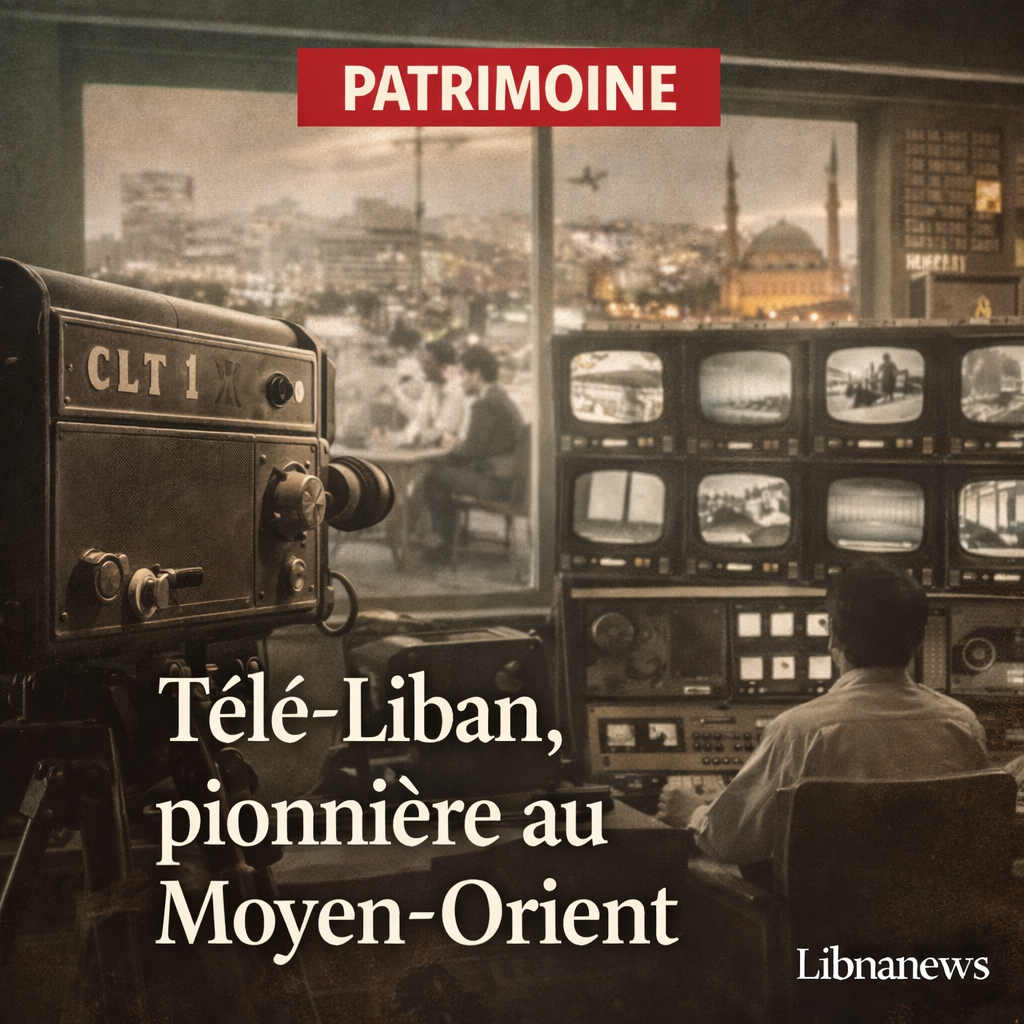
In the tumultuous history of Lebanon, a country with a thousand facets of foreign cultures, religions and influences, the birth of Télé-Lebanon is an emblematic chapter. This channel, the first public television in the Arab region, is not just a medium; It reflects an era of optimism and modernity, marked by the economic boom of the 1950s and 1960s. Based on the ruins of a political crisis and at the heart of a plural society, Télé-Lebanon was able to forge a unique cultural bond, before being caught up in the turmoil of the civil war. A review of the origins of this institution, which, more than sixty years after its creation, continues to symbolize Lebanese identity, recently honoured by Unesco as « Memory of the World ».
A TV while Lebanon was in full swing
To understand the genesis of Tele-Lebanon, one must return to Lebanon after independence. In 1943, the country emerged from the French mandate, inheriting a fragile but functional denominational system. The 1950s marked a period of relative prosperity, often referred to as the Lebanese golden age. Beirut, nicknamed « Middle East Switzerland », attracts investors and tourists, thanks to its thriving banking sector and strategic position. However, this stability was shaken by the 1958 crisis: an internal conflict between Arab nationalists, supported by Nassarian Egypt, and the pro-Western forces of President Camille Chamoun. The American intervention, with the landing of marines in Beirut, put an end to the crisis, but left behind.
It is in this climate of reconstruction and openness to the world that the idea of a national television is born. Lebanon, with its predominant Arabic, French and English multilingual population, aspires to position itself as a regional media hub. Unlike other Arab countries still under colonial influence or in full nationalization, Lebanon opted for an initial private model, reflecting its economic liberalism. As early as 1954, two visionary entrepreneurs, Wissam Ezzeddine and Joe Arida (sometimes spelled Alex Moufarrej in some sources), planned to create a television channel. Their project is part of a wave of technological innovations: television, invented in the 1920s in Europe, is beginning to democratize in the Middle East.
In October 1954, Ezzeddine and Mufarrej submitted an official request to the Lebanese government to establish a television station. After two years of negotiations in August 1956, they obtained the country’s first television licence. Thus, the Lebanese Television Company (CLT), a private company that marks the beginnings of television in Lebanon and in the Arab world, was founded. The premises are located in Tallet El Khayat, a lively neighbourhood of Beirut, symbolizing the rapid urbanization of the capital.
The first programs: a pioneering launch
28 May 1959 remains a date engraved in Lebanese media history: it is the day the CLT broadcasts its first programmes. At the time, television was an exotic novelty; Only a few wealthy households have a receiver. The CLT operates on two VHF channels: channel 7, dedicated to Arabic programming under the direction of Adel El Assaad, and channel 9, directed towards French and English, directed by Jean-Claude Boulos. This linguistic duality reflects the cultural diversity of Lebanon, where French, the language of the elite and of education, coexists with dialectical and literary Arabic.
The first face to appear on the screen is that of Najwa Kazoun, the Arab speaker, followed by May Abdel Sater for channel 7, and by Andrée Hani and Leny Nofal for channel 9. Hind Sayed presents the newspaper in Arabic, opening an era in which women occupy visible roles in the media. The first live show is the inauguration of the Exhibition of the Sports City, a symbolic event of modernity. Programs include objective newsletters, local fact sheets such asAbu MelhemandAbu Salimeducational programs and american or french imports, such asGood night, little onesorRintintin.
This historical image captures an emblematic moment ofAbu Melhem, a series that embodied lebanese humour and strengthened community ties.
Technically, the CLT innovates quickly. In 1967, Lebanon became the third country in the world to broadcast in colour via the French SECAM system, with a broadcast tested on only ten television sets. Supported by the French Sofirad, the CLT positions Lebanon as a regional technological leader. In Tripoli, the programmes are relayed on channels 4 (French/English) and 2 (Arabic), extending the coverage to the north of the country.
At the same time, in July 1961, a second private company emerged: Télé-Orient, or Société de Télévision du Liban et du Moyen-Orient (STLMO), operating from Hazmieh, in the eastern suburbs of Beirut. It broadcasts on channel 11, providing sound competition to the CLT. This private duality stimulates creativity: the two stations produce local content adapted to a plural audience, fostering cultural cohesion in a country divided denominationally.
The cultural and social role: a vector of unity
Tele-Lebanon, even before its public form, plays a pivotal role in Lebanese society. Having a TV becomes a sign of social status, marking the rise of the middle class. In working-class neighbourhoods or villages, families with no appliances gather at the neighbours’ homes to watch the programs, creating moments of conviviality. The series in Lebanese dialect, asAbu Salim, discuss with humour the themes of everyday life, transcending religious barriers.
Educational programmes, such as inter-curricular competitions, boost school enrolment and highlight the importance of education in a developing country. Music and culture occupy a central place: artists such as Sabah or Samira Toufic go on the air, forging a shared heritage. Even information remains neutral, avoiding biases in a volatile region. During Independence Day, the daytime broadcasts of the military parade inspire children, who parody soldiers in their lounges, strengthening patriotism.
This archive capture illustrates the visual treasure preserved by Télé-Lebanon, demonstrating its role in historical documentation.
However, television remains black and white for most households until the 1980s; The colour, introduced in 1967, is first a luxury. Some remember a colorful « pink » appearing briefly on the screen, a moment of collective wonder. The speakers, with their French rolling the « r » and their modest appearance, embody an ideal of modernity tempered by tradition.
Towards fusion and publicity: the shadows of war
The 1970s marked a turning point. The Lebanese civil war, which broke out in 1975, weakened the two private companies. The advertising market collapsed, the infrastructure was damaged, and the stations fell under the influence of the militias: the CLT channels in West Beirut were controlled by Muslim groups, while those from Tele Orient to Hazmieh were controlled by Christians. Coverage becomes partisan, undermining previous neutrality.
In the face of this chaos, President Elias Sarkis, elected in 1976, sees a unified television as a tool for reconciliation. In 1977, Decree-Law No. 100 authorized the merger of the two private entities with the State, which acquired 51% of the shares. On 7 July 1977, Télé-Lebanon was officially established as a public company, a state monopoly until 1994. This entity, renamed Télé-Lebanon in 1991, absorbs channels 7, 9, 5 and 11, becoming the official voice of Lebanon.
During the war (1975-1990), the chain was divided: TL1 in East Beirut, TL2 and TL3 in the West. Bombardments and sabotage aggravate its debts, but it survives, documenting the history of the country.
The contemporary heritage: from obsolescence to recognition
Today, Télé-Lebanon is often criticized for its archaism, overshadowed by private channels like LBC. Yet its archives, an invaluable treasure, were recognized by Unesco in 2023 as « Memory of the World », highlighting its role in preserving Lebanese culture. The Minister of Information, Ziad Makary, praised this distinction, recalling that Tele-Lebanon was « the first state-level television set up in the Arab world ».
The birth of Télé-Lebanon illustrates Lebanese resilience: from a pioneering private initiative to a public institution, it has navigated between prosperity and conflict, forging a collective identity. In a Lebanon still seeking stability, she recalls that the media can unite as much as divide. More than 60 years after its first signals, Télé-Lebanon remains a cultural beacon, although its radiance has faded.




