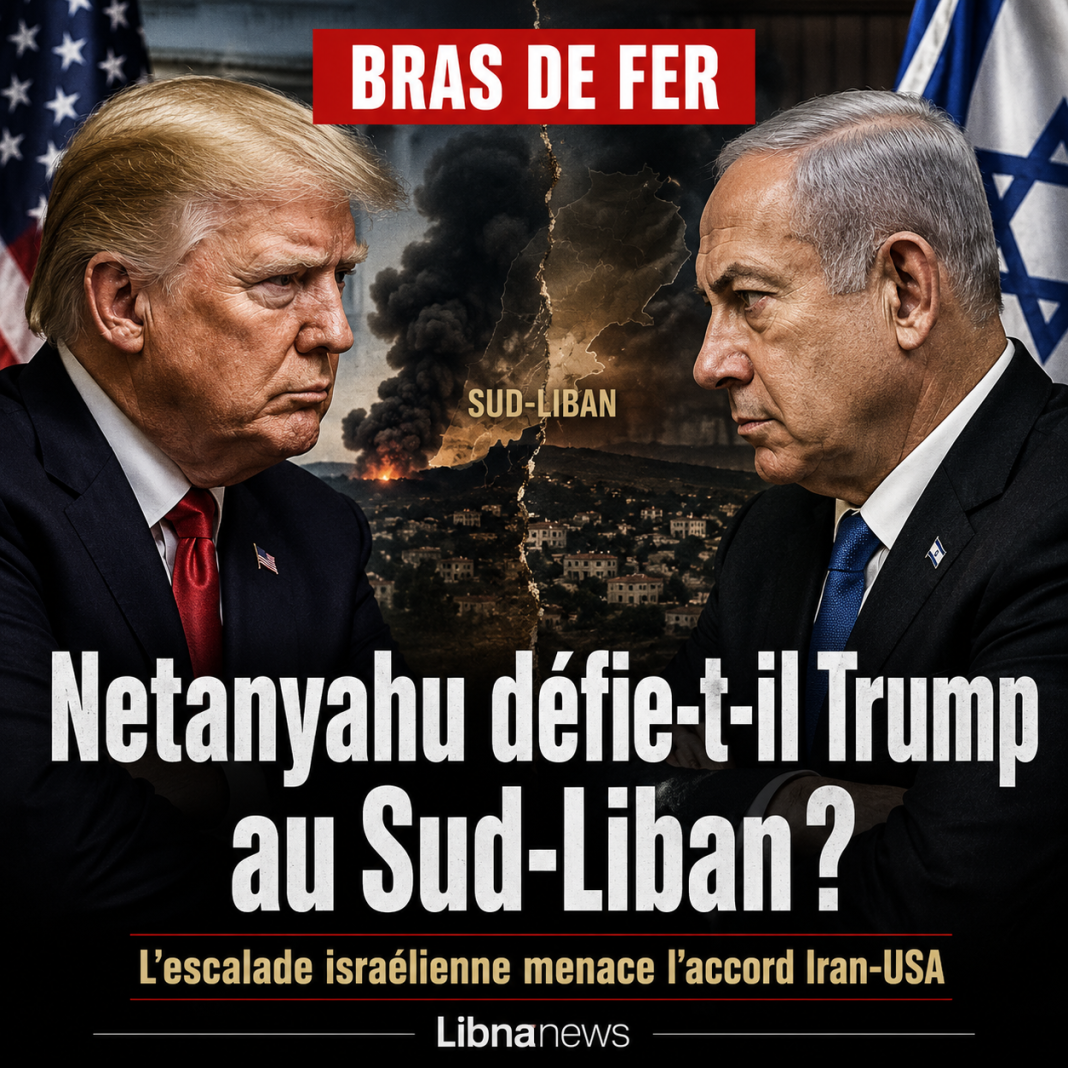






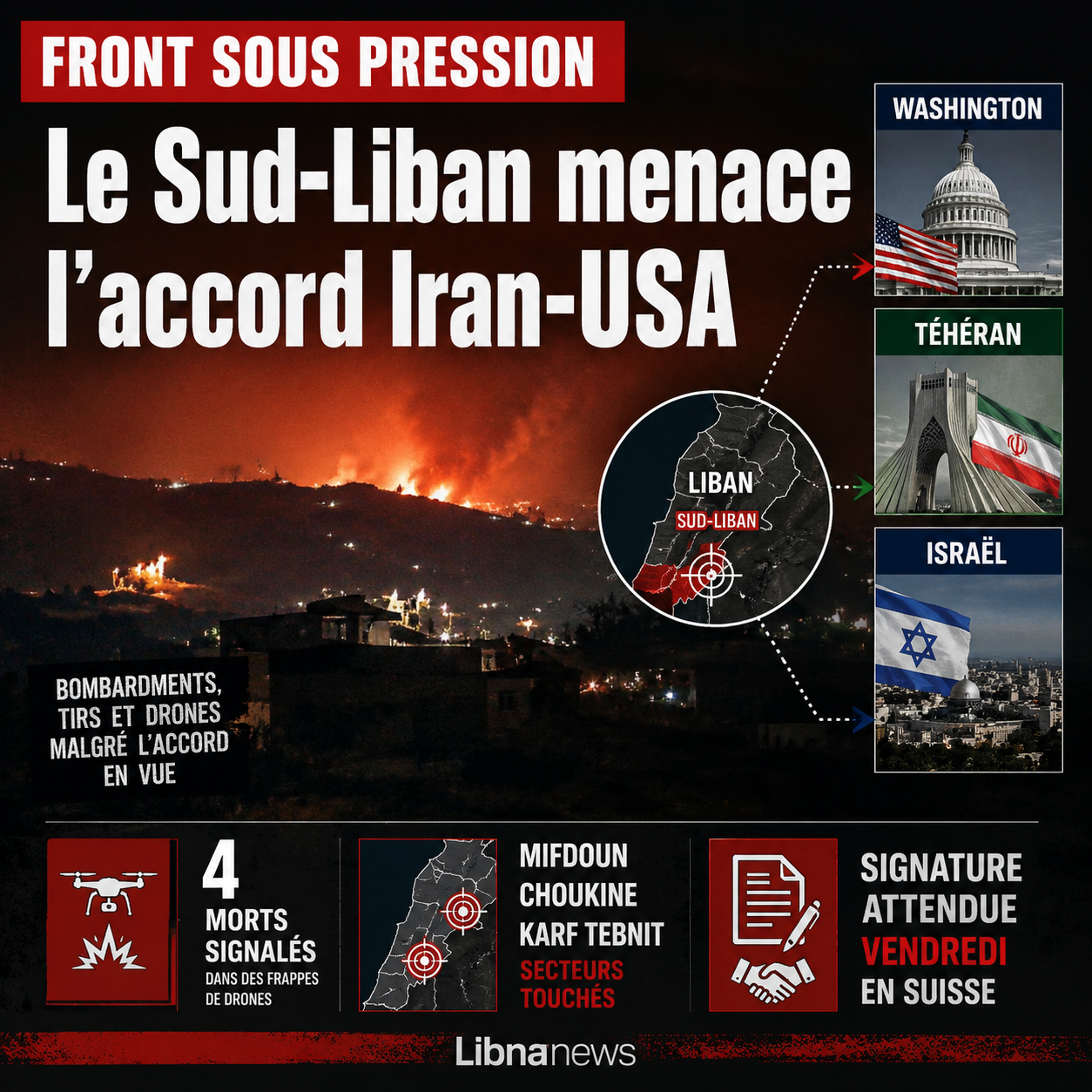
South Lebanon experienced a new night of bombing and exchange of fire, despite the announcement of a pending agreement between Washington and Tehran. Mifdoun, Choukine, Rihane, Hadatha-Haris and Kfar Tebnit are among the sectors affected or reported. Iran threatens to retaliate if Israel continues its attacks and maintains its forces in Lebanon, while the United States is increasing pressure on its Israeli ally.
In South Lebanon, on the night of 16-17 June, the regional ceasefire remained fragile. Israeli bombardments affected several areas of Nabatiyah Governorate and Jezzin District. Rocket, missile and drone fire were also reported around Kfar Tebnit, which became one of the most sensitive points of the contact line. Hezbollah claims to have targeted Israeli soldiers who were trying to advance in the area. The Israeli army says, for its part, that it is continuing operations against positions of the Lebanese Shiite movement.
The information available remains partial. The Lebanese National Information Agency reported drone strikes on several vehicles in Mifdoun and Choukin. Regional media also reported artillery fire on the outskirts of Rihane, in the district of Jezzine, as well as a drone strike against a van on the Hadatha-Haris axis in Bint Jbeil district. Al-Manar reported overflights of drones and raids on areas near Mifdoun, Choukin, Khiam and Chakra. These elements draw a dispersed military sequence, but dense enough to influence the open diplomatic dynamics between Washington and Tehran.
A night of strikes between Nabatiyah, Jezzine and Bint Jbeil
The main documented episode concerns Mifdoun, in Nabatiyah District. According to the National Information Agency, an Israeli drone hit a vehicle in the village. A second strike followed while people gathered at the scene. This type of strike, often described as a two-stage attack, increases the risk to rescuers, residents and journalists who visit the site after the first explosion. Two deaths were reported in this sequence.
Another strike hit Choukine, a locality not far from Mifdoun. Again, the attack targeted a vehicle. Two other people were killed, according to information relayed by the Lebanese agency and taken over by several international media. A total of at least four deaths and several injuries were reported during these drone strikes against three vehicles in the south of the country. The Israeli army did not immediately comment on these attacks within the first hours of their announcement.
The Mifdoun-Choukin sector is not annoyed. It is located in a back space of the immediate front line, but close to Nabatiyah and the axes used by local residents, rescuers and forces. The strikes created strong pressure on civilian movements. They also maintain the idea that the danger zone is no longer limited to directly border villages. For returning families to inspect their homes, this uncertainty becomes a concrete obstacle to return.
Rihane, Hadatha-Haris, Kfar Tebnit: an expanded voltage card
Further northeast, Israeli artillery fire was reported on the outskirts of Rihane, in the district of Jezzine. This hilly and strategic sector links the heights of Jezzine to the Nabatiyah approaches. It has already been affected several times since the expansion of Israeli operations in the spring. Bombardments in this area indicate that the Israeli army is still trying to maintain pressure on the terrains that dominate the southern roads.
In Bint Jbeil caza, a drone strike reportedly targeted a van on the Hadatha-Haris road. The first reports did not give a precise human assessment. The information therefore remains to be handled with caution. However, it confirms that Israeli drones continue to operate at a shallow depth in Lebanese territory, with spot strikes on vehicles. This tactic often involves alleged movements of combatants, equipment or local cadres, but it also exposes civilian roads to permanent risk.
Kfar Tebnit concentrates another dimension of the crisis. The village, located near Nabatiyah, is at the heart of an area where Israeli forces have increased in recent days. The Lebanese army had withdrawn from a position in the area after an Israeli advance in the vicinity. Hezbollah claims to have delayed an Israeli attempt towards Kfar Tebnit. According to regional media, its fighters used rockets, drones and direct fire against Israeli soldiers in the area. Israel did not recognize a loss of control of the initiative in this sector.
Hezbollah maintains military pressure
Hezbollah presents its actions as a response to the occupation of parts of Lebanese territory and Israeli strikes. In its communiqués, the movement insists on the defence of the villages of the South and on the refusal of a ceasefire that would leave Israeli troops there. This line allows it to justify the continuation of limited operations, even in the context of a regional agreement announced between the United States and Iran.
The exchanges around Kfar Tebnit are part of this logic. The movement did not claim a deep attack on Israeli territory in this sequence. Rather, it claims to target Israeli forces in Lebanon. This distinction is important. It allows Hezbollah to say that it does not directly break the regional truce, while maintaining armed pressure against the Israeli occupation. However, it leaves a dangerous margin of interpretation. Israel can view these shots as a direct threat to its soldiers and respond with broader strikes.
The sequence thus shows an active but contained front. At this stage, there is no massive rocket salve to the northern cities of Israel. Instead, localized fire, drone strikes, artillery bombardments and clashes around contact points are observed. This configuration can last several days. It can also shift rapidly if a heavier human balance sheet affects civilians, Israeli military or Hezbollah cadres.
Israel Wants to Keep its Freedom of Action
Israel claims to maintain its operations in Lebanon to prevent Hezbollah from reorganizing south of the Litani and around the axes overlooking Galilee. The Israeli Prime Minister reiterated that the army would remain in areas deemed necessary for Israel’s security. This position contradicts Lebanese, Iranian and American expectations of rapid de-escalation. It is, above all, an ambiguity: can a ceasefire stand if one of the parties retains troops in the territory of the other?
For the Israeli government, the presence in southern Lebanon is a security logic. It aims to prevent anti-tank fire, explosive drones or short-range rockets against northern Israel. For Beirut, it is an occupation. For Hezbollah, it justifies the continuation of armed resistance. For Iran, it becomes an argument in negotiations with the United States. The same military reality therefore produces four opposite readings.
This disagreement explains the intensity of the last few hours. The strikes on vehicles in Mifdoun and Choukine, the shots on Rihane and the clashes around Kfar Tebnit are not isolated incidents. They are part of a battle of positions before the expected formalization of the American-Iranian agreement. Israel wants to show that it will not be locked in a negotiated text without it. Hezbollah wants to show that Israeli withdrawal remains inevitable. Washington wants to prevent these two lines from failing together.
Iran raises tone on Lebanese issue
Tehran chose to place South Lebanon at the centre of its message. Iran’s foreign minister, Abbas Araghchi, said that lasting peace presupposes an end to Israeli occupation in Lebanon. Iranian officials also warned that a continuation of Israeli attacks could lead to a harsh response. The message targets both Israel and the United States. It means that Iran does not want to sign an agreement that would immediately be contradicted by bombardments in Lebanon.
Hezbollah itself suggested that Tehran would defend the Israeli withdrawal in the next phase of discussions with Washington. The movement does not present this withdrawal as a formal precondition for Friday’s signature. Rather, he describes it as an expected outcome of the process. This shade is important. It allows the agreement to remain possible, while giving Iran a lever of pressure after signing.
The Iranian threat therefore remains calibrated. Tehran doesn’t close the door. It sets a political limit. He claims that the continuation of Israeli raids or the continued existence of Israeli forces in southern Lebanon will be considered violations of the spirit of understanding. This position gives Iran an argument if the discussions were to begin after Friday. It also reassures Hezbollah, who fears being marginalized by a direct agreement between Washington and Tehran.
Iran-USA agreement under duress
The agreement between the United States and Iran must, according to several media, be formalized Friday in Switzerland. This would be a memorandum of understanding opening a 60-day negotiation period. The text would aim at stabilizing several fronts, restoring inspectors’ access to Iran’s nuclear file and organizing a gradual lifting of certain economic restrictions. The reopening of the Strait of Ormuz and the easing of the US naval blockade on Iranian ports are among the measures reported.
In this context, Lebanon occupies a special place. It is not the technical core of the nuclear issue. Nor is it simply a secondary theatre. It is the front on which Iran can demonstrate to its allies that negotiation produces tangible gains. It is also the front on which Israel can test the American determination to impose de-escalation. That is why night strikes have a diplomatic weight greater than their military reach alone.
The risk of failure before Friday exists, but it does not appear mechanical. The United States and Iran have an interest in preserving the open channel. Washington is trying to avoid a direct war with Iran. Tehran wants economic relief and an expensive maritime isolation. On the other hand, a serious incident in South Lebanon could impose a postponement, or tighten the terms of the signature. The most sensitive point therefore remains the American ability to obtain from Israel a visible reduction in its operations.
American Signals to Israel
Washington sent several signals of discontent to Israel. The case of Itamar Ben Gvir attracted attention. The Israeli Minister of National Security cancelled a trip to the United States after difficulties with the visa procedure. According to the Israeli press, the American authorities had asked him to present himself to provide his biometric fingerprints. This is not a confirmed official refusal. But the episode was read as a gesture of distance towards an Israeli extreme right figure, hostile to regional compromises.
Another signal concerns American refuelling aircraft stationed at Ben Gurion Airport. Media reports indicate that the US Army is preparing for the withdrawal of approximately 20% of these aircraft. This movement can have an operational and logistical explanation. It can also be read as a political choice. Refuellers are an essential tool for long-distance strikes. Their partial withdrawal reduces the visibility of a device that could be interpreted as preparation for direct confrontation with Iran.
These actions do not mean a break between Washington and Israel. The military alliance remains strong. But they show that the United States wants to limit its exposure. They do not want to be dragged into a sequence where Israel would hit Lebanon or Iran at the very moment when Washington is trying to sign an agreement. The reported lifting of the embargo on Iranian ports is in the same direction. It states that the US administration now favours a mechanism of relaxation, even if limited and reversible.
A sabotage or a pressure strategy?
The political question is asked with insistence: Does Israel seek to sabotage the agreement between Washington and Tehran? The facts do not make it clear as a certainty. However, they show that Israeli operations in southern Lebanon directly complicate the diplomatic sequence. Each strike gives Iran a motive for protest. Each Israeli advance gives Hezbollah an argument to continue its attacks. Each incident requires the United States to arbitrate between its Israeli ally and their goal of de-escalation with Iran.
Israel may consider that it acts primarily to preserve its security. His Government believed that Hezbollah should not take advantage of the agreement to return to border contact. He also refused to let Iran present the truce as a regional victory. This reading leads to preventive strikes, field checks and a willingness to retain positions. But the political effect of this strategy is clear: it makes the agreement more fragile.
For Washington, the challenge is therefore to turn pressure into discipline. The United States can push Israel to limit strikes, avoid densely populated areas and accept a discussion of a withdrawal schedule. They may also condition certain military or diplomatic facilities. Signals around Ben Gvir and refuellers show that this pressure exists. They don’t yet prove that it will be enough.
Lebanon as a trading variable
Lebanon remains the most exposed actor and the least master of the sequence. His Government called for respect for its sovereignty, the withdrawal of Israeli forces and the return to an international security framework. But it must deal with an armed Hezbollah, a national army weakened by the economic crisis and a population displaced by months of war. The Lebanese authorities have already called on the inhabitants not to return too quickly to certain areas for lack of security guarantees.
The humanitarian situation is heavy. The destruction in the South, Nabatiyah and several villages make it difficult to return. Houses are uninhabitable. Water and electricity networks remain fragile. The roads remain exposed to drones. The inhabitants who return to Mifdoun, Choukine, Kfar Tebnit or to the localities near the border do not find an established peace. They find a space suspended between announced ceasefire and residual violence.
It is this reality that can weigh on Friday. If strikes decline in the next few hours, negotiators will be able to present incidents as limited violations, to be dealt with in the next phase. If the bombing continues around Nabatiyah, Jezzine and Bint Jbeil, Iran will be able to demand stronger guarantees. The United States would then have to choose between a quick signature and a more binding text for Israel. In the field, drones continued to fly over the South in the morning.