

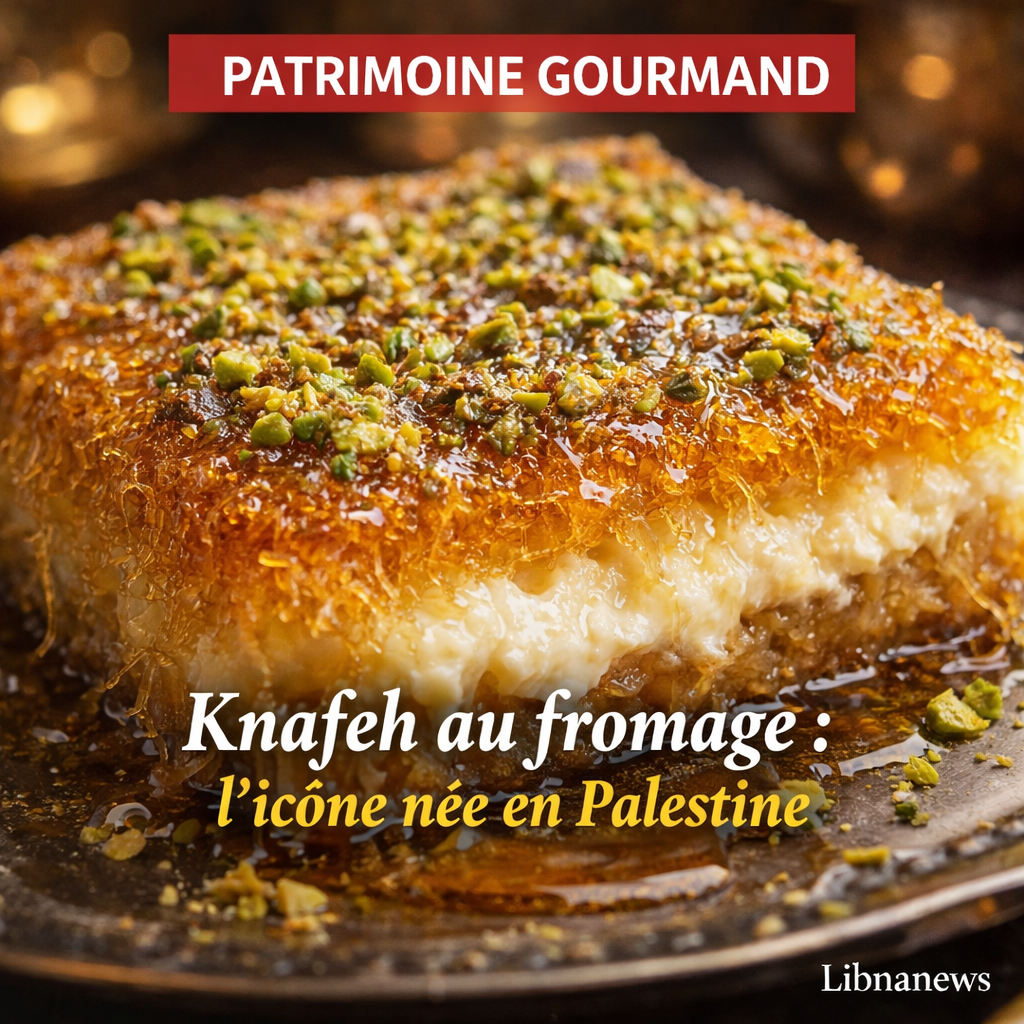
The cheese knafeh, a dessert composed of crunchy dough filaments coated with fragrant syrup and garnished with a heart melted with sweet cheese, represents a pillar of the Levantian pastry. This sweetness, rooted in the culinary traditions of the Middle East, illustrates the cultural exchanges that have marked the region over the centuries, transforming simple ingredients into a festive meal. In the Levant, where regional influences are mixed, the knafeh has provided moments of sharing, integrating craft practices that have adapted to local developments. Let us examine how this specialty, often tasted during family gatherings, defined food rituals in medieval and Ottoman Arab societies.
The historical roots of an iconic sweetness
The history of the knafeh goes back to the Caliphal eras, with origins debated but firmly rooted in the Arab world. Sources indicate that this stuffed pastry comes from the Fatimid era in the 10th century, where it would have emerged as a refined dessert in Egyptian courts. Other traces lead her back to the Abbasid period, between 750 and 1258, a period of culinary prosperity where the markets of Baghdad and Damascus were full of sweet innovations. A persistent legend attributed even to the Umayyad period, during the reign of Sulayman ibn Abd al-Malik (674-717), where she was allegedly served at royal banquets, her name derived from the Arabic verb « kanaf », meaning « host » or « envelop », evoking the way the dough surrounds the cheese.
In the Levant, the knafeh was established via trade routes, influenced by Palestinian and Syrian traditions. As early as the Middle Ages, it was sold by travelling merchants during the holidays, adapting local recipes based on spun dough and cheese. In the 15th century, with Ottoman expansion, it integrated the urban pastries of Nablus and Tripoli, where families of artisans perfected it. This legacy was manifested in shops where fresh knafeh was prepared in large quantities to meet daily demand.
Analytic, this evolution illustrates how knafeh transcended its street food status to become a symbol of cultural identity. In Lebanon, its artisanal production has supported local practices, with bakeries employing artisans trained in ancestral methods. In Palestine, especially in Nablus, the nabulsiyeh variant dominated, using a local cheese that gives a unique texture, while in Syria, Damascene influences added spicy notes. This diffusion reflects the historical interconnections of the Levant, where revenues have migrated with the populations and adapted to the terroirs.
Essential ingredients and their precise role
At the heart of the cheese knafeh is a selection of modest ingredients, transformed by a precise culinary alchemy. The base paste consists of kataifi, a dough spun from wheat flour, water and salt, forming fine filaments which, once cooked, offer a crisp and porous texture, ideal for absorbing syrup. Typically, 450 grams of kataifi for a standard recipe ensure optimal coverage, producing a cracker that characterizes the Khishneh variant.
The pranks vary, but the classic Levantines include a mixture of cheeses, such as l For 450 grams of cheese, we often add 200 grams of mozzarella for a better fusion, cooking up to a spinning consistency. Pistachios, ground with sugar, bring a contrasting crunch, with a ratio of 100 grams of nuts per 50 grams of sugar. The attar syrup, based on sugar, water and lemon juice, is boiled at 1:1 for a viscous consistency, infused with orange blossom water to balance the richness of cheeses.
In a historical Levantin context, these ingredients reflect local adaptations: families opted for local cheeses or substitutes such as ricotta, while pistachios imported from Iran remained a popular choice. This simplicity masks a nutritional complexity: knafeh provided protein from cheese and carbohydrates from syrup, with about 300 calories per serving, helping to maintain during shared meals.
The preparation technique analysed step by step
The making of the knafeh requires a technical mastery which raises this recipe to the rank of craft. The process begins with the preparation of the syrup: mix 200 grams of sugar in 200 ml of water, bring to a boil, add lemon juice and rose water, then simmer 10 minutes for a syrupy reduction. This syrup, cooled, will soak the finished knafeh for a balanced humidity.
Then the cheese: rinse the akkawi under cold water for 30 minutes to desalinate, then chop and mix with grated mozzarella. The kataifi paste is thawed, hand-cut or by robot for uniform filaments of about 5 cm, then impregnated with 150 grams of melted butter, possibly coloured with an orange food dye for a traditional golden hue. In a buttered dish 25 cm in diameter, spread half the dough, press firmly, add cheese evenly, then cover with the rest of the dough.
The cooking follows: in a preheated oven at 180°C for 20-25 minutes, until the edges brown, or on a heating plate for a travelling variant, turning to brown both sides. Once cooked, sprinkle immediately with hot syrup and garnish with chopped pistachios. Analytically, this method highlights practical challenges: in Lebanon, artisans used traditional techniques, adapting the recipe to the wet conditions of the coast. The family techniques, transmitted orally, incorporate tricks such as adding fine semolina for more crispy in the na-ameh variant.
Regional variations and contemporary adaptations
The knafeh has nuances depending on the region, reflecting the diversity of the country. In Lebanon, especially in Tripoli and Beirut, the Khishneh version dominates, with an abundant spun dough and a highly flavoured pink water akkawi cheese, reflecting Ottoman influences. In Syria, in Damascus, spicy nuts prevail, while in Palestine, in Nablus, Nabulsi cheese – a salty cheese from the city – adds a sweet salty note, with generous portions for extended families.
In Jordan, knafeh is often stuffed with Ashta cream and baked, sold by artisans at markets. Historical adaptations include vegan versions, using herbal cheese, responding to growing demand for lactose-free options. Internationally, as in Canada or the United States, chains offered ready-to-eat knafehs, stuffed with sweet cheese and orange-flavoured, adapting the recipe to Western palates.
These variations highlight socio-cultural dynamics: in Lebanon, home versions were gaining popularity, encouraging family exchanges. In Turkey, the Hatay künefe incorporates a double layer of dough, with a local stretchy cheese, marking a culinary border with the Levant.
Cultural significance in the Lebanese context
The knafeh transcends the dessert to embody deep social values in Lebanon. Served at gatherings, it symbolizes hospitality, often prepared in quantities for family taboos where generations gather. In Lebanese culture, influenced by Shia, Sunni and Christian communities, it unites during the holidays, even in times of regional tensions.
Analyze its role: during winter evenings, the knafeh facilitated exchanges, seniors teaching techniques to young people, strengthening family ties. Specialized pastries supported seasonal jobs, with production increasing in times of increased demand. This cultural dimension strengthened a national identity, where food made political divisions easier.
Historical practices in the Levant
In historical Levantine cuisines, knafeh maintained an increased presence, with preparations influenced by seasonal availability. Fresh cheese, abundant in winter, favoured creamy stuffings, while local pistachios enriched fillings. The artisans noted a demand for lighter versions, with less sugar – from 200 to 100 grams per litre of syrup – adapted to health concerns.
The markets in Beirut saw a flood for the fresh knafeh. Community initiatives, such as oral workshops, disseminated adapted recipes, perpetuating tradition while integrating tools of the time. This historical evolution would balance heritage and daily reality, where each portion consumed strengthened cultural resilience to persistent challenges.




