

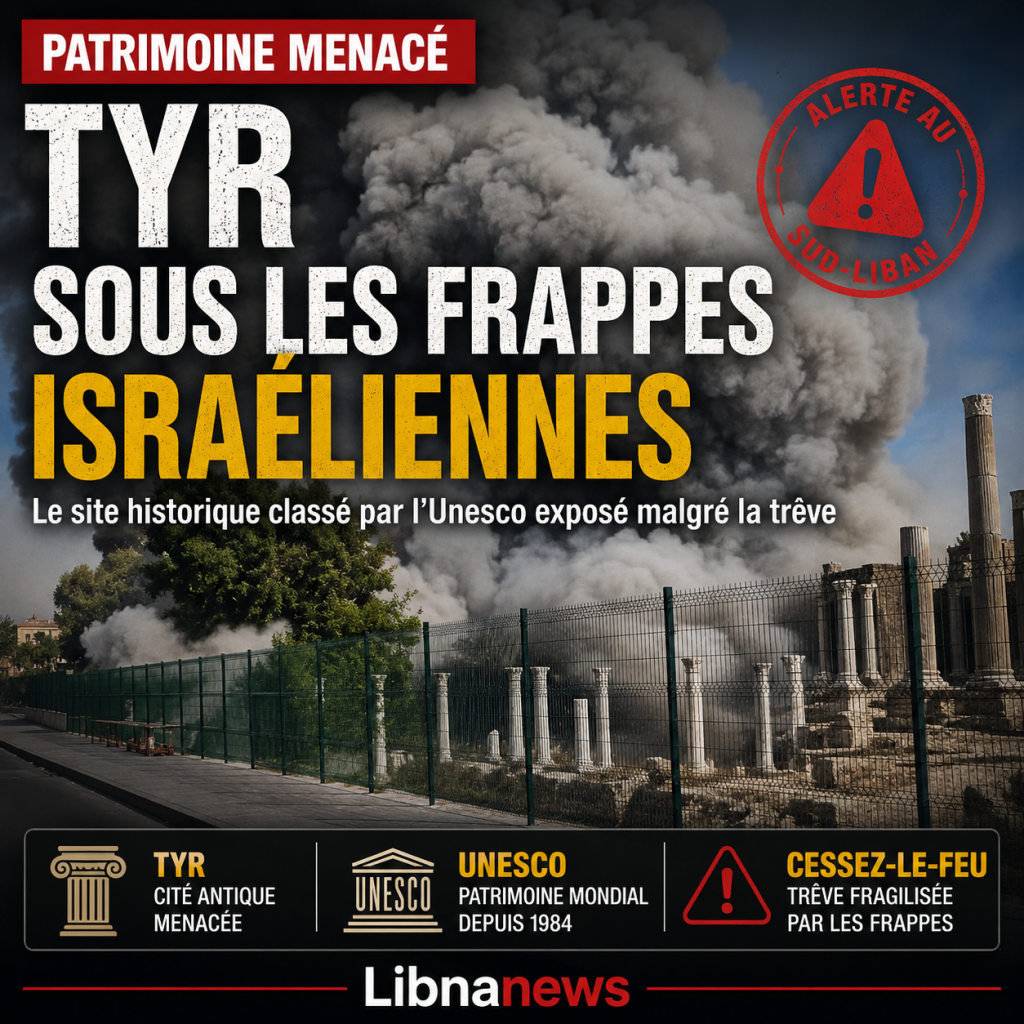
Israeli strikes were reported in the perimeter of the historic site of Tyre in southern Lebanon, while the city remains under repeated bombardments despite the announced ceasefire. The confirmation relates to the immediate proximity of the archaeological area and the new danger of a world heritage complex of Unesco. No full technical assessment has yet been made of the extent of direct damage to the remains, but the available information confirms that the strikes have moved closer to the historic heart of the city.
Tyre is not an ordinary city in Lebanese geography. It concentrates a Phoenician, Roman, Byzantine, medieval and Ottoman heritage, visible in the areas of Al-Bass and Al-Mina, in the hippodrome, necropolises, columns, paved roads and remains of the ancient port. Each explosion in this perimeter thus exposes a legacy that goes beyond Lebanon. People now fear that a war presented as a military will also become a threat to the material memory of the Eastern Mediterranean.
Tyre struck in its historic perimeter
Recent developments in the South indicate that Israeli attacks have affected the city of Tyre and its surroundings, including areas close to the classified archaeological site. The area concerned is part of a dense urban fabric, where the ruins are not separated from the modern city by a large protective belt. Houses, shops, roads, hospitals and remains coexist in a narrow space. This configuration makes every strike more dangerous for civilians and heritage.
The Lebanese Ministry of Culture had already warned in recent days about the serious danger facing Tyre. Bombardments had fallen very close to the ruins, according to official statements reported by a news agency. The resumption of strikes in the perimeter of the site confirms this alert. It shows that the mechanisms of heritage protection remain insufficient when Israeli aviation decides to strike a inhabited and classified city. The international classification did not prevent explosions. Nor has it guaranteed rapid access by experts to threatened areas.
Tyre is exposed to double vulnerability. The first is human. The city is home to residents, displaced families, caregivers, traders and municipal personnel who try to pursue a minimum life under drones and bombardments. The second is heritage. Ancient remains, sometimes weakened by time, infiltration, urbanization and unfinished restorations, can be damaged by a shock wave without even being directly affected. An old wall, column, pavement or vault do not react to an explosion like a modern building.
A World Heritage Under Bombs
The site of Tyre has been a UNESCO World Heritage Site since 1984. This recognition is based on the exceptional place of the city in Phoenician and Mediterranean history. Tyre was one of the great maritime powers of ancient times. It radiated through its trade, colonies, naval control and the production of purple, which became a symbol of wealth and power. The city also remains associated with the founding of Carthage by ancient tradition. Its history therefore far exceeds the current borders of Lebanon.
The vestiges visible today bear witness to this long stratification. In Al-Bass, the Roman hippodrome is one of the best known elements. Visitors discover steps, a monumental path, arches, sarcophagi and a necropolis. In Al-Mina, the coastal ruins recall the continuity between the port, the ancient city and the sea. These are not just tourist attractions. They are an archive of stone, a scientific source and an identity marker for the people of Tyre and for the whole country.
The strikes in the perimeter of the historic site call into question this continuity. They threaten visible remains, but also still buried layers. An ancient city is never limited to open monuments. Under the streets, under empty land, under recent constructions, archaeological levels can preserve essential traces. Bombings, craters, fires and vibrations can destroy these strata even before they are studied. The loss then becomes irreversible, because a destroyed archaeological data does not rebuild.
Modern city, ruins and civilians
In Tyre, the heritage is not in a desert. It is in the middle of a living city. This reality complicates the debate, but it cannot serve as an excuse for endangering the site. The ruins of Al-Bass and Al-Mina are close to residential areas, roads, shops and public facilities. The inhabitants pass by the remains to work, heal or leave the city. When an Israeli strike falls within this perimeter, it not only threatens an ancient stone. It also threatens civilian lives.
This superimposition between heritage and habitat gives Tyre a special dimension. The inhabitants do not only defend monuments. They defend their city as a space of continuity. The ruins are part of the daily landscape. They are not a remote reserve. They frame journeys, family stories, tourist activities and the image of the city. Their damage would be seen as a local injury as well as an international cultural loss. That’s why the calls to protect Tyre have been increasing for several days.
Several residents and local actors have called for the city to be considered an open and demilitarized city. This request is intended to prevent military use of the city and to reduce the risk of strikes. It reflects deep concern. The inhabitants know that the actual or alleged presence of armed actors in an area can serve as a justification for an Israeli attack. They therefore call on the Lebanese State to assume visible protection, including the deployment of the army and the verification of sensitive neighbourhoods. Their priority is simple: to prevent Tyre from becoming an urban battlefield.
Israel strikes despite ceasefire
The strike near the historic perimeter occurs in a sequence marked by the fragility of the ceasefire. The truce announcements did not end Israeli operations in Lebanon. The southern suburbs of Beirut were again targeted. Villages in the south have received evacuation orders. Lebanese Army roads, vehicles, hospitals and positions were reached. In this context, Tyre appears as another test of the reality of de-escalation. If a world heritage city remains under bombs, the truce loses much of its meaning.
Israel claims to be targeting Hezbollah infrastructure and responding to gunfire towards its territory. This argument is not sufficient to rule out the issue of civil and property risk. A military operation in an old, dense and classified city requires a very high level of precaution. International humanitarian law protects civilians. The conventions on cultural property also require the prevention of damage to heritage, unless there is a strictly regulated military necessity. Each strike near a classified site therefore requires a precise justification, not a general formula.
Israeli logic creates permanent insecurity. An area is threatened, then a building is hit, then a neighbourhood is evacuated. People never know if the next area announced will include their street, school or entrance to an archaeological site. This mechanics produces displacements, panics and closures. It transforms heritage into hostage to a changing military geography. Even without the massive destruction of the site, simply placing it in a bombardment perimeter is enough to break its function as a public, scientific and tourist place.
The invisible risk of shock waves
Property damage is not limited to direct impacts. In an ancient city, the shock wave can crack stones, move blocks, weaken vaults, disrupt old joints or aggravate already known weaknesses. Repeated vibrations can accelerate degradations that the naked eye does not see immediately. A quick inspection after a strike may therefore miss certain effects. Surveys, photographic comparisons, measurements, conservation specialists and secure access to the field are required.
This technical requirement becomes almost impossible under bombardments. The teams of the Ministry of Culture, archaeologists and conservatives cannot freely inspect the exposed areas. Roads are dangerous. Nearby buildings can be unstable. Drones remain present. Relief naturally gives priority to victims. Heritage is waiting, even though every hour can count to stabilize an affected element. This tension between human emergency and cultural preservation is one of the silent tragedies of urban wars.
Lebanon is already experiencing this problem. Its heritage has often survived wars, occupations, incomplete restorations and anarchic urbanization. But the current combination is more dangerous. The sites are legally protected, while remaining physically exposed. They are recognized worldwide, but dependent on weak local resources. They are documented, but not always digitized with the precision necessary to prepare a scientific reconstruction. Tyre concentrates all these frailties.
Lebanese and international responsibility
The protection of Tyre is not limited to Lebanon. The country is responsible for its assets, but it acts in a context of war, financial crisis and institutional weakness. Unesco, specialized agencies and partner states must treat this as an emergency. World heritage classification cannot remain symbolic. It must involve monitoring, documentation, diplomatic pressure and, as soon as possible, an assessment mission. Heritage cannot be protected only after its destruction.
The Lebanese authorities have already called for international mobilization around the threatened sites. They evoked Tyre, Beaufort Castle and other places in the South. This must now accelerate. Accurate mapping of strikes, measurement of distances from monuments, documentation of visible damage, and preparation of legal records are required. Satellite images can help. Local testimonies too. Old and recent photographs will make it possible to compare structures. The work will have to be methodical, because the defence of heritage is based on evidence, not only on indignation.
Lebanon’s partners must also speak clearly. Condemning damage to the heritage in general terms is no longer enough. We must name the strikes, their location and their effect. It should be remembered that a classified site cannot be treated as a mere collateral damage. The city of Tyre belongs to the memory of Lebanon, but it also belongs to the history of humanity. Its protection should therefore constitute a shared obligation.
Tyre, symbol of an overflowing war
The threat to Tyre shows that the war not only destroys military infrastructure or civilian buildings. It overflows into places of memory, urban landscapes and archaeological traces. It changes the way a society tells itself. When an ancient city is bombed, the inhabitants lose more than a material setting. They lose part of the continuity that links them to previous generations. This loss is not always recorded in the balance sheets. It is deep though.
Tyre has special value in Lebanon. It connects the coast, the sea, the Phoenician memory, the Roman presence, the Byzantine and medieval heritages, and then the modern history of the South. It is both a popular city, a port, a refuge, a tourist site and a national symbol. To strike it, or to strike its perimeter, is to put under threat several dimensions of the country: its inhabitants, its economy, its memory and its international image.
The risk is also that of habit. After several strikes, the exception becomes repetition. An explosion near a classified site first arouses the emotion, then another occurs, then the inhabitants get used to it by necessity. This standardization is dangerous. It reduces the alert capacity. It makes damage to heritage almost ordinary. But Tyre cannot become one more line in a list of strikes. Its value requires specific treatment, continuous monitoring and constant pressure to keep fighting away from its perimeter.
What confirmation requires
The confirmation of the strikes in the perimeter of the historic site of Tyre requires several observations. The first is that the ceasefire does not really protect heritage areas. The second is that international mechanisms remain too slow in the face of rapid military operations. The third is that the Lebanese State must document each attack around sites classified with judicial precision. The fourth is that the people of Tyre cannot be left alone in the face of a threat that also affects the international community.
A technical assessment is now required. The competent services will have to check whether ancient structures have been affected, cracked or weakened. They will also have to control the surroundings, fences, accesses, depots, protective panels and modern infrastructure of the site. Indirect damage counts. A damaged door, a destroyed surveillance facility or a cut-off road can prevent maintenance and promote looting. Heritage protection also depends on these modest elements.
The city must also remain accessible to relief workers and residents. Protecting the ruins cannot mean forgetting civilians. Both priorities are being strengthened. A city emptied, traumatized and bombed cannot protect its heritage. People forced to leave can no longer report damage, monitor sites or transmit their memories. Tyre needs comprehensive protection: human, urban, cultural and legal.
The next few hours will be crucial. The authorities will have to specify the number of strikes, the sectors affected, the human impact and the state of the remains. Cultural organizations will need access as soon as security permits. The mediators will have to say whether a truce that lets a listed city bomb is still operational. In Tyre, smoke is not just a threat to buildings. It rises above one of the oldest cities in the Mediterranean, sometimes a few meters from stones that tell three millennia of history.




