

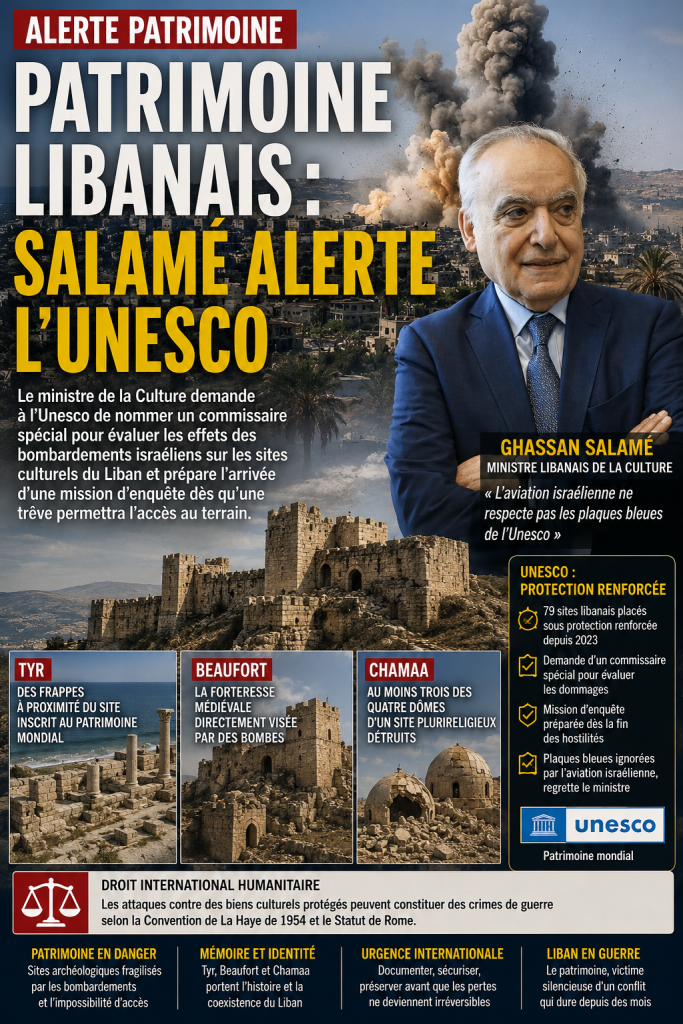
Lebanese Minister of Culture, Ghassan Salamé, warned on Friday of the serious danger to several archaeological sites in Lebanon, placing the Lebanese heritage at the heart of the emergency, following a further intensification of Israeli bombings in the South. In an interview with a press agency, he cited the ruins of Tyre, which were listed as a world heritage site, the medieval castle of Beaufort, in the Nabatiyah region, and the multi-religious site of Chamaa, near Tyre. The Minister asked Unesco to appoint a special commissioner to assess the effects of violence on Lebanese cultural sites and to prepare for a fact-finding mission as soon as a truce would allow access to the ground.
Ghassan Salamé’s alert comes the day after a new series of strikes in and around Tyre, an ancient city already at the heart of heritage concerns. According to the minister, shells fell near the ruins, while the ministry’s teams were unable to visit most of the sites because of the fighting. In Beaufort, he claims that the fortress was directly hit by Israeli bombings. In Chamaa, he evokes heavy damage to a religious and archaeological complex that would have lost at least three of its four domes.
Ghassan Salamé warns about Lebanese heritage
The message of the Minister of Culture is initially intended to be operational. It is no longer just a matter of denouncing possible attacks on Lebanese heritage. The aim is to seek an international, independent and rapid assessment of damage. Ghassan Salamé wants to appoint a UNesco Special Commissioner to monitor the effects of the violence. He also wants a commission of inquiry to visit Lebanon when security conditions permit.
This demand reflects a major difficulty. The Lebanese authorities say they lack direct access to the sites concerned. Roads are dangerous, fighting continues and areas close to monuments can be bombarded at any time. Without access to the land, damage remains assessed from testimonies, images, local correspondents and partial surveys. The Ministry cannot secure the sites, consolidate the structures, or establish a definitive balance sheet.
The use of Unesco therefore has two objectives. The first one is technical. We need to document, compare, map and prioritize damage. The second is political and legal. The presence of an international forum may remind belligerents that cultural property is afforded specific protection in times of conflict. This protection does not depend on the sentimental value of a monument. It is subject to international commitments, including the 1954 Hague Convention and its second Protocol.
Ghassan Salamé also recalled that Lebanon had placed blue plates on sites listed or protected by Unesco. These signs must make protected cultural property visible. However, the Minister regretted that Israeli aviation did not seem to respect these marks. His remark refers to a central point of the law of war: a known, identified and reported cultural site cannot be treated as a mere space for military manoeuvre.
Tyre, an ancient city again exposed
Tyre occupies a unique place in Lebanese and Mediterranean history. Ancient Phoenician city, major port of Antiquity, Roman and then Byzantine city, it concentrates vestiges that tell several millennia of exchanges, powers and civilizations. Its Roman hippodrome, necropolises, ancient ways, arches and port structures belong to a heritage that transcends the borders of Lebanon.
Recent strikes have revived an already old concern. Tyre had already been affected by damage near its archaeological areas in previous episodes of the war. This time, according to Ghassan Salamé, bombardments fell near the classified ruins. Press footage also showed an explosion and smoke plume in a neighbourhood close to the archaeological area. Even when a monument is not reached directly, shock waves can weaken ancient structures.
The danger is particularly serious for open, extended and integrated sites in the urban fabric. Tyre is not an isolated museum. The remains are close to inhabited neighbourhoods, roads, shops and roads. Any strike in the immediate environment can produce cracks, stone displacements, partial collapses or invisible damage at first. Dust, fire, vibration and shrapnel can also alter already fragile elements.
The city also received evacuation orders in the last few days. This military pressure adds an additional risk. When the inhabitants leave, the sites lose part of their daily monitoring. Technical teams can no longer intervene normally. Municipalities operate in emergency mode. The heritage then becomes doubly exposed: direct strikes and the impossibility of implementing immediate protective measures.
Beaufort, historic fortress and military stakes
Beaufort Castle, also known as Qalaat al-Shaqif, dominates the Nabatiyah region and the surrounding valley. Its position explains its historical importance. The fortress, associated with medieval periods and crusades, was also marked by contemporary wars. Israel had used it as a base during its occupation of southern Lebanon, completed in 2000. This military memory makes the site particularly sensitive.
According to Ghassan Salamé, Beaufort was directly beaten. He claims that several shells or bombs fell on the fortress. The region around the castle is now at the heart of a battle for the control of nearby localities. This proximity between a historic monument and an area of operations greatly increases the risk of destruction. However, it does not remove the protection due to the site.
The status of Beaufort raises a central question. A monument may have had military value in the past. This is not enough to make it a target today. Under international humanitarian law, only current, actual and concrete military use can alter the analysis. A cultural site does not lose its protection because it is located on a height, because it dominates a strategic area or because it has been used in previous conflicts.
The fortress is also a symbol of the South. It bears traces of occupation, fighting, reconstruction and competing memories. Its damage would not only be an architectural loss. It would have a collective reference, recognized by the inhabitants of the region and by heritage specialists. In a country where war has often left destroyed monuments, Beaufort embodies the difficulty of protecting history in still militarized spaces.
Chamaa, a heavily affected multi-religious site
The Minister of Culture also quoted Chamaa, about ten kilometres from Tyre. He described it as a very valuable site, where traces of several religious traditions cross. According to his statements, the site was heavily bombed and reportedly lost at least three of its four domes. This indicates serious structural damage, even if on-site expertise is still needed to establish the exact balance sheet.
Chamaa illustrates a often neglected dimension of Lebanese heritage. Not all important sites are known worldwide. Some have an essential local, religious and community memory. They can associate shrines, ancient remains, tombs, walls, domes, inscriptions and popular practices. Their value is not only measured by their seniority. It also attaches importance to their role in the continuity of villages.
The destruction of domes in a multi-religious site is of particular significance. It touches the materiality of a monument, but also the symbolic coexistence it represents. In southern Lebanon, places of worship and historical sites are often mixed with inhabited landscapes. They accompany roads, cemeteries, schools and houses. Their disappearance exacerbates the sense of uprooting felt by displaced inhabitants.
The inability to access the site complicates any intervention. The first hours after a bombardment are essential. They support a structure, cover fragments, secure stones, photograph damage and prevent secondary collapses. When fighting prohibits this response, part of the loss becomes irreversible even before an inventory can begin.
The reinforced protection of Unesco tested
Ghassan Salamé claims that Lebanon has managed to place seventy-nine sites under reinforced protection from Unesco, including Tyre and Beaufort, in the context of the Israeli attacks since 2023. International protection decisions have increased since the beginning of the escalation. In particular, Unesco had granted temporary enhanced protection to dozens of Lebanese cultural property, in order to recall its immunity from attacks and its prohibition on military use.
This enhanced protection constitutes the highest level of safeguard provided by international instruments on cultural property in the event of armed conflict. It means that the sites concerned must be protected from attacks, but also from any military use that would turn them into objectives. It commits the parties to the conflict. It may also establish responsibilities for serious violations.
On paper, the device is clear. In practice, it encounters the realities of war. A site marked with an emblem or registered in an international register remains vulnerable to an air strike, artillery, fire or blast effect of a nearby explosion. Legal protection has an effect only if the armed forces take it into account in the planning of operations. It involves up-to-date maps, targeting instructions, audits and command decisions.
The Lebanese Ministry is therefore seeking to transform protection into an active mechanism. The appointment of a special commissioner would make it possible to monitor sites, set priorities, dialogue with international institutions and prepare an emergency response. It would also prevent each attack from being treated as an isolated incident. Property damage is now a series that requires a coherent file.
Circumstances liable for liability
Violations of archaeological and religious sites may constitute serious violations of international humanitarian law. The Rome Statute calls it a war crime to intentionally direct attacks on buildings devoted to religion, education, art, science, charity and historical monuments, provided that they are not military objectives. The 1954 Hague Convention also requires the safeguarding and respect of cultural property.
The legal qualification will depend on established facts. It will be necessary to determine whether the sites were directly targeted or affected by close strikes, whether they were used for military purposes, what information was available for the attacker, what precautions were taken and whether the damage was proportionate to a concrete military advantage. An independent investigation is therefore necessary. That is exactly what the Lebanese Minister of Culture demands.
Repeating incidents, however, reinforces the gravity of the alert. Tyre, Beaufort and Chamaa are not unknown places. Their location is documented. Some are registered or reported. If strikes occur in the immediate vicinity or at these sites, military authorities must be able to explain the nature of the target, the reasons for the strike and the measures taken to avoid damage. Without a verifiable explanation, the suspicion of violation worsens.
Heritage protection does not compete with the protection of civilians. She’s one of them. Monuments, schools, places of worship and cemeteries structure the lives of people. Their destruction often accompanies forced displacement, loss of landmarks and the erasure of local memory. Defending Tyre, Beaufort or Chamaa is not a hijacking of human victims. It is to recognize that war also targets the conditions of return.
A cultural and national emergency
The alert of Ghassan Salamé arrives in a country already exhausted by crises. Lebanon lacks public resources, funding, specialized teams and emergency restoration capabilities. However, the protection of heritage requires rapid action. Damaged sites must be inventoried, photographed, secured and stabilized. Fragments must be preserved. The archives must be doubled. Local teams must be trained to intervene as soon as fighting stops.
The Ministry of Culture cannot act alone. It needs Unesco, Icomos, universities, municipalities, professional bodies, archaeologists, architects and donors. It must also work with the security authorities to allow access to the affected areas. This coordination is difficult in times of war. However, it becomes essential when sites are in emptied, bombed or partially inaccessible areas.
Lebanese heritage has often survived wars by the tenacity of the inhabitants and specialists. But the current sequence presents a new threat because of its intensity, its geographical extension and the impossibility of intervening quickly. A monument can resist a close strike and collapse later. A cracked dome may fall under a new vibration. An ancient wall can lose its stability after an invisible shock wave.
The request to Unesco is therefore intended to save time, create international pressure and prepare the ground work. It also recalls that heritage is not a luxury in a country at war. It is part of the national identity, the future economy, the memory of communities and the relationship between generations. In Tyre, Beaufort and Chamaa, the immediate challenge is to prevent bombings from adding an irreversible loss of Lebanese history to the list of dead and displaced persons.




