

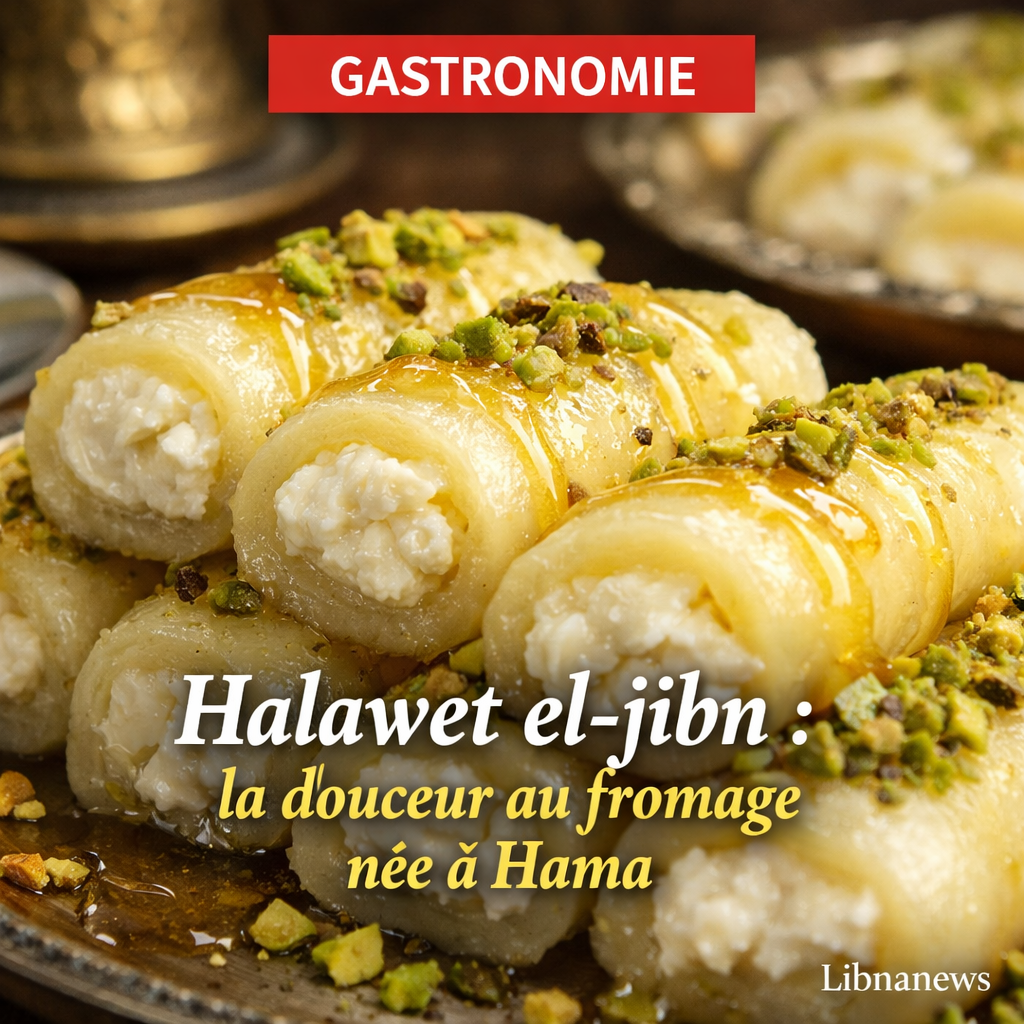
The halawet el-jibn, these sweet rolls with cheese that combine finesse and tradition, represent a pillar of the Levantine pastry. Invented in the 1870s by a sweet seller in Hama, Syria, these creations quickly transcended local borders to impose themselves as an emblem of the gastronomy of the Middle East. Their preparation, mixing melted cheese and semolina, illustrates a culinary ingenuity that is based on simple ingredients but requires precise technical mastery. At a time when trade and cultural exchanges at the Levant encouraged innovation, this sweetness emerged as a response to the search for new flavours, combining the salt of cheese with the sweet syrup. Let us analyse how this invention, rooted in a context of family traditions and handicrafts, continues to define regional pastry practices.
The origins of an iconic sweetness
The history of the halawet el-jibn dates back precisely to the 1870s, when the patriarch of the Salloura family, a travelling seller in Hama, Syria, designed a paste made from sweet cheese rolled around a sweet cream. This innovation was not fortuitous: it was part of a culinary landscape where local cheeses, such as l’akkawi, were abundant and syrups fragrant with orange blossom or rose were an integral part of desserts. The very name « halawet el-jibn », meaning « cheese sweetness », reflects this unexpected alliance between a traditionally salty ingredient and a sweet preparation. From the beginning, this softness was sold in the streets, attracting queues similar to those of a modern glacier, and symbolizing a form of democratization of gourmet pleasures.
Over the decades, the Salloura family has perfected its recipe, extending its influence to cities like Homs and Aleppo. This family development illustrates an economic model typical of the Levant, where know-how is passed on from generation to generation, favouring artisanal specialization. Sources indicate that, initially, the halawet el-jibn were simple strips of paste, watered with syrup and sold as a quick snack. The subsequent addition of a cream stuffing, or ashta, enriched the texture, transforming this sweetness into a more sophisticated dessert. This evolution reflects the social dynamics of the time, where religious and family holidays called for more elaborate preparations.
Today, although debates persist on the exact origins – some attributing creation to Homs or even Tripoli in Lebanon – the facts point to Hama as a cradle. This controversy highlights cultural interconnections in the Levant, where recipes migrate with people and adapt to local terroirs. For example, in Tripoli, the halawet el-jibn are often associated with the Hallab family, whose legacy dates back to 1881, marking a commercial expansion that has sustained the recipe.
Essential ingredients and their role
At the heart of the halawet el-jibn is a selection of modest but crucial ingredients, which give this sweetness its unique texture and taste balance. The cheese, traditionally from the akkawi or a mixture with mozzarella for better fondability, is the basis. This white cheese, semi-firm and slightly salty, is rinsed to soften its salt before being melted, allowing to obtain an elastic paste. Analytically, this choice is not annoyed: l的akkawi, native to the region of Acre in Palestine, offers an ideal melting capacity, avoiding granulosity while providing a smoothness that contrasts with semolina.
Fine meal, often based on durum wheat, acts as a binder, absorbing moisture from cheese to form a malleable paste. Typically, about a cup of meal is used for 200 grams of cheese, cooked with water and sugar. This ratio ensures neither too firm nor too soft consistency, essential for driving. The sugar, added in moderate amounts – three to five tablespoons depending on the preferences – balances the residual salt of the cheese, while the rose or orange blossom water infuses a subtle floral note, typical of the Middle Eastern desserts.
The stuffing, usually of l’ashta or qishta – a slit cream made of curded milk plus fresh cheese – brings a creamy richness. Prepared with thick cream, flour, corn starch and sugar, it is sometimes flavoured with vanilla or mastic for a more refined variant. Final garnishes, such as crushed pistachios or rose petals, add crunch and visual dimension, strengthening sensory appeal. This simplicity of the ingredients masks a technical complexity: a overcook can make the dough brittle, while a subcook it sticky leash.
From an analytical perspective, these components reflect a culinary economy adapted to local resources. Cheese and meal, basic products in the Levant, minimize costs while maximizing yield, making halawet el-jibn accessible to low-income households as well as to specialty pastries.
The technique of decorticated preparation
The making of halawet el-jibn requires a precision that raises this recipe to the rank of culinary art. The process begins with the preparation of the simple syrup: a cup of boiled water with a cup of sugar, fragrant with rose water, and simmered until a syrupy consistency is obtained. This syrup, cooled, will be poured onto the finished rolls for optimal humidity.
Then the dough: in a saucepan over medium heat, the grated cheese is melted in water, stirring constantly to avoid lumps. Once melted, the meal and sugar are incorporated, cooking the mixture until it detachs from the walls, forming an elastic ball – about five to seven minutes. This critical step requires increased vigilance, as heat must be moderate to maintain elasticity. The paste is then spread over an oiled surface, in a thin layer of about three millimetres, often using a roll for perfect uniformity.
The laashta stuffing is spread over the dough, which is then rolled tight and cut into five centimeters. Each roll is watered with syrup and sprinkled with pistachios. Let’s analyze the challenges: the cheese must be fresh to melt properly, and the hot dough to remain manipulatory. Variations include the use of mozzarella for a more accessible version outside the Levant, where the akkawi is rare.
This method, transmitted orally in families, highlights a cultural transmission that values the practical experience on accurate measurements, adapting the recipe to local conditions like ambient humidity.
Regional variations and adaptations
The halawet el-jibn have nuances in different regions, reflecting Levantin diversity. In Syria, especially in Hama and Homs, the original version favours a finer paste and an abundant stuffing with l-ashta, with a syrup strongly scented with rose. In Aleppo, there is a tendency to add nuts for an increased crunch, reflecting Ottoman influences on local pastries.
In Lebanon, especially in Tripoli, the halawet el-jibn are more robust, often stuffed with a denser cream and garnished with bright green pistachios. The Hallab family, for example, maintains a recipe where the cheese is a mixture of d This adaptation responds to a tourist market, where sweetness must remain appetizing for several hours.
In Palestine and Jordan, versions incorporate mastic into the stuffing, adding a subtle resin, while some recipes reduce sugar in the dough to accentuate the syrup. Analytically, these variations illustrate environmental adaptations: in drier areas, the paste is hydrated more; In coastal areas, fresh cheese dominates.
Modern adaptations include lactose-free versions, using vegetable cheese, or fruity garnishes for a contemporary touch, although purists maintain traditional forms.
Cultural significance in the Levant
The halawet el-jibn transcend the simple dessert to embody deep social values. Served at parties like Eid or weddings, they symbolize hospitality and sharing, often prepared in large quantities for family taboos. In Syrian culture, they evoke artisanal resilience, having survived Ottoman times and proxy to become an identity marker.
Let’s analyze their role: during gatherings, these sweets facilitate intergenerational exchanges, seniors teach young people the precise gestures. They also incorporate religious rituals, as during Ramadan, where they break the fast with moderate mildness, balancing nutrition and pleasure.
Economically, halawet al-jibn pastries support family chains, such as the Salloura in Syria or the Hallab in Lebanon, generating jobs and preserving know-how. This cultural dimension strengthens a regional identity where food unites across borders.
Immediate implications in contemporary practice
In current domestic and professional kitchens, halawet el-jibn maintains a stable presence, with preparations that vary according to the seasonal availability of ingredients. Fresh cheese, for example, is more abundant in the spring, influencing the frequency of making. Craftsmen note an increased demand for lighter versions of sugar, adapted to modern dietary preferences, while preserving essential floral flavours. This immediate evolution reflects a balance between tradition and adaptation, where each prepared roll perpetuates a legacy while responding to the daily contexts of consumers.




