



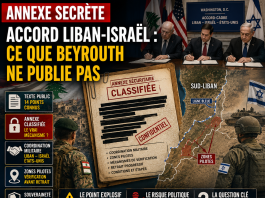


Lebanon-Israel: the clause that worries the victims of Israeli crimes
A clause in the Lebanon-Israel framework agreement calls on both sides to stop hostile or unfavourable actions in international political and legal forums. It could limit the ability of the Lebanese State to file a complaint against Israel for war crimes or to support an international referral. But it does not automatically block victims, NGOs, foreign jurisdictions or third States. The real challenge concerns Beirut's cooperation, the ICC's competence and the risk of peace built at the cost of amputated justice.
Hezbollah rejects framework agreement
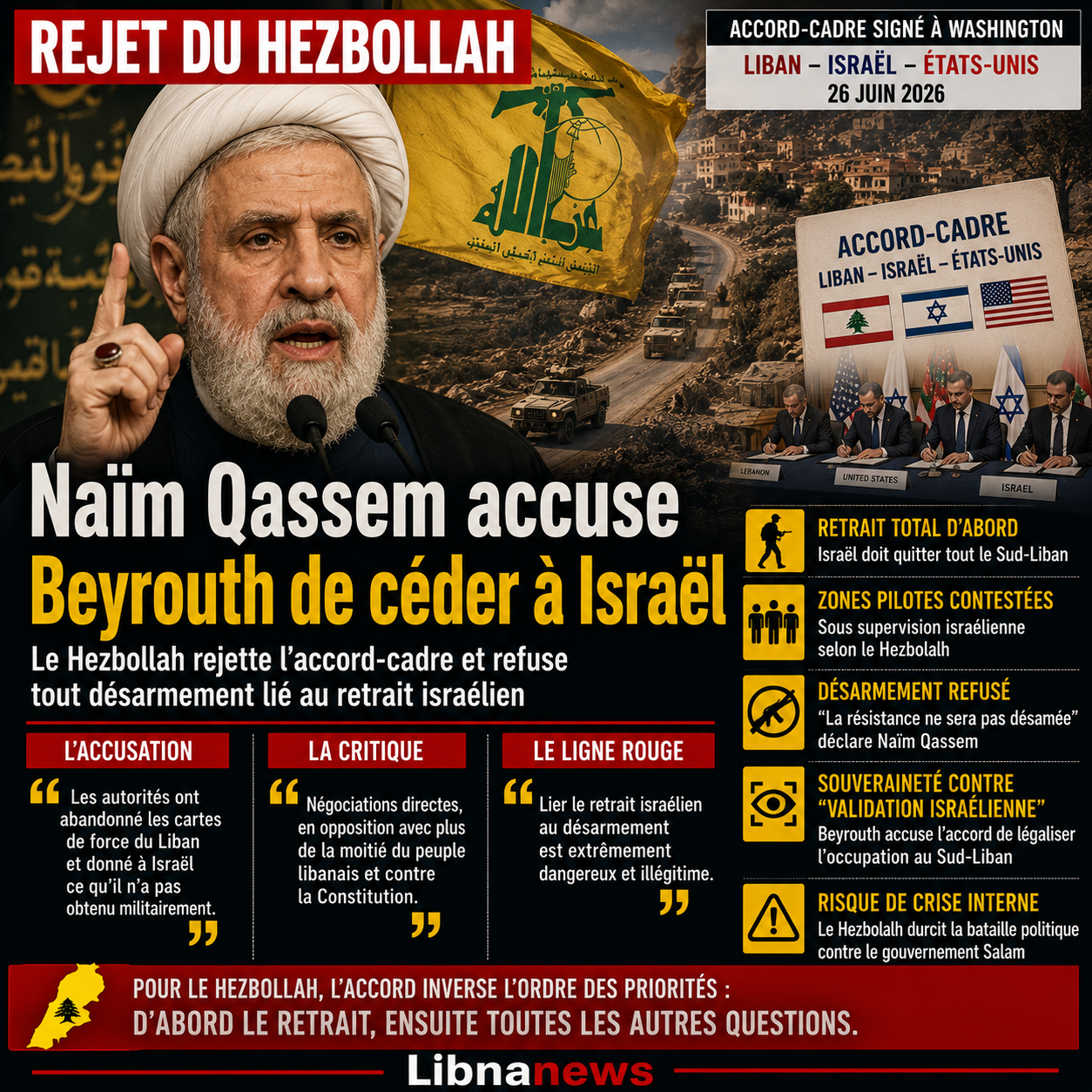
Hezbollah rejects the framework agreement signed in Washington between Lebanon, Israel and the United States. In a statement attributed to its secretary-general, Sheikh Naïm Qassem, the party accuses the Lebanese authorities of having abandoned Lebanon's cards of force, of having accepted direct negotiations deemed favourable to Israel and of having dangerously linked the Israeli withdrawal to the disarmament of resistance. Hezbollah claims that its weapons will not be surrendered and that any agreement must begin with the total withdrawal of the occupier.
Hezbollah rejects framework agreement
Hezbollah rejects the framework agreement signed in Washington between Lebanon, Israel and the United States. In a statement attributed to its secretary-general, Sheikh Naïm Qassem, the party accuses the Lebanese authorities of having abandoned Lebanon's cards of force, of having accepted direct negotiations deemed favourable to Israel and of having dangerously linked the Israeli withdrawal to the disarmament of resistance. Hezbollah claims that its weapons will not be surrendered and that any agreement must begin with the total withdrawal of the occupier.

Smotrich revives the fear of annexation in South Lebanon after the war; Israeli-Lebanese Agreement
Despite the framework agreement signed in Washington, Bezalel Smotrich's positions revive Lebanese concerns. The Israeli Minister reiterated his call to push the border to Litani and defended the maintenance of a safe area as long as Hezbollah was not disarmed or even colonized the Lebanese region. This line undermines the Lebanese reading of an agreement supposed to lead to Israeli withdrawal.
Lebanon-Israel Agreement: Under Tension in Beirut
The framework agreement signed in Washington on 26 June between Lebanon, Israel and the United States provoked a first round of political reactions in Beirut. Joseph Aoun, Nawaf Salam and Nada Hamadeh Mouawad presented him as a step towards the sovereignty and return of the displaced. Hezbollah, by Hassan Fadallah and Naim Qassem, rejects him and warns of a risk of internal crisis. Other officials are not mentioned for lack of a public response verified after the signature.

Lebanon-Israel agreement and the spectre of a new Lebanese civil war
The framework agreement signed in Washington between Lebanon and Israel is presented as a step towards peace. But several officials and analysts, both in Lebanon and Israel, believe that it can open a major internal crisis. The text places the Lebanese army at the centre of the disarmament of non-State armed groups, without a clear timetable for complete Israeli withdrawal. The previous agreement of 17 May 1983 recalls that a text signed with Israel under American sponsorship can revive internal fractures if it is perceived as imposed and unbalanced.
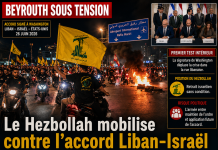
Beirut: protests against the Lebanon-Israel agreement
Demonstrations broke out in Beirut following the signing of the framework agreement between Lebanon and Israel in Washington. Hezbollah supporters blocked several routes, including the airport road, before the Lebanese army intervened. The Shiite movement rejects the text, which it considers a concession to Israel and a threat to its military role. This mobilization opens a delicate political phase for the government of Nawaf Salam.
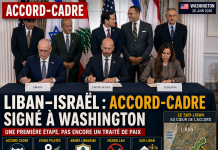
Lebanon-Israel: framework agreement signed in Washington
Lebanon and Israel signed a framework agreement in Washington, D.C., presented by the United States as a step towards a lasting political settlement. The text does not yet constitute a peace treaty, but it sets a framework for negotiations on pilot areas, Israeli withdrawal, the deployment of the Lebanese army, the role of Hezbollah and the reconstruction of southern Lebanon. Its scope will now depend on the published details, the calm on the ground and the ability of the parties to implement the first measures.
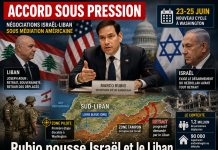
Israel-Lebanon negotiations: Rubio pushes agreement
Negotiations between Israel and Lebanon continue in Washington under the leadership of Marco Rubio. The United States wants to transform the discussions into a sustainable security mechanism, with a pilot zone, an increased role for the Lebanese army and a prospect of reconstruction. But the differences remain major. Lebanon demands a complete Israeli withdrawal and the return of the displaced, while Israel conditions any progress towards the demilitarization of the South and the disarmament of Hezbollah.

UNIFIL: Macron and Meloni prepare next
Emmanuel Macron and Giorgia Meloni announced their willingness to prepare a multinational coalition to support Lebanon after the end of the UNIFIL mandate. The Franco-Italian proposal remains to be defined, but it aims to avoid a security vacuum in southern Lebanon. Paris and Rome want to work with the European Union and the United Nations, while the UN mission must end its mandate at the end of 2026 before a gradual withdrawal.

Back South: Salam mobilizes the state
Nawaf Salam chaired a meeting on the return to the South and the launch of early recovery measures. The Prime Minister asked the ministries and agencies concerned to accompany the inhabitants, to speed up the identification of the damage, to clear the roads and to restore the electricity, water and telecommunications networks. The Government intends to mobilize available funds, including LEAP, the High Relief Commission and the Southern Council.

Judicial audit of production vessels electricity in Lebanon
Prime Minister Nawaf Salam announced that the terms of reference to launch a judicial audit on electricity-generating vessels were in its final stages. The document, prepared at the request of the Ministry of Energy, includes a specific part on the electrical ship file and a general part that can be used by other government departments. The Government presents this approach as a tool for transparency and monitoring waste in public administrations.

Official examinations cancelled in Lebanon
The Lebanese Council of Ministers decided to cancel the official final examinations for the current year, while providing for an exceptional session for some candidates. The meeting, held at the Baabda Palace under Joseph Aoun's chairmanship, also resulted in several appointments in the administration, the electricity sector, scientific research and the oil sector. The Government also approved the new Lebanese pre-university curriculum.

ال的معي
أقامت الجمعية الطبية اللبنانية الأوروبية عشاءها السنوي الرابع في باريس، بحضور حشد من الأطباء اللبنانيين والعاملين في الحقل الطبي في فرنسا وأوروبا، إلى جانب سفير لبنان في فرنسا ربيع الشاعر وعدد من الشخصيات والفعاليات الاغترابية.واستهلّ رئيس الجمعية الدكتور إيلي حداد المناسبة بكلمة رحّب فيها بالحضور، معرباً عن سعادته بانعقاد النسخة الرابعة من هذا اللقاء السنوي […]



