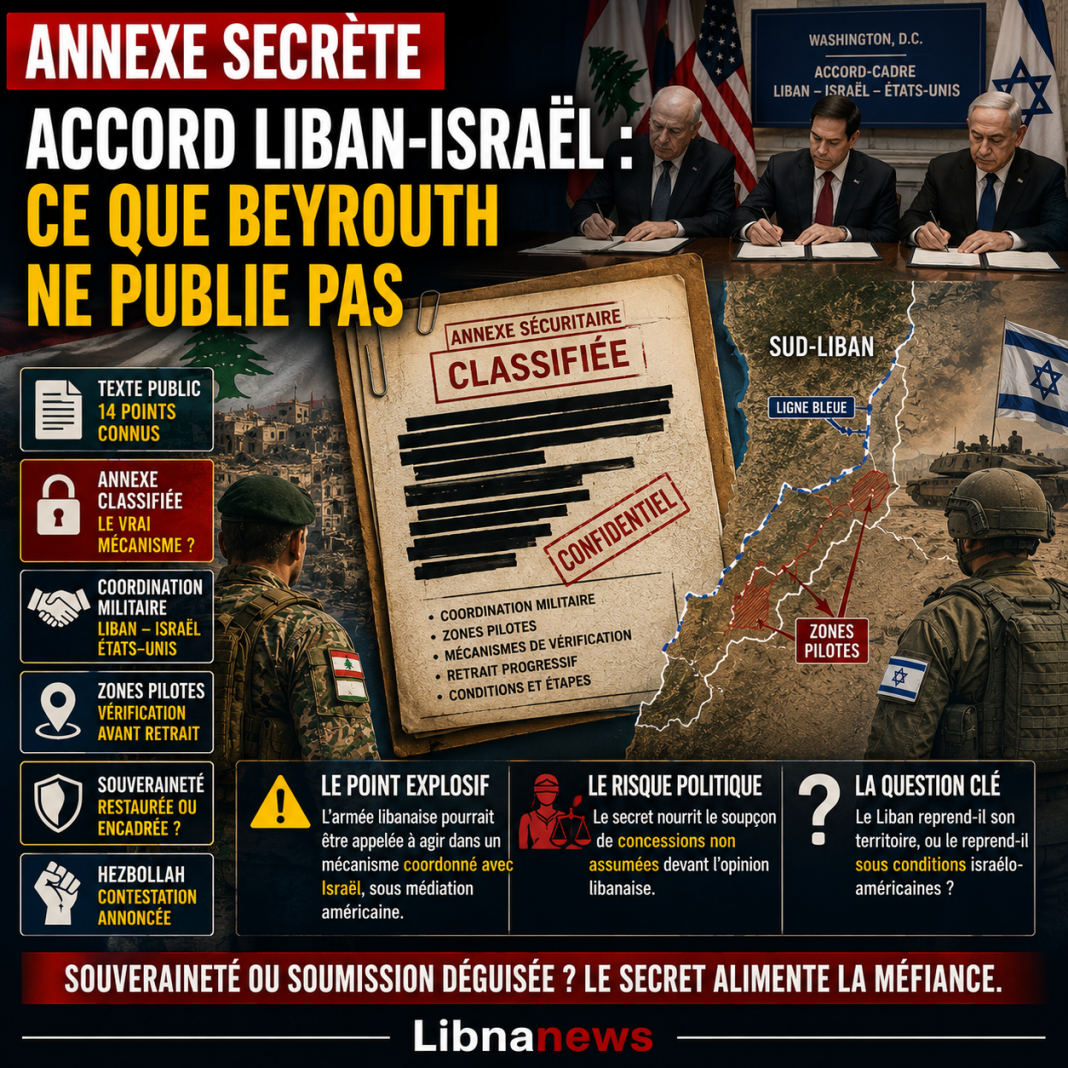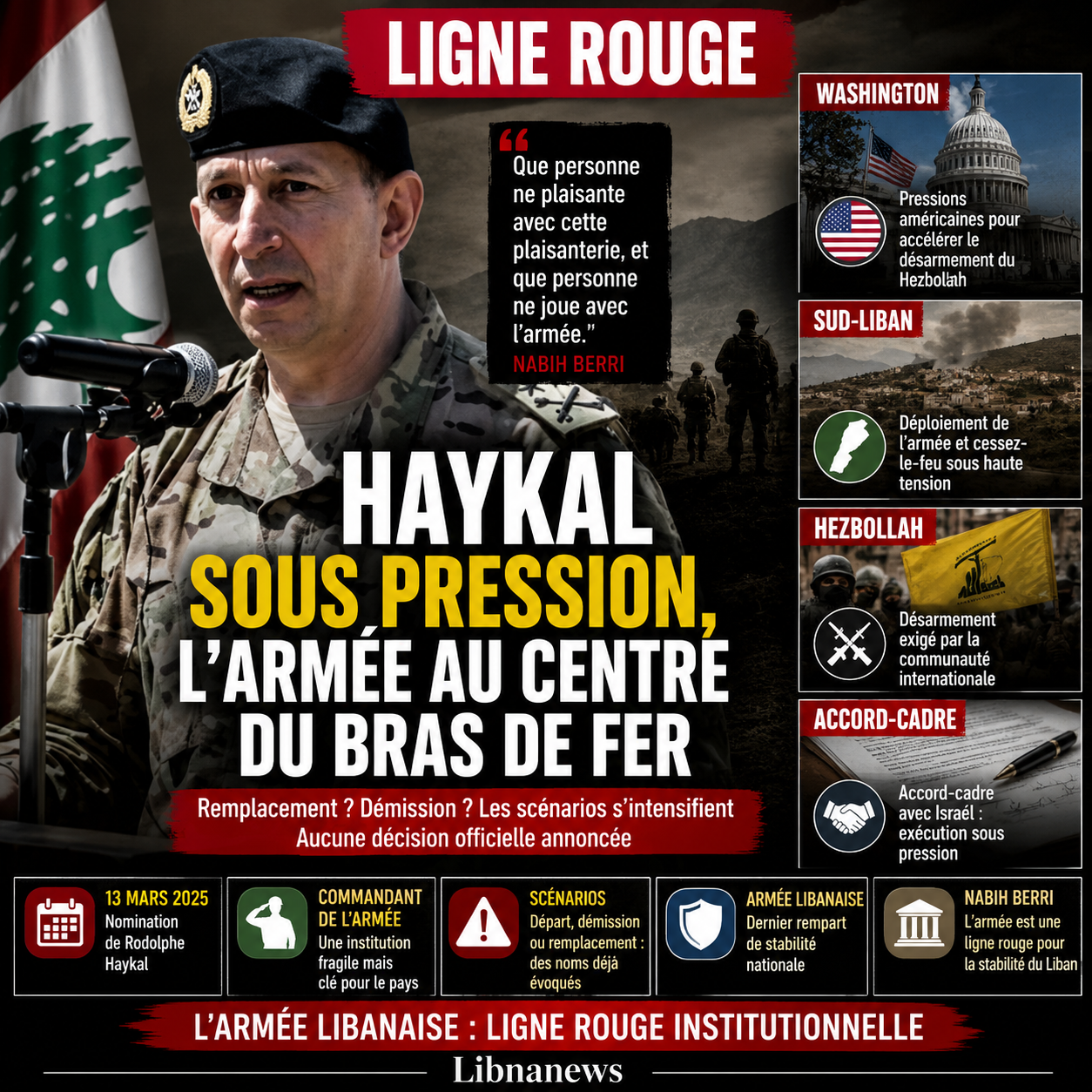







The President of the Lebanese Parliament, Nabih Berri, rejected on Monday the framework agreement concluded in Washington between Lebanon and Israel under American sponsorship. In an interview published by a Lebanese daily, the leader of the Amal movement described this text as « taxes » and considered it « ten times worse than the agreement of 17 May 1983 ». He also stated that the framework agreement « will not be executed », while calling on his supporters not to go down the street.
The tone used by Nabih Berri marks a clear break with the official presentation of the text, defended as a step towards a progressive Israeli withdrawal, a return of the Lebanese army to the South and a lasting stabilization of the border. For the Speaker of the House, the document signed in Washington does not protect the rights of Lebanon. In his view, it reverses the order of priorities by placing political and security conditions before the demand for a complete Israeli withdrawal.
The strongest formula concerns the parallel with 17 May 1983. « Ten times on 17 May rather than this agreement, » he said, according to reports from the Lebanese press. This sentence refers to a heavy symbol in the recent history of the country. The agreement of 17 May, concluded between Lebanon and Israel after the 1982 Israeli invasion, had been challenged by a large part of the political class and the street, before being repealed in 1984. By taking this reference, Nabih Berri inscribed the framework agreement in a national memory of refusal, external pressure and internal fracture.
Nabih Berri speaks of « taxes »
Nabih Berri does not present the framework agreement as a negotiated compromise. He describes it as a text dictated in Lebanon. According to his report, the agreement signed in Washington would consist of « taxes » rather than reciprocal commitments guaranteeing Lebanese interests. The choice of this word is not neutral. It means that the President of Parliament challenges both the method and the content. He suggests that Beirut would have accepted a framework designed by others under strong diplomatic pressure.
This charge is primarily directed at American sponsorship. Washington presented the agreement as a route of de-escalation after long months of tension in South Lebanon. But the Nabih Berri camp considers that the text primarily meets Israeli security requirements. The most sensitive issue is the disarmament of Hezbollah and the redeployment of the Lebanese army to so-called experimental areas. For Ain al-Tinah, the priority should be the opposite: Israel’s total withdrawal, the cessation of violations, the release of prisoners, the return of displaced inhabitants, and then discussion of security arrangements.
The President of Parliament also stressed the risk of internal disturbances. He warned against any street mobilization that could be exploited. According to the words reported on Saturday, he told the Lebanese: « O my people in Lebanon, all Lebanon is discord. He then took up a traditional formula calling to stay away from the fitna, without offering either back or milk milk. The message is addressed first to its own camp. It aims to channel anger and avoid confrontation between Lebanese.
This double register is characteristic of the position of Nabih Berri. He firmly rejects the text, but he refuses to appear as the trigger for a street confrontation. He has been speaking since an institutional function, that of Speaker of the House, while assuming his role as leader of a Shiite movement directly concerned with the future of the South. His line is therefore to move the battle towards the institutions. He wants to challenge the agreement in the Council of Ministers, in Parliament and in the political debate, without paving the way for security disorder.
The 17 May precedent placed at the centre of the debate
The comparison with the 17 May agreement gives Nabih Berri a historical dimension. In 1983, Lebanon had signed a text with Israel, including the withdrawal of Israeli forces and security arrangements. The context was that of the post-invasion of 1982, with a weakened state, divided institutions and a massive foreign military presence. The agreement was quickly perceived by its opponents as an imposed normalisation. Its repeal in March 1984 remains a political victory for them.
By claiming that the new agreement is « ten times worse » than the one of 1983, Nabih Berri is therefore not limited to a rhetorical comparison. He sought to place the Washington document in the same political category: that of an arrangement reached under duress and rejected by a decisive part of the country. This reference can mobilize a popular base sensitive to the history of resistance to the South. It can also put pressure on officials who defend the agreement in the name of diplomatic realism.
The strength of this comparison is also due to the personal role of Nabih Berri. The leader of the Amal movement was one of the actors in the political confrontation against the 17 May agreement. He therefore knows the symbolic burden of this date. By reminding her, he warned that the current text might suffer the same fate if it proceeded without national consensus. It also suggests that the formal adoption of an agreement is not sufficient to ensure its implementation, especially when political forces are able to influence it on the ground.
This memory may, however, accentuate cleavages. For the defenders of the framework agreement, Lebanon can no longer manage the southern border with the instruments of civil war and the 1980s. They believe that the country needs a stabilization mechanism, even an imperfect one, to allow the return of its inhabitants, relaunch reconstruction and avoid a new war. For Nabih Berri, the danger is the opposite. A text perceived as an abandonment of sovereignty could cause a more serious internal crisis than the status quo.
The battle of the sequence
Beyond words, the controversy is about the order of stages. The document presented in Washington provides for a gradual process. Israel would gradually withdraw from the areas where its forces entered southern Lebanon. The Lebanese army is reportedly deployed in certain areas. Non-State armed groups should withdraw their weapons and positions. Verification mechanisms would accompany this implementation. Supporters of the text claim that this architecture gives the Lebanese State the opportunity to regain its authority over the border.
Nabih Berri rejects this logic. According to him, it turns the Israeli withdrawal into a conditional result, whereas it should be a prior obligation. It considers that Lebanon should not agree to negotiate under partial occupation, nor should it subordinate the return to sovereignty to a series of security requirements. This position is tantamount to rejecting the principle of an immediate exchange between progressive disarmament and progressive withdrawal. First, it demands an end to the Israeli presence and attacks.
The disagreement is profound, because it affects the very definition of sovereignty. For the promoters of the agreement, the Lebanese State cannot fully claim its sovereignty if it does not hold the armed force alone in the South. For Nabih Berri and his allies, sovereignty begins with the departure of Israel and the cessation of any violation of the territory. Both readings use the same words, but they do not place priorities in the same place. The framework agreement thus becomes a sign of an old political conflict.
The debate also focuses on the experimental areas provided for in the text. They would test withdrawal, army deployment and security control in limited areas. This method is intended to be pragmatic. It reduces the risk of a general collapse of the process. But it worries the opponents, who see it as a way of cutting the South into conditioned spaces, without a global binding timetable for Israel. Nabih Berri defends an approach based on a clear, complete and verifiable withdrawal, before any further substantive discussion.
Government facing institutional challenge
The rejection of Nabih Berri creates an immediate difficulty for the government. The President of Parliament said that the Ministers of the Amal movement would not boycott a Council of Ministers meeting devoted to the agreement. They will participate and express their position. This clarification shows that the arm will be played in the institutional framework. It also confirms that the Berri camp does not want to let the government move forward without formal opposition.
The Speaker stated that the framework agreement « will not pass » and « will not be executed ». This declaration directly engages the political process. While the government supports the text, its implementation requires military, administrative and budgetary decisions. It also requires cooperation from Parliament if legislative or financial measures become necessary. Now Nabih Berri has a major lever on the Chamber’s agenda. Its refusal can therefore slow down, block or renegotiate the entire device.
The debate could also move towards the legal qualification of the text. Is it a simple political roadmap or an international agreement creating obligations for the State? The response will affect the procedure to be followed. A text on borders, the role of the army, Israeli withdrawal and security commitments cannot be treated as an ordinary communiqué. Several political forces should seek clarification on its exact content, annexes, guarantees and timetable.
This requirement of transparency becomes central. The content of the document has already given rise to contradictory readings. Some see it as a step towards the return of the state to the South. Others read a dangerous road map, which could place Lebanon under external surveillance. In this context, formulations matter. Delays also matter. The degree of American commitment, the nature of the guarantees given in Beirut and the obligations imposed on Israel will determine the government’s ability to defend the text before the public.
Army, crystallization point
Nabih Berri also reacted to reports of a possible attack on the army command. His words were direct: « Let no one joke about this joke, and let no one play with the army. He added that the military institution was a « red line. » This sequence shows that the framework agreement is not limited to relations with Israel. It also affects the internal balance of Lebanese institutions.
The army occupies a delicate position. It is called upon, in the scenario advocated by the promoters of the agreement, to deploy to sensitive areas of the South and to guarantee security there. But its resources remain limited. Its role depends on a minimum political consensus. If it appears to be the instrument of a plan rejected by a significant part of the country, it may be drawn into a confrontation that it is seeking precisely to avoid. Nabih Berri exploits this fear to remind that the army must not become the ground for settling accounts.
The mention of the army commander gives an additional scope to his warning. It means that any attempt to move the crisis to the military institution could provoke a strong political reaction. For the Speaker of the House, the stability of the army remains one of the last points of support of the State. He therefore refused to allow it to be weakened as the country entered into a sequence of diplomatic and security tensions. This position can be echoed beyond its side.
The government will therefore have to protect the army from excessive politicization. It should specify its missions, means, rules of engagement and international safeguards associated with any redeployment. Without these elements, the framework agreement could put soldiers at the heart of conflicting expectations. Some will want to impose a state monopoly. Others will refuse to replace a comprehensive negotiation on Israeli withdrawal and security from the South.
The American-Iranian Canal as the only way out
Nabih Berri also identified the most realistic framework for achieving results. According to him, the only chance of wrestling Lebanon’s rights and forcing Israel to withdraw fully lies in the American-Iranian negotiating channel. This statement reflects a regional reading of the balance of power. For the President of Parliament, the Lebanese issue cannot be isolated from the balances between Washington, Tehran and Israel. A direct negotiation between Beirut and Israel, conducted under American and Israeli conditions, is likely to prolong the occupation.
This is tantamount to recognizing the weight of the Iranian factor in the Lebanese case. It assumes that the issue of Hezbollah, its weapons and its role in the South cannot be resolved simply by a government decision. It also states that the Speaker of the Chamber does not believe in a strictly Lebanese-Lebanese outcome in the immediate future. Lebanon could express its demands, but Israel’s balance of power was, in its view, being played on a broader scale.
This reading irritates the supporters of a strict return of the decision within the Lebanese institutions. For them, linking the destiny of the South to the American-Iranian Canal is to prolong the country’s dependence on outside powers. They believe that the framework agreement, despite its shadow zones, can provide a national mechanism under international supervision. Berri’s refusal thus opens another debate: that of the real capacity of the Lebanese State to decide alone on a security arrangement with Israel.
The President of Parliament did not call for any diplomatic contact to be broken. Rather, he rejected the current form of the process. His remarks suggest that another framework might be acceptable if it began with Israeli withdrawal, if it guaranteed Lebanese rights and if it avoided bringing the bulk of obligations to Beirut. This shade will be important in the coming days. It can be used as a gateway to a renegotiation. It can also become a means of maintaining the blockage while refusing the charge of obstruction.
An open political crisis in the South as in Beirut
The refusal of Nabih Berri is all the more so as the situation in the South remains unstable. The inhabitants of many localities are waiting for security guarantees to return in a sustainable manner. Destruction requires substantial funding. Municipalities are demanding resources. Displaced families want concrete answers. In this reality, the debate on the framework agreement is not just a clash of slogans. It concerns the timetable for return, reconstruction and effective control of the territory.
The government will now have to choose its pace. An acceleration without consensus could worsen the political crisis. A freeze in the process would weaken Beirut’s credibility with the sponsors of the agreement. A renegotiation could provide intermediate space, but it would require American and Israeli concessions on the sequence of withdrawal. It would also require internal clarification of the role of Hezbollah, the authority of the army and the guarantees offered to the inhabitants of the South.
In the next few hours, the positions of the other parliamentary blocs will measure the magnitude of the balance of power. Hezbollah opponents should defend the agreement as an opportunity to restore state authority. Nabih Berri’s allies should stress the imposition of the text and the priority of Israeli withdrawal. In between, several officials will try to preserve the army and avoid an institutional explosion. The first test will come from a government meeting if the agreement is on the agenda.