





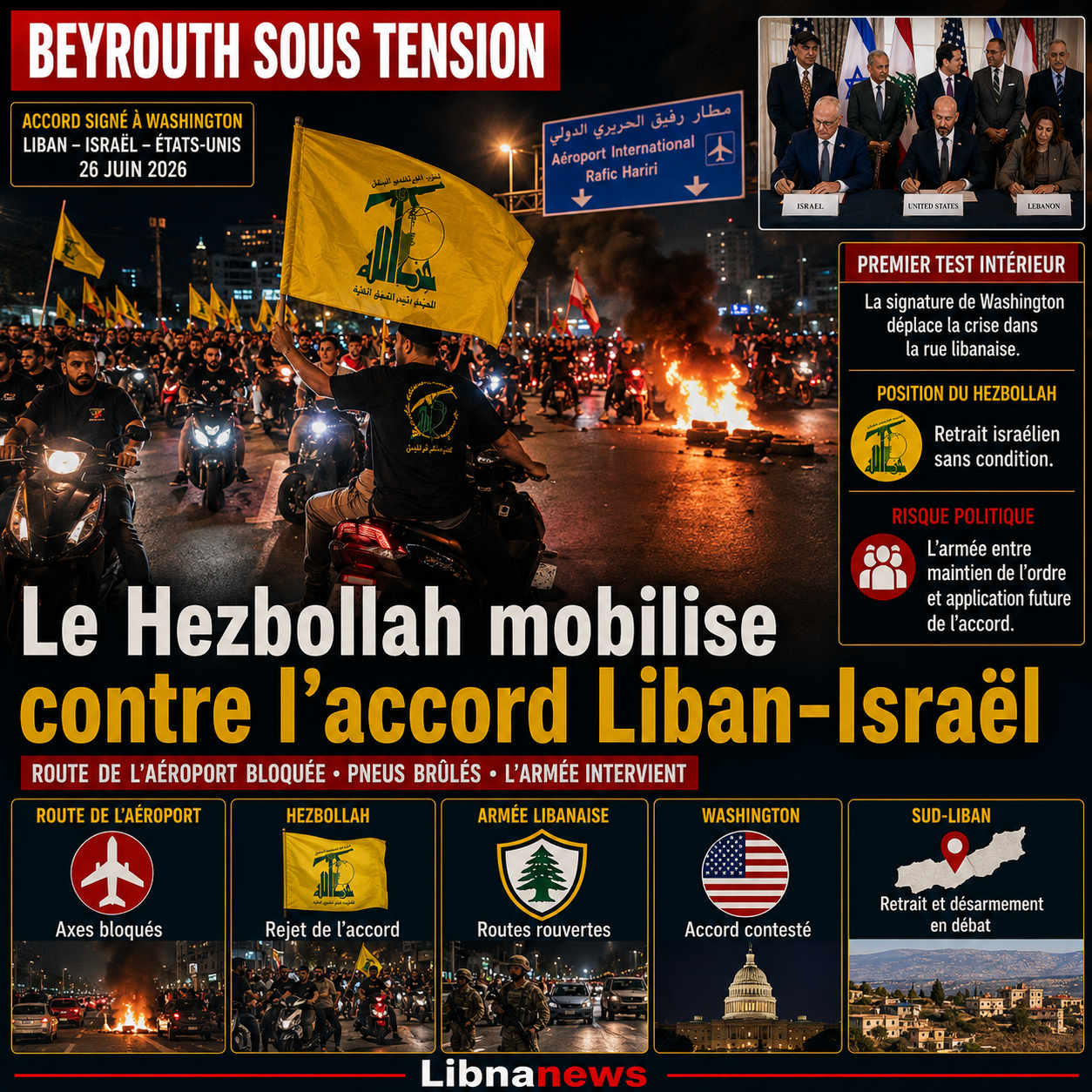
The first demonstrations against the framework agreement signed in Washington between Lebanon and Israel broke out in Beirut on the night of Friday to Saturday. Hezbollah supporters rode on motorcycles in several parts of the capital and its southern suburbs before blocking several routes, including the road to Beirut International Airport. Tires were burned at at least one crossing point. The Lebanese Armed Forces intervened to reopen the roads and contain the rallies, without any immediate release of an official report of the wounded.
A quick challenge after signature
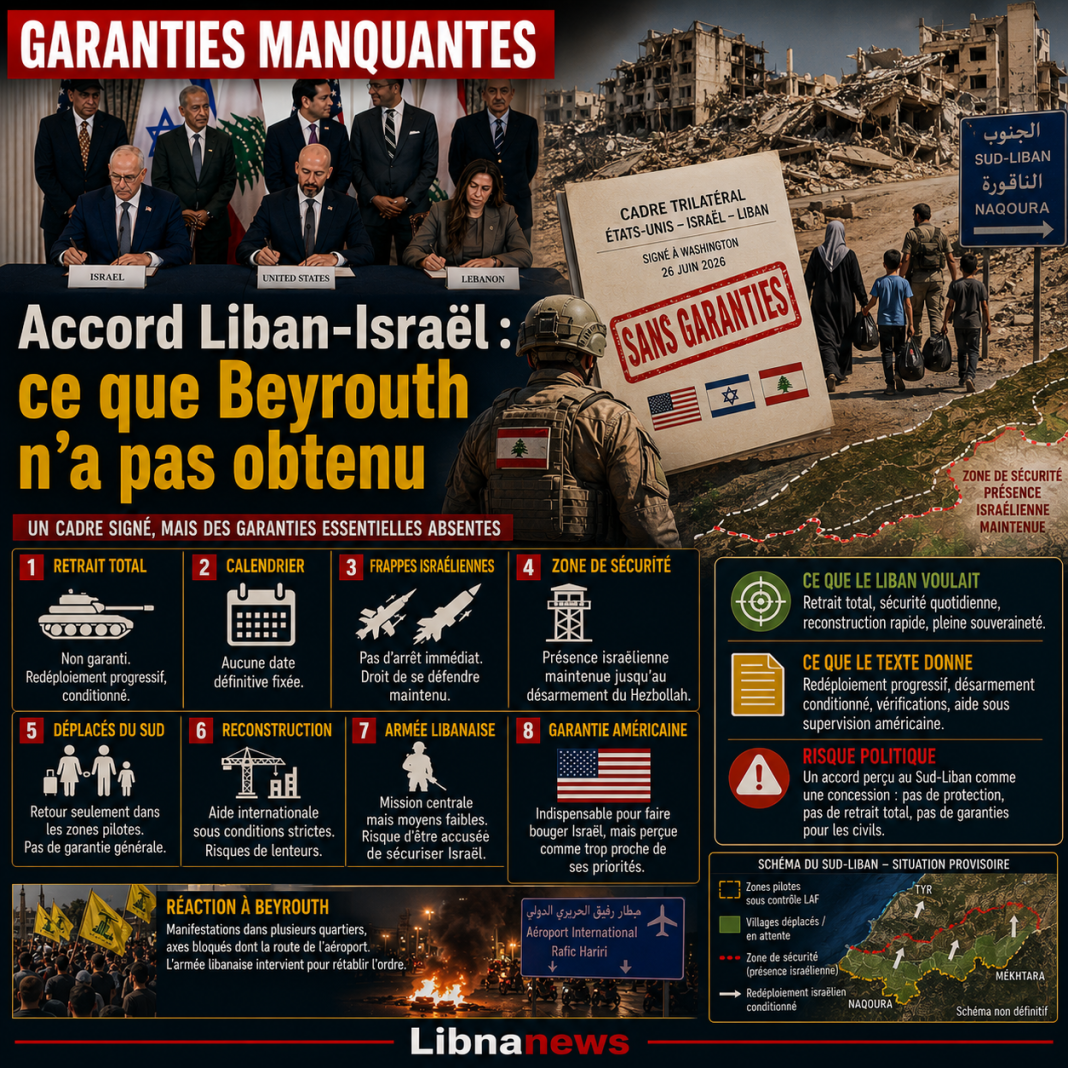
This mobilization reflects the depth of the rejection of part of the Hezbollah camp against the text signed in the United States. The agreement, presented by Washington as a step towards peace between Lebanon and Israel, provides for a process of pilot zones, the deployment of the Lebanese army and verified disarmament of non-State armed groups. For its opponents, it is, above all, paving the way for political normalization with Israel, while accepting a transitional Israeli military presence in southern Lebanon.
Hezbollah’s reaction has come at two levels. Its Secretary General, Naïm Qassem, reaffirmed that the Israeli army must leave southern Lebanon and cease its unconditional land and air attacks. A party MP, Hassan Fadllallah, attacked the framework agreement more directly, calling it a text without operational value. He also warned that the Lebanese authorities could not impose its application without opening internal confrontation. These positions put the government at an immediate difficulty: defending an agreement presented as an instrument of sovereignty, while the main armed actor targeted by the text publicly rejects it.
The demonstrations did not immediately take on the scope of a structured national movement. However, they have had a strong political impact. They took place only a few hours after the signing was announced in Washington. They have touched symbolic places, including the airport road, a sensitive axis of the capital. They also demonstrated the ability of Hezbollah supporters to react quickly in public space, mobilize motorized processions and transform diplomatic disagreement into street pressure.
Airport road and blocked roads
The images broadcast by several Arab and Lebanese media show motorbike parades, Hezbollah flags, rallies in the southern suburbs and interrupted axes. slogans against the agreement have been reported. The demonstrators denounced a text presented as a concession to Israel and as an attack on the so-called line of resistance. In some rallies, protesters called for the fall of the government of Nawaf Salam, accused of having accepted a framework deemed favourable to American and Israeli demands.
The choice of the airport route is not insignificant. This axis has often served as a place of political pressure in Lebanon in major crises. Blocking it is like touching a strategic infrastructure, sending a message to the government and showing that the capital can be paralyzed quickly. The army’s intervention to reopen the road was therefore aimed at preventing an expansion of the movement and preserving traffic to the airport, particularly sensitive in the context of the expected return of the diaspora and economic fragility.
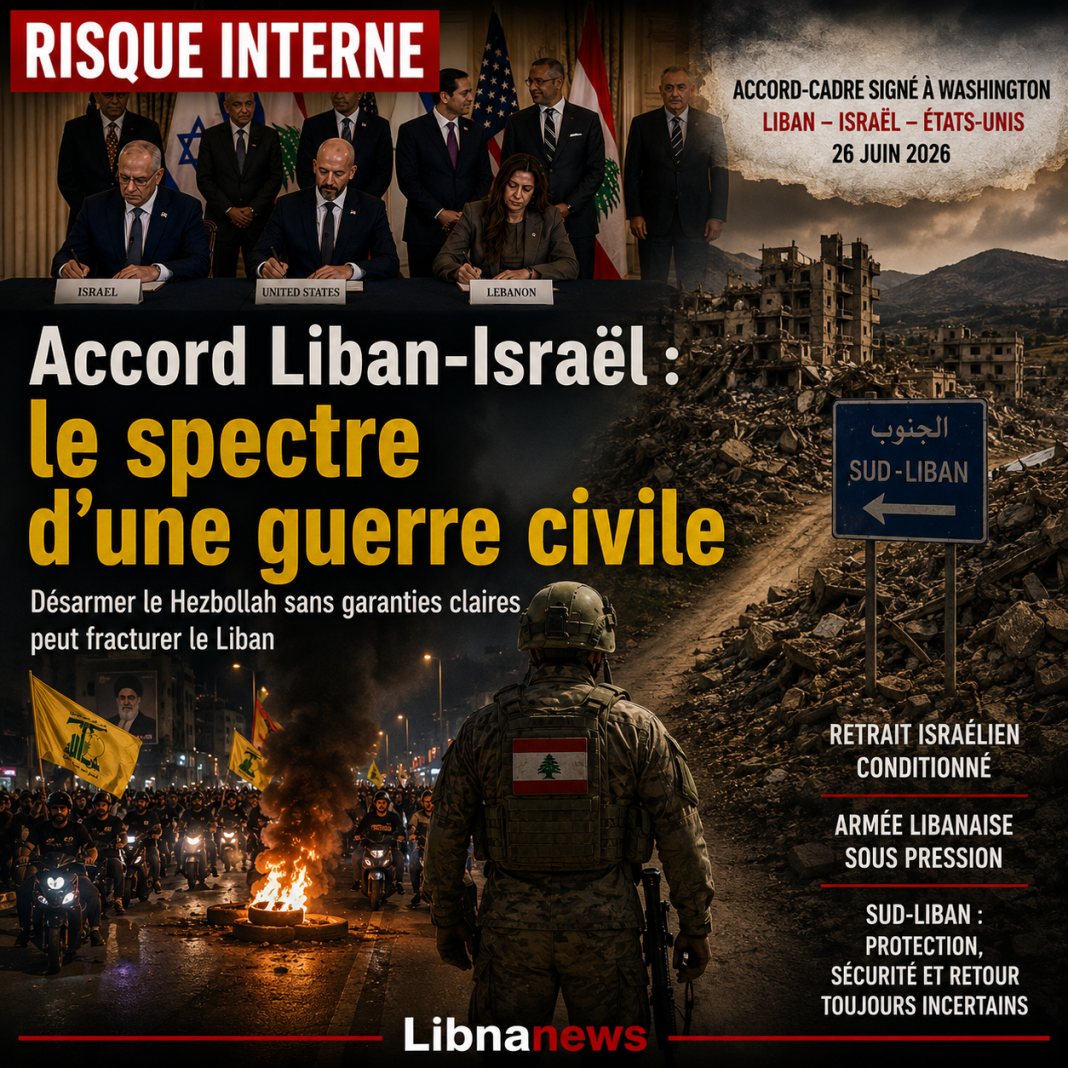
The Lebanese army is thus at the forefront of a crisis that goes beyond the mere maintenance of order. It is already called upon by the framework agreement to assume security responsibilities in the pilot areas of the South. It must also preserve public order in Beirut against demonstrators opposed to the same agreement. This dual mission places her in a delicate position. If it intervenes firmly, it can be accused by the Hezbollah camp of protecting a political orientation imposed by Washington. If it fails, the state seems unable to impose the order.
The Government Against the First Internal Test
The government had not yet given a detailed response to the street protest within hours of the demonstrations. The authorities are seeking to present the agreement as a step towards the restoration of Lebanese sovereignty, not as an imposed normalization. The Lebanese representation in Washington insisted on the idea of a first step towards the recovery of state authority throughout the territory. But this reading comes up against a political reality: the agreement requires the disarmament of non-State armed groups, mainly Hezbollah, without the latter being a party to the signature.
The Washington text gives the Lebanese army a central role. It foresees that it will gradually take control of pilot areas, following the disarmament of non-State armed groups and the dismantling of their infrastructure. These areas should allow the redeployment of the Israeli army and the return of Lebanese civilians. The formulation can be defended as a mechanism of sovereignty. But it can also be perceived by Hezbollah as an attempt to transfer the mission to the Lebanese State to neutralize its military presence.
The party’s reaction shows that this critical reading already exists. Naïm Qassem has placed the case in a broader context, that of confrontation with Israel and Iran’s role. He claimed that the American-Israeli project had been broken and that the Israeli withdrawal must be complete and unconditional. This formula rejects the very principle of an Israeli withdrawal conditional on disarmament. It reverses the order envisaged by the agreement: for Hezbollah, Israel must first leave; for the framework agreement, Israeli redeployment depends on verified conditions on the ground.
Hezbollah’s reaction hardens the debate
Hassan Fadllallah adopted a more directly political tone. According to Lebanese and Arab media, the Hizbullah deputy called the deal a simple ink on paper. He also felt that the Lebanese authority could not apply it except to engage, with American support, in internal confrontation. This warning is aimed at the heart of the device. It means that the implementation of the text will not only be a diplomatic debate with Israel. It will also be a test of political strength within Lebanon.
The issue of disarmament is the most explosive. The agreement is not limited to southern Lebanon. It refers to the complete and verified disarmament of all non-State armed groups, as well as the absence of any military or security role for these groups throughout Lebanon. This clause gives the government a legal and political framework to reaffirm the state’s monopoly on weapons. But it also opens a direct conflict with Hezbollah, which considers its arsenal to be linked to the defence of the country against Israel.
The rejection of the agreement by Hezbollah supporters is therefore based on several elements. First, there is the refusal of any direct engagement with Israel. Then there is the challenge of a text signed under American sponsorship, in a context where Washington is perceived as close to Israeli priorities. Finally, there is the fear that the Lebanese army will be used to implement a road map to withdraw Hezbollah’s military capabilities, without any guarantee of a full Israeli withdrawal.
A limit of the Washington process
This challenge highlights a weakness in the Washington process. The agreement was signed between states, with US support, but it directly targets an actor who does not recognize its legitimacy. The Lebanese government may commit itself on behalf of the State. It cannot guarantee, by a simple signature, the accession of Hezbollah. The Beirut protests recall this limit. They show that implementation will depend as much on Lebanese internal reports as on discussions with Israel.
The street thus becomes a political indicator. Friday evening gatherings are not enough to measure the extent of rejection throughout the Shia community or throughout the country. However, they show that Hezbollah still has a rapid mobilization network. They also allow the party to send a message to the government without announcing a military breakdown of the ceasefire. The street protest then serves as an intermediate pressure between verbal denunciation and the resumption of armed operations.
For the Salam government, the challenge is to avoid uncontrolled polarization. It must reassure international partners of its ability to implement the agreement. It must also avoid the country tipping into an internal confrontation around the role of the army. The Prime Minister and President Joseph Aoun will have to explain the guarantees obtained, specify the pilot areas, demand a halt to the Israeli strikes and show that the text does not enshrine a lasting Israeli presence. Without concrete elements, the discourse on sovereignty will remain fragile.
Israel, Washington and the fear of an imbalance
The Israeli position further complicates this task. Israeli officials have already insisted on maintaining a safe area until Hezbollah is disarmed. This reading feeds the challenge in Lebanon. If Israel stays in a part of the South without a clear starting schedule, Hezbollah can present the agreement as a legalization of occupation. The Beirut protesters reacted precisely to this fear: that of a text that imposes immediate obligations on Lebanon, while leaving Israel with a prolonged military presence.
The American role is also contested. Washington presents itself as a mediator and guarantor. But in a large part of Lebanese opinion, the United States remains seen as a strategic ally of Israel. The provisions on disarmament, verification and control of reconstruction funds reinforce this perception. Opponents see it as an agreement designed to address Israeli concerns before meeting Lebanese demands for withdrawal, sovereignty and protection of civilians.
The demonstrations also highlight the absence of clearly identified alternative guarantors. France, the European Union and the United Nations are not central to the agreement. However, these actors could have offered more acceptable mediation for certain segments of Lebanese opinion. The very American nature of the scheme may facilitate pressure on Israel, but it weakens the internal legitimacy of the process. The protest in Beirut is also part of this suspicion of imbalance.
A political crisis to contain
The follow-up will depend on the response of the authorities and Hezbollah’s ability to maintain pressure without causing an open break. If the demonstrations remain ad hoc, the government will be able to try to take over through pedagogy and first measures on the ground. If blockades are repeated, especially on routes such as the airport road, the crisis will become more serious. It will test the military’s ability to maintain order without appearing as a party to the political conflict.
Hezbollah will also have to calibrate its response. Too strong a challenge against the State may expose the accusation of sabotage of an Israeli withdrawal and reconstruction. Too weak a challenge can be seen by its basis as tacit acceptance of the agreement. The party therefore seeks a narrow path: to reject the text, to mobilize its supporters, to recall the principle of unconditional Israeli withdrawal, but to avoid for the moment a military escalation which would place it in direct responsibility for a collapse of the truce.
The inhabitants of the South remain at the centre of this equation. For them, the debate on the agreement is not limited to normalization or disarmament. It concerns return to villages, security, destroyed houses, roads, water, electricity and aid. Part of the population can reject any concession to Israel. Another can wait for the end of the bombings and reconstruction. Hezbollah, the government and foreign partners will have to deal with this social reality.
Order of priorities under discussion
The sequence is all the more sensitive as the agreement comes after weeks of violence, displacement and destruction in the South. The government wants to start a recovery and return process. But Hezbollah claims that this reconstruction cannot be separated from the Israeli departure. This divergence is reflected in street slogans. Protesters do not dispute only a diplomatic text; They challenge the order of priorities set by Washington. For them, the end of the occupation must precede any discussion on weapons. For the signatories of the agreement, verified disarmament must pave the way for withdrawal.
This step-order opposition can become the main blocking point. The Lebanese Government will seek to show that the pilot areas can produce concrete results. Hezbollah will attempt to demonstrate that these same areas create a dangerous precedent, in which Israel retains the power to decide when the threat has disappeared. The Beirut protests are therefore beyond their immediate size. They announce a political battle over the interpretation of the agreement, the military mission and the very meaning of Lebanese sovereignty.
The Beirut demonstrations thus mark the first internal test of the framework agreement. They show that the Washington signature did not close the debate, but moved to Lebanon. The text promises future peace, gradual withdrawal and the return of the State. The street near Hezbollah sees a risk of capitulation, imposed disarmament and prolonged Israeli presence. Between these two readings, the Lebanese army will have to maintain order, the government will have to defend its choice, and Hezbollah will have to decide how far to push the challenge.