






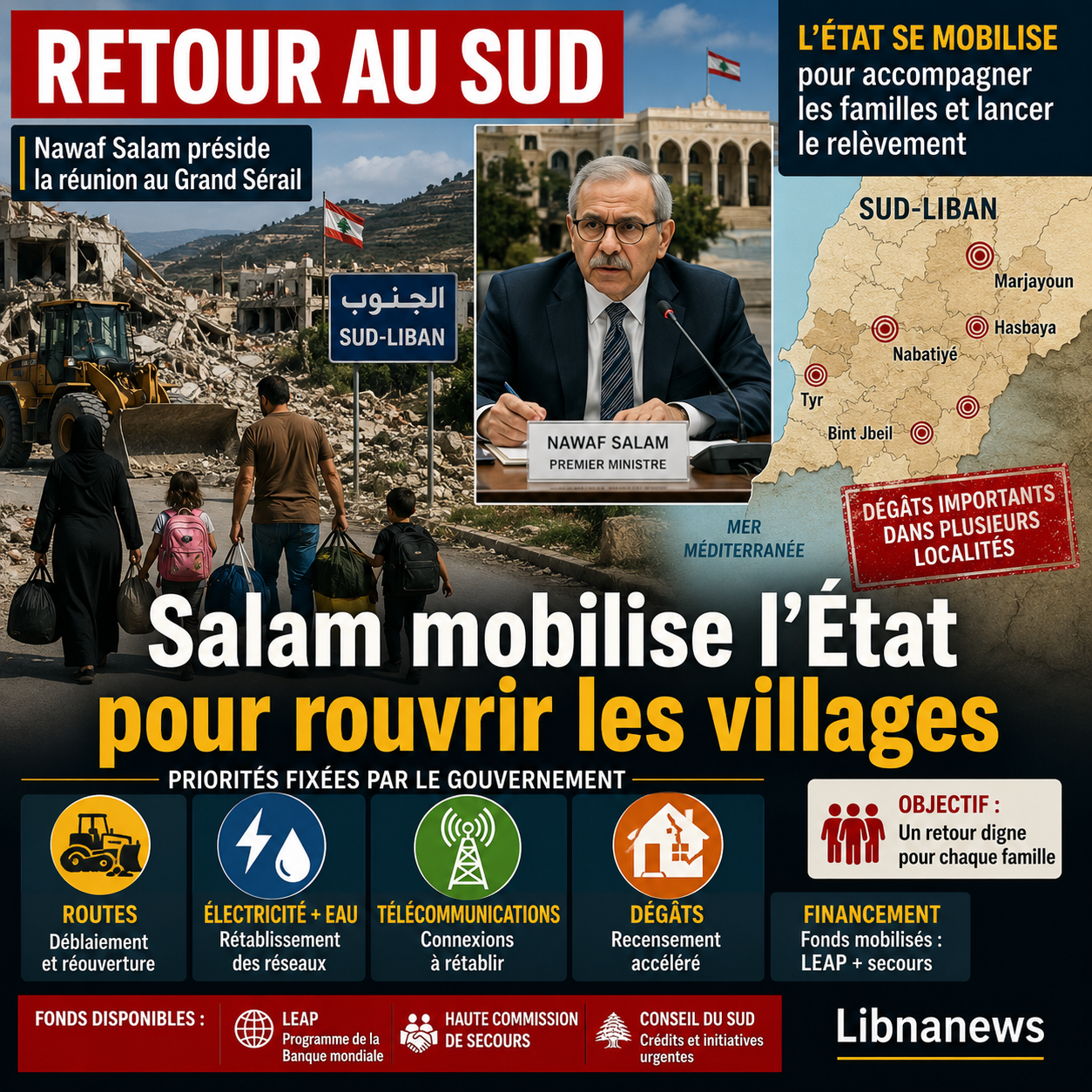
Prime Minister Nawaf Salam chaired a preparatory meeting on Wednesday, 25 June, on the return of the inhabitants of southern Lebanon to their villages and the launching of the first rehabilitation measures. The meeting brought together several ministers and heads of public bodies responsible for infrastructure, relief, basic services and administrative monitoring. The Head of Government asked the authorities concerned to accompany the return of families, to speed up the damage, to clear the roads and to restore the essential networks. He claimed that the people of the South had not left their land voluntarily and that the State should be present alongside them.
This meeting takes place in a phase in which the government seeks to organize the first practical responses after the destruction in several southern localities. The priorities displayed include roads, electricity, water, telecommunications, public infrastructure and available funding mechanisms. The Prime Minister referred to the funds already provided under the LEAP programme, as well as the funds of the High Relief Commission and the Southern Council. The announced objective is to launch quick initiatives without waiting for the complete completion of loss assessment.
The meeting was attended by Finance Minister Yassine Jaber, Energy and Water Minister Joe Saddi, Social Affairs Minister Hanine Sayed, Telecommunications Minister Charles Hajj and Public Works and Transport Minister Fayez Rasamny. The President of the Council for Development and Reconstruction, Mohammad Ali Kabbani, the President of the Council of the South, Hashem Haidar, the Chairman of the High Relief Commission, General Bassam Nabulsi, and the Head of the Central Operations Hall at the Grand Serail, Zahi Chahine, also participated.
The return to the South placed at the governmental emergency level
The main message of the head of government was the obligation to accompany the return. Nawaf Salam called on all parties concerned to coordinate their efforts so that families could return to their villages in dignified conditions. This request covers both ministries, administrations, public bodies and relief agencies. It also aims to avoid the spread of interventions in a region where needs are both humanitarian, technical and administrative.
The Prime Minister insisted that the people of the South had not left their homes by choice. This sentence sets the tone of the meeting. It places the question of return in the register of the right of families to return, but also in that of public responsibility. The government wants to present the response as a national obligation, not as one-off assistance. The formula chosen by Nawaf Salam is a reminder that displacement is linked to war and its direct effects.
The concept of a dignified return was emphasized. It involves more than just geographical access to localities. It involves practical roads, partially restored networks, minimum public services and a clear risk assessment. In several villages, the presence of rubble, the destruction of homes or damage to public facilities can complicate return. The Government therefore wants to link immediate measures with a broader recovery process.
The meeting was not limited to one observation. It has set a series of tasks for the departments concerned. The Prime Minister asked to complete the damage census, remove the rubble, open the roads and restore the electricity, water and telecommunications networks. This work must proceed in parallel with the assessment of damage to infrastructure and public facilities. This method is intended to respond to emergencies while preparing funding files.
Basic roads, networks and services at the centre of priorities
The reopening of roads is one of the first emergencies. It requires the return of residents, access to technical teams, the transport of materials and the intervention of public services. Gravats can also block the entrance to certain streets or prevent access to damaged houses. The Ministry of Public Works and the specialised bodies will therefore have to coordinate their resources with the local authorities in order to establish a priority according to the state of the axes.
The restoration of electricity is another sensitive project. The Lebanese electricity network already suffers from structural weaknesses. Destruction in the South adds additional pressure on a weakened service. The Ministry of Energy and Water will be responsible for assessing affected lines, damaged posts and emergency repairs. The work will not always be limited to rapid interventions. Some areas may require heavier replacements, depending on the extent of the damage.
Water is also a minimum condition for return. Repairs to damaged networks, pumping stations or pipes should allow families to resume their daily lives. Without reliable supply, return may be temporary or impossible. The services concerned will therefore have to identify where water can be restored quickly and where temporary solutions are to be provided. The needs of schools, health centres and public buildings should also be integrated.
Telecommunications complete the list of essential services. The return of the inhabitants presupposes the possibility of communicating with relatives, authorities, relief and administrations. Damaged networks can complicate requests for help, follow-up of files or the organization of local life. The presence of the Minister of Telecommunications at the meeting confirms that this sector is one of the operational priorities. The government wants to treat connections as part of recovery, not as a secondary service.
A census of damage to guide aid
The damage survey is the central administrative step. It is intended to distinguish between destroyed dwellings, partially affected dwellings, damaged shops, affected agricultural land and public facilities to be repaired. Without this work, the authorities cannot distribute the aid reliably. The Prime Minister therefore requested that this phase be accelerated, while maintaining the evaluation of infrastructure and utilities.
The task lies with several actors. The Southern Council has an ancient experience in cases related to destruction in this region. The High Rescue Commission intervenes in emergency situations and in the distribution of certain aids. The Council for Development and Reconstruction monitors major infrastructure projects. The ministries concerned provide their sectoral expertise. Coordination between these institutions should avoid duplication, delays and differences of assessment.
The government is also seeking to set priorities. Initial interventions should address the conditions for immediate return. Heavy repairs, complete housing reconstruction or sustainable infrastructure rehabilitation will require more time and funding. The census must therefore produce a clear mapping of needs, with emergency categories. This distinction will be important for families with uninhabitable homes and those who may return after limited work.
The reliability of the data will have a direct impact on local confidence. Families expect legible procedures, known criteria and understandable deadlines. The risk in this type of situation is due to administrative delays and perceived inequalities in access to aid. The meeting chaired by Nawaf Salam aims to show that the case is being monitored at the highest level of the executive. The next steps will tell if this coordination is translated into action on the ground.
LEAP, High Relief Commission and Southern Council
Nawaf Salam mentioned several sources of funding. The LEAP program is one of the tools mentioned. It is a framework to support the recovery and restoration of essential services in conflict-affected areas. According to the World Bank, the scheme is structured as a one-billion-dollar rolling project, with an initial funding of $250 million. The Lebanese Government intends to mobilize the amounts already foreseen in this framework to support urgent measures.
The Prime Minister also quoted the funds available from the High Relief Commission and the Southern Council. Both channels can finance quick interventions or targeted support. However, their use will need to be coordinated more closely so that expenditures meet the priorities set by the census. The Government has indicated its intention to put all available capacities at the service of the return and recovery of the South.
Funding remains a key issue. Damage to housing, roads and networks can quickly exceed ordinary state capacity. Local resources must therefore be linked with external support, programmes already committed and possible international contributions. Authorities will have to submit specific files to obtain or release additional funding. The assessment work undertaken in the localities concerned will also serve this purpose.
In the immediate future, the government is focusing on urgent initiatives. This term covers actions that can facilitate a quick return, even when complete reconstruction remains to come. It may include clearing, interim repairs, partial re-use of networks or support for families most affected. The Prime Minister did not announce a detailed schedule or new amount. Instead, it set out a methodology and called for the mobilization of available funds.
Coordination between ministries and public bodies
The composition of the meeting shows the extent of the file. The ministries present cover finance, energy, water, social affairs, telecommunications, roads and transport. Government agencies represented are involved in reconstruction, relief, regional development and coordination of operations. This configuration reflects a cross-cutting approach. Return does not depend on a single ministry. It requires a complete chain of interventions, from access to villages to the processing of social files.
The Department of Finance will have to monitor the availability of appropriations, disbursement procedures and budget arbitration. The Ministry of Social Affairs will have to identify vulnerable families, support needs and the most urgent forms of assistance. Technical ministries will have to send teams, diagnose networks and prepare work. Reconstruction and relief agencies will have to transform these decisions into concrete programmes, with local contact points.
The central operating room at the Grand Sérail plays a coordinating role. Its presence in the meeting indicates that the government wants to centralize information and monitor the execution of requests. In a situation where data are from several villages, services and teams, this coordination can reduce delays. It may also provide the Prime Minister with an up-to-date picture of open roads, re-serviced networks, accessible communities and families still prevented from returning.
The challenge will remain implementation. Government announcements are not sufficient if the teams do not have the necessary resources, appropriations and authorizations. The recovery of the South will also require cooperation with municipalities, residents and local representatives. Families know the state of their neighbourhoods, but they expect clear decisions from the state. The government must maintain a constant link between the central cell and the municipalities concerned.
A humanitarian response before full reconstruction
The meeting chaired by Nawaf Salam is taking place in an interim phase. The country is not yet in a fully funded and planned reconstruction phase. It must first manage the return of families, urgent needs and immediate damage. This stage requires quick, sometimes temporary, responses, but it conditions the future. A reopened road, a repaired water network or a restored communication line can allow a family to return and evaluate the condition of its property itself.
However, return may remain partial. Some homes require heavy work. Other areas may require technical verification prior to sustainable return. Families may have to stay elsewhere for an additional period. The authorities will therefore have to deal with several situations at the same time. People who can return will need services. Those who cannot will need social and administrative support. Both flaps cannot be separated.
The social dimension of the dossier explains the presence of the Minister for Social Affairs. Destruction is not just about material property. They affect income, education, care, travel and family ties. Households already weakened by the economic crisis may have less resources to repair, relocate or transport their business. Therefore, recovery will have to take into account vulnerabilities, not just the visible level of damage.
The South also remains an agricultural and border area. Damage to land, access and services can affect subsistence activities. Even when the houses are still standing, the local economy can remain disturbed. Authorities will need to assess the needs of farmers, small businesses and local services. The return of the inhabitants is not limited to a physical presence. It presupposes the gradual recovery of an economic and social life.
A political commitment formulated without a detailed timetable
Nawaf Salam concluded his message by saying that the people of the South would not be left alone in the face of the effects of the war. He said that all available capacities would be used for their return and recovery in the region. This declaration establishes a clear political line. It does not yet provide a full schedule, but it urges the government to act in the coming days through the departments and agencies involved.
The head of government chose a direct formulation. He spoke of « the people of the South » as families forced at the beginning, then engaged in a return that must be accompanied by the State. The vocabulary used remains focused on help, dignity and recovery. It avoids technical details, but refers administrations to specific tasks. Requests made during the meeting are now the immediate roadmap.
The next sequence should relate to execution. The services concerned will have to announce reopened roads, rehabilitated networks, completed surveys and mobilised aid. The Government will also need to clarify how LEAP, High Relief Commission and Southern Council funds will be used. The inhabitants expect visible measures, especially in localities where damage still prevents normal return.
The meeting of the Grand Sérail thus marks the beginning of an operational phase. It does not deal with the whole of the case, but sets the first priorities. The South is entering a period when the return of families, the repair of basic services and the preparation of reconstruction will have to move forward together. The ministries concerned are now responsible for transforming the announced decisions into measurable interventions on the affected roads, networks and villages.