





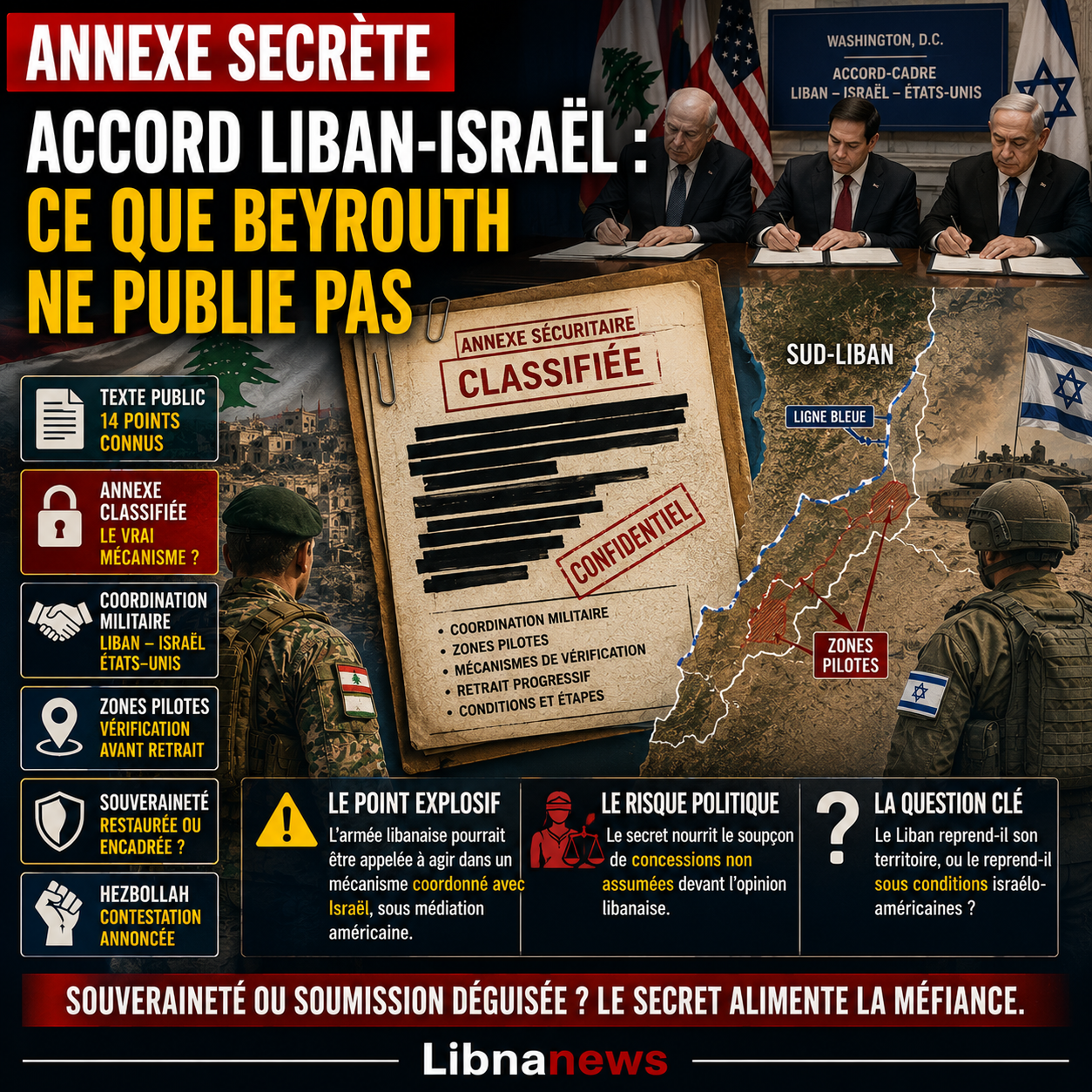
The agreement signed between Lebanon, Israel and the United States is not limited to a diplomatic framework to end hostilities in southern Lebanon. Behind the public text, already with political consequences, is a security annex that remains classified as secret. Officially, this annex was not published at the request of the Lebanese Government. Politically, this clarification is essential. It states that the content of this document is sensitive enough not to be taken into account by the Lebanese public opinion.
The core of the problem is not only the gradual withdrawal of the Israeli army, nor even the disarmament of Hezbollah in certain areas of the South. The most explosive point is elsewhere: the annex would organize, according to the media that reported its general content, a form of operational coordination between the Lebanese army and the Israeli army, under American mediation. In other words, two officially enemy armies, without a peace treaty, without full political recognition and after months of war, would now be called upon to act in a common security sequence.
The public text speaks of a trilateral military coordination mechanism, facilitated by the United States. This diplomatic formula seems technical. She’s not. It means that Washington would serve as an interface between the two parties to organize the gradual passage of certain areas of southern Lebanon under the control of the Lebanese army, in connection with the Israeli redeployment. Lebanon would therefore no longer negotiate only a political position. It would be part of a security architecture in which the movements of its army, the areas to be resumed, the verification criteria and the steps of the Israeli withdrawal would be discussed within a framework directly involving Israel.
This is precisely what the secret annex makes politically flammable. Published in its entirety, it could give the image of de facto military cooperation between the Lebanese army and the Israeli army. Although this cooperation is indirect, framed by the United States and presented as a stabilization mechanism, it would constitute a major break in Lebanon’s recent history. So far, the Lebanese official line was based on three pillars: Israeli withdrawal, Lebanese state sovereignty, refusal to normalize. The annex seems to introduce a different logic: Lebanese sovereignty, yes, but verified, sequenced and coordinated with Israel.
According to the media, this annex would detail the pilot areas in which the Lebanese army should deploy. It would also specify the modalities for the Israeli redeployment, the mechanisms for verifying the dismantling of Hezbollah infrastructure and the conditions for the return of civilians. Apparently, this is a military procedure. In reality, it is a form of political control of Lebanese territory in stages. The Lebanese army would not simply take over the South because it is a national territory. It would be resumed under a mechanism validated by Israel and the United States, with imposed or negotiated security criteria.
The most sensitive issue is verification. Who decides that an area is sufficiently « cleaned » of Hezbollah infrastructure? Who certifies that the Lebanese army effectively controls the ground? Who believes that the Israeli withdrawal can proceed to the next stage? If Israel retains a right to look, even indirectly, then the agreement does not simply restore the authority of the Lebanese state. It places this authority under external security conditions.
This is where the Lebanese demand for classification is making sense. The Lebanese government knows that such a reading would be politically explosive. For some public opinion, the agreement could be presented as an attempt to restore national sovereignty. For others, it would appear to be a security coordination with the enemy. Hezbollah, as well as its allies and part of the Shiite population of the South, can see this as a legalization of the Israeli presence until the conditions are met. They may also see it as an attempt to transform the Lebanese army into a force to do, under US and Israeli pressure, what Israel has failed to achieve through the war: the dismantling of Hezbollah’s military infrastructure in the south of the country.
The other disturbing element is the lack of an automatic calendar. Israel does not seem to commit itself to a full withdrawal on a fixed date. The withdrawal would be linked to stages, areas, verifications. This gives Israel an ability to block. If an area is deemed insufficiently secure, if infrastructure is discovered, if Hizbullah activity is reported, Israeli redeployment may be delayed. Lebanon would then find itself in a paradoxical situation: its army would be called upon to cooperate in the process, but without immediate guarantee of recovering its entire territory.
This architecture creates a precedent. It places the Lebanese army at the centre of a mechanism where it must simultaneously reassure Israel, satisfy Washington, avoid internal confrontation with Hezbollah and preserve its national legitimacy. It’s an almost impossible mission. Too much firmness against Hezbollah can open a major internal crisis. Too much caution can allow Israel to maintain its presence. Too much coordination with Israel can be seen as military normalization. Too little coordination can fail the agreement.
The secret annex is therefore probably the true text of the agreement. The public document sells a political formula: peace, security, sovereignty, return of the inhabitants. The annex would organize the concrete mechanics: which deploys, where, when, under what verification, with what coordination and to the benefit of what security guarantee. It is this mechanics that disturbs. For it transforms South Lebanon into a laboratory for a new balance: a Lebanese sovereignty under Washington, monitored by Israel and challenged by Hezbollah.
The Lebanese government may have asked for secrecy to avoid an immediate explosion. But the secret doesn’t fix anything. On the contrary, it feeds suspicion. In a country already traumatized by war, destruction, displacement and economic collapse, a security agreement involving the Israeli army, even indirectly, cannot remain in the shadows for long. If it is really a question of restoring Lebanese sovereignty, then the Lebanese will have to know at what cost. If it is a matter of establishing disguised military coordination, then the political debate is just beginning.
If the text of the 14 issues made public is already controversial, one can only question the extent of the other concessions made by Lebanon and contained in this annex.