






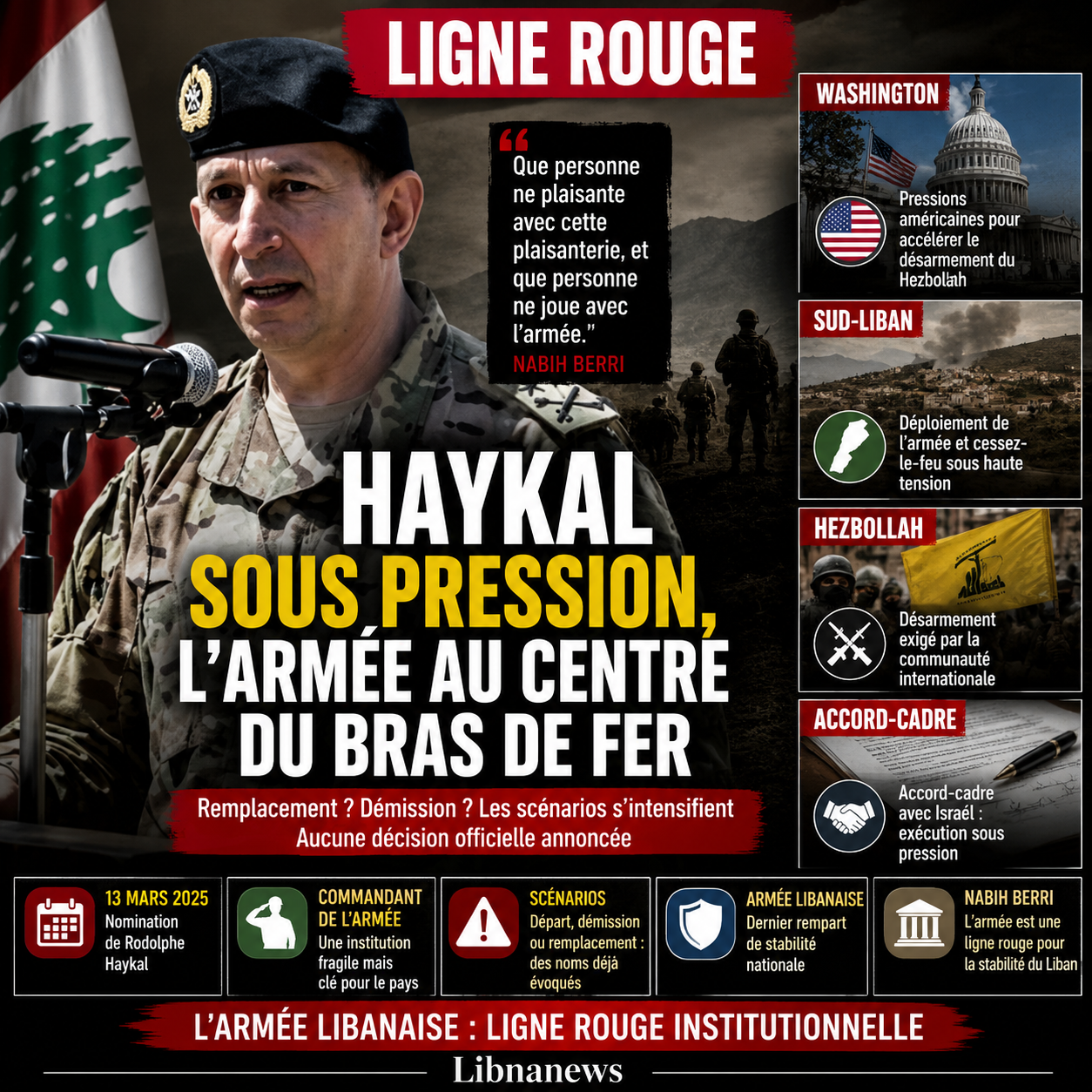
Pressures are being exerted around the Lebanese Army command, in a context marked by the signing of the framework agreement with Israel, Hezbollah’s international demands for disarmament and persistent tensions in southern Lebanon. The name of General Rodolphe Haykal, appointed Commander-in-Chief of the Army on 13 March 2025, is now associated with scenarios of departure, resignation or replacement. No formal decision was announced. But the discussions reported in several political and media circles led Nabih Berri to issue a direct warning: « Let no one joke about this joke, and let no one play with the army. »
The Lebanese Army at the core of the pressure
The subject is sensitive because it affects one of the few institutions still perceived as capable of maintaining a minimum national balance. For several months, the army has been at the centre of a difficult equation. It must deploy its units to the South, implement the Government’s decisions on arms monopoly, cooperate with ceasefire monitoring mechanisms and avoid internal confrontation. At the same time, it suffers the consequences of Israeli strikes, limited resources and increasingly pressing external demands.
According to media reports, no official order to dismiss General Haykal was sent to Beirut. Sources, however, point to international dissatisfaction with his pace of action and his reservations about a rapid operation against Hezbollah’s weapons. Names of potential successors are already circulating in some circles, including those of two senior officers presented as possible options in the event of a vacancy. This information was not confirmed by the Lebanese authorities. Yet they are sufficient to feed a climate of suspicion.
Pressure doesn’t come from a single channel. It combines diplomatic requirements, parliamentary criticism, American signals and internal government debates. Western leaders want to see rapid progress in the disarmament of non-State armed groups. Lebanese elected officials blame the army for not carrying out the decisions of the civilian power with sufficient firmness. Others, on the other hand, believe that a challenge to military command in a period of war and border tensions would create a dangerous crisis.
To understand the scope of the case, it is necessary to return to the role assigned to General Haykal since his appointment. His arrival at the head of the army followed the election of Joseph Aoun as President of the Republic. The military institution then inherited a central role in the implementation of the ceasefire concluded in the autumn of 2024, followed by discussions on territorial control south of the Litani River. The Commander-in-Chief was responsible for the deployment of the army, for coordinating with the Finul and for responding to the government’s requests for exclusive state authority.
Rodolphe Haykal facing an impossible mission
This mission was complicated by the intensification of clashes and debates on Hezbollah. The Government reaffirmed the need to limit weapons to official institutions. But the application of this decision remains an explosive subject. The military command argues that the issue cannot be dealt with by force alone. He believes that any poorly prepared operation can cause an internal fracture and expose the army to political, religious and operational risks. This caution is worth serious criticism.
General Haykal has already defended this line in his public statements. He said that the Israeli attacks hindered the implementation of the military plan. He also stressed that the command made its decisions according to the complex circumstances, with the aim of preserving Lebanon, its unity and the military institution. These formulations were interpreted in two opposite ways. His supporters see it as a realistic reading of the field. His detractors see it as a hesitancy in the face of executive decisions.
Criticism has increased following calls for faster implementation of the arms monopoly. Independent parliamentarians from the Change Bloc accused the command of not clarifying its position sufficiently. They believe that the army is not a political body and that it must implement the decisions of the government. In their reading, the legitimacy of the State depends on its ability to impose a single armed authority on the territory. The delay or prudence of the command would weaken this approach.
On the other hand, several officials consider that a brutal injunction addressed to the army amounts to asking it to resolve a national political crisis alone. This position is based on a well-known reality: the Lebanese army reflects the religious balance of the country and cannot be sent into an internal confrontation without a minimum consensus. A direct operation against Hezbollah or its networks, in the South or in the Bekaa, could lead to serious incidents, weaken the cohesion of the units and put soldiers in the face of heavily implanted civilians or veterans.
It was in this context that the issue of the commander’s resignation resurfaced. Information published in recent months already referred to the hypothesis of voluntary departure if the army was placed in front of a mission likely to cause bloodshed between Lebanese. The message given to the commander was clear: he would rather leave his post than order an operation leading the army to shoot Lebanese. Again, the formulations refer to reported information, but they reflect a deep discomfort within the security equation.
The replacement of the commander mentioned behind the scenes
The current sequence gives new scope to these rumours. The signing of the framework agreement with Israel and the United States places military command at the centre of a mechanism that provides for the redeployment of the army, verification of the withdrawal of non-State weapons and security guarantees in the South. If the Commander-in-Chief is considered too cautious by some sponsors of the process, his/her retention may be presented as an obstacle. If, on the contrary, it is replaced under pressure, the army may lose part of its internal credit.
The President of the Republic, Joseph Aoun, former commander of the army, has so far shown his support for the institution. According to media reports, he would maintain General Haykal and refuse a change of command in the midst of a crisis. This position is explained by an imperative of stability. The Head of State knows that a replacement of the Commander would not be read as a simple administrative decision. It would be interpreted as a political signal to Hezbollah, the United States, Israel and Lebanon’s international partners.
Prime Minister Nawaf Salam is also in a delicate position. His Government wanted to reaffirm the state’s monopoly on arms. It must also show Western and Arab partners that Beirut takes its commitments seriously. But he cannot afford to open a crisis with the army. A meeting between the Head of Government and the Commander-in-Chief is mentioned to monitor the implementation of government decisions and clarify the points of friction that emerged after the last military communiqués.
The American factor occupies a major place in this case. Washington has been the main external support of the Lebanese army for years. Its financial, logistical and operational support affects the institution’s ability to function. Diplomatic information referred to the suspension or slowing down of certain forms of coordination in order to exert pressure on Beirut. The American messages emphasize two areas: the disarmament of Hezbollah and the opening of a more direct process with Israel. This approach increases the pressure on military command.
Berri sets a red line
The Lebanese response remains cautious. Those who reject a change of command do not deny American expectations. However, they believe that the stability of the army outweighs the impatience of external partners. In a period when southern Lebanon remains under threat, communities have been destroyed and displaced people are waiting for their return, a crisis at the top of the army could cripple operations. It could also complicate dialogue with Finul and international monitoring mechanisms.
Nabih Berri chose to intervene publicly to set a limit. His warning is not only directed against General Haykal. It also targets external forces that might think that the army command can be reshaped to accelerate the implementation of the framework agreement. By declaring that the army is a « red line » and one of the pillars of national stability, the President of Parliament places the military institution outside the scope of immediate settlement of accounts. He speaks in political leadership, but also as an actor capable of blocking part of the institutional process.
This support for the army does not mean that the debate on its role is closed. On the contrary, it shows that the institution becomes the place where all Lebanese contradictions cross each other. Some ask him to restore the state. The others ask him not to trigger an internal crisis. International sponsors ask for measurable results. The people of the South ask for protection and return to security. Hezbollah, for its part, refuses to see its weapons treated as a mere police or administrative issue.
The main risk is to turn the army commander into a political fuse. If the disarmament process progresses too slowly, some will try to blame it for failure. If the army acts too fast and provokes confrontations, others will accuse him of having executed an external agenda. If she stays careful, she will be accused of ambiguity. This untenable position explains the nervousness surrounding the maintenance of General Haykal. She also explains why the discussions about her possible replacement are prompt.
A decision that exceeds a military appointment
The names of successors mentioned in the press should be treated with caution. They reflect the scenarios discussed, not the decisions taken. The Lebanese system makes any military appointment sensitive. The army commander must be Maronite, according to the institutional practice resulting from the communal division of responsibilities. Its appointment depends on the political power and the Council of Ministers. In the current context, any change would therefore require a difficult agreement between the presidency, the government and influential political forces.
The calendar also plays against a hasty decision. A replacement of the Commander a few days after the signing of a disputed framework agreement would be immediately linked to this text. It would give the impression that the army is adapted to an external road map. It would weaken the ability of the new commander to act, as his authority would be challenged from the outset. It could also send a message of fragility to Israel, as Lebanon seeks withdrawal and guarantees on the ground.
The case finally reveals the fragility of the Lebanese compromise on security. Everyone says they support the army. But everyone expects a different mission. The government wants a force to execute its decisions. Western partners want an instrument for stabilization and disarmament. Nabih Berri wants an institution protected from internal pressure and confrontation. The sovereignist forces want a stronger command. The people of the South want soldiers present, able to prevent strikes, infiltrations and war returns.
The caution of the official vocabulary confirms this discomfort. The authorities are not talking about a command crisis. They refer to the monitoring of government decisions, coordination with the army and the need to preserve internal security. The purpose of this restraint is to avoid a political setback. But it also leaves a gap filled by leaks, partisan readings and diplomatic messages. In a country where every security appointment reflects a balance, official silence can fuel as much tension as a direct statement.
The question of replacing the commander cannot therefore be separated from the broader debate on the chain of command. The army obeys political power, but it cannot compensate alone for the absence of a national agreement on arms, borders and war. Its commander must execute decisions, while assessing operational risks. This grey zone becomes explosive when foreign powers, local parties and parliamentary blocs seek to impose their tempo. General Haykal thus finds himself at the point of contact between a demand for rapid results and the fear of a lasting internal rupture.
In the coming days, Joseph Aoun’s position will be decisive. If the President clearly reaffirms his support for General Haykal, the replacement scenarios will lose their immediate strength. If the government raises the tone against command, rumors will resume. If Washington maintains visible pressure, the issue will return to political discussions. At this stage, the only established element remains the absence of official announcement of resignation or dismissal. The rest comes from an arm where the Lebanese army once again becomes a mirror of the country’s tensions.