





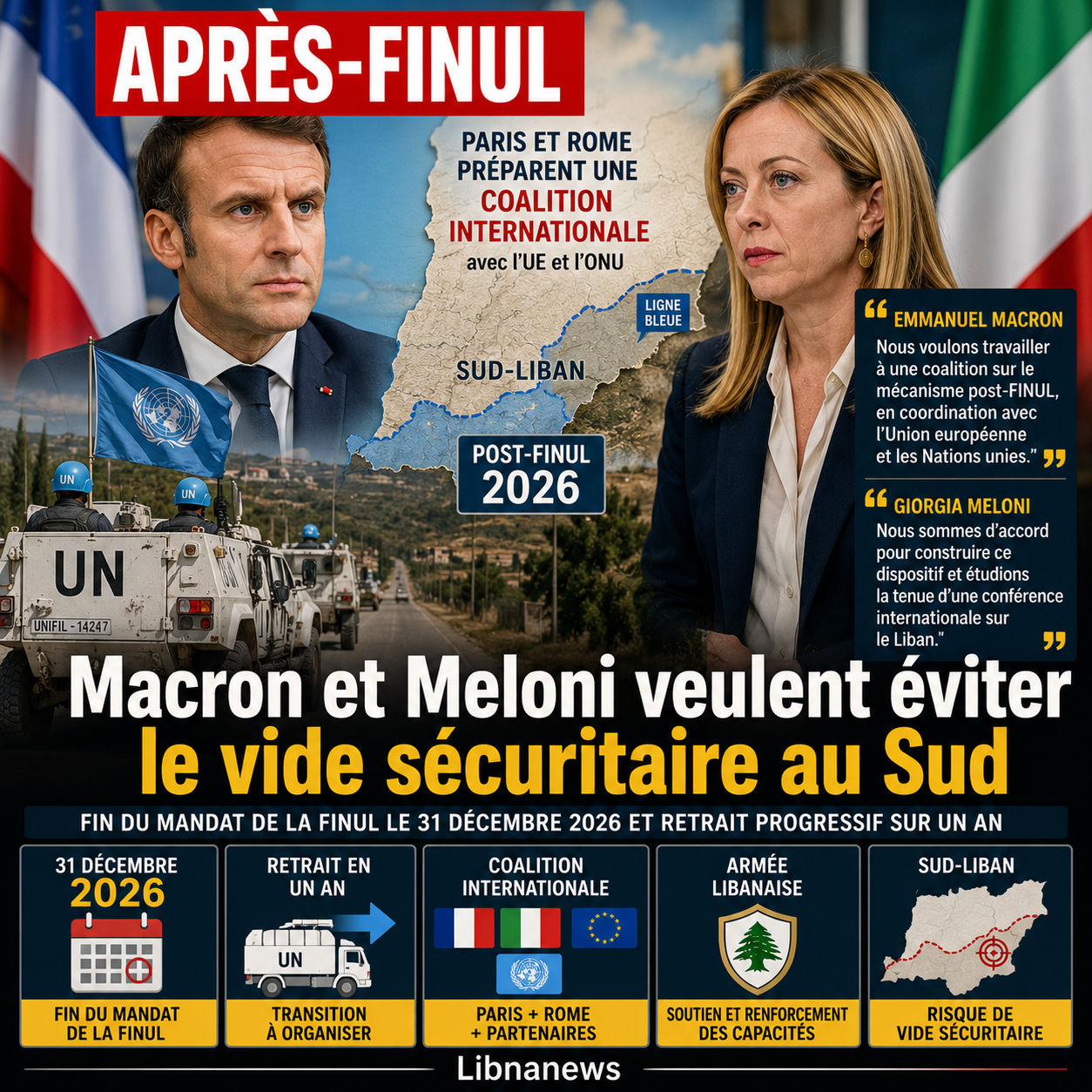
French President Emmanuel Macron and the President of the Italian Council Giorgia Meloni announced on Thursday 25 June their willingness to work on a multinational coalition to accompany Lebanon after the end of the mandate of the United Nations Interim Force in Lebanon. The announcement was made following a bilateral meeting in Antibes, in southern France. It comes as the future of UNIFIL is now framed by a drawdown schedule, following the latest renewal decided by the Security Council.
The two leaders want to prepare an international mechanism capable of supporting the stability of South Lebanon when the UN mission ceases to operate in its current format. Emmanuel Macron referred to a coalition on the post-FINUL mechanism, in coordination with the European Union and the United Nations. Giorgia Meloni confirmed the Franco-Italian agreement on this orientation and mentioned the possibility of an international conference on the Lebanese dossier.
The process remains at a preparatory stage. No specific terms of reference, final composition and operational schedules were announced. However, France and Italy, two major contributors to UNIFIL, seek to avoid a security vacuum in a border area marked by tensions between Israel, Hezbollah and the Lebanese State. Paris and Rome place the initiative in support of Lebanon’s sovereignty and the strengthening of Lebanese institutions.
Paris and Rome want to prepare the post-FINUL
The interview between Emmanuel Macron and Giorgia Meloni placed Lebanon at the centre of Franco-Italian coordination. Both countries have an old presence in UNIFIL. Their military, diplomatic and humanitarian commitment places them among the European actors most concerned with the future of southern Lebanon. France maintains a historical relationship with Beirut. Italy is one of the main troop contributors to the UN mission.
The idea of a multinational coalition does not yet mean the creation of a new force. Instead, the terms used refer to a system to be built, which could involve several states, the European Union and the United Nations. The exact role of this coalition must be defined. It could include support to the Lebanese army, observation, security coordination, logistical support or stabilization of border areas. These options remain dependent on international decisions and the agreement of the Lebanese authorities.
Emmanuel Macron stressed coordination with the European Union and the UN. This clarification shows that Paris does not want to present the initiative as a strictly bilateral approach. France seeks to include it in a broader framework, in order to give political and operational legitimacy to the future mechanism. Italy shares this approach, as the security of its soldiers and the maintenance of an international presence in southern Lebanon are priorities for Rome.
Giorgia Meloni reported that both countries had discussed the possible organization of an international conference. Such a meeting could bring together potential contributors, European partners, representatives of the United Nations and the Lebanese authorities. It could also clarify the financial means, rules of engagement and the role of local forces. No date was announced for this conference.
A schedule for the UN mission
UNIFIL has been present in Lebanon since 1978. Its mandate was strengthened after the 2006 war with Security Council resolution 1701. The mission operates in southern Lebanon, between the Litani River and the Blue Line. It monitors the cessation of hostilities, accompanies the Lebanese army and serves as a liaison channel with the parties concerned. Its role was often considered indispensable by Beirut, but criticized by Israel, which believes that it has not prevented the strengthening of Hezbollah in the area.
The mandate of UNIFIL is due to expire on 31 December 2026. After that date, an orderly and secure withdrawal of its staff must be organized over a period of one year, in consultation with the Lebanese Government. This schedule profoundly changes the security equation. It gives stakeholders a few months to define what can replace, accompany or complement the current mission. The Franco-Italian proposal fits directly into this diplomatic window.
The UN Secretary-General recommended the continuation of an international military presence in Lebanon after the end of the current mandate. This recommendation does not necessarily mean extending UNIFIL in its current format. It highlights the risk of a vacuum in a region where the Lebanese State remains engaged in a deployment and consolidation effort. The Security Council must arbitrate between Lebanese expectations, Israeli reservations, American positions and the concerns of contributing countries.
France and Italy therefore seek to weigh early in the discussion. Their initiative aims to prepare options before the deadline. It also sends a signal to the Lebanese authorities, Israel, the United Nations and other European partners. However, the future mechanism will have to be politically accepted and secure on the ground. The attacks and incidents that have affected UNIFIL positions in recent years have highlighted the vulnerability of international troops.
South Lebanon at the heart of the proposed mechanism
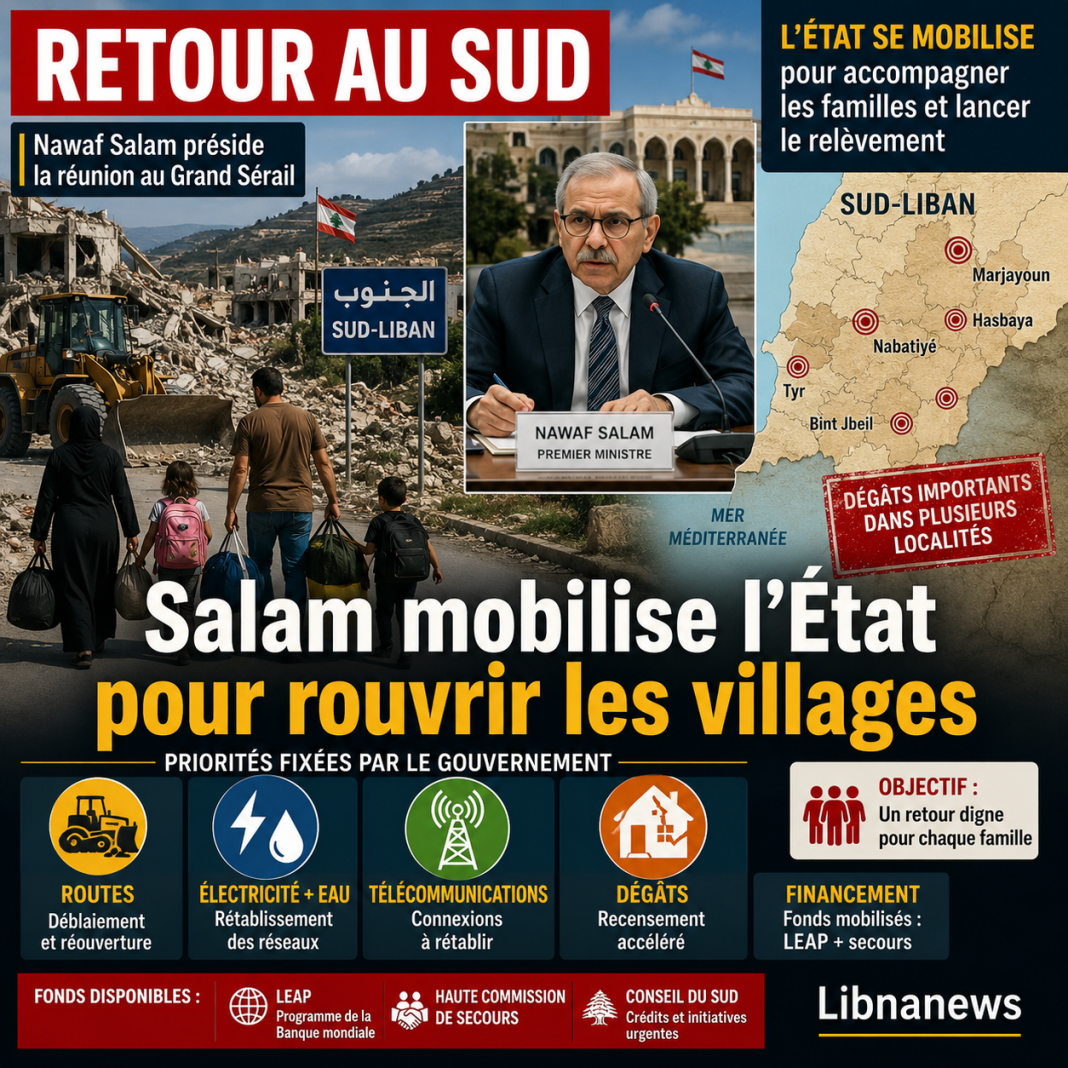
South Lebanon remains the heart of the case. The region focuses on issues of sovereignty, security and reconstruction. Communities close to the Blue Line have experienced population displacement, destruction and access restrictions. The Lebanese authorities seek to accompany the return of the inhabitants, restore essential services and strengthen the State presence. The planned end of UNIFIL adds additional constraint to this sequence.
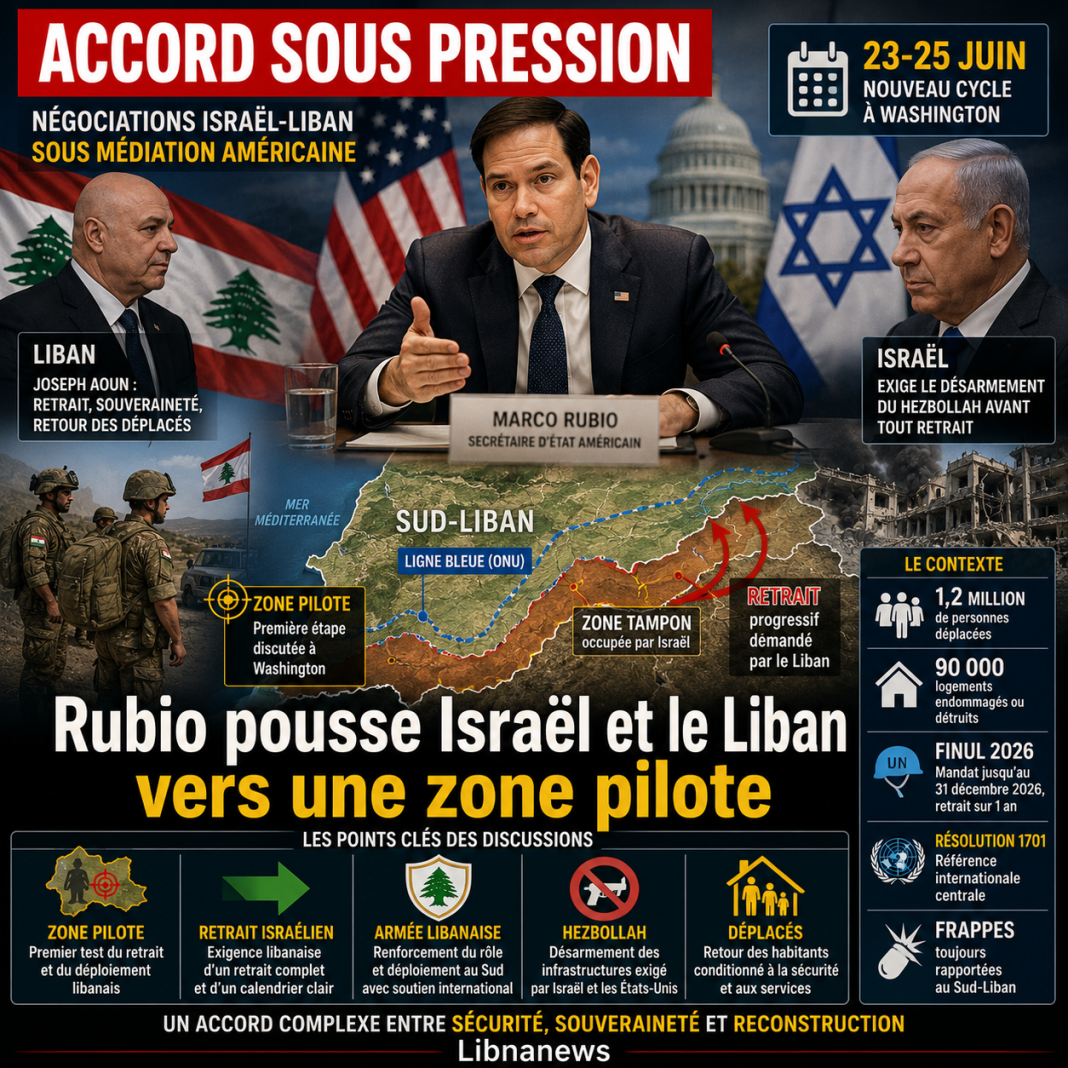
The future mechanism should take into account the role of the Lebanese army. International partners have long called for its effective deployment in the South. The Lebanese Government stresses the need for adequate human, logistical and financial resources. The army must ensure a visible presence, monitor the ground, cooperate with local authorities and maintain coordination with foreign partners. Without capacity-building, any transition after UNIFIL will remain fragile.
The issue of the Blue Line will also remain central. This United Nations withdrawal line serves as a practical reference between Lebanon and Israel. It does not resolve all border disputes, but it does structure surveillance mechanisms and indirect exchanges. UNIFIL has for a long time acted as an interface around this line. A post-FINUL device should specify who monitors incidents, transmits information and intervenes in the event of tension.
The political dimension cannot be separated from the military dimension. Hezbollah remains a major armed actor in Lebanon. Israel continues to call for security assurances on its northern border. The Lebanese Government affirms its commitment to national sovereignty and the role of the institutions. In that context, an international coalition should avoid becoming an object of internal controversy. It should be presented as support for the Lebanese State, not as a substitute for its authorities.
France and Italy, two countries already engaged in the field
France and Italy are aware of the constraints of UNIFIL. Their contingents were exposed to tensions on the ground, movement restrictions and incidents of violence. In October 2024, Paris, Rome and Madrid had condemned fire at the mission, following injuries among the peacekeepers. The three capitals had recalled that the protection of United Nations personnel was a matter of international law. This sequence had reinforced European demands for security guarantees for deployed soldiers.
Italy follows the case with particular attention. Giorgia Meloni visited Beirut in 2024 in a context of strong regional tensions. At that time, Rome emphasized the safety of its troops and the need to preserve the role of UNIFIL. The Italian presence in the mission is an important element of its Mediterranean policy. It also gives Italy legitimacy to participate in the definition of post-FINUL.
France, for its part, has played a constant diplomatic role since the ceasefire of November 2024. Emmanuel Macron visited Lebanon in January 2025 to support the new authorities and encourage the strengthening of the Lebanese army. Paris participates in discussions on the stabilization of the South, Israeli withdrawal, Lebanese sovereignty and the mobilization of international partners. The initiative with Rome extends this diplomatic line.
The Franco-Italian rapprochement on Lebanon also took place after several periods of tension between Paris and Rome on other European issues. The coordination announced in Antibes shows that both governments want to show convergence on the eastern Mediterranean. Lebanon is becoming a field of operational cooperation, where the interests of security, regional stability and a European presence join together.
A coalition still to be defined
The word coalition covers several possibilities. It may designate a political support structure, an assistance mission, a group of contributing countries or a coordination framework. At present, no authority has announced the establishment of an autonomous military force to replace UNIFIL directly. The French government has spoken of a post-FINUL scheme. This formulation voluntarily leaves open the nature of the mechanism.
The first option would be to further support the Lebanese army. Participating countries could provide training, vehicles, surveillance equipment, communications or logistical assistance. This approach would strengthen Lebanese sovereignty while avoiding the creation of a new heavy foreign force. However, it would require substantial funding and close coordination with the Beirut authorities.
A second option could take the form of an international compliance mechanism. It would monitor incidents, support liaison channels and provide reports to the United Nations or a group of partners. This would be less burdensome than a peacekeeping force. However, it could be considered insufficient if the security situation deteriorated or local actors refused to cooperate.
A third option would combine support to the Lebanese army, a reduced international presence and political coordination. It would be more in line with the idea of a transitional mechanism. It would preserve a foreign presence without exactly replicating UNIFIL. However, it would depend on a delicate political agreement. The United Nations, the United States, Europeans, Lebanon and Israel will have to accept the parameters of the mandate.
An initiative related to Lebanese sovereignty
Emmanuel Macron presented the initiative as a means of strengthening Lebanon’s sovereignty. This concept is central to the international discourse on the country. It refers to the capacity of the State to control its territory, deploy its army and ensure security without dependent on non-State armed forces. It also refers to the protection of civilians, the stability of borders and the functioning of institutions.
For Beirut, sovereignty also implies respect for Lebanese territory and an end to violations. The Lebanese government must defend this position while negotiating international aid. It must obtain guarantees without giving the impression of abandoning the national decision. The future mechanism should therefore be built with the Lebanese authorities. Without their agreement, no lasting presence will have sufficient legitimacy.
European partners know that the issue remains sensitive in Lebanon. UNIFIL has long been accepted because it was based on a Security Council mandate and a Lebanese request. Any replacement mechanism should preserve this principle. A coalition perceived to be imposed could fuel internal divisions. On the contrary, a coalition conceived as a support to the state could accompany the transition, especially if it strengthens the capabilities of the army and institutions.
Lebanese sovereignty will also be at the heart of discussions with Israel. The withdrawal of UNIFIL will not resolve border and security issues. A post-FINUL system should reduce the risk of escalation, maintain communication channels and support the implementation of existing arrangements. Its credibility will depend on its ability to act without creating new tensions.
The next diplomatic steps
The Franco-Italian announcement opens a sequence of consultations. Paris and Rome will first have to clarify their proposals with the United Nations. They will then have to convince other partners to join the initiative. The European Union could play a political or financial role, but its Member States will have to agree on the level of commitment. Some contributing countries to UNIFIL could wait for security assurances before engaging in a new framework.
The position of the United States will be decisive. Washington supported a clearer transfer of responsibilities to the Lebanese state and its army. The United States authorities will have to assess whether the proposed coalition meets this objective or whether it is likely to extend a model deemed insufficient by Israel. The Security Council will also need to be seized if the mechanism maintains a formal relationship with the United Nations.
Israel will observe the discussions carefully. His authorities called for guarantees for Hizbullah’s presence south of the Litani River and for border security. They could refuse a mechanism that they would consider too close to the current UNIFIL. On the other hand, they could consider a more robust verification mechanism or direct support to the Lebanese Armed Forces if it responds to their security concerns.
Lebanon, for its part, must specify its requests. The government can ask for support from the army, the infrastructure and the return of the inhabitants. It can also defend the maintenance of an international presence to avoid a vacuum. The Lebanese authorities should link those priorities with the reconstruction of the South, the management of the internally displaced and the commitments made in the ceasefire discussions.
An announcement launching a negotiation phase
The Antibes declaration does not yet create the successor mechanism to UNIFIL. It is launching a preparatory phase. France and Italy want to prevent the deadline of 31 December 2026 from leading to an improvised transition. They also want to maintain a European presence in the stabilization of Lebanon as the region remains exposed to military and political tensions.
The next few months will need to clarify the essential elements. It will be necessary to know which States will participate, under what mandate, with what means and in which areas. The relationship between the future arrangement, the Lebanese army, the United Nations and the existing ceasefire monitoring mechanisms will also need to be determined. The issue of funding will be equally important. A coalition without sufficient resources could not ensure a lasting mission.
The timetable requires a quick decision. UNIFIL continues to operate until the end of 2026 and is scheduled to withdraw for the following year. This period may allow a gradual transition. It can also create an area of uncertainty if discussions do not succeed. France and Italy are now seeking to unite partners around a common framework, while Beirut expects concrete guarantees for South Lebanon.