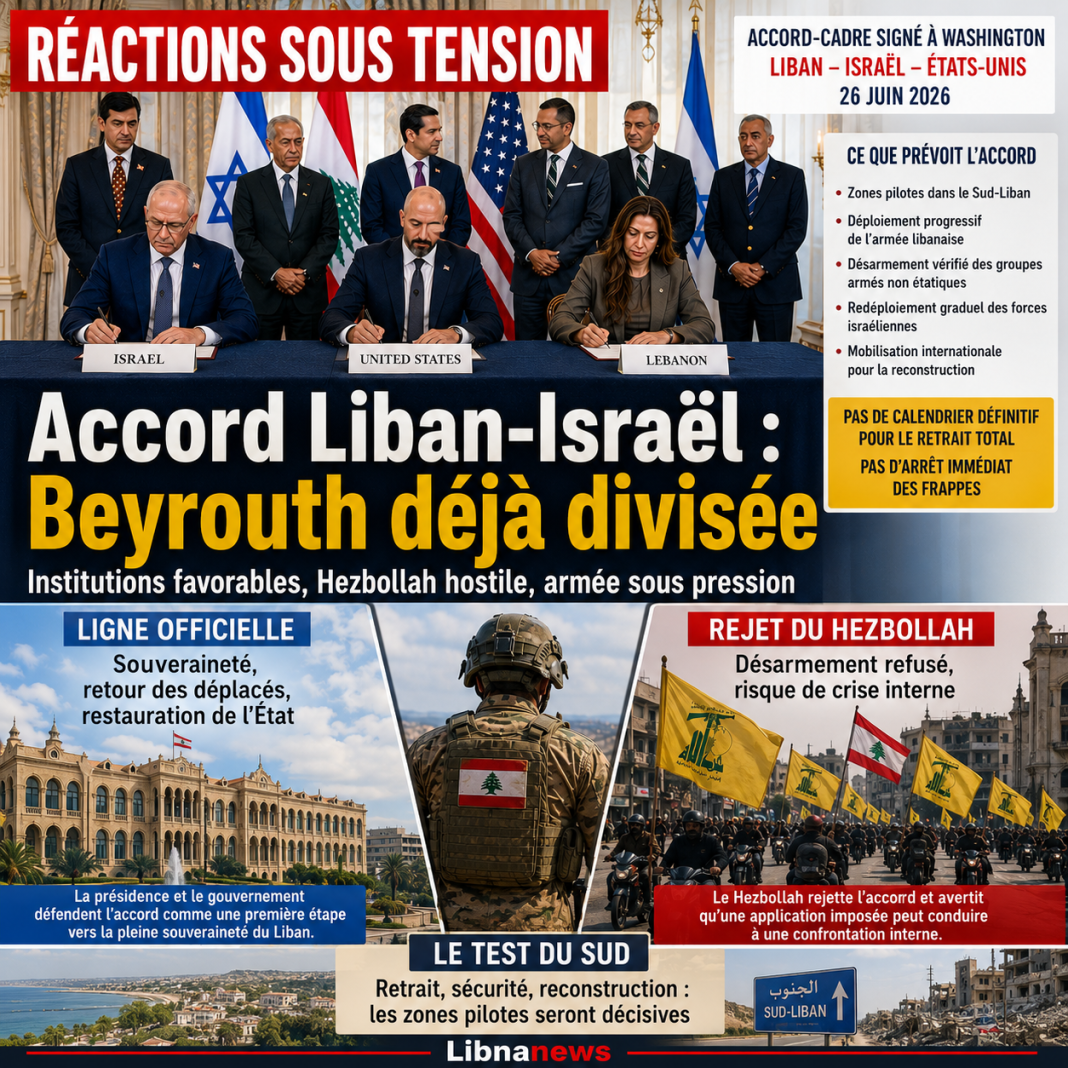






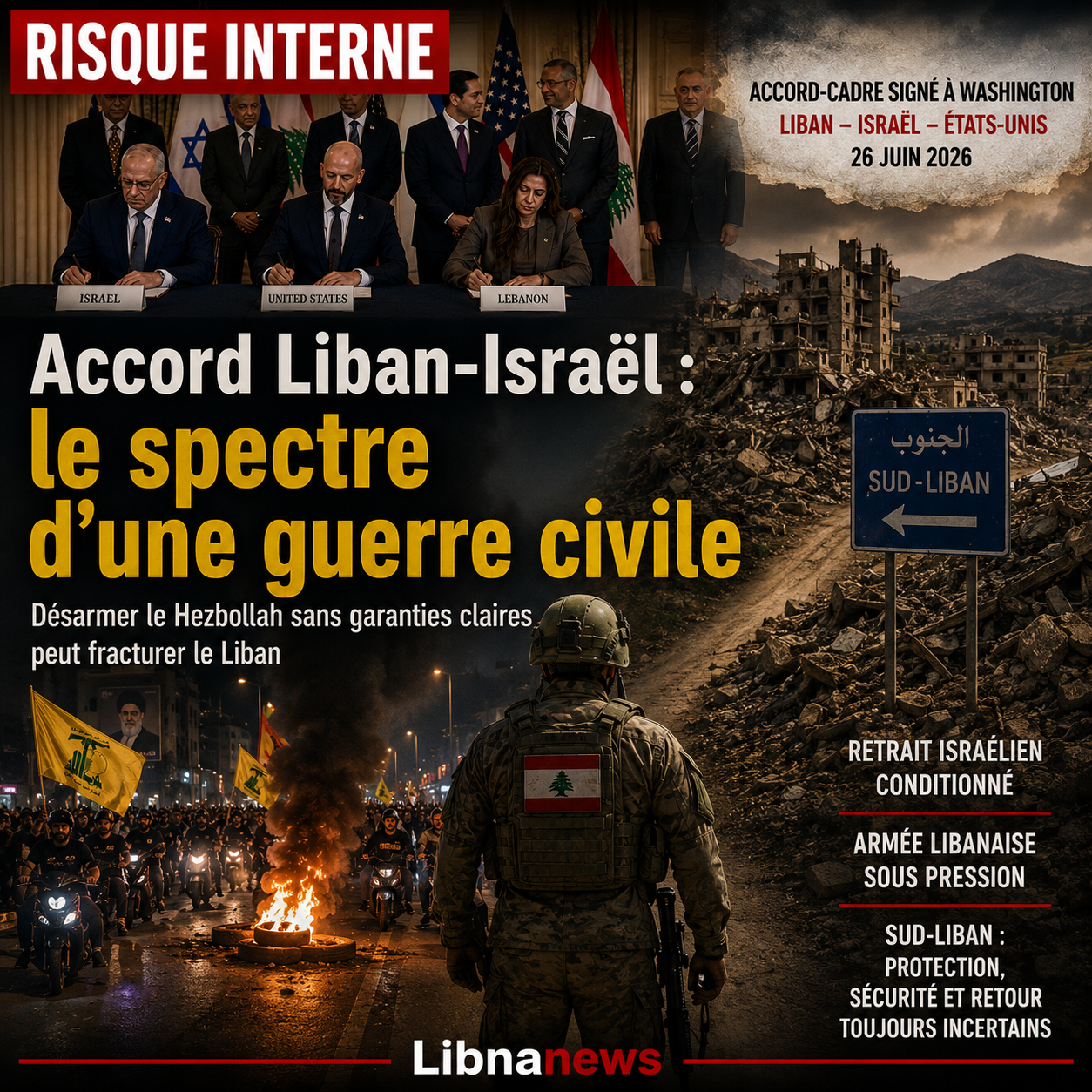
The framework agreement signed in Washington between Lebanon, Israel and the United States was to pave the way for de-escalation. It was intended to allow for a gradual Israeli withdrawal, the return of the Lebanese army to pilot areas, the reconstruction of the South and the restoration of State sovereignty. But from the time it was published, the text aroused a major fear: that of a Lebanese internal crisis that could go as far as armed confrontation around Hezbollah disarmament.
The risk is not only raised by the Lebanese opponents of the agreement. It also appears in several Israeli readings, which emphasize that the text is based on a fragile hypothesis: the ability of the Lebanese state and its army to disarm or marginalize Hezbollah without causing the collapse of internal equilibrium. In the Israeli press, several analyses present the mechanism as an attempt to push Beirut to do what the previous wars have failed to achieve completely: to withdraw from Hezbollah its military capacity in southern Lebanon, and eventually throughout the territory.
This reading joins the warnings of Hezbollah. MP Hassan Fadllallah claimed that the Lebanese authorities could not implement the agreement, with American support, without going to « civil war ». This sentence focuses on the political threat to the text. Hezbollah is not just challenging a clause. He refused the idea that the Lebanese State could become the instrument of an Israeli-American road map for its disarmament.
The agreement therefore puts Lebanon before a contradiction. On paper, it reaffirms the state’s monopoly on the use of force. In fact, it calls on a weakened State, an underequipped army and a divided political class to resolve one of the most explosive issues in recent Lebanese history. If this is done by consensus, it can strengthen the state. If it is done under external pressure, without clear Israeli withdrawal and without civil guarantees, it can open a deep internal crisis.
Hezbollah at the heart of the text
The core of the agreement is the complete and verified disarmament of non-State armed groups. The formula is general, but its political objective is obvious. First, it targets Hezbollah, the only non-state actor with a structured military force, a significant arsenal, an autonomous chain of command and a strategic link with Iran.
For Washington, this is the condition for lasting peace. For Israel, it is the central objective. For the Lebanese government, it can be described as the restoration of the state monopoly on war and peace. But for Hezbollah, it is an attempt to dismantle the enemy and its main ally. This divergence is sufficient to explain why some analysts talk about a risk of civil war.
The text is not limited to border areas. It refers to the disarmament of all non-State armed groups and the absence of any military or security role for these groups throughout Lebanon. This national scope goes far beyond the question of a withdrawal south of the Litani. It transforms the agreement into a programme to reshape the Lebanese security balance.
This is precisely what makes the application dangerous. Hezbollah is not an isolated group. He is a political party, a social actor, a military force and a pillar of the pro-Iranian camp in Lebanon. It has an important popular base, especially in the Shia regions of the South, the Bekaa and the southern suburbs of Beirut. Any attempt at disarmament by coercion can therefore spill over from military ground to the streets, institutions and community relations.
Hezbollah’s Warning
Hezbollah’s reaction was immediate. The movement rejects the agreement, challenges its legitimacy and asserts that it will not produce effect on the ground. Hassan Fadllallah warned that the application of the text by the Lebanese authorities, with American support, would lead to internal confrontation. He also stated that the party would oppose any action to implement the commitments contained in the agreement.
This warning directly targets the government of Nawaf Salam and Joseph Aoun’s presidency. Hezbollah means that they will not be able to engage the Lebanese State in a disarmament strategy without paying a domestic price. The message is also addressed to the Lebanese Army. The movement wants to prevent it from being used as a force to execute the text.
Hezbollah’s secretary-general, Naïm Qassem, had already rejected any Israeli security zone in Lebanon. He claims that Israel must leave unconditionally and that the Lebanese army can deploy its forces to preserve sovereignty, but not to legitimize an Israeli presence. This shade is central. Hezbollah accepts in principle the role of the army when it is directed against Israel. He refuses it if he becomes a control tool against his own weapons.
The order of the steps thus contrasts the two readings in front. For the agreement, the Israeli withdrawal depends on the verified disarmament and the takeover by the Lebanese army. For Hezbollah, the total Israeli withdrawal must precede any internal discussion of weapons. This reversal of priorities can block implementation from the first pilot zone.
The precedent of 17 May 1983
The precedent of 17 May 1983 weighs on this sequence. This agreement, signed between Lebanon and Israel under American mediation during the civil war, was to organize the Israeli withdrawal after the 1982 invasion and establish a security relationship between the two countries. It was quickly perceived by a large part of Lebanon as a text imposed by the Israeli-American balance of power. Syria, the Palestine Liberation Organization, several Lebanese Muslim forces and large sectors opposed to President Amine Gemayel rejected it.
The parallel is not mechanical, because the Lebanon of 2026 is not that of 1983. But political memory is strong. The agreement of 17 May gave the impression that the state was under occupation, while the country was already fragmented. It linked Israeli withdrawal to security and regional conditions, including the Syrian question. He also placed the Lebanese army at the centre of a security system in the South. This combination had fueled the idea of an unbalanced agreement, more favourable to Israel than to real Lebanese sovereignty.
The political effect was devastating. The agreement did not pacify Lebanon. He accentuated internal fractures, reinforced opposition to central power and helped isolate the Gemayel presidency. The fighting continued, the multinational force was attacked, and the Lebanese government finally repealed the text in March 1984. The complete Israeli withdrawal did not follow. Israel remained in southern Lebanon for many years until 2000.
This precedent explains the current caution. Many Lebanese officials and observers see the Washington agreement as a risk of repetition: a text signed under strong American pressure, presented as a path to peace, but perceived on the ground as a concession to Israel. As in 1983, Lebanon accepted a framework in which its sovereignty was proclaimed, but the Israeli presence depended on security conditions. As in 1983, Europeans and the UN appear to be back in the face of American mediation. As in 1983, the central government may find itself accused of signing on behalf of a country that has not really found an internal consensus.
The lesson of 17 May is clear: an agreement with Israel can fail if it is not carried by a Lebanese internal balance. It can even become a civil war accelerator if it turns an external fracture into a domestic confrontation. The current danger lies precisely in this displacement. The pressure is no longer just on Israel to withdraw its forces. It also exercises itself over Lebanon to disarm Hezbollah. If this pressure becomes an injunction to the Lebanese army to act against a part of the country, the memory of 17 May will again become an active political reference.
Careful Israeli Analysis
In Israel, the agreement is often read as a diplomatic success because it turns the disarmament of Hezbollah into a Lebanese commitment. But not all analyses are triumphalistic. Several Israeli commentators point out that the text is based on an uncertain execution and that the Lebanese army has not demonstrated its ability to face Hezbollah directly.
In the Israeli press, Seth J. Frantzman described pilot areas as the heart of the mechanism. It recalls that these sectors should allow the Lebanese army to exercise exclusive control without non-State actors. But it also stresses that the Lebanese government has long wanted to address the Hezbollah problem while remaining cautious, and that the Lebanese army has not been willing to confront the movement directly. This observation points to the main operational weakness of the agreement: it presupposes a political and military leap that Beirut has never really achieved.
The same analyst notes that the Israeli strategy in southern Lebanon was based on limited offensives and a gradual approach, with villages heavily destroyed in order to punish or weaken Hezbollah. He added that the effectiveness of this method remains uncertain. This is important because it shows that part of the Israeli analysis also recognizes the limitations of the military power ratio. Israel can destroy infrastructure, but this does not automatically mean that Hezbollah loses its political and social roots.
Other Israeli voices are concerned about an agreement that could restrict Israel’s freedom of military action without sufficient guarantees. An analysis published in the Israeli press states that Israel cannot base the security of its northern communities on promises linked to incomplete mechanisms. The author considers that an agreement that leaves Hezbollah armed remains an unfinished diplomacy.
Another Israeli reading, associated with Jacques Neriah, presents the worst-case scenario for Israel as a country allied with the United States but driven to bear the risk of Hezbollah alone. This approach shows that, on the Israeli side, fear is not just Lebanese civil war. It is also the failure of a mechanism that would leave Israel forced to face a Hezbollah still capable of acting. Israeli analysts therefore fear both a Lebanon too weak to impose the agreement and a Washington too eager to stabilize the region.
A Lebanese Armed Forces Exposed
The Lebanese Army is the central part of the device. It must regain control of the pilot areas, prevent the return of Hezbollah, ensure security, facilitate the return of civilians and serve as a guarantor of national sovereignty. This mission is immense. It is also politically explosive.
On the one hand, the army can be accused by Israel and the United States of failing to fulfil its obligations if Hezbollah retains a presence in the areas concerned. On the other hand, it may be accused by a part of the Lebanese population of indirectly protecting the Israeli presence if it secures areas adjacent to Israeli positions. This double pressure can weaken an institution that remains one of the few symbols of national unity.
The problem is compounded by the lack of resources. The Lebanese army does not have the capacity to control the entire South in a sustainable manner, monitor sensitive areas, manage civilian returns, prevent infiltration, deal with incidents and absorb political pressure. It needs vehicles, fuel, communication systems, surveillance, intelligence, demining and regular funding.
The agreement provides for US support conditional on verifiable steps. But aid can become a political problem. The more the army depends on US support to implement the text, the more it can be accused of acting under Washington supervision. However, in a large part of Lebanese opinion, the United States remains perceived as too close to Israel. This perception can reduce the legitimacy of the army in areas where it will have to intervene.
South, civilian death angle of the agreement
Civil risk is one of the most serious points. For a large part of the inhabitants of the South, the state has not protected. The army withdrew or could not maintain itself in several exposed areas. The inhabitants were bombed, displaced, houses destroyed, roads cut off, water, electricity and telecommunications networks lost.
In this context, the agreement can be seen not as a restoration of sovereignty, but as a concession to Israel. Many southerners may wonder why a State that could not protect them during the war is returning today with a text that requires the disarmament of Hezbollah, accepts a transitional Israeli presence and does not clearly guarantee the cessation of strikes.
This perception is decisive. Hezbollah derives part of its legitimacy from the idea that the Lebanese State does not adequately protect the South. If the agreement does not quickly produce a visible Israeli withdrawal, a real reduction in strikes and a concrete reconstruction, it can reinforce this argument. The Lebanese government risks losing the battle of narrative in the most affected areas.
Reconstruction itself can become a stressor. The agreement envisages preventing funds from reaching entities linked to non-State armed groups. This requirement responds to American and Israeli concerns. But in the South, social, municipal and political realities are intertwined. Too strict restrictions can slow down aid, create a sense of collective punishment and increase distrust of the state.
Insufficient US guarantee
The agreement is based almost entirely on the American guarantee. It’s a strength and weakness. It is a force because the United States is the only one able to put pressure on Israel. Without Washington, it is unlikely that the Israeli government will even accept a partial withdrawal. But it is also a weakness, as the American guarantee does not appear to be balanced in the eyes of a large part of the Lebanese.
The United States remains Israel’s strategic ally. On security issues, Washington often shares Israel’s priorities: preventing the return of Hezbollah near the border, controlling financing, preserving Israel’s right to respond to threats and condition aid for verifiable results. For Lebanon, this creates an imbalance. The main guarantor of the agreement is also the main support of the country that maintains forces in the South.
This situation can become explosive if violations are contested. If Israel strikes a pilot zone claiming to be a threat, who will say whether it is a self-defence or a violation of the agreement? If Hezbollah claims that the Israeli army has not fulfilled its commitments, who will arbitrate? If the United States validates the Israeli interpretation, the agreement will quickly lose credibility in Beirut.
The absence of a central role for France, the European Union or the United Nations accentuates this weakness. These actors could have offered a more multilateral guarantee, more acceptable to some Lebanese opinion. They can finance, train, rebuild or advise, but they do not seem to be at the heart of the decision-making mechanism. This leaves Washington in a dominant position and feeds the accusation of an unbalanced text.
A risk not automatic, but real
Lebanon knows the price of internal confrontations around weapons. The memory of the civil war remains present. Any attempt at disarmament by force reactivates this story. Hezbollah knows that. His opponents too. That is why the word « civil war » is not a mere propaganda formula. It refers to real fear in a country where the Community balance remains fragile.
Not all analysts who mention this risk say that civil war is inevitable. Rather, they warn that the text can create conditions for confrontation if its clauses are applied without internal compromise. The disarmament of Hezbollah cannot be treated as an administrative operation. It concerns security, political identity, regional alliances, community representation and the memory of resistance against Israel.
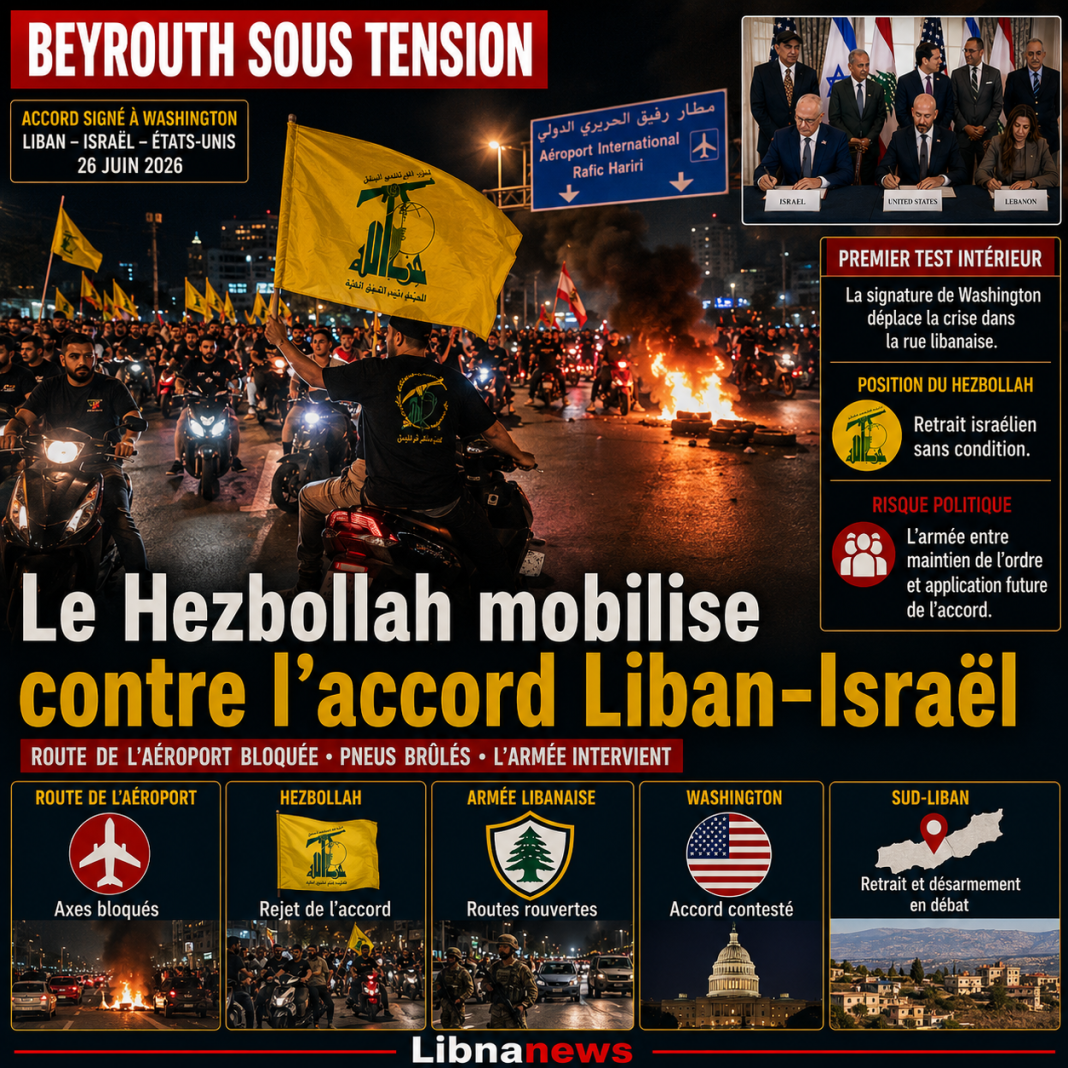
The protests in Beirut against the agreement have shown that the protest can quickly move on the street. A first signal is motorcycle processions, roadblocks and slogans hostile to the government. Hezbollah does not need to immediately launch a military confrontation to influence the implementation of the text. It can use popular, parliamentary, media and territorial pressure.
The government must therefore avoid brutal application. He will have to look for a sequence that gives visible results to civilians before demanding major political sacrifices. A real Israeli withdrawal from a first zone, halting strikes, opening roads and rapid reconstruction assistance would be essential to reduce mistrust. Otherwise, the agreement will remain associated with obligations imposed on Lebanon without sufficient consideration.
Israeli Paradox
From the Israeli point of view, the agreement may seem advantageous. It puts pressure on Hezbollah and the Lebanese state. It allows Israel to maintain a safe area as long as the threat persists. It makes withdrawal conditional on performance criteria. It gives the United States a supervisory role. But this pattern can turn against Israel if Lebanon becomes ungovernable.
An internal crisis Lebanon will not be able to control its border. A weakened or contested army will not prevent Hezbollah from returning. A population in the South convinced that the State had surrendered to Israel would not support the Lebanese deployment. In this case, Israel would get a favourable text, but not the lasting security it seeks.
This is one of the paradoxes highlighted by some Israeli analyses. Pushing too hard on disarmament can delegitimize the Lebanese state faster than it reduces Hezbollah. If the Lebanese government appears to be carrying out US and Israeli pressure, Hezbollah will be able to stand as a defender of real sovereignty against a submissive state. The result would be inverse to the stated objective.
Israel therefore has an interest in the implementation of the agreement with caution. He has an interest in a strong Lebanese state, but not humiliated. It is in the interest of a Lebanese army capable, but not perceived as a collaborator. He had an interest in a Pacific South, but not a population convinced that reconstruction was conditioned by political capitulation.
Clauses that can ignite the situation
Four elements can trigger a crisis. The first is the lack of a clear timetable for full Israeli withdrawal. As long as Israel can remain in the safe area until it considers the threat eliminated, Hezbollah can present the agreement as a legalization of occupation.
The second is the national disarmament of non-State armed groups. This clause goes beyond pilot areas and targets the core of Hezbollah’s power. It can become the breaking point if it is activated quickly.
The third is the Lebanese Army mission. If it is responsible for securing areas close to Israeli positions, it may be accused of indirectly protecting the Israeli army. This charge can weigh heavily in areas affected by the bombings.
The fourth is conditional reconstruction. If aid is delayed or blocked by political criteria, civilians may be taken hostage by the mechanism. An displaced and impoverished population can quickly lose patience.
Conditions to avoid burning
The risk of civil war is not automatic. It can be reduced if the government succeeds in transforming the agreement into a national process rather than an imposed roadmap. This implies first concrete results against the Israeli presence: a visible withdrawal, a reduction in strikes and a credible timetable.
This then requires an internal strategy. Disarmament cannot be dealt with solely by the army. There must be political discussion, a national defence strategy, guarantees of the role of the State and real protection of the people of the South. Without these elements, the army will be placed before an impossible mission.
This also implies an expansion of safeguards. The American presence is necessary, but it is not enough. France, the European Union and the United Nations should be more clearly involved in the monitoring, reconstruction and arbitration of violations. A more multilateral framework could reduce the perception of an agreement dictated by Israeli priorities.
Finally, this implies treating civilians as the centre of the process. The people of the South cannot only be the humanitarian background of a security agreement. They must see open roads, rebuilt houses, reopened schools, restored services and daily security. Without this, sovereignty will remain an abstract word.
The Washington Agreement can therefore become a step towards stabilization. But it can also become an internal crisis accelerator. The precedent of 17 May 1983 recalls that an agreement signed with Israel under American sponsorship may fail if it is not based on a sufficient Lebanese consensus and if it gives the impression of limiting national sovereignty. Its success will depend less on the signing ceremony than on the ability of the Lebanese State to avoid confrontation with Hezbollah, to obtain visible Israeli concessions, to protect civilians and to convince the people of the South that the State is returning to defend them, not to apply against them the conditions of a negotiated agreement under American guarantee.