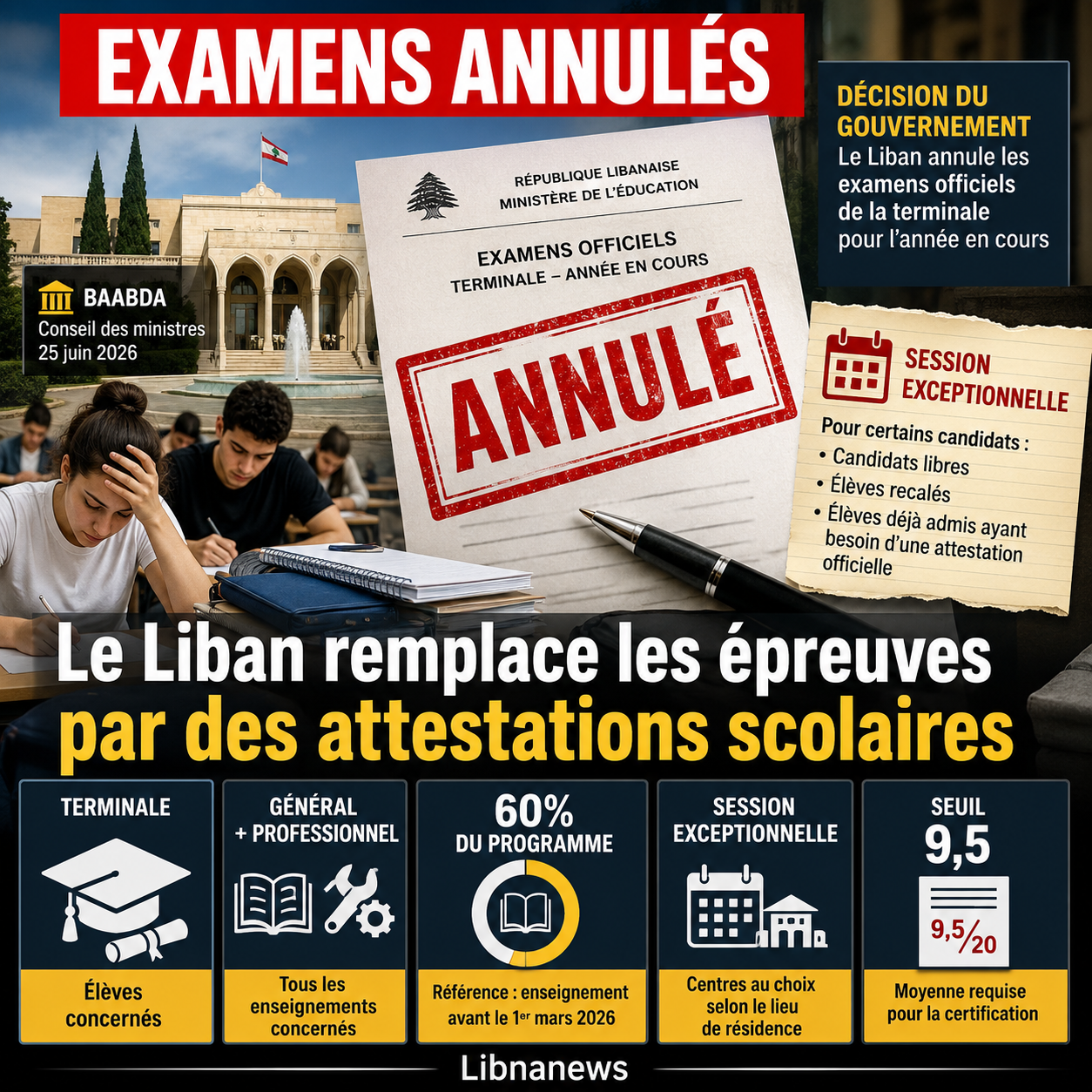
The Lebanese Council of Ministers decided, at its meeting held on Wednesday 25 June at the Baabda Palace, to cancel the official examinations of the terminal for the current year. The measure concerns general and vocational education, as specified after the meeting by the Minister of Education. It intervenes in a security and social context deemed exceptional by the executive, while the authorities state that they must take into account the situation of pupils, families and institutions.
Government closes official review files
The meeting, chaired by the Head of State, Joseph Aoun, in the presence of Prime Minister Nawaf Salam, also led to a series of appointments in several public institutions. They affect the Co-operative of Officials, the Electricity Regulatory Authority, the National Scientific Research Council and the Petroleum Management Authority. The Government also approved the founding status of the Beirut International Airport, as well as a draft decree on the new Lebanese curriculum for pre-university general education.
Information Minister Paul Morcos presented the decisions at the end of the meeting. He indicated that the Council had reviewed political, security and humanitarian developments, in addition to administrative and public service issues. Exchanges also covered internally displaced persons, the damage caused by the recent aggression, reconstruction, preparation for the summer season and the fight against waste in administrations.
The most sensitive decision concerns official secondary examinations. It ends several days of waiting for senior students, their families and school management. The Executive has adopted an alternative formula based on school certificates, while providing for an exceptional session for some candidates. Education Minister Rima Karami acknowledged that no option could be considered ideal. She presented the government’s choice as a realistic response to security, educational and administrative constraints.
Official examinations: school certificates and exceptional session
According to the explanations given after the session, the students concerned will be able to draw on the results established by their schools, within the limits set by the Ministry. The reference used takes account of education provided before 1 March. The Minister justified this date by a previous decision based on a recommendation of the Educational Council. She stated that the programmes covered corresponded to about 60% of the curriculum, with possible differences between public and private institutions.
The exceptional session will remain open to open candidates, students who wish to represent themselves, as well as students who have already been admitted by their school but who need an official certificate for work, scholarship or university admission. However, the Minister reiterated an important principle. A student who chooses to attend this session will be submitted to the regular examination system. If he fails, he will not be able to return to the results granted by his school.
The Ministry of Education has one month to finalize the organisation of this session. Rima Karami stated that the authorities intended to respect, as far as possible, the choice of examination centres according to the place of residence of the students. She also stated that the test conditions, materials and rules would not be changed. The subjects should cover the parts of the program actually taught before the date chosen.
The Minister defended the 9.5 threshold, which was the average usually used for secondary certification. It rejected the idea of an arbitrary figure. It also confirmed that the TS and LT technical diplomas had been incorporated into the scheme, having been erroneously omitted from the text read during the meeting. The decision therefore covers general and vocational education, which broadens its impact to a more diverse school population.
Rima Karami stressed the value of Lebanese certification. It stated that it had defended the maintenance of the examinations until the last moment, in order to preserve the rights of the students and the recognition of the diploma, especially for those who are considering studying or working abroad. However, it found that the circumstances required an immediate decision. In her view, universities and foreign countries should be able to understand the reasons that led Lebanon to retain this solution.
A new curriculum for general education
The adoption of the new Lebanese curriculum was the other major educational decision of the session. The draft decree on pre-university general education has been approved. The Minister presented this reform as an important step for the school system. She stressed that the new programmes would include skills, citizenship, living together and freedom of expression in a pluralistic society.
The transition to new programs will be gradual. The Minister indicated that their application would be voluntary next year for primary school. This phase should allow schools, teachers and school administrations to adapt their methods and tools. The government has not publicly detailed the full timetable for generalization, but the approved text opens the way for a gradual transformation of general education.
The issue of public discourse and social cohesion was also raised. Rima Karami reported that several interdepartmental initiatives were being prepared with the Ministries of Information, Culture, Youth and Sports. They must address public language, civic responsibility and the prevention of social tensions. The Minister has linked this direction to the difficulties encountered in recent weeks in the debate on reviews.
Appointments to government and public bodies
The Council of Ministers also approved a number of appointments expected in the administration and public bodies. Nazih Hammoud was appointed Director General at the State Officials’ Cooperative. In the electricity sector, lawyer Christina Issam Abi Haidar has been appointed a full-time member of the Regulatory Authority. This body is expected to play a central role in a sector that remains one of the most important issues for public finances and users.
At the National Council for Scientific Research, the government appointed Dr. Assad Antoine Eid as President. Dr. Satea Arnaout becomes Vice President. The membership includes Ramzi Hafez, Nehme Azouri, Marie Abboud, Nassim Farès, Dima Issa, Marie Fawzi Chambas, Joseph Constantine, Lama Matar, Nader Siraj, Salah Zeineddine, Mohammad Talal Mustafa Farran, Hani Moussa Abbas and Ali Abdel Reda Faour. These appointments must ensure the continuity of an institution responsible for supporting research and public scientific expertise.
The Petroleum Management Authority has also been renewed. The names announced are Jean-Paul Sabbagh, Fawzi Khalifa, Grace Rachid, Caby Daaboul, Wissam el-Dahabi and Wissam Chebat. This authority is involved in the monitoring of oil and public policies related to exploration. Its composition is closely monitored, as the oil sector remains associated with important economic expectations, as well as transparency and governance requirements.
The Government also approved the request of the Ministry of Public Works and Transport for the founding status of the Beirut International Airport. This decision concerns a strategic infrastructure, both a gateway to the country and an essential element for the displacement of Lebanese diaspora, visitors and economic actors. It intervenes while the authorities say they want to strengthen the preparation of administrations for the expected flows during the summer.
Displaced, damaged and prepared for reconstruction
Joseph Aoun asked the departments and services concerned to prepare for a possible increase in arrivals, if security stability is confirmed. He linked this perspective to respect for the ceasefire and the possibility for Lebanese expatriates to come and spend part of the summer season in the country. He also called on the air, land and sea border services to be fully mobilized to support this movement.
The Head of State opened the meeting with a message addressed to the Lebanese, and in particular to members of the Shiite community, on the eve of the commemoration of the Ashura. He spoke of the figure of Imam Moussa Sadr and the values of sacrifice, refusal of injustice and attachment to principles. He then reaffirmed the State’s commitment to the law, unity of Lebanon and solidarity among its citizens, as a central element of national cohesion.
The President also stressed the need to monitor the situation of internally displaced persons, particularly in shelters. He called for the launch of a census of the damage caused by the recent aggression. The assessment should cover housing, infrastructure, agricultural land, electricity and telecommunications. This step must prepare for possible conferences in support of reconstruction, if an international willingness to contribute is confirmed.
The government therefore wants consolidated data before any funding is made available. The damage census should allow the relevant ministries to submit specific files to foreign partners. The authorities seek to avoid a dispersed approach, while the needs may vary greatly depending on the region, the nature of the infrastructure affected and the situation of displaced families. No financial envelopes have been announced at this stage.
Joseph Aoun also asked to continue the procedures for the promotion of civil servants from the third to the second category. He called for the rapid launch of a preparatory cycle for the officials concerned, in accordance with the laws and regulations in force. The stated aim is to modernise the administration and motivate employees, especially the most competent ones, so that public services are more responsive to the needs of the country.
Judicial audit of electric vessels
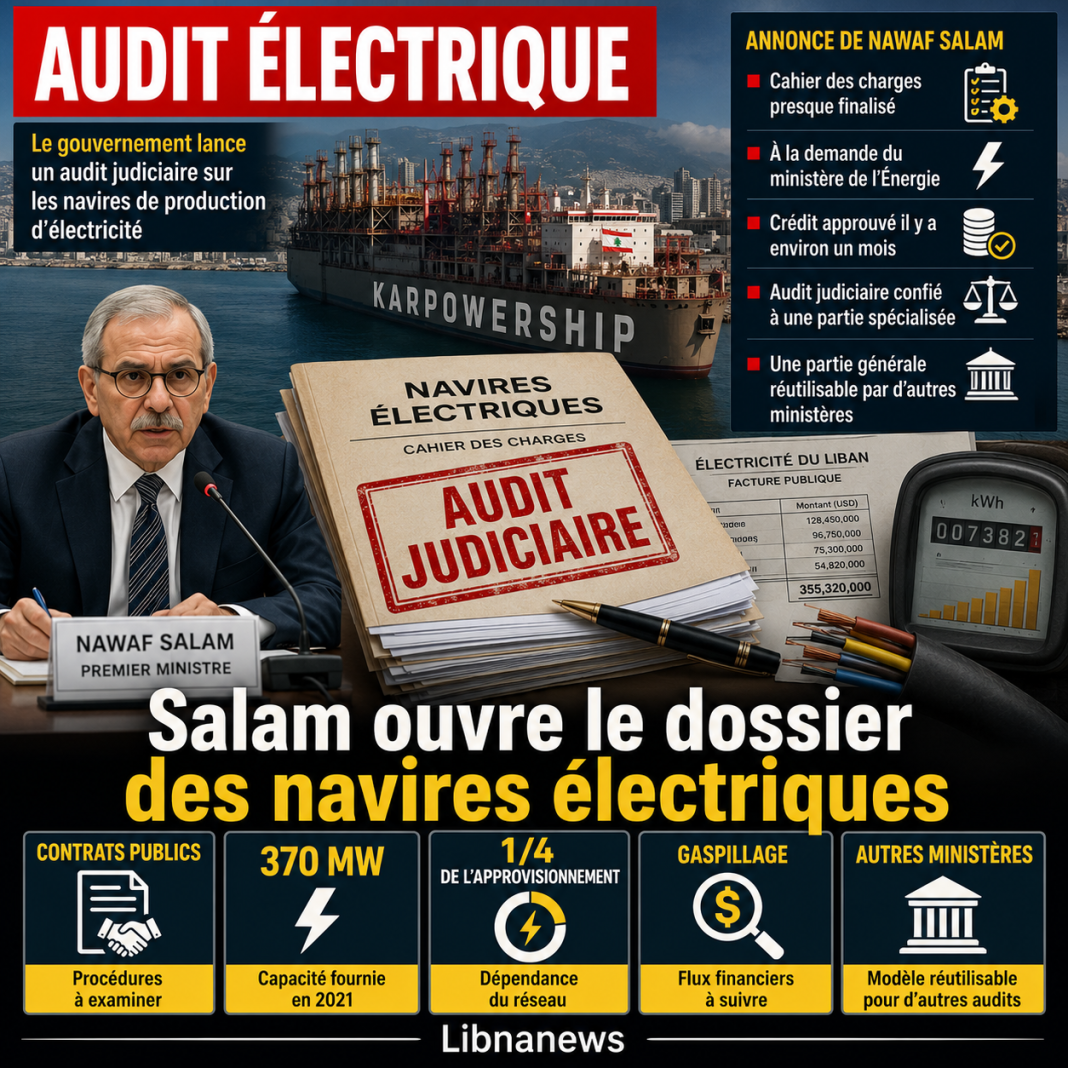
Nawaf Salam, on the other hand, presented the status of the electricity-producing vessels. The Prime Minister indicated that the terms of reference for a specialized party to conduct a judicial audit were now being finalized. He recalled that an appropriation had been approved approximately one month earlier at the request of the Ministry of Energy to prepare this document.
The Head of Government stated that the specifications had two components. The first is general and can be used for any judicial audit in a ministry. The second relates specifically to electric ships. Nawaf Salam invited ministers with waste indices in their administrations to use the general part of the document, if the extent of suspicion justifies such a procedure. He presented this approach as a step towards further reform, transparency and the fight against corruption.
Health, telecommunications and ongoing investigations
The health issue was addressed by the Minister of Health. He presented the preventive measures taken to prevent the Ebola virus from arriving in Lebanon, following reported outbreaks in several African countries and the registration of a first case in France. Measures include airport, crossing points and hospital preparation, in cooperation with the World Health Organisation. The minister said that no Ebola cases were recorded in Lebanon. The Head of State requested an awareness campaign in connection with the Ministry of Information.
The Minister of Telecommunications presented a point on the fire that occurred two days earlier in a depot under the Ministry and d-Ogero in Dekwaneh. He thanked the Civil Defence, Beirut firefighters, the army, security forces, local authorities and the teams mobilized. He indicated that the disaster had affected a part of a complex consisting of several deposits and sections, but that the flames had been controlled before spreading further.
No human loss was reported in this fire. The Minister called for a speedy recovery for firefighters injured or affected by the intervention. He also announced two parallel approaches. The first is an internal investigation by the ministry and agencies concerned to assess the damage, loss and property affected. The second is the responsibility of the security and justice services to determine the causes and circumstances of the disaster.
The Minister of Telecommunications called for no conclusions to be drawn before the investigations were completed. It considered that unfounded interpretations could hinder the conduct of the investigation and the search for the truth. He promised to make the results public once the procedures had been completed. The stated objective is to identify the causes of the incident and take the necessary steps to avoid its recurrence.
Political and Adjourned Issues
Exchanges with the press also covered several political and administrative issues. When asked about the proposed law on the service of the homeland, Paul Morcos replied that it had not been approved. He explained that several departments had made comments or expressed their refusal. On Zahlé’s electricity issue, the Minister referred to an extension related to the need for continuity of the public service.
A question was also raised about possible direct negotiations with Israel and Hizbullah’s opposition to such a perspective. Paul Morcos indicated that the outcome of the ongoing negotiations had not been presented to the Council of Ministers. He added that, at the appropriate time, the matter could be referred to the Government in accordance with article 52 of the Constitution, which regulates the prerogatives of international treaties and agreements.
The session was preceded by an interview between Joseph Aoun and Nawaf Salam. Both officials addressed the agenda items prior to the opening of ministerial discussions. This coordination preceded a dense meeting, combining administrative decisions, educational measures, governance files, security monitoring and response to humanitarian emergencies. The government adopted most of the agenda items, according to the report presented by the Minister of Information.
For students and families, the decision on examinations remains the most immediate measure. The Ministry of Education will now have to publish the operational modalities, organize the centres of the exceptional session and clarify the procedures with the institutions. Universities, employers and scholarship organizations will also be waiting for the official documents needed to process the student files for this atypical school year.