





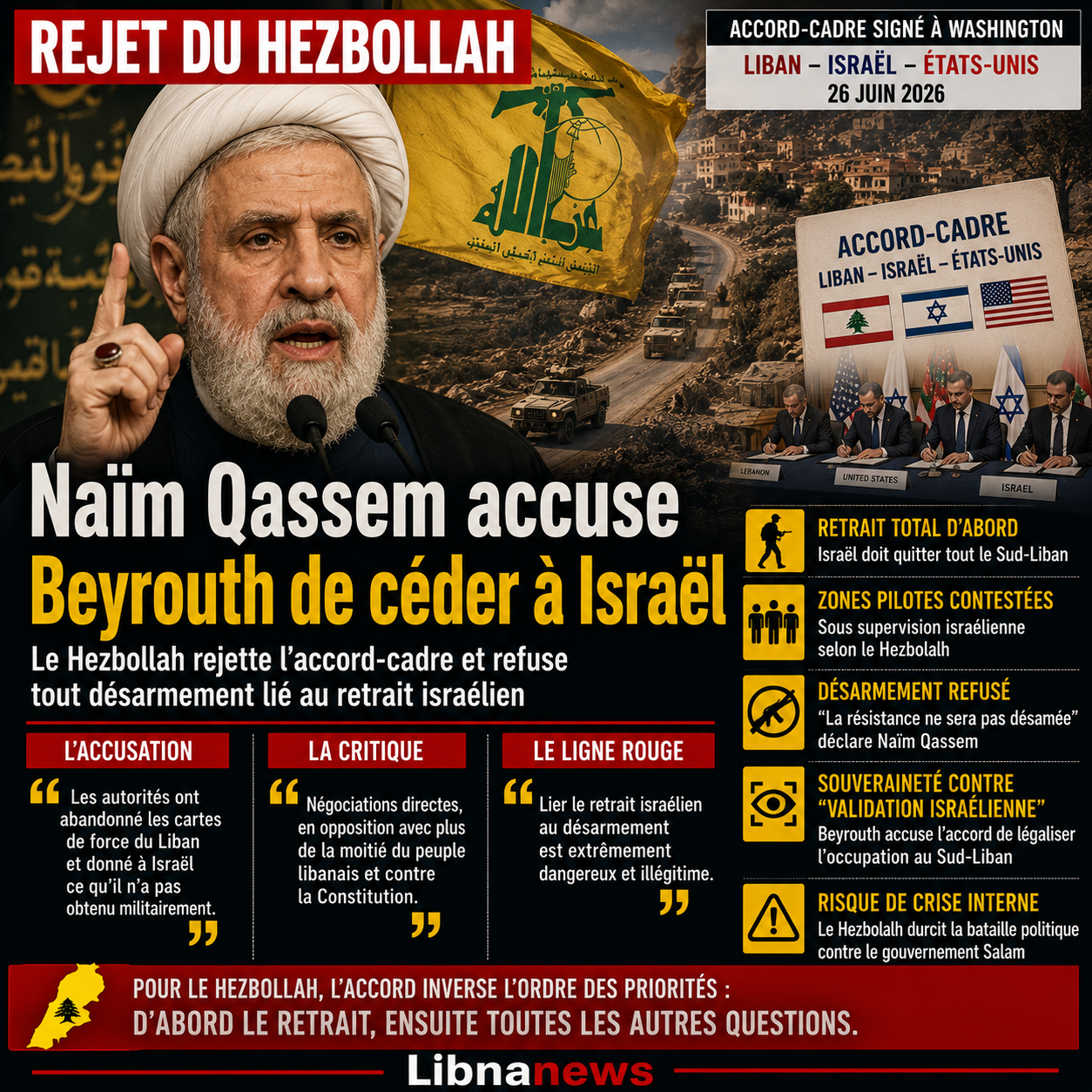
Hezbollah rejected the framework agreement signed in Washington between Lebanon, Israel and the United States, through its Secretary General, Sheikh Naïm Qassem. In a statement on the text, the leader of the Shiite party accuses the Lebanese authorities of having abandoned cards of force, of having accepted free concessions to Israel and of having placed the disarmament of resistance at the heart of a mechanism which, according to him, would legalize the Israeli presence in southern Lebanon. Its stance has strengthened the political battle in Beirut since the signing of the agreement.
Naim Qassem’s statement is not limited to a refusal of principle. It directly attacks the presidency, the government and the negotiating method followed by the Lebanese authorities. The Secretary-General of Hizbullah believes that the framework agreement places Lebanon in a position of weakness, rather than taking advantage of the regional balance of power created, in his view, by the American-Iranian negotiations. He also accuses the Lebanese executive of ruling out resistance in the midst of war and of offering Israel what it could not have obtained militarily.
This declaration comes as the Lebanese government presents the framework agreement as a first step towards the restoration of sovereignty, the return of displaced persons and the reconstruction of the South. The Washington text provides for pilot areas, an increased role for the Lebanese army, a progressive Israeli redeployment and verified disarmament of non-State armed groups. For Hezbollah, this architecture reverses the order of priorities. Israel should first fully withdraw from Lebanese territory. The question of weapons could not, according to the party, be asked as long as an Israeli presence remained.
A direct accusation against the Lebanese authorities
Naim Qassem opened his statement by questioning the Lebanese authorities ‘ responsibility. He asks: « Where is the honesty and responsibility of the Lebanese authorities towards their people and the protection of Lebanon’s sovereignty, while the American sponsor has not given them a ceasefire? Hezbollah’s leader blames the Lebanese authorities for having embarked on a diplomatic path without, according to him, obtaining the prior guarantee that would protect civilians.
He continued by saying that the ceasefire had reached Lebanon « through American-Iranian negotiations in April 2026 », but that the Lebanese authorities had allegedly rejected it. According to him, this refusal would have led Israel to commit what he calls « black Wednesday », with hundreds of dead and wounded, a terror imposed on the population and « a campaign of 100 air strikes across Lebanon, including Beirut ». These elements are part of the political accusation made by Hezbollah. They were not presented in the declaration as data from an independent official review.
This first part seeks to shift responsibility. Hezbollah wants to show that the Washington accord did not save Lebanon, but that it would have happened after government choices deemed to be wrong. The objective is clear: to challenge the official narrative that the agreement would be diplomatic progress. For Naïm Qassem, the authorities rejected a more favourable option and then accepted a more costly text for Lebanese sovereignty.
Direct negotiations denounced as concessions
The second axis of the declaration is direct negotiations. « We told the authorities that direct negotiations are free concessions to Israel. According to him, these meetings would not be an ordinary diplomatic exercise, but « taxing meetings of submission to Israeli and American requirements. ».
Hezbollah leader also argues that these discussions take place « in opposition to more than half of the Lebanese people » and « unlike the Constitution and laws that consider Israel an enemy and criminalize any contact with it ». This statement records the party’s rejection in a political and legal register. Hezbollah seeks to present the agreement as a problem of national legitimacy, not only as a strategic disagreement.
Naïm Qassem then blames the authorities for abandoning the resistance map. « You don’t have a map of strength because you have abandoned the strength of the resistance and the people, » he says. The formula summarizes Hezbollah’s doctrine. For the party, the military capacity of the resistance is a lever in any negotiations with Israel. To consider it a problem to be solved is, in his view, to weaken Lebanon even before the discussion.
The hardest part is the government decision of March 2. Qassem claims that the authorities « sat down the resistance in the back » by declaring it outlawed « in the midst of war, » and this « at the service of the Israeli project ». He adds: « The words do not change anything, it is the results that matter: it is an abandonment of Lebanon’s sovereignty. Hezbollah therefore rejects the official discourse on sovereignty and affirms that sovereignty is measured by concrete results, including Israeli withdrawal.
Iran presented as a map of strength
The declaration also highlights Iran’s role. Naïm Qassem states that « the Iranian-American memorandum of understanding placed the end of the war in Lebanon as the first point ». According to his version, when Israel refused to comply, « Iran suspended the agreement and closed the Strait of Ormuz until the United States put pressure and imposed a ceasefire. ».
These statements must be reported as Hezbollah’s position. They reflect the party’s reading of the regional power ratio. Naïm Qassem wanted to show that Tehran had acted in favour of Lebanon and that the Lebanese authorities would not have been able to use that lever. He claims that the American-Iranian text provided for « an immediate and lasting cessation of military operations on all fronts, including Lebanon », as well as a commitment to « not use force » and « guarantee Lebanon’s sovereignty and territorial integrity ».
According to him, « negotiations for a final agreement must take place within 60 days ». He adds that the Lebanese authorities have again refused this route « until it is explained that the ceasefire was already achieved and that negotiations on the Israeli withdrawal are Lebanese ». Qassem concludes this sequence with a political formula: « It is a gift from Iran to Lebanon. But the authorities abandoned these cards in the framework agreement and gave Israel what he wanted free of charge. »
This part of the statement confirms the depth of the disagreement between Hezbollah and the government. The Lebanese government wants to include the agreement in a state-to-state relationship between Lebanon and Israel, under American mediation. Hezbollah insists on a regional framework in which Iran remains a power of mediation, pressure and protection. The framework agreement seeks to remove Iran from the formal equation. Naïm Qassem handed it back to the center of the story.
Pilot zones denounced as a legalisation of occupation
The strongest criticism relates to pilot areas. Naïm Qassem speaks of a « serious fall » and a « major mistake » which, according to him, « is to yield sovereignty to the Israeli enemy ». He accuses Israeli Prime Minister Benjamin Netanyahu of authorizing the strengthening of the Lebanese army « only in two pilot zones », while « the enemy oversees its deployment and disarmament ».
This wording covers the core of the mechanism provided for in the agreement. The Washington text provides that the Lebanese army gradually takes control of certain areas, after verification of the disarmament of non-State armed groups and the dismantling of their infrastructure. For the Lebanese authorities, this method should allow the return of the State. For Hezbollah, it gives Israel a right of control over the deployment of the Lebanese army and the internal affairs of the country.
Naïm Qassem states that « the trial period can last months, with Israeli validation at each stage ». It draws a very hard conclusion: « This legalizes the occupation for years, even the transformation of these territories into annexation. This accusation is part of a context where Israeli officials have already mentioned the maintenance of a security zone in southern Lebanon until Hezbollah is disarmed.
Hezbollah’s secretary-general also believes that the agreement « prevents the return of Lebanese to their lands ». This statement responds to the official Lebanese speech, which, on the contrary, presents the text as a path towards the return of the displaced. The divergence therefore concerns the same objective. The government says the pilot areas will allow the return. Hezbollah claims that they can block this return if Israel retains validation power.
Refusal to link Israeli withdrawal and disarmament
The final part of the statement deals with the most explosive issue: the link between Israeli withdrawal and the disarmament of resistance. Naim Qassem states: « What is Israel’s relationship to our internal affairs? Any agreement should be limited to the south of Litani. Hezbollah refuses to address the issue of arms in Lebanon in an agreement with Israel.
The leader of the party added: « To link the Israeli withdrawal to the disarmament of resistance is extremely dangerous. According to him, this would make « every weapon in Lebanon a justification for continued occupation. » This formula summarizes the heart of Hezbollah’s opposition. If Israel can stay as long as there are weapons outside the state, then withdrawal becomes dependent on a condition that Tel Aviv can judge indefinitely unfulfilled.
Qassem then states: « Resistance will not be disarmed, and the right to defence is legitimate. This sentence is the closing point of the declaration. Hezbollah is not part of the logic of negotiating its arsenal. It reaffirms a red line: its weapons will not be surrendered under the framework agreement.
He concludes: « Israel must withdraw as an occupant. Any other approach is a reward for Israel and an attack on Lebanon’s sovereignty. This sentence reverses Washington’s logic. For the United States and Israel, withdrawal depends on safeguards against Hezbollah. For Hezbollah, any condition of withdrawal rewards occupation and violates Lebanese sovereignty.
A direct challenge to the Salam government
Naim Qassem’s statement puts the government of Nawaf Salam at an immediate test. The Prime Minister presents the agreement as a path towards Israeli withdrawal and the return of sovereignty. On the contrary, Hezbollah affirms that the text abandons this sovereignty and gives Israel a right of interference in Lebanese internal affairs.
The government will have to answer several questions. Will the pilot areas be under the sole control of the Lebanese army, or will Israel retain a right of validation? Will the Israeli withdrawal be included in a clear timetable? Will civilians be able to return before Hezbollah’s total disarmament? Will the Lebanese army be called upon to dismantle directly the party’s infrastructure? These questions will determine the next steps.
The risk is also institutional. If the agreement is to be approved by the Council of Ministers or submitted to Parliament, Hezbollah and its allies will be able to use Naim Qassem’s arguments to challenge its legality, legitimacy and compliance with Lebanese sovereignty. The debate will not only be diplomatic. It will become constitutional and internal.
The Lebanese army at the centre of the tension
The Lebanese Army is the most exposed actor. The framework agreement entrusts it with security responsibility in pilot areas. Naïm Qassem presents this mechanism as an Israeli supervision of the deployment of the army. This reading can weaken the military institution, especially in areas where Hezbollah retains social and political influence.
If the army deploys in the pilot areas without confrontation, the government can talk about returning from the state. If it is to prevent the return of Hezbollah or dismantle positions, the risk of confrontation increases. If it does not, Israel and Washington can say that the mechanism is not working. The army can thus be caught between external demands and internal challenge.
Naïm Qassem is precisely trying to prevent this configuration. By denouncing the agreement as an infringement of sovereignty, he tries to delegitimize any military mission that is perceived to be linked to Israeli conditions. The message is addressed to both the government and the military: the army must protect Lebanon, not apply a road map dictated by Israel.
A Battle of the Sovereignty Story
Hezbollah’s statement confirms that the main battle is now about the meaning of sovereignty. For the presidency and the government, sovereignty means the return of the state, army and institutions to the South. For Hezbollah, it means first of all the total Israeli withdrawal and the absence of Israeli interference in the internal affairs of Lebanon.
Both sides therefore use the same word to defend opposing priorities. The government is talking about a state monopoly on weapons. Hezbollah speaks of the right to defence. The government is talking about pilot areas to restore Lebanese authority. Hezbollah is talking about the legalization of occupation. The government is talking about the return of the displaced. Hezbollah claims that the agreement may prevent it.
This battle of the narrative will determine the receipt of the agreement in Lebanon. If the first steps bring visible Israeli withdrawal, lower strikes and civilian return, the official line will gain ground. If Israel maintains its security zone and the agreement begins with disarmament requirements, the reading of Hezbollah will be strengthened.
South Lebanon as arbitrator
The people of the South will be the first to judge. Many have experienced the bombing, displacement, destruction and collapse of public services. For a part of them, the State has not protected. The army withdrew or could not maintain itself in certain areas. In this context, an agreement that does not immediately guarantee full Israeli withdrawal can be met with distrust.
Naim Qassem addresses this perception directly. He presented the resistance as the map of strength that the government would have abandoned. He presented Iran as a support that would have offered a ceasefire. He presents Israel as an occupier rewarded by the agreement. This story can be echoed if civilians do not see concrete improvements.
The government will therefore have to answer by acts more than by communiqués. He will have to prove that the agreement allows the return, reconstruction and end of the Israeli presence. Otherwise, the rejection of Hezbollah can become a broader political movement than the party itself.
An agreement already threatened by its implementation
Naim Qassem’s statement does not legally block the framework agreement. But it threatens its application. She announced that Hezbollah would not cooperate in the disarmament provided for in the text. It challenges the legitimacy of direct negotiations. It rejects any Israeli role in Lebanese internal affairs. She claims that the resistance will not be disarmed.
This position makes the security annexes decisive. If they place the Israeli withdrawal in a clear schedule, pressure on Hezbollah will be more difficult to maintain. If they let Israel validate each step, the rejection of the party will become stronger. If they give the Lebanese army too direct a mission against Hezbollah infrastructure, the risk of internal crisis will increase.
Hezbollah has therefore turned the Washington accord into an internal political battle. The text should pave the way for lasting peace. It now opens up a confrontation on arms, sovereignty, the role of Iran, the place of the army and the very definition of resistance. The next step is not just between Beirut, Washington and Tel Aviv. It will also be played in Lebanese institutions and in the South, where the agreement will have to prove that it withdraws Israel instead of legalizing its presence.