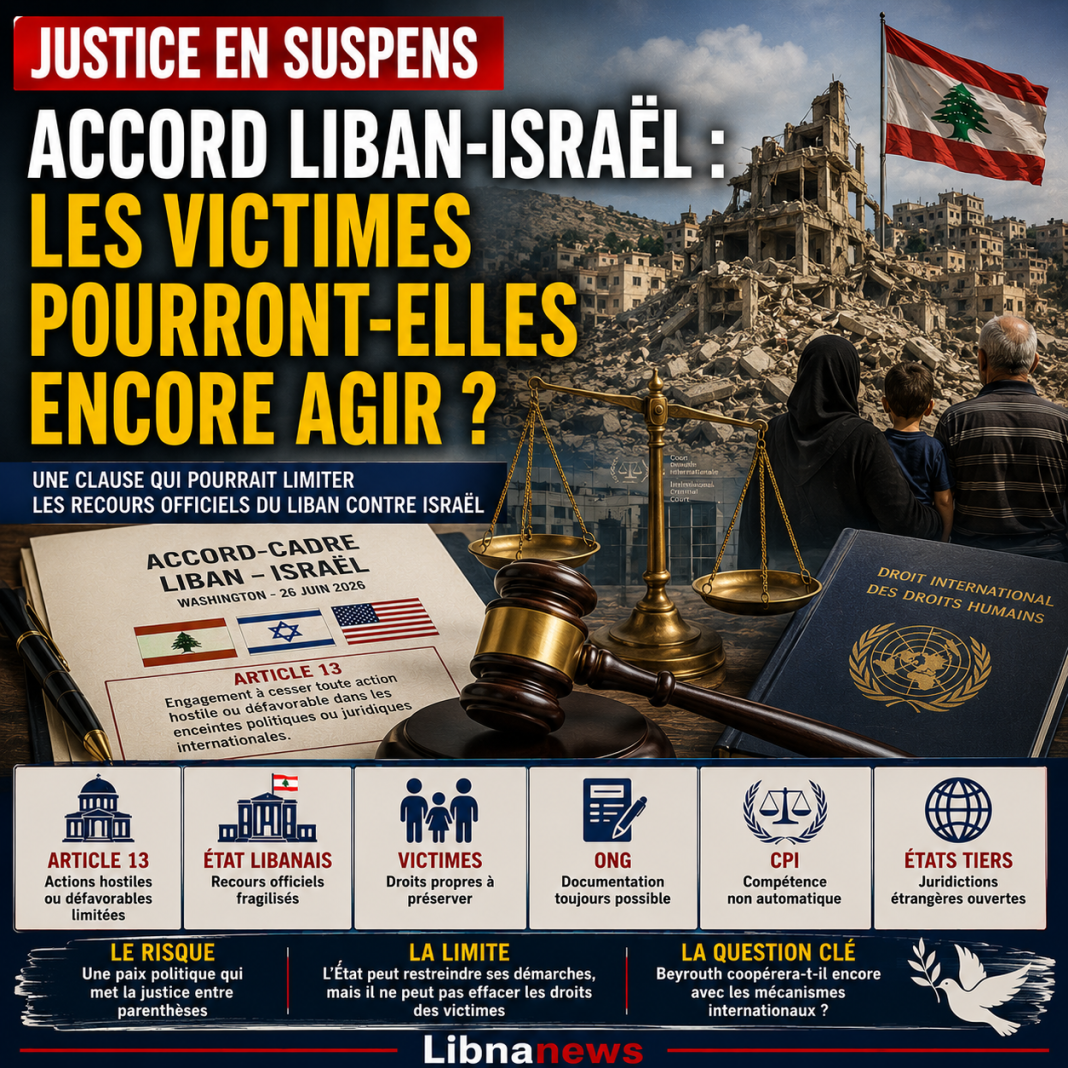






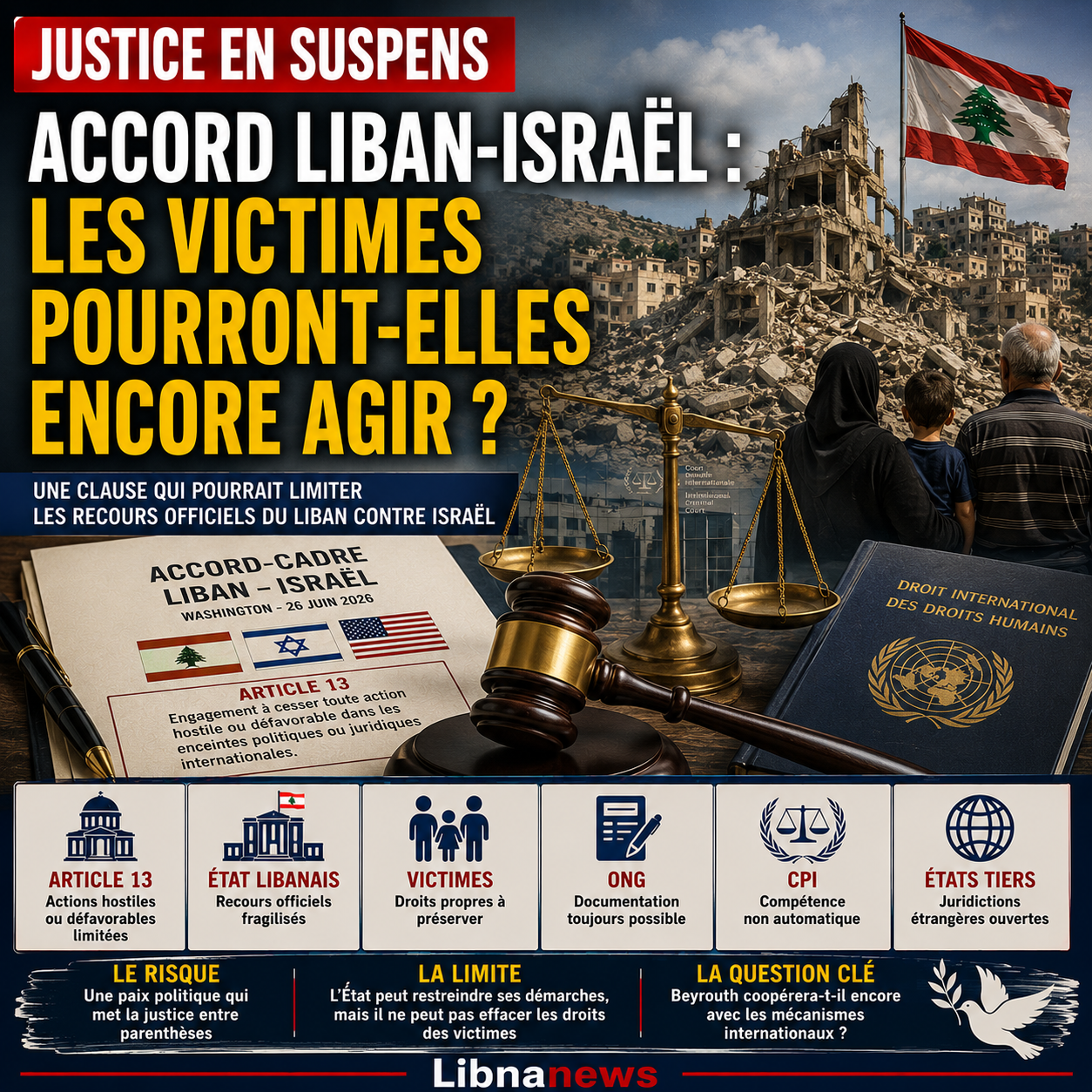
The clause of the Washington Framework Agreement between Lebanon, Israel and the United States opens up a sensitive debate on the right to justice. The text urges both States to take measures in good faith, including the cessation of any hostile or adverse action in international political or legal forums. Formulated in this way, the clause can be read as a commitment of the Lebanese State to no longer bring cases against Israel before international forums. It can also be understood as an attempt to pacify the bilateral relationship by preventing both Governments from using the courts or international organizations as a platform for confrontation.
This reading concerns human rights organisations, lawyers and some of the families of victims. The war has caused massive destruction, displacement and accusations of serious violations of international humanitarian law. In this context, a clause that limits the Lebanese State’s international approaches can be seen as a political waiver of accountability. But its legal effect must be clearly distinguished. A government may decide not to initiate a diplomatic complaint. It cannot, by means of a bilateral clause, erase the rights of all victims, prevent any NGO from transmitting information or automatically link third States or foreign courts.
A clause that first targets the Lebanese State
The first effect therefore concerns the Lebanese State. If the clause is interpreted strictly, Beirut could refrain from bringing a complaint against Israel before international forums, supporting a hostile resolution, or calling for the opening of an international judicial mechanism for Israeli operations. This is an important change. It limits a legal map that Lebanon could use after strikes against civilians, first aid workers, journalists, infrastructure and housing. It can also reduce the government’s ability to formally support victims’ families in an international approach.
This possible waiver poses a political problem. The Lebanese government presents the agreement as a path to sovereignty, the return of displaced persons and reconstruction. But if this sovereignty means giving up international prosecutions against Israel, the text can be accused of exchanging peace against impunity. For the inhabitants of the South, already marked by the bombings and the lack of effective state protection, this signal can be heavy. Many may wonder why the State agrees to limit its remedies when destruction remains visible and families are still looking for accounts.
The issue of the International Criminal Court is the most sensitive. Lebanon is not a State party to the Rome Statute. This means that the jurisdiction of the Court is not automatically open for all crimes committed in its territory. The Lebanese Government could, however, theoretically accept the ICC’s jurisdiction for a period or facts determined by an ad hoc declaration. A clause whereby Lebanon undertakes to stop adverse actions in international legal forums could make such a declaration politically very difficult.
That is where the clause becomes concrete. She doesn’t necessarily say that the victims can’t do anything. But it can prevent the Lebanese State from making the decisive gesture that would open up certain ways. If the ICC’s competence depends on a Lebanese declaration, and if the government is committed not to act against Israel in international legal forums, the families of victims lose an essential lever. They can still document the facts, but access to international justice is getting closer.
Victims and NGOs keep margins
However, private initiatives do not disappear. Victims, families, lawyers or NGOs may continue to document alleged violations, collect testimonies, maintain images, prepare medical records, transmit information to United Nations organs or foreign prosecutors. They may also address communications to the ICC Prosecutor. Article 15 of the Rome Statute allows the prosecutor to receive information from various sources and to act on his own initiative, subject to the conditions of jurisdiction and authorization required.
This possibility should not be overestimated. Private communication to the ICC is not enough to create the Court’s jurisdiction. It may attract the attention of the Prosecutor, but the Prosecutor must verify whether the Court has territorial, personal or temporal jurisdiction. If the alleged crimes are not covered by an already open situation, and no State party or the Security Council applies to the Court, the chances of an investigation remain limited. NGOs can therefore feed a file without replacing the sovereign act of a State when it is necessary.
Foreign national courts are another way. Some countries recognize forms of universal jurisdiction for war crimes, crimes against humanity or torture. Victims may attempt to lodge complaints in those States if their domestic law permits. Conditions vary greatly. Some systems require the presence of the suspect in the territory. Others require a connection with a victim or a nationality. Others leave an important margin for the prosecution. The Lebanon-Israel agreement does not bind these third States. A Lebanese Government cannot prevent a foreign judge from applying its own right.
A third State may also act in accordance with its own international obligations. If he is a party to the Rome Statute and the ICC has jurisdiction over the situation, he may, under certain conditions, refer a situation to the ICC. It can also support UN investigative mechanisms, request reports or fund documentation teams. The agreement signed by Lebanon and Israel does not remove from a third State its powers or commitments.
The limits of an action without the State
The Security Council remains a theoretical path. It may refer a situation to the ICC, even where the State concerned is not a party to the Rome Statute. But this option depends on the diplomatic power ratio and the veto of the permanent members. In the Lebanese case, such a referral would be politically very difficult. It cannot therefore be presented as an immediate route. However, it remains legally separate from the bilateral clause.
United Nations mechanisms can also continue. Special rapporteurs, fact-finding missions, OHCHR or commissions of inquiry may receive information, document violations and issue conclusions. A non-hostile clause in a bilateral agreement does not automatically remove the ability of United Nations bodies to investigate. However, it may reduce the active cooperation of the Lebanese Government if the Government chooses not to provide any official documents, testimony or formal requests.
The most sensitive issue therefore concerns state cooperation. Victims can document. NGOs can alert. Lawyers can testify. Third States may act. However, the Lebanese State holds information, administrative evidence, official reports, hospital reports, military elements, strike cards and vital public data. If it limits its cooperation to the name of the agreement, private approaches become more difficult.
The clause may also have a deterrent effect. Even if it does not legally block victims, it may discourage public administrations, diplomats or institutions from participating in documentation. Staff members may be reluctant to submit files. Departments may avoid publicly supporting complaints. Families may fear that their approach will be presented as contrary to the official line. It is a political effect more than a legal effect, but it can be powerful.
Peace cannot erase serious crimes
The advocates of the clause will reply that it aims to prevent further confrontation by other means. According to this reading, if Lebanon and Israel want to emerge from the war, they must stop turning international forums into diplomatic battlefields. The search for the missing, the return of the remains, the release of the detainees and the reconstruction would require de-escalation. The clause would therefore be an instrument of stabilization.
This argument has a limit. International humanitarian law does not disappear with political agreement. War crimes are not mere diplomatic disputes. Victims retain a right to truth, justice and reparation. A security agreement cannot be interpreted as a general amnesty for serious international crimes, except to provoke a major legal and moral challenge. Even if the Lebanese State renounces certain remedies, it cannot erase the facts or prevent any independent search for responsibility.
The issue also concerns the hierarchy between peace and responsibility. In many post-conflict agreements, the parties seek to neutralize hostile approaches to international organizations in order to create a more favourable political climate. But when serious international crimes are alleged, this neutralization cannot be total. International criminal justice is based precisely on the idea that certain crimes go beyond the interests of Governments. Victims are not just diplomatic subjects. They have their own rights, even when their State chooses political prudence.
The Lebanese National Human Rights Commission recalled, according to international press reports, that the search for justice for war crimes cannot be equated with a hostile act. This distinction is important. Calling for an investigation into attacks against civilians, journalists or rescue workers is not necessarily a political attack on a state. It is also the exercise of a right to justice.
Necessary clarification from Beirut
For the Lebanese Government, the difficulty will be to clarify the scope of the clause. Does he undertake not to file any further complaints against Israel? Does he only commit to not using international forums for political campaigns? Will victims be able to obtain support from the ministries? Could Lebanon cooperate with UN mechanisms? Will it be able to pass on evidence to foreign courts if they so request? Without a clear answer, the clause will feed the accusation of impunity.
Hezbollah and other opponents can use this point politically. They will say that the government has not only accepted a conditional Israeli withdrawal, but has also given up pursuing Israel for destruction and death. This speech can be echoed in the South, where families are waiting for reparations and where the state is already accused of failing to protect the population sufficiently.
The question of reparations is also central. An international complaint is not only criminal. Lebanon has already, in other episodes, sought recognition of Israel’s responsibility for environmental or economic damage. If the agreement limits international approaches, it may weaken future claims for compensation. This directly affects reconstruction and social justice.
The disqualification clause may therefore become one of the most disputed points of the agreement. It is less spectacular than the pilot zones or the disarmament of Hezbollah, but it affects the memory, victims and the state’s ability to defend its citizens after the war. It asks a simple question: can peace be built by putting justice in brackets?
A judicial area still open
Legally, the answer must remain balanced. The Lebanese State can limit its own actions. He may choose not to seize certain instances. It may refrain from supporting certain complaints. But it cannot deprive victims of any initiative, prevent NGOs from documenting the facts, link third States or automatically neutralize the jurisdiction of foreign jurisdictions. The clause reduces the scope of official Lebanese action. It does not close all the international judicial space.
It is precisely this distinction that the authorities will have to explain. If they do not, the agreement will be accused of sacrificing justice to achieve a political compromise. If they clarify that the rights of victims remain intact and cooperation with independent mechanisms remains possible, they will reduce part of the challenge. But they will have to face another question: how far can we talk about cessation of hostile actions if the victims continue to seek justice against Israel?
The exact drafting of the annexes and Lebanese implementing decisions should therefore be monitored. If the clause remains an obligation of diplomatic restraint, its effect will be significant but limited. If it is interpreted as a ban on cooperation with investigative mechanisms, it will cause more serious controversy. The authorities will also have to explain whether the alleged crimes committed by all parties remain documentable, including those attributed to Israel, Hezbollah or other actors. A lasting peace cannot be based on amputated memory.
The answer will determine one of the most sensitive dimensions of the post-agreement. Withdrawal, pilot areas and reconstruction will be measured on the ground. Justice, on the other hand, will be measured over time, in victim files, NGO archives, foreign courts and international reports. The framework agreement can hinder the Lebanese state. He cannot erase the demands for truth that arise from the ruins of the South.