






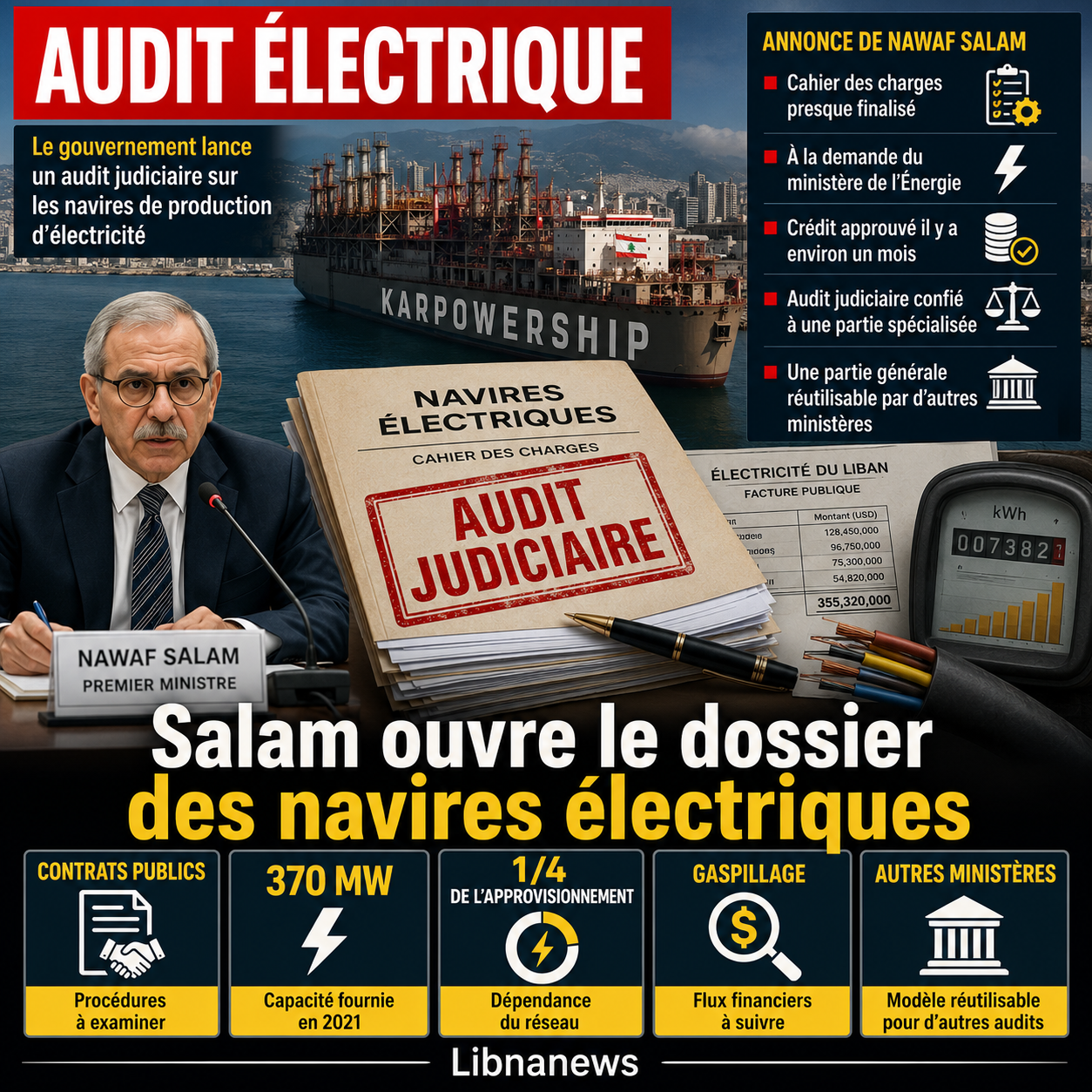
Lebanese Prime Minister Nawaf Salam announced on Wednesday, 25 June, that the terms of reference for launching a judicial audit of electricity generation vessels had been prepared at the request of the Ministry of Energy. The announcement was made at the beginning of the meeting of the Council of Ministers, held at the Baabda Presidential Palace. According to the Head of Government, the document has now reached its final stages and is intended to mandate a specialized party to examine this old electrical sector file.
The statement was circulated by the Council Presidency Press Office. It is part of a government sequence dedicated to several administrative, social and institutional issues. The subject of electric ships occupies a special place in the Lebanese public debate. It concerns electricity management, public contracts, state spending and suspicions of waste which have accompanied several energy policies for years.
Nawaf Salam reported that the Council of Ministers had approved, about a month ago, the appropriation claimed by the Ministry of Energy to prepare the specifications. The document consists of two parts. The first is general and can serve as a basis for judicial audits in other departments. The second relates specifically to electrical production vessels. The Prime Minister invited ministers with elements of suspected waste in their own administrations to use the general part of the specification.
A Judicial Audit Targeted on Electric Ships
The file concerns electricity generation vessels used in Lebanon to strengthen the supply of electricity in Lebanon. These floating units were presented as an interim solution to chronic production deficits. They then occupied a sustainable place in the energy landscape, while cuts remained frequent and public finances continued to bear a heavy burden linked to the sector.
The judicial audit announced by Nawaf Salam aims to examine the conditions of the case, its financial aspects and possible responsibilities. The term used by the head of government refers to a mission that is more than just an accounting audit. The aim is to entrust the work to a specialised party, able to monitor flows, contracts, procedures, administrative decisions and possible blocking points. The government has not yet announced the name of the entity that could be retained.
The terms of reference shall constitute the stage prior to the choice of that entity. It normally defines the scope of the mission, the documents to be reviewed, the procedures to be followed, the deadlines, the confidentiality obligations and the deliverables expected. In this case, the Prime Minister indicated that the document was almost finalized. The next phase should therefore focus on the formal initiation of the procedure and the selection of a specialised operator.
The distinction between a general part and a part specific to electric ships shows that the government wants this initiative to be broader in scope. The energy record serves as a starting point. The model could then be applied to other jurisdictions if suspicions of waste are considered sufficiently serious. This approach would allow departments to have a framework already prepared, rather than to repeat a full procedure each time.
Ministry of Energy
According to Nawaf Salam’s statement, the Ministry of Energy had requested an appropriation to prepare the specifications. The Council of Ministers approved this request approximately one month before the announcement. This clarification places the file in an administrative process already underway. The intervention of the head of government is therefore not only a political intention. It reflects a step in the technical preparation.
The Ministry of Energy and Water is at the heart of the issue, as it oversees public policies in the electricity sector. Contracts, power purchase decisions, financing requests and relations with Electricity in Lebanon are directly or indirectly within its scope. However, the audit will have to exceed the department alone if the documents reviewed involve other jurisdictions, public bodies, suppliers, intermediaries or previous government decisions.
Nawaf Salam did not detail the cost of the upcoming mission or the amount approved to prepare the terms of reference. He also did not specify the timing of the call for applications. His intervention mainly established that the technical document was completed or close to being completed. It also placed the audit within a governmental framework of transparency and continued waste.
This announcement comes in a country where the electricity sector remains one of the main symbols of the failure of public services. Households rely heavily on private generators, individual solar systems or intermittent supplies. Public administrations, hospitals, schools and businesses are also affected by network instability. The case of electric ships is therefore part of a broader set of past decisions which have sought to fill a production deficit without addressing structural causes.
An electrical sector marked by successive emergencies
The use of electric ships was presented at its launch as a quick response to a power shortage. Lebanon lacked stable production capacity. Existing plants suffered from a lack of investment, maintenance problems, high fuel costs and delays in reforms. Floating units allowed for the addition of available power without the immediate construction of new shore-based power plants.
However, this interim solution lasted several years. The two vessels linked to Karpowership were associated with a significant share of domestic supply. In 2021, the company announced that the supply would be discontinued due to payment arrears and legal litigation against its units. According to an international agency, the ships then supplied 370 megawatts, or about a quarter of the electricity available at that time. This cut illustrated the network’s dependence on temporary solutions that have become strategic.
The cost of the device fed the critics. International organizations and civil society actors noted that ships had been a high financial burden on the State. The debate focused on the appropriateness of this expenditure, possible alternatives, the duration of the contract and the lack of durable solutions. The authorities will now have to document these elements in a formal framework if the judicial audit is initiated.
The audit does not replace sector reform. However, it can establish a documentary basis on a specific file. It may also indicate whether the procedures have been complied with, whether the payments correspond to the contracts, whether decisions have caused damage to the State or whether irregularities must be transmitted to the competent authorities. The government presents this step as an instrument of transparency, in a sector where the opacity has often fuelled mistrust.
A specification for other ministries
One of the new elements of the announcement concerns the possible use of the specification by other departments. Nawaf Salam clarified that the general part of the document could be used for any judicial audit in an administration. Ministers who have sufficient suspicions of waste can therefore be inspired. This guidance gives the electrical ship file an administrative method dimension.
A general specification may reduce delays. It may set common standards for defining an audit mission, protecting documents, identifying persons concerned, organizing access to archives and supervising the submission of reports. It can also prevent each department from writing a different document, with varying requirements. In a State where procedures are often slow, standardization can facilitate the launch of comparable missions.
The Prime Minister linked this opportunity to the continuation of the reform process. He also referred to respect for transparency and the need to monitor waste and corruption in ministries. These terms place the judicial audit in a broader framework than the energy sector alone. They indicate that the government intends to use technical tools to verify sensitive files, not just political statements.
This approach requires, however, that the ministers concerned provide sufficiently documented files. A judicial audit cannot be based solely on general suspicions. It requires contracts, invoices, decisions, payment statements, correspondence and administrative data. The actual scope of the approach will therefore depend on the ability of departments to identify specific files and submit them for professional review.
Transparency as a political message
In his speech, Nawaf Salam described the finalization of the terms of reference as « not blessed », according to the Arabic language distributed by his press office. He expressed the hope that other departments would follow the same path. This sentence gives the announcement a clear political dimension. The Head of Government wants to present the audit as a sign of continuity in reforms and as a response to accountability requests.
Lebanon has been facing a crisis of trust between citizens and institutions for years. The financial crisis, the deterioration of public services and repeated accusations of corruption have reinforced this mistrust. The electricity sector concentrates part of this discontent, as it has mobilized significant expenditure without guaranteeing a continuous current. Daily cuts remind residents of the gap between committed budgets and service received.
The Prime Minister’s statement does not contain a nominative accusation. It does not designate any person responsible or conclude that there are irregularities. She announced a mechanism to review a file. This distinction is important. A judicial audit does not replace a judicial decision. It can produce conclusions, establish facts, recommend follow-up or report anomalies. Any prosecutions are then the responsibility of the competent authorities.
The government will therefore have to manage expectations. Part of the opinion can wait for quick results. This type of mission requires time, especially when contracts cover several years and involve several administrations. The specifications should specify the deadlines and the objectives. The results should be presented with sufficient clarity to avoid further controversy over the scope of the audit.
Public contracts at the centre of the examination expected
The electrical ship file raises issues related to public contracts. Auditors will be required to review the terms and conditions of procurement, any amendments, payments, penalties, arrears, obligations of the supplier and those of the State. They will also have to check the consistency between the planned capacity, the electricity actually supplied and the amounts paid. The final scope will depend on the specifications and documents made available.
The ships were associated with an emergency solution. This may have influenced the procedures and decisions of the time. The authorities will therefore have to distinguish between what was of immediate necessity, what resulted from a political choice and what might constitute an irregularity. The duration of the scheme, extended well beyond a strictly transitional phase, is likely to form part of the points discussed.
Payments and arrears are another component. In 2021, the cut-off had been linked to delays in payment and a legal threat to ships. These episodes showed the fragility of contractual relations around electricity. A judicial audit can trace the amounts due, the regulations made, the decisions taken by the authorities and the financial consequences for the State.
The role of electricity in Lebanon could also be examined. The public institution shall be responsible for the production, purchase, distribution and sale of electricity under the national system. Its chronic deficit weighed heavily on public finances. Decisions on electric ships cannot therefore be separated from the general structure of the sector, even if the announced audit concerns a specific case.
A procedure that still needs to be initiated
At this stage, the government announced the advanced preparation of the specifications. It has not yet announced the formal publication of the call for tenders, the list of eligible entities, the selection schedule or the start date of the audit. These steps will be decisive. They will measure whether the announcement is rapidly turning into an operational procedure.
The choice of the specialized party will have to meet criteria of independence, competence and experience. A judicial audit of a sensitive public case requires financial, legal and contractual expertise. It also calls for the ability to handle large volumes of documents and resist political pressure. The terms of reference should therefore include safeguards on conflicts of interest and access to information.
The government will also need to determine the degree of publicity of the findings. Certain elements may be protected by confidentiality rules, particularly when they relate to contracts, legal proceedings or commercial data. But the objective of transparency requires sufficient communication on results. Citizens will need to understand what the audit has established, what it has not been able to establish and what follow-up will be given.
Coordination with judicial authorities may become necessary if the audit identifies elements that could be prosecuted. The term judicial audit specifically suggests a mission capable of producing a report that can be used by the competent authorities. The government did not detail this in the statement released on Wednesday. However, it should be included in the practical terms of reference.
A test for the government method
Nawaf Salam’s announcement puts the government before a concrete test. The electricity sector has long been identified as a reform priority. Plans followed, promises of increased production were repeated, but results were limited for users. The audit of electric ships will not solve the current crisis. However, it can show whether the executive is able to document responsibilities in a specific file.
The Prime Minister sought to broaden the issue. By opening the possibility of using the specifications in other departments, he wants to make this approach a model. Administrations with suspicious files will be able to rely on the general part of the document. This may include contracts, expenditure, service contracts or public projects. However, each case must be justified by sufficiently strong evidence.
The success of this method will depend on three conditions. The first is the quality of the specifications. The second concerns the independence of the chosen entity. The third concerns the follow-up to the conclusions. An audit without clear publication, administrative decisions or judicial transmission may lose its scope. The government will therefore have to ensure continuity between the order, the report and the next steps.
In the immediate future, the case is back to the procedural phase. The Ministry of Energy must finalize the documents, the government must supervise the selection of the specialized entity and the authorities concerned must prepare the necessary archives. The next decisions will tell whether the judicial audit on electric ships becomes a precedent for other ministries or remains limited to an emblematic record of the electricity sector.