






Washington moves centre of gravity south
Al Quds Al Arabi of 29 June 2026 places the day under the double sign of a Lebanese-Israeli agreement torn up in Washington and a renewed tension between the United States and Iran. The newspaper describes a text that opens the way to test areas in the South. He cites Zawtar Al Gharbiya and Frun as the first possible locations for an Israeli withdrawal followed by a Lebanese army deployment. The same story highlights a channel of direct contact between Lebanon and Israel. He also referred to an unpublished security annex. This secret dimension gives the agreement its true political weight. It feeds the reserves of several Lebanese actors. She also places the army at the centre of a test. This test goes beyond mere field presence. It concerns his ability to act without being caught by an Israeli reading of his mission.
Al Arabi Al Jadid of 29 June 2026 insists on the advantage given to Israel in the test areas. The newspaper reports that the Israeli army would not simply leave defined points. It would also keep a watch on what the Lebanese army is doing after its entry. This reading turns withdrawal into a conditional mechanism. The Israeli departure would depend on what Tel Aviv considers a real disarmament of Hezbollah. Thus, the agreement is not limited to fixing a map. It also sets out a method. But this method moves the load to Beirut. It asks the State to demonstrate its ability to control the South. It gives Israel a margin to say that the next step can wait.
An agreement legible by its military details
Al Joumhouria of 29 June 2026 talks about a transition from crisis management to solution management. The newspaper reports the expected arrival of American Admiral Brad Cooper to launch the application of test areas. It presents the agreement as a political piece, not as a mere security arrangement. According to this reading, the text links Lebanese sovereignty to the state monopoly on arms. In return, it links the Israeli withdrawal to the gradual fulfilment of these commitments. The message is clear. The presence of the army becomes the key to the whole. US and European support to the Lebanese military is therefore described as a central investment. However, this approach leaves a shadow zone. If a step is blocked, Israel can justify its continued presence.
Al Sharq Al Awsat of 29 June 2026 goes further in the Israeli reading. The newspaper reports that Tel Aviv is putting on a Hezbollah failure to accept the agreement. This bet would then return to a logic of military settlement. The same source indicates that Lebanese units are to be deployed in both model zones, under United States follow-up. It states that Frun and Zawtar Al Gharbiya are outside the yellow line held as a de facto belt by Israel. This precision is important. It shows that the beginning of the application may relate to areas where direct occupation is not the most obvious. The political gain would then be stronger than the immediate territorial gain. This would show that a mechanism exists, even if limited.
The internal front facing the risk of rupture
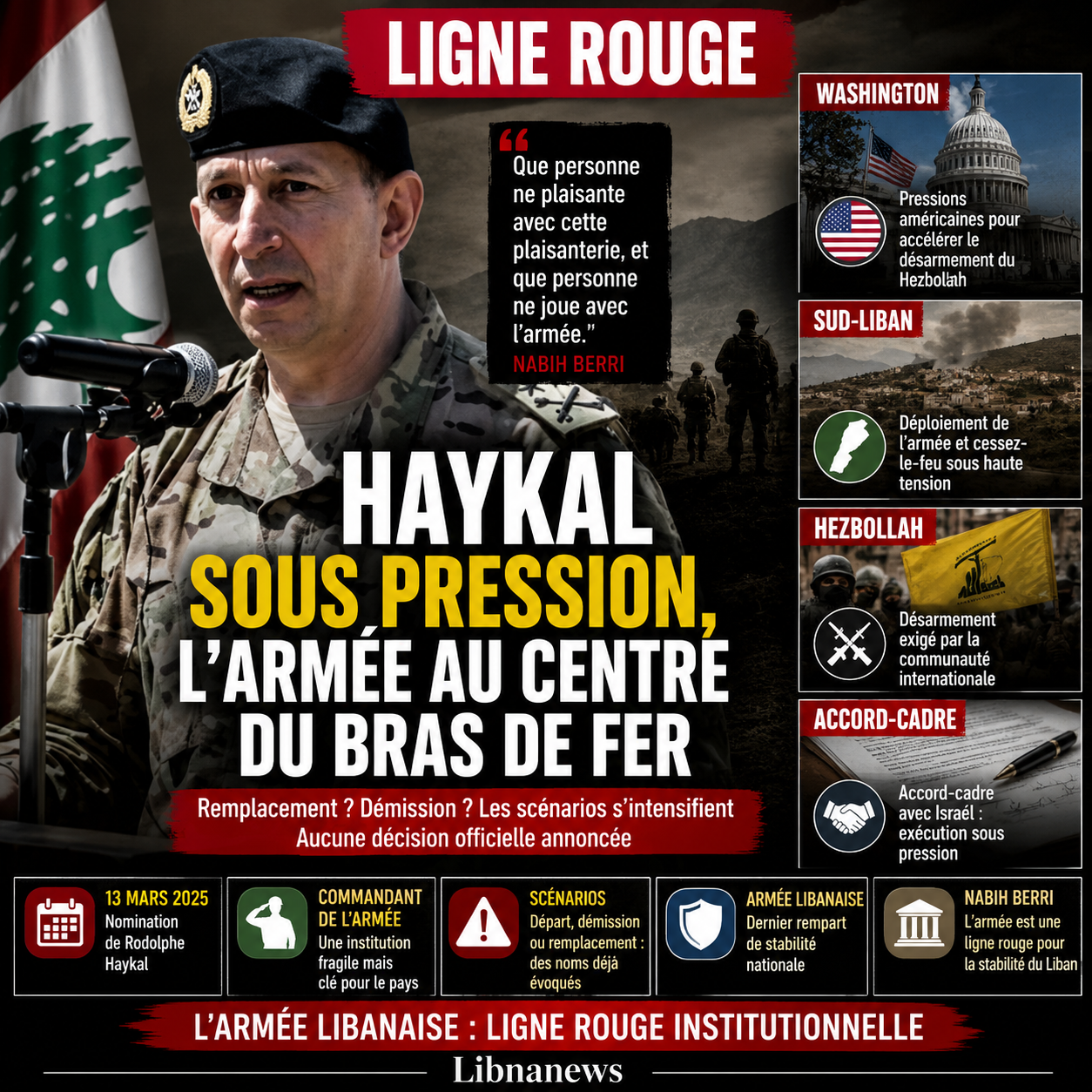
Al Akhbar of 29 June 2026 gives the most hostile reading to the agreement. The newspaper reports that Nabih Berri judges him worse than the agreement of 17 May 1983 and considers that it will not be applied. It focuses on a security annex that would allow Israel to remain, move and closely monitor the Lebanese army. In this reading, the agreement does not organise a withdrawal. He’s legalizing a presence. He also transfers the conflict inward. The newspaper cites a specific fear around the military institution. According to this account, we must avoid playing with the army and pave the way for a crisis around his command. This position overlaps with a broader fear. The debate on the agreement may become a debate on the loyalty of the institutions.
Al Bina of 29 June 2026 also entered the agreement in a refusal register. The newspaper talks about a text that recalls the agreement of 17 May. He describes a new line of opposition that includes Nabih Berri, Walid Jumblatt and Sleiman Frangieh. He insists on criticism of an attack on the army and humiliation of the state. In the same vein, Al Bina of 29 June 2026 quotes the ministers Mohammad Haidar and Rakan Nassereddine, who reaffirm their refusal to negotiate directly with Israel. Hezbollah, led by Naim Kassem, for its part rejects the link between Israeli withdrawal and the disarmament of resistance. The word « resistance » remains the word used by its supporters. But the issue for the State is formulated differently. This is the monopoly of the decision of war and peace.
Beirut between American support and fear of the street
Al Liwa of 29 June 2026 adopts a more institutional angle. The newspaper reports Donald Trump’s appeal to Joseph Aoun after the agreement was signed. He sees it as a signal of American commitment in following up the text. He also recalled that the Lebanese President called on the United States to weigh to prevent Israeli violations and to secure a withdrawal from the South. This position tries to hold two lines. On the one hand, the State wants to show that it has chosen a diplomatic framework. On the other hand, he does not want to appear as simply executing a plan from Washington. Al Liwa of 29 June 2026 finally poses a direct question to Hezbollah: what solution does he propose if the refusal of the agreement blocks the return of the inhabitants and the opening of a reconstruction site?
Ad Diyar of 29 June 2026 stresses the same tension, but from the angle of internal stability. The newspaper explains that Hezbollah is postponing a popular or military escalation and putting on the Swiss-related negotiating path to impose an Israeli withdrawal. He also recalls Nabih Berri’s warning against internal discord. In another reading, Ad Diyar of 29 June 2026 states that the agreement removes the framework of Resolution 1701 and reduces the role of the United Nations. This evolution puts Washington at the centre of the mechanism. It weakens the old balance based on international forces. It also creates a debate of sovereignty. Who’s checking? Who judges? Who decides the stage was successful? These issues now dominate the Lebanese case.
Hormuz puts Lebanon back in the regional arm
The Lebanese case is not read alone. Al Quds Al Arabi of 29 June 2026 reports an exchange of strikes between Washington and Tehran for the second consecutive day. The newspaper describes American strikes against Iran, following attacks attributed to Tehran against American ships and sites in the region. It also reports Iranian fire on Kuwait and Bahrain, condemned by several Arab countries. Donald Trump then threatens to destroy the Islamic Republic if it fails to comply with the temporary agreement. Abbas Araghchi, head of Iranian diplomacy, replied from Baghdad that any separate arrangement on Hormuz would complicate the reopening of the Strait. The strait thus becomes a central map. It serves as a reminder that Iran refuses to be excluded from regional files.
Al Arabi Al Jadid of 29 June 2026 describes the same sequence. The newspaper reports that the US command hit ten Iranian sites after an oil tanker attacked. He states that the Revolutionary Guards subsequently targeted American positions in Kuwait and Bahrain. He emphasizes that Tehran claims responsibility for the management of navigation in Hormuz. Al Akhbar of 29 June 2026 sees it as an American attempt to empty the agreement with Iran from its reach. According to the newspaper, Washington would not seek to break the text, but to deprive it of its concrete effects. This reading joins the Lebanese file. The United States is trying to separate Lebanon from Iran. Iran, on the contrary, wants to keep Lebanon in the regional negotiations.
The first test
Nida The newspaper presents the agreement as the passage from the negotiating table to the field. This formula speaks well of the nature of the open phase. Nothing’s settled. It all starts. The first question concerns the deployment of the army to the test areas. The second concerns the response of Hezbollah and its political environment. The third concerns Washington’s ability to hold Israel in the event of a blockade. The fourth depends on Tehran, which tries to take over the Lebanese map while the battle of Hormuz is intensifying. The agreement is therefore less an end than a pressure instrument. He put the Lebanese state, the army, Hezbollah, Israel, the United States and Iran in one equation. Each side sees a possible gain. Each side also sees this as a major risk.
Local politics: the framework agreement breaks power between institutional betting, Hezbollah’s refusal and the central role of the army
Baabda seeks to transform the signature into an act of authority
Nida的 Al Watan of 29 June 2026 presents the framework agreement signed in Washington as the « early beginning ». The formula summarizes the state of the local political scene. The negotiations leave the American table and enter the most sensitive area of the Lebanese debate. It’s not just about who signed. It is about who can execute, who can block and who can take over the sequels. Joseph Aoun’s presidency wants to establish the idea that the state should resume the initiative. The government of Nawaf Salam also wants to show that the diplomatic path can replace the war of wear and tear. But this line remains fragile. It is based on a hard equation. The army must enter the test areas. Israel must withdraw in stages. Hezbollah must accept that sovereignty should be defined by the state monopoly on weapons. Each point opens up an internal political conflict. Thus, the local scene is not only divided between supporters and opponents of the agreement. It is divided between two readings of sovereignty. One passes through the State and its regular forces. The other is the ability of resistance to maintain its armed function.
Al Liwa The newspaper reports that the US President congratulated his Lebanese counterpart after the signing. It also promised to support Lebanon’s sovereignty, independence and the deployment of State authority by its armed forces. Joseph Aoun, in turn, called for Washington to prevent any Israeli violation and urged Israel to withdraw from the occupied areas in the South. This formulation allows the presidential palace to present the agreement as a tool, not as a concession. It also makes it possible to place the army at the heart of the equation. Yet the same framing creates a heavy responsibility. If Israel delays the withdrawal, Baabda will have to explain why American commitment is not enough. If Hezbollah blocks, the government will have to choose between political pressure and the search for a compromise. In both cases, the Presidency no longer has the comfort of waiting.
Ain el-Tineh gives a reverse reading
Al Akhbar of 29 June 2026 places Nabih Berri in the center of the protest. The newspaper reports that the President of Parliament considers the agreement to be worse than that of 17 May 1983 and believes that it will not be executed. This position is not merely a procedural objection. She says the deal threatens internal balance. Berri also warns against any attempt to play with the army or joke with the idea of dismissing his command. This sentence reveals the heart of his fear. According to this reading, the agreement does not only weigh on Hezbollah. It can also transform the military institution into a field of political pressure. Al Akhbar of 29 June 2026 refers to a security annex giving Israel a close watch on what the army would do in the test areas. For Ain al-Tinh, the danger lies in the displacement of the conflict. The conflict with Israel would become a conflict around the army mission, then a conflict between Lebanese.
Al Bina on 29 June 2026 describes the emergence of a political front against the agreement. The newspaper quotes Nabih Berri, Walid Jumblatt and Sleiman Frangieh as the nucleus of a new line of refusal. This line is not uniform. Berri has been speaking since Parliament’s presidency and since Amal’s environment. Joumblatt speaks with an acute memory of internal wars. Frangieh talks from a political camp close to the resistance. But their convergence has political value. It expands refusal beyond Hezbollah alone. The position of ministers close to the Shiite tandem, Mohammad Haidar and Rakan Nassereddine, is also reported by Al Bina on 29 June 2026. They claim that the Council of Ministers has not considered a negotiating mandate and reiterate their rejection of any direct negotiations with Israel. The message to the government is clear. Ministers want to prevent the agreement from being presented as a decision taken by the entire cabinet. The debate is therefore moving towards the internal legitimacy of the signature.
Hezbollah refuses, but delays on the street
Al Quds Al Arabi of 29 June 2026 reports that Naim Kassem rejects the link between Israeli withdrawal and Hezbollah disarmament. The party secretary-general considers this condition to be a crossing of the red lines. This refusal is expected, but its wording counts. He presented the agreement as an attempt to transform Lebanon into an instrument in the hands of Israel. In this way, the party wants to avoid the debate focusing only on its arsenal. It seeks to put it in a logic of national dignity and refusal of Israeli guardianship. The same newspaper notes that protests took place in the southern suburbs of Beirut, on the airport road, in Riad Al Solh and in the Bekaa, before the army reopened the roads. This sequence shows a double limit. Hezbollah can mobilize. But the army intervenes to contain. The state wants to keep the street under control, while the party still avoids a frontal break.
Ad Diyar of 29 June 2026 reports that Hezbollah tends to postpone the escalation. The newspaper cites sources according to which the party does not want to launch a popular or military confrontation at this stage. He preferred to wait for the effects of Iranian efforts to achieve a complete cessation of hostilities and an Israeli withdrawal. This caution meets two constraints. First, the party does not want to be accused of preventing the return of displaced people from the South. Then he does not want to open an internal crisis while Nabih Berri warns against discord. However, Al Liwa If the agreement is refused, what concrete path does it propose to free the occupied areas, allow the return of the inhabitants and initiate reconstruction? This issue is political, but also social. It places resistance in front of the human cost of waiting.
The army becomes the pivot and the target of the debate
Al Joumhouria of 29 June 2026 states that Washington and European partners consider support for the army as the main investment to succeed in the agreement. The newspaper reports that a diplomat sees the text not as a mere border arrangement, but as a new phase. The aim would be to broaden the deployment of the army, strengthen its monitoring capabilities and give it the sole security reference. This reading is that of the camp that defends the agreement. It gives the army an unprecedented political centrality. It settles as an arbiter between American demand, Israeli pressure and Hezbollah’s protest. But this role can turn against her. If the army moves too fast, it will be accused of serving an imposed road map. If it moves too slowly, Israel will say that it is not ready.
Al Arabi Al Jadid of 29 June 2026 and Al Sharq Al Awsat of 29 June 2026 insist on the margin left to Israel. The two newspapers report that Tel Aviv intends to verify itself the action carried out in the test areas and maintain a lasting presence in the safe area if the disarmament of Hezbollah is not advanced. Al Sharq Al Awsat of 29 June 2026 adds that Israel bets on a Hezbollah failure to accept the agreement. This anticipation is heavy for local politics. It means that the refusal of the party can become, in the eyes of Israel, a justification for the continued occupation. It also means that the army is placed between two opposing accounts. For the government, it embodies the return of the state. For Hezbollah, it must not become the tool of an external constraint. For Israel, it remains to be tested and monitored.
A political scene without a stable centre
Ad Diyar of 29 June 2026 shows that the debate is beyond the classical blocs. The Maronite Patriarch Bechara Rai, from Rome, thanks God for the agreement and asks that he be placed under the protection of peace. Samir Geagea presented it as a major step towards breaking Lebanon’s impasse. Oppositely, Ali Hassan Khalil replies that the one who minimizes discord does not understand that his fire will spare no one. These positions summarize the fracture. Part of the Christian and government scene sees the text as a chance to close a war sequence and restore the state. Part of the Shiite camp and its allies see it as a trap that can lead to a civil crisis. In between, several actors seek to maintain a language of caution. Joseph Aoun called for dialogue as the only way to resolve conflicts. Nabih Berri demands to avoid discord and says he wants to lead confrontation in institutions. Nawaf Salam must preserve a government majority large enough not to turn the agreement into a cabinet crisis.
Al Jumhouria of 29 June 2026 notes that the contact between Nabih Berri and the President of the Iranian Parliament Mohammad Bagher Qalibaf linked the Lebanese case to broader regional guarantees. This dimension irritates the supporters of a Lebanon separated from the Iranian agenda. It reassures, however, those who believe that only an American-Iranian balance can compel Israel to withdraw. Local politics is therefore caught between two scenes. In the first, the government talks about sovereignty, army and reconstruction. In the second, Hezbollah and its allies talk about regional balance, guarantees and denial of normalization. The blockage came from there. The word sovereignty is shared by all. But it doesn’t mean the same thing. For Baabda, it means state authority. For Ain el-Tineh, it also means the protection of inner unity. For Hezbollah, it means the refusal to surrender armed force before Israel’s complete withdrawal. This divergence is sufficient to make the framework agreement not an immediate local solution, but a test of power.
Quote and speech by political figures: disputed sovereignty, fear of discord and battle of words around the framework agreement
Baabda speaks state language
Al Liwa The US President welcomed the agreement and affirmed that Washington would support Lebanon’s sovereignty, independence, territorial integrity and state authority by its armed forces. Joseph Aoun’s answer is formulated in a cautious register. He thanks Washington. But he also called for the United States to prevent any Israeli violation and for Israel to withdraw from the occupied areas in the South. This speech is therefore aimed at two audiences. It first addresses outside the country to confirm that the Lebanese State accepts a diplomatic route. She also addresses herself inside, saying that Baabda does not sign a white-sing to Israel. Thus, the central word remains sovereignty. But this sovereignty is presented as a project, not as an acquired fact.
Ad Diyar of 29 June 2026 shows the same concern in another register. Joseph Aoun condemns the attacks on Bahrain and Kuwait. It describes them as an infringement of State sovereignty and a direct threat to regional security. He then called for dialogue and diplomatic means as the only means of settlement. The presidential speech therefore avoids camp rhetoric. It seeks to place Lebanon on the side of Arab stability and international legality. However, this caution also has a local function. It tries to contain the internal debate as the street warms up and Hezbollah refuses to agree. The word « dialogue » then becomes an internal protection tool. It serves to prevent the dispute over the agreement from turning into a confrontation between Lebanese.
Nabih Berri turns the agreement into a national alert
Al Akhbar of 29 June 2026 gives Nabih Berri the toughest formula of the day. The President of Parliament considered the agreement worse than that of 17 May 1983 and stated that it would not be executed. He also warns against any attempt to play with the army or to joke with the idea of dismissing his commander. This word is central. It is not limited to the rejection of the text. It aims to prevent the army from becoming the instrument of an internal conflict. Berri is not just talking to the government camp. He also talks to his own audience. He told him that the response must remain political and institutional. The word « discord » then becomes the national alarm. He suggests that the main danger is not only the text signed in Washington, but what its application could cause inside.
Al Bina He replied to Samir Geagea and said that he was disappointed that Berri’s warning against discord was welcomed by more division. He claims that Berri does not warn against an illusion, but against a danger that all Lebanese know the price. He adds that those who underestimate discord do not understand that their fire will spare no one. The sentence has a clear political significance. It turns the defence of civil peace into an argument against the agreement. She also said that the debate on the South could not be separated from the memory of internal war. Thus, the agreement is no longer only read as a safety device. It becomes a test of national coexistence.
Hezbollah trace its red lines
Al Quds Al Arabi of 29 June 2026 reports that Naim Kassem refuses the link between any Israeli withdrawal and the disarmament of Hezbollah. The party secretary-general considers this condition very dangerous and asserts that it exceeds the red lines. He presents it as an attempt to turn Lebanon into a tool in the hands of Israel. The logic of the speech is clear. Hezbollah is not just discussing a calendar or a map. He contests the very principle that places his weapon at the heart of the agreement. He also tries to move the debate. For its opponents, the stakes are state authority. For him, the issue is the refusal of a condition imposed by Israel. This difference in vocabulary makes mediation difficult. The same words, as sovereignty and security, do not refer to the same reality in the camps.
Al Liwa, of 29 June 2026, reports an even more offensive formula by Naim Kassem. He describes the framework agreement as a humiliation, a shame and a surrender of sovereignty. He claims that any agreement should be limited to dealing with the situation south of the Litani River, without entering into Lebanese internal affairs or the Hezbollah weapons file. This scoping aims to separate the Israeli withdrawal from the national debate on the monopoly of force. At the same time, on 29 June 2026, Al Bina, quoted the ministers Mohammad Haidar and Rakan Nassereddine. Both reaffirm their refusal to negotiate directly with Israel and assure that the Council of Ministers did not discuss a negotiating mandate. Their words serve to set a government limit. She said that the signature was not a total consensus.
The supporters of the agreement talk about peace, exit from crisis and realism
Ad Diyar of 29 June 2026 reports from Rome the homily of the Maronite patriarch Bechara Rai. He asked to thank God for the agreement approved by Lebanon, the United States and Israel. He says he wants to put this agreement in God’s hand, because the path to peace is difficult. His word is not a matter of diplomatic technique. It seeks to give the agreement a moral dimension. She speaks of peace after decades of war and fear. But it also recognizes that not everyone will accept it. This shade is important. Rai doesn’t deny the fracture. He tries to cover it with religious and pastoral language. His speech defended the agreement without going into the details of test areas, withdrawal or disarmament.
In the same political space, Ad Diyar of 29 June 2026 reports that Samir Geagea presents the framework agreement as an important step towards breaking Lebanon’s deadlock. This reading joins that of part of the camp which favours the exclusive authority of the State. Al Quds Al Arabi of 29 June 2026 also mentions the positive reactions of Fouad Makhzoumi and Ashraf Rifi, who speak of a historic milestone and believe that it is no longer acceptable that the Lebanese decision should remain hostage to Iran. The vocabulary here is that of breaking up. It is not just about supporting an agreement. It is a question of saying that the State must recover the decision of war and peace. Opponents face this language as a provocation. They read there an attempt to isolate Hezbollah before Israeli withdrawal is guaranteed.
Jumblatt and Frangieh move the refusal towards the balance ground
Al Bina, 29 June 2026, gives a special place to Walid Jumblatt. The newspaper reports that its judgment on the agreement was read carefully by diplomatic sources, as it does not come from an organic ally of Hezbollah. Jumblatt describes the agreement as tripartite in its form, but unilateral in its content. The formula is political. It means that Lebanon and the United States are present at the table, but the real benefit would go mainly to Israel. This position allows part of the political centre to refuse the agreement without taking over the entire language of Hezbollah. It turns refusal into a balanced criticism. She asked whether the text really gave Lebanon guarantees, or whether it imposed obligations on it.
The same newspaper reports that Sleiman Frangieh also criticizes the path followed until the agreement. According to him, the problem is not the principle of negotiation, but the way to go to the table after wasting Lebanon’s elements of strength. He believes that resistance should have been used as a trading card, rather than becoming the subject of negotiation. This word is different from that of Naim Kassem. It does not reject diplomacy as such. She challenges the balance of power. It reveals a wider concern in the camp against the agreement. Several actors fear that the state has agreed to treat Hezbollah’s weapon before obtaining a clear, complete and dated Israeli withdrawal.
Regional voices put Lebanon back in the American-Iranian arm
Al Arabi Al Jadid of 29 June 2026 reports Donald Trump’s threats against Iran, in a context of American strikes and Iranian responses around Hormuz. The US president says Iran could disappear if Washington were to resume war. This speech increases the pressure on the Lebanese file. It means that the Washington agreement is not only played in Beirut. It is part of a broader duel, where the United States wants to limit Tehran’s regional maps. In response, Abbas Araghchi told Baghdad that any attempt to create separate arrangements for Hormuz would complicate the situation. He added that the cessation of attacks on Lebanon and the Israeli withdrawal were among the conditions to be met.
Ad Diyar of 29 June 2026 finally reports the appeal between Mohammad Bagher Qalibaf and Nabih Berri. The President of the Iranian Parliament affirms that Tehran will continue its efforts with regional and international guarantors to compel Israel to end its war against Lebanon. He also referred to a technical commission involving Iran, the United States and Lebanon. This speech contradicts the American logic of separating files. It recalls that Iran wants to remain present in the follow-up to the Lebanese front. Al Akhbar of 29 June 2026 quotes Benjamin Netanyahu, who presents the agreement as an acknowledgement of Israel’s right to keep a safe area as long as necessary. In this intersection of discourse, each side speaks of peace, security or sovereignty. But each side gives these words an opposite meaning.
Diplomacy: Washington, Tehran and Arab capitals dispute the framework of the Lebanese settlement
Washington imposes separation diplomacy
Al Quds Al Arabi of 29 June 2026 presents the diplomatic sequence as an American attempt to separate the Lebanese file from the Iranian file. The newspaper reports that the framework agreement between Lebanon and Israel was concluded under American impetus, with the aim of depriving Tehran of the Lebanese map at a time when the crisis around Hormuz is at the forefront. This reading places Washington at the centre of a double strategy. On the one hand, the United States wants to organize an Israeli withdrawal and Lebanese army deployment mechanism in test areas. On the other hand, they seek to prevent Iran from using the Lebanese front as a lever in broader discussions on navigation, sanctions and regional security. So American diplomacy is not just about borders. It is trying to re-design Lebanon’s place in the regional balance of power.
Al Arabi Al Jadid of 29 June 2026 confirms this logic by describing the framework agreement as a text in which Israel retains a strong hand in the experimental areas. According to the newspaper, the role of the United States is to oversee the execution, verify the steps and push the Lebanese army to take responsibility for the ground. The same account points out that Donald Trump’s call to Joseph Aoun, after the signing, gave direct political weight to the agreement. Al Liwa Joseph Aoun responded by asking the United States to prevent Israeli violations and push Israel to withdraw. Thus, Lebanese diplomacy seeks to transform the American commitment into a guarantee. But this guarantee remains linked to Washington’s willingness to remain the main arbitrator.
The American Canal is gradually replacing the UN framework
Ad Diyar of 29 June 2026 insists on a major development: the transition from the framework of resolution 1701 to a de facto tripartite agreement between Washington, Beirut and Tel Aviv. The newspaper notes that the agreement does not take up the classical logic of international force in the South. It reduces the role of the United Nations to a more limited monitoring function. This change is important for Lebanese diplomacy. Since 2006, Beirut has used resolution 1701 as an international reference for the cessation of hostilities and the presence of the army. The framework agreement now introduces a more political mechanism, led by the United States, with security steps and verifications. The risk is clear. Lebanon won a strong sponsor, but lost part of the multilateral net that allowed Israeli violations to be brought before a wider international forum.
Al Joumhouria of 29 June 2026 presents this transition as a transition from crisis management to solution management. The newspaper quotes a diplomat who sees the agreement as a new approach, based on the state monopoly on arms and the expansion of the role of the army. The expected visit of American Admiral Brad Cooper to Lebanon illustrates this move. It shall monitor the application of the test areas and specify the practical mechanisms. This visit gives the agreement a military but also diplomatic dimension. It means Washington wants to act on the ground, not just in the negotiating rooms. It also means that the Lebanese Government will have to respond to specific requests. The speech on sovereignty will include maps, units, inspections and calendars.
Tehran is trying to re-enter Lebanon in the big bargain
Al Binah of 29 June 2026 highlights the Iranian diplomatic response. Abbas Araghchi, visiting Baghdad, said that any external intervention in the management of Hormuz would complicate the situation and delay the full reopening of the Strait. He added that the memorandum with Washington provided for the end of the war on all fronts, including Lebanon. This sentence is central. It states that Iran refuses to let Washington deal with the Lebanese case separately. For Tehran, the Israeli withdrawal from the South and the cessation of operations against Lebanon must remain linked to American-Iranian understanding. The message to Washington is therefore twofold. Iran wants to retain the management of Hormuz. It also wants to preserve its role in monitoring the Lebanese front.
Ad Diyar of 29 June 2026 reports, in the same vein, the appeal between Mohammad Bagher Qalibaf and Nabih Berri. The President of the Iranian Parliament stated that Tehran would continue its efforts with regional and international guarantors to compel Israel to end its war against Lebanon. He also referred to a technical commission involving Iran, the United States and Lebanon. This proposal is a direct response to the Washington approach. It wants to reintroduce Iran in the follow-up to the Lebanese case. It also gives Nabih Berri a political margin. The President of Parliament can thus state that the Israeli withdrawal depends not only on the Washington agreement, but also on a regional balance of power in which Iran remains present.
Baghdad, Doha, Riyadh and Cairo seek to contain the escalation
Al Arabi Al Jadid of 29 June 2026 reports that Iraqi Foreign Minister Fouad Hussein proposes to host a meeting between the Gulf countries, Iran and Iraq to discuss regional security and economic ties. This Iraqi offer is a matter of neighbourhood diplomacy. Baghdad wants to prevent the confrontation around Hormuz from leading to a wider war. It also wants to preserve its role as a bridge between Tehran and the Arab countries. At the same time, Iraq cannot ignore the Lebanese scope of the case. If the American-Iranian confrontation resumes, Lebanon becomes one of the theatres where this tension can be translated as quickly as possible.
Al Sharq Al Awsat of 29 June 2026 reports a call between Mohammad bin Salman and Emmanuel Macron. Both leaders insist on freedom of navigation and support for diplomatic efforts to reduce escalation. This sequence gives the dossier a European and Arab dimension. France, which traditionally follows Lebanon, is also committed to Hormuz, because the energy issue affects the entire world market. The newspaper also reports Saudi-Pakistani exchanges around the same sequence. For its part, Al Jumhouria of 29 June 2026 refers to contacts between Washington, Riyadh, Doha and other capitals during the negotiations. These mediations show that the Lebanese agreement was not born in an isolated head-to-head. He was accompanied by capitals who wanted to stabilize the South, weaken Iranian margins and avoid open regional war.
Arab condemnation tightens diplomatic status on Iran
Al Quds Al Arabi of 29 June 2026 and Al Sharq Al Awsat of 29 June 2026 report a wave of Arab condemnations after the Iranian attacks on Kuwait and Bahrain. Qatar, Saudi Arabia, the United Arab Emirates, Oman, Egypt, Jordan, Lebanon and the Arab League denounce violations of sovereignty and call to avoid the enlargement of the conflict. These reactions are not mere declarations of solidarity. They form a diplomatic front that isolate Iran at a time when Tehran wants to defend its role in Hormuz and Lebanon. Lebanon, by condemning the attacks, aligns itself with an Arab position of protection for the Gulf States. This choice served Joseph Aoun’s presidency. It shows that Beirut wants to be a responsible State committed to international law and regional stability.
Ad Diyar of 29 June 2026 reports that Joseph Aoun calls for dialogue and diplomatic means as the only means of settlement. The formula is conservative. It condemns the attacks without pushing Lebanon into confrontation with Tehran. The Lebanese President is thus seeking a difficult balance. It must maintain the link with the Arab countries, whose assistance will be crucial for the army and reconstruction. But it must also avoid aggravating the internal fracture with Hezbollah and its allies. Lebanese diplomacy is therefore in a narrow area. It must speak as a sovereign state, without causing an internal shock. It must build on the United States and the Arab countries, without giving the impression that Lebanon is becoming a ground for implementing a regional plan against Iran.
Lebanon between promise of aid and risk of guardianship
Al Liwa This promise is diplomatically decisive. It gives the government an argument against internal criticism. The agreement would not only be a safe text. It could pave the way for support conferences for the army and reconstruction. However, this aid will have a political price. Al Joumhouria of 29 June 2026 states that the United States and its European partners regard support for the army as the essential investment to succeed in the agreement. The Gulf countries, for their part, link any economic effort to lasting stability and a unified security decision. Financial diplomacy therefore becomes a tool of pressure. She encourages the state, but she asks for results.
Al Akhbar of 29 June 2026 gives an opposite reading. The newspaper believes that Washington is not just trying to support the state, but to turn the agreement into an instrument of pressure against Hezbollah. He claims that the Washington agreement is used to detach Lebanon from the American-Iranian memorandum and to place the army under close surveillance. This criticism joins the reservations of Nabih Berri, reported by the same newspaper, who sees in the American-Iranian channel the only realistic way to impose a complete Israeli withdrawal. Lebanese diplomacy is therefore divided between two competing promises. The first promises Western and Arab aid if the state advances. The second promises a better balance of power if Lebanon remains linked to the great bargaining with Iran.
Lebanese diplomacy under domestic surveillance
Nida The signed text does not extinguish the crisis. He’s running an execution test. Lebanese diplomacy will now have to prove that the signature can produce real effects. It will have to obtain withdrawals, limit violations, support the army and convince the people of the South that the process can allow the return. It will also have to manage Hezbollah’s refusal, Nabih Berri’s reserves and the expectations of Arab capitals. That’s where the real test will be played. The agreement was signed in Washington, but its value will depend on what will be verified in Frun, Zawtar Al Gharbiya and the chanceries that finance or block the continuation.
International policy: Hormuz, Gaza and Baghdad at the heart of an unstable regional sequence
The Strait of Hormuz returns to the main axis of the American-Iranian iron arm
Al Quds Al Arabi of 29 June 2026 describes a region that has been placed on the edge of a direct confrontation between the United States and Iran. The newspaper reports that both countries exchanged strikes for the second consecutive day, following attacks on navigation around the Strait of Hormuz. According to this source, Washington claims to have responded to an oil tanker’s attack, while Tehran responded to US military sites in Kuwait and Bahrain. Donald Trump then raises the tone. It threatens to lead the military operation to the end if Iran fails to comply with the temporary agreement to stop the war. This rhetoric gives the crisis a wider scope. It is no longer limited to maritime security. It also affects the future of dialogue between Washington and Tehran.
Al Arabi Al Jadid of 29 June 2026 insists on the core of the dispute: which controls the passage through the Strait of Hormuz. The newspaper reports that the announcement of a « safe south passage » by Oman and the international shipping organization on 24 June 2026 was perceived by Tehran as an attempt to circumvent its authority over navigation. The United States sees this as a security measure. Iran sees this as an infringement of the content of the memorandum of understanding signed with Washington. The conflict therefore focuses on a specific point. Iran wants the ships to use the roads it’s valid for. Washington supports an alternative passage. This divergence is sufficient to weaken the entire negotiation process.
Gulf capitals denounce Iranian strikes
Al Sharq Al Awsat of 29 June 2026 reports a wave of indignation following Iranian fire on Bahrain and Kuwait. The Kuwaiti authorities report that they intercepted two ballistic missiles without damage or casualties. Bahrain reports property damage in a residential building in Muharraq. The Gulf Cooperation Council, Saudi Arabia, the United Arab Emirates, Qatar, Oman, Egypt, Jordan and the Arab League condemn the attacks. The vocabulary used is that of sovereignty. The Arab States denounce a violation of international law and a risk to regional security. This reaction diplomatically isolate Tehran, as Iran seeks to present its management of Hormuz as a strategic right.
Al Bina He states that any outside intervention in Hormuz management will complicate the situation and delay the full reopening of the Strait. It calls on the other parties not to remove the agreed memorandum from its framework. His Iraqi counterpart, Fouad Hussein, proposes a meeting between the Gulf countries, Iran and Iraq to address regional security and economic ties. Baghdad thus seeks to avoid an extension of the crisis. Iraq speaks as a neighbouring country of Iran, as an Arab state and as an actor exposed to military shocks.
Gaza sinks into a humanitarian and diplomatic crisis
Al Quds Al Arabi of 29 June 2026 reports the continuation of Israeli attacks against Gaza, despite a ceasefire framework. The newspaper reports three Palestinians killed in 24 hours. It also refers to shooting, artillery bombing and destruction operations in areas east of Gaza City. The medical situation remains blocked. Israel cancels the departure of a new group of patients to be treated abroad. The Ministry of Social Development warns, in parallel, about the worsening of the humanitarian and health catastrophe with the arrival of the summer. The crisis is therefore not only military. It affects access to care, water, heat, shelter and daily survival.
Al Sharq Al Awsat of 29 June 2026 reports that the Gaza factions are moving towards partial rejection of the changes proposed by Nikolai Mladenov, representative of the Peace Council. Sources close to the file indicate that the expected response in Cairo will be negative on several points, without rejecting the entire text. That shade counts. The factions do not completely close the door. But they consider the amendments to be unfavourable. The same newspaper states that the mediators themselves are not satisfied with the new version. The negotiation therefore returns to the starting point. The actors are still talking about a ceasefire, but the ground produces new victims. The diplomatic calendar appears late on the humanitarian emergency.
Syria remains exposed to Israeli operations
Al Quds Al Arabi of 29 June 2026 reports a new Israeli operation in southern Syria. The Israeli army claims to have killed two armed men in the Quneitra area. She describes the area as a defensive security space. Local sources report shooting in the Hader area in the northern part of the province. Damascus regards these movements as violations of the 1974 disengagement agreement and Syrian sovereignty. This episode shows that the southern Syrian border remains unstable, despite the decline of several fronts. Israel justifies its incursions by preventing threats. Syria regards them as a direct attack on its territory.
This Syrian sequence is part of a wider environment. Tensions around Lebanon, Gaza, Hormuz and Syria feed together. The same powers come back in every file. The United States is trying to contain Iran. Israel is multiplying security zone logics. Iran seeks to prevent the isolation of its allies. The Arab countries want to avoid open regional war. Syria, in this context, remains a vulnerable space. It undergoes military operations while lacking real diplomatic levers to stop them. Al Quds Al Arabi of 29 June 2026 gives this event a secondary place, but it sheds light on the continuity of Israeli strikes outside Gaza and Lebanon.
Baghdad launches spectacular anti-corruption campaign
Al Quds Al Arabi of 29 June 2026 reports a vast campaign of arrests in Iraq. Iraqi special forces are conducting dawn operations in Baghdad, including in the green zone, but also in affluent neighbourhoods and several provinces. The Iraqi official agency reports that 47 people are arrested. They include deputies, officials, former elected officials and figures related to administrative and financial corruption. The newspaper also cites the deployment of armoured and anti-terrorist forces around the green zone. This staging gives the operation a strong political burden. The power wants to show that it strikes at the top.
Al Arabi Al Jadid of 29 June 2026 reads this campaign with more distance. The newspaper notes that it responds to an old demand on the Iraqi street, but that it also has a political dimension. He referred to the role of Ali Al Zaydi’s new government team, American expectations and the desire to reduce networks linked to Mohammed Shia Al Sudani’s former government. Al Sharq Al Awsat of 29 June 2026 recalls that corruption remains one of Iraq’s greatest challenges since 2003, with low rankings in transparency indicators. The question therefore is whether this operation will go up to credible trials, or whether it will remain a demonstration of force.
Sudan challenges American reading of war
Al Quds Al Arabi of 29 June 2026 reports that the Sudanese government rejects the presentation made by Massad Boulos, an American envoy for African affairs, before the Security Council. Khartoum considers this presentation incorrect. The Sudanese authorities claim that they did not refuse the American plan for a truce. They said they had sent a response and detailed comments. So the file is stuck in a battle of narratives. Washington talks about a Sudanese refusal. Khartoum speaks of a text discussed. This divergence complicates the mediation effort. It also shows that the Sudanese war is no longer confined to the battlefield. It is being used in the Security Council, in regional capitals and in how to appoint responsibilities.
The Sudanese crisis remains less visible than Hormuz or Gaza in the sources of 29 June 2026, but remains heavy. Al Quds Al Arabi of 29 June 2026 also refers to Sudanese accusations against Israel in the conflict. This point adds a sensitive regional element. It reflects the degree of suspicion surrounding foreign interference. The Sudan seeks to defend its version before international forums. The United States is trying to push a truce framework. In between, civilians remain caught up in a long, fragmented and difficult-to-frame war.
Egypt and Europe facing visible internal crises
Al Quds Al Arabi of 29 June 2026 also devotes a subject to railway accidents in Egypt. The newspaper notes that accidents continue despite massive expenses incurred in transport and major infrastructure projects. He cites the derailment of four cars of a Cairo-Alexandria train in Kafr Al Zayat. He also recalled the collision between a car and a train in Suez province, which killed eight people two weeks earlier. The same article puts these accidents in a series started with the fire at Cairo Central Station in 2019, and then marked by the dramas of Sohag and Toukh. The subject goes beyond the fact. It questions the effectiveness of public spending and the security of basic services.
The effects of the heat wave in Europe are also reported by Al Liwa on 29 June 2026. The newspaper reports three hundred and twenty-seven deaths in Spain and a heavy pressure on aid in France. Public hospitals in Paris report a significant increase in calls and exceptional attendance at emergencies. The article also mentions French departments placed on red alert and calls in Germany to adapt cities to the effects of heat. This information extends the international section to another type of crisis. She’s not military. She’s not diplomatic. But it shows that States are also judged on their ability to protect people from climate and health risks.
Economy: banking reform, return of the Gulf and reconstruction under political conditions
Banks remain the central test of the IMF relationship
Nida的 Al Watan of 29 June 2026 places the banking file at the forefront of its economic page. The newspaper asked about the allegedly rejected amendments to the Bank Act and whether MPs would comply with the opinion of the International Monetary Fund. This scoping shows that the Lebanese economic debate is not just about figures. It focuses first on the credibility of the state. The banking sector remains the core of the crisis. Deposits, losses, restructuring and the responsibility of public and private actors continue to block any solid agreement with the IMF. Parliament is therefore faced with a heavy choice. It can adopt an internal compromise logic, which helps banks and large depositors. It can also seek to satisfy international conditions, at the risk of opening a social and political conflict over the distribution of losses. In both cases, the economy remains suspended from a law that must say who pays, who protects small depositors and who assumes past mistakes.
Al Sharq Al Awsat of 29 June 2026 expands this reading. The newspaper quotes a financial officer that the two paths, political and economic, are now linked. The State’s arms monopoly objective is linked to the objective of restoring the legality of financial and commercial activities. This approach gives the IMF a leading role. According to the same source, clear compliance with international requirements must enable external support to be mobilized, to emerge from war as an immediate priority, and then to enter a recovery phase. The newspaper adds that this trajectory must also help Lebanon to emerge from the deep deterioration of its sovereign and financial rankings. Thus, banking reform can no longer be treated as an isolated technical dossier. It becomes a condition for a return to credit, aid and investment.
Bank of Lebanon seeks to regain transparency
Al Sharq Al Awsat of 29 June 2026 also reports that the Bank of Lebanon, under the authority of Karim Suaid, has launched an audit with the Ministries of Finance and Justice entrusted to Alvarez & Marsal. The scope is not limited to the amounts paid by the central bank to finance the old support programmes. It also covers payments made until the end of 2023, amounts transferred to banks by international transfers and payments made on behalf of the State. The newspaper states that the Bank of Lebanon cooperates with the judicial authorities and provides them with the financial information and analysis that the law permits to communicate. This is important. It gives the reform a judicial component. It is no longer just a matter of correcting the balance sheets. It is also about finding the channels of decision-making, payment and transfer.
This approach can serve two purposes. It can first respond to requests for transparency from the beginning of the crisis. It can then prepare a stronger ground for discussion with the IMF. But its effect will depend on the future. An audit without clear judicial use may become another document. On the contrary, a follow-up audit can help to distinguish the responsibilities of the State, the Bank of Lebanon, commercial banks and policy makers. The difficulty remains the same. Lebanon must produce evidence, not just intentions. It must also avoid the selective use of transparency against a camp. The economic need is simple: rebuild trust. The political path remains heavier.
Saudi signal opens a window for exporters
Al Jumhouria of 29 June 2026 devotes a topic to the lifting of Saudi restrictions on Lebanese products. The newspaper sees it as an economic and political signal. According to the analysis cited, this decision can revive Lebanese exports, which had lost the Saudi market during the years of break-up. It also marks Riyadh’s willingness to reopen a relationship with the Lebanese State and to support a path of reform. The text emphasises the scope of this measure for producers. The return to the Saudi market can help the legal sectors, bring currency and restore some of the Arab confidence. The newspaper speaks of a rare opportunity, but it also insists on a condition: Lebanon must show that it knows how to control its borders and fight smuggling.
Al Joumhouria of 29 June 2026 goes further by linking this decision to the real economy. The newspaper explains that six years of interruption have weighed on the productive sectors. The lifting of restrictions can support employment, boost production, increase the entry of legal currencies and prepare a gradual return of Gulf tourists. Tourism, hotels and real estate are mentioned as sectors that can benefit from a more favourable climate. But the article warns that the effects will not be immediate. They will depend on the capacity of the State to stabilize the country, control land, air and sea crossings, combat trafficking and continue reforms. So the message is double. The Gulf can reopen a door. But it will not finance an economy where the state does not control flows or risks.
Reconstruction of the South becomes a major financial challenge
The economic debate is linked to the return of the people of the South. The newspaper questions Hezbollah about the concrete alternative it proposes if the framework agreement is rejected. The question raised concerns the liberation of the occupied areas, the return of the displaced and the initiation of reconstruction. This question gives a social dimension to the economic issue. The South is not just a front. It is a region where households have lost homes, incomes, land, shops and landmarks. Financing reconstruction cannot be based on vague promises. It requires donors, minimal security, guarantees of work and an administration capable of managing the funds.
Ad Diyar of 29 June 2026 insists on the scale of the project. The newspaper evokes a reconstruction of the South that could require up to twenty billion dollars, in the context of massive destruction and prolonged displacement. This estimate, even if it falls within an editorial framework, gives an idea of the magnitude of the problem. Lebanon has not now the budgetary means of such an operation. It will therefore have to rely on a combination of Arab aid, Western support, international funding and private contributions. These resources will not come without a political framework. Donors will demand an identifiable public authority, control mechanisms and security that prevents the recurrence of destruction.
External aid depends on the stability and role of the army
Al Joumhouria of 29 June 2026 presents the framework agreement as a possible gateway to aid and investment programmes. The newspaper states that the Gulf countries regard stability as a prerequisite for long-term economic engagement. He added that official institutions must be able to manage security and economy far from dual decision-making. This sentence illuminates the Lebanese issue. The funds will not only be needed. They will be linked to the state’s ability to decide. In this reading, the army becomes an indirect economic institution. Its deployment can pave the way for help. Its failure can block funding.
Al Sharq Al Awsat of 29 June 2026 also describes the link between security, economy and external support. The newspaper reports that authorities will have to meet international requirements to mobilize external support. This requirement concerns the IMF, but also investors, Gulf States and Western partners. Lebanon must therefore act on several fronts at the same time. He needs to reform the banks. He needs to clarify the losses. It must control financial flows. He must support the army. He must rebuild the South. Above all, it must prove that public decisions will not be overturned by an armed power relationship or an opaque compromise. This accumulation makes the exit of crisis slow. But it also shows why the economic dossier can no longer be separated from the institutional dossier.
Public finances seek targeted revenue
Al Akhbar of 29 June 2026 deals with another aspect of the public economy with the debate on waste management costs. The newspaper reports that the ministries of the Environment, Finance and Economy have issued a statement to respond to criticism. According to this explanation, the decree does not create a new tax designed to increase general government revenues. It implements Act No. 38 of 2026 and aims to finance sustainable solid waste management. The funds collected must not enter the Consolidated Revenue Fund. They should be reserved for integrated waste management, sorting, treatment, recycling and health storage infrastructure.
This debate shows a classical tension in an exhausted economy. The State needs revenue to finance services. Households and businesses are already under heavy pressure. Any new contribution is therefore received as a burden. The government is trying to defend a logic of allocation. He says the money will go to a specific service. But confidence remains weak. For such a mechanism to work, it requires legible public accounts, transparent contracts and visible results. Waste management is also an economic test. It affects municipalities, businesses, public health, tourism and the country’s image. It can become a useful reform. It can also be seen as an extra sample if the service does not change.
Hormuz, Gulf markets and currency risk
Al Quds Al Arabi of 29 June 2026 reports that the Gulf stock markets closed in dispersed order after the military escalation between the United States and Iran. The newspaper reports that Iranian attacks on US bases in Kuwait and Bahrain have shaken investor confidence. The same file refers to the departure of a CMA CGM company from Hormuz Strait in an environment that is considered complex and requires constant vigilance. For Lebanon, this context counts. Any sustained increase in tensions in the Gulf can affect transport costs, energy, transfers and regional tourism.
Al Sharq Al Awsat of 29 June 2026 reports, in parallel, the call between Mohammed bin Salman and Emmanuel Macron on freedom of navigation and reduction of climbing. The newspaper also highlights the energy relations between Riyadh and Tokyo, with a Japanese interest in the stability of the world oil market. This context recalls that Lebanon is developing in a regional economy that is highly sensitive to maritime routes, oil and political confidence. If the Gulf stabilizes, the window open to Lebanese exports, tourism and investment can expand. If Hormuz remains a zone of confrontation, regional priorities will move towards energy security, and Lebanon risks becoming a secondary issue again.
Justice: Iraqi corruption, detention without trial and judicialization of regional conflicts
Baghdad turns anti-corruption into a force operation
Al Sharq Al Awsat of 29 June 2026 presents the campaign of arrests in Iraq as an unprecedented recent judicial and security sequence. The newspaper reports that tanks and armoured vehicles surrounded the green area of Baghdad, while joint forces raided houses and villas. The operations targeted politicians, parliamentarians, businessmen and personalities related to corruption and abuse of influence. The Iraqi authorities claim that the arrests were conducted on the basis of judicial warrants. The Federal Integrity Commission also ensures that all procedures have been carried out in accordance with the law. This precision is important. She seeks to prevent the operation from being read as a political purge. But the military deployment, the closure of access and the presence of anti-terrorist forces give the case a scope that goes beyond the ordinary procedure. Justice appears here with its judges, mandates and investigations. But she advances under heavy escort, in a power space where the suspects belong to the most protected circles of the state.
Al Quds Al Arabi of 29 June 2026 reports that the operations led to the arrest of 47 persons, including deputies and officials, on suspicion of administrative and financial corruption. The newspaper notes that the operation took place at dawn, in the green zone, but also in affluent areas of Baghdad. The staging counts as much as the names. It means the state wants to show that no place is out of reach. This image responds to an ancient popular anger. For years, corruption in Iraq has been seen as one of the causes of the weakening of public services, the exile of young people and the loss of confidence in institutions. Yet the force of the operation creates another question. Can justice remain independent when its action becomes a national security event? The answer will depend less on the number of arrests than on the follow-up. Investigations will have to produce evidence, trials will have to be public and assets will have to be recovered according to law.
Adnan Al Jumaili’s confession opens a file chain
Al Sharq Al Awsat of 29 June 2026 links the campaign with the previous arrest of Adnan Al Jumaili, former senior oil sector official. The newspaper reports that the warrants were triggered based on its statements and investigative evidence. Sources cited by the daily speak of a joint force of anti-terrorism, military and integrity services. This combination gives the case a sensitive dimension. The oil sector remains the financial centre of the Iraqi state. While suspicions concern markets, posts, contracts and diversion channels, justice does not only deal with isolated incidents. It affects the way the public rent operates. The same newspaper reports that the sums seized in the Al Jumaili investigation reached ten million dollars and thirty-one billion Iraqi dinars, after the discovery of additional amounts and the failure of an attempt to leak funds.
Al Arabi Al Jadid of 29 June 2026 gives a more precise list of the persons concerned. The newspaper cites Muthanna Al Samarrai, Bahaa Al Nouri, Mohammad Al Karbouli, Alia Nassif, Mohammad Jamil Al Mayahi, Hassan Al Khafaji, Abdel Rahman Al Loueizi, Mudhar Al Karawi, Hind Al Abbasi, Mohammad Farman Al Joubori, Bushra Al Qaisi, Mohammad Al Sayhoud, Ali Maarij and Ibrahim Al Soumaidaie. He stated that the arrests were based on the statements of Adnan Al Jumaili, who had been detained since the beginning of June 2026. This accumulation of names creates a political shock. It shows that the case affects several currents and several levels of power. So it can become a turning point. But it can also become a field of revenge. Justice will have to prove that it does not choose its targets according to the balance of the moment. The risk is all the greater because several figures belong to old networks linked to previous governments and current rivalries.
The decisive question remains that of trials
Al Arabi Al Jadid of 29 June 2026 stresses that the success of the operation will not be measured by the number of persons arrested. It will be measured by the ability of justice to reach out to those who are responsible, return the funds diverted and make evidence-based decisions. The paper cites analyses that see the operation as a political turning point, also fuelled by American pressure. This reading introduces a difficulty. The fight against corruption is popular. It can also become a tool for reorganizing power. If the judges work under pressure, the effect will be fragile. If investigations resist intervention, the operation may open a new phase. So the challenge is not to stop quickly. It is to judge right.
Al Sharq Al Awsat of 29 June 2026 recalls that corruption has remained one of Iraq’s main challenges since 2003. The country ranks low in international transparency indicators. Ali Al Zaydi’s government says it wants to make this a priority. Former Prime Minister Haider Al Abadi, for his part, calls for a global, lasting and non-political struggle. This response provides a useful framework. A successful campaign must go beyond the legal spectacle. It must establish stable rules on public procurement, appointments, oil contracts, seized property and parliamentary control. Without this, arrests can calm the street for a few days. They do not change the deep order of impunity.
Samah Hajjawi’s administrative detention exposes justice without public accusation
Al Quds Al Arabi of 29 June 2026 reports that the Israeli authorities extended for the third time the administrative detention of Samah Bilal Abdel Rahman Hajjawi, a 27-year-old Palestinian woman from Qalqilya. The extension covers an additional six months and keeps her in prison until 29 September 2026. The newspaper recalls that administrative detention is an imprisonment without public accusation or trial, based on a secret record to which neither the detainee nor her lawyer have access. This point is central to a justice section. This is not just a prison decision. This is a regime whereby the security authority replaces the indictment. The detainee must challenge evidence that he or she does not know. The right of defence becomes very limited.
Al Quds Al Arabi of 29 June 2026 adds that Samah Hajjawi had already been imprisoned for the first time for seven and a half months, and a second time for three and a half months. She was released on 19 January 2025 in the first phase of an exchange of prisoners linked to the ceasefire in Gaza. She was subsequently arrested again on 1 April 2025, less than three months after her release, and then returned to administrative detention. His appeal against the extension was dismissed by an Israeli court. The same article reports that she was moved between several places of detention, including Damon, Jalameh and Sharon, without being questioned. The Palestinian prison authority describes these arbitrary transfers.
Conditions of detention become a human rights issue
Al Quds Al Arabi of 29 June 2026 reports that Samah Hajjawi claims to have been arrested after a search of the family home. She also claims to have been subjected to ill-treatment, insults and humiliating searches at Sharon’s prison. She further reported that violations against prisoners continued in Damon prison. These elements move the case from the proceedings to the conditions of detention. The issue is no longer just why a person is detained without an indictment. It is also important to know how she is treated once she is placed under prison supervision. The newspaper adds that nearly 49 per cent of Palestinian prisoners detained in Israeli prisons would be held without indictment, either under the status of illegal combatants or under administrative detention. This data gives the Hajjawi case a collective scope.
The same case shows that justice is also caught up in the Gaza crisis. Al Quds Al Arabi of 29 June 2026 reports that Israel cancelled the departure of a new group of patients from Gaza who were to be treated abroad. The newspaper also reports that a significant part of the dialysis apparatus stopped at the Al Shifa medical complex due to lack of material necessary for its operation. These facts are primarily humanitarian. But they also involve the legal responsibility of a power that controls movements, accesses and authorizations. When a sick person cannot leave and when a vital service is blocked, the issue of the protection of civilians joins that of law.
In Yemen and Iran, justice becomes a language of war
Al Sharq Al Awsat of 29 June 2026 reports that the Houthis are expanding their economy of levying and controlling public goods. The newspaper describes new fees imposed on farmers and owners who are eligible for environmental permits. He also referred to the transformation of areas under public and military institutions into commercial projects managed by relatives of the movement’s leaders. In this case, the legal issue is that of public ownership, abuse of authority and the capture of resources. The inhabitants speak of charges imposed by force. The economic sources cited see this as an increase in the financing of de facto power. The right is therefore absent as protection, but present as lack. Public property is no longer guaranteed by a neutral authority. They become redistributed assets according to political power.
Al Sharq Al Awsat of 29 June 2026 finally reports that the Iranian authorities want to judicialize the American and Israeli attacks against Iran. The newspaper cites appeals for the prosecution of those responsible for these strikes before domestic and international courts. The physical, psychological, material and moral damage suffered by Iranians is presented as constituting judicial records. Attacks on health and service centres and the deaths of civilians are mentioned as possible elements of complaints. This approach shows how justice becomes another front of conflict. It is used to build a victim’s story, seek redress and set responsibilities. She can produce files. But its effectiveness will depend on access to evidence, the jurisdiction of the courts and the ability to exceed the mere logic of propaganda.
Society: precarious returns, fragile housing and civil life under pressure
The South between expected return and impossible reconstruction without guarantees
Ad Diyar of 29 June 2026 describes the most important social issue of the moment through the plight of the displaced from the South. The newspaper states that it is important not to forget more than one million people who are remote from their villages and cities, living in tents or schools, with food and vital needs that remain open. He adds that the reconstruction project could reach twenty billion dollars, as the destruction is compared, in his editorial, to that of a very large-scale war. This estimate brings the Southern crisis into another scale. It is no longer just a military dossier or negotiation of test areas. These are lost homes, schools interrupted, shops stopped, abandoned farms and families waiting to know whether the return will be possible before the next fall, the next season or the next cold wave. The same source also recalls the issue of prisoners detained by Israel. This point adds a human burden to the file. Displaced families are not just asking for cards and guarantees. They ask for an answer about the living, the dead, the prisoners and the houses.
Al Liwa The newspaper believes that the political refusal to negotiate cannot be complete without a practical proposal for the inhabitants of the South. He asked how the remaining occupied areas would be liberated, how the displaced would return, where reconstruction funds would come from and how to avoid further destruction. The same text stresses the need for real Arab and international support, not limited to statements. It stresses that the Lebanese army cannot assume sole responsibility for deployment and security in a wide area and destroyed without military, logistical and financial means. Thus, civil society in the South is suspended on three conditions. We need a verifiable Israeli withdrawal. Quick financial support is needed. It also requires a public authority capable of managing aid without transforming reconstruction into a new space of clientelism or rivalry.
Frun, Zawtar Al Gharbiya and the grieving villages
Al Liwa The newspaper describes a road that gradually becomes a crossing of the damage. After Bourj Rahhal, Deir Qanoun Al Nahr, Maaroub and Srifa, he refers to houses destroyed on both sides of the road, razed buildings, and then shops and houses that fell in Al Ghandouriya. The article also reports residents who organize rituals linked to Ashura, with water, coffee, meals and signs of mourning. This scene summarizes a society that does not leave its rituals, even when the space that carries them is broken. Villages are not just points on a military map. They are networks of families, cemeteries, mosques, small trades and souvenirs. When a house falls, it is not only private property that disappears. It is often a family archive, a neighbourhood and proof of belonging.
The controversy over Frun reinforces this tension. Al Liwa, of 29 June 2026, reports that the municipality and the inhabitants reject the idea of integrating the town into a test area because it is not occupied and is outside the yellow line. The newspaper adds that Frun is inhabited by a few families who returned to the houses that held. It also notes the absence of Israeli forces and armed elements in the locality. The social debate arises precisely from this gap. For trading cards, Frun can become a part in a security device. For the inhabitants, it remains an injured village that tries to maintain a minimum presence. The question asked by the newspaper, about the choice of Frun and Zawtar Al Gharbiya, thus reflects a broader concern. Villages are afraid of being treated as technical areas, as they are already experiencing a crisis of housing, mourning and return.
The southern suburbs occupy the ruins
Al Joumhouria of 29 June 2026 devotes a report to the southern suburbs of Beirut, where life resumes in the midst of the rubble. The newspaper describes the return of the traffic jams, the bakeries that come out of bread again, the cafés filled with customers watching World Cup matches, the fruit sellers that store their stalls and the motorcycles that sneak between cars. This apparent normality does not hide damage. The same report reports that the piles of rubble remain between the broken and open buildings on the sky. He explains that families fled in the middle of the night, at the time of the meal preceding Ramadan’s fast, to the seafront, other neighborhoods, other cities or relatives’ houses. The return, in this context, is not an end of crisis. It’s a way to get back in a neighborhood whose landmarks are still broken.
The same report by Al Joumhouria of 29 June 2026 shows that the revival of life is linked to religious and community memory. For ten nights, residents gather in the neighbourhood squares to pray, sing, listen to speeches and distribute cold water, coffee and meals. One resident, Ali Al Alawieh, says that the commemoration of Achoura teaches not to be afraid, while recognizing that this year’s edition bears a great deal of sadness. However, the newspaper states that not all have returned. Many remain displaced because their homes are damaged. Older people prefer to stay away, so as not to repeat the cycle of suitcases, flight and return. This sentence says social fatigue. Displacement is no longer an episode. It becomes a repetition that uses bodies, bonds and trust.
Housing, old rents and unauthorized constructions
Al Akhbar of 29 June 2026 addresses another social crisis, less spectacular than the destructions of the South, but heavy for households: that of former residential leases. The newspaper reports that the courts make numerous judgments releasing these leases and ordering tenants to leave their homes. He explains that the interpretation adopted by a part of the court sets the start of the legal extension period to the 2017 law, which leads to the conclusion that the nine-year period ended in February. According to the article, this approach applies in a context of a lack of housing policy and social safety net. Lawyers cited in the newspaper believe that former tenants suffer injustice when the courts strictly enforce the law, regardless of the country’s economic, social and human conditions.
Al Akhbar of 29 June 2026 also quotes the president of the Lebanese real estate authority, Andira Al Zouhairi, according to which the number of dwellings rented before 1992, estimated at about 64 thousand, has fallen sharply. The newspaper reports that only in Bourj Hammoud, more than 100 apartments were emptied, some of which even before certain decisions came into force. This case affects a sensitive area of Lebanese society. The owners invoke their rights and the old weakness of rents. Tenants invoke the absence of alternatives, the rise in prices and the fear of decommissioning. Between the two, the state remains absent as an actor of protection. A legal crisis is therefore becoming a crisis of old age, urban poverty and forced mobility. It can produce a silent form of internal displacement, this time without bombardment.
Ad Diyar of 29 June 2026 points out, in parallel, the relative decline in unauthorized construction in Akkar over the last two years, thanks to stricter control in several sectors. But the newspaper states that municipalities do not have sufficient powers to prevent offences directly. Their role is often limited to monitoring and reporting, while the responsibility for implementing decisions rests with the competent authorities and the security forces. The article adds that work stoppage often occurs after the start of the construction site and that destruction remains limited to small structures. This case reveals a weakness in public action. The need for housing, the lack of planning and the slow pace of administrative implementation produce grey areas. They then fuel conflicts between residents, municipalities, owners and the state.
Administration, diaspora and invisible violence
Ad Diyar of 29 June 2026 reports that Interior Minister Ahmad Al Hajjar launched a biometric fingerprinting service for passports from the Lebanese Embassy in Kuwait, for the first time outside the country. He was accompanied by General Security Director Hassan Choucair, Ambassador Ghadie Khoury and security officials. The Minister presents this measure as a step in modernizing the administration and improving services to expatriates. The scheme is intended to enable Lebanese residents abroad to take steps, take their fingerprints in their country of residence and transmit them electronically to Lebanon. The experience must then be extended to other embassies and consulates in the Gulf and elsewhere. This measure is both social and administrative. It reduces the cost of travel. It maintains a link with the diaspora. It also gives the state a rare image of useful service.
Al Joumhouria of 29 June 2026 finally opens a file on domestic violence suffered by men. The newspaper states that this is not intended to compare the suffering of women with that of men, nor to minimize violence against women. Rather, it recalls that violence remains a rejected behaviour, regardless of the identity of the victim or perpetrator. According to the text, such violence often takes non-physical forms: repeated insults, devalorization, mocking of role, appearance or abilities, constant questioning of decisions and emotional blackmail. The article also points out that some social images prevent men from saying their pain or asking for help. This approach broadens the family debate. It shows that protection against violence must be based on the act, its psychological effects and its social consequences, not only on the expected profile of the victim.