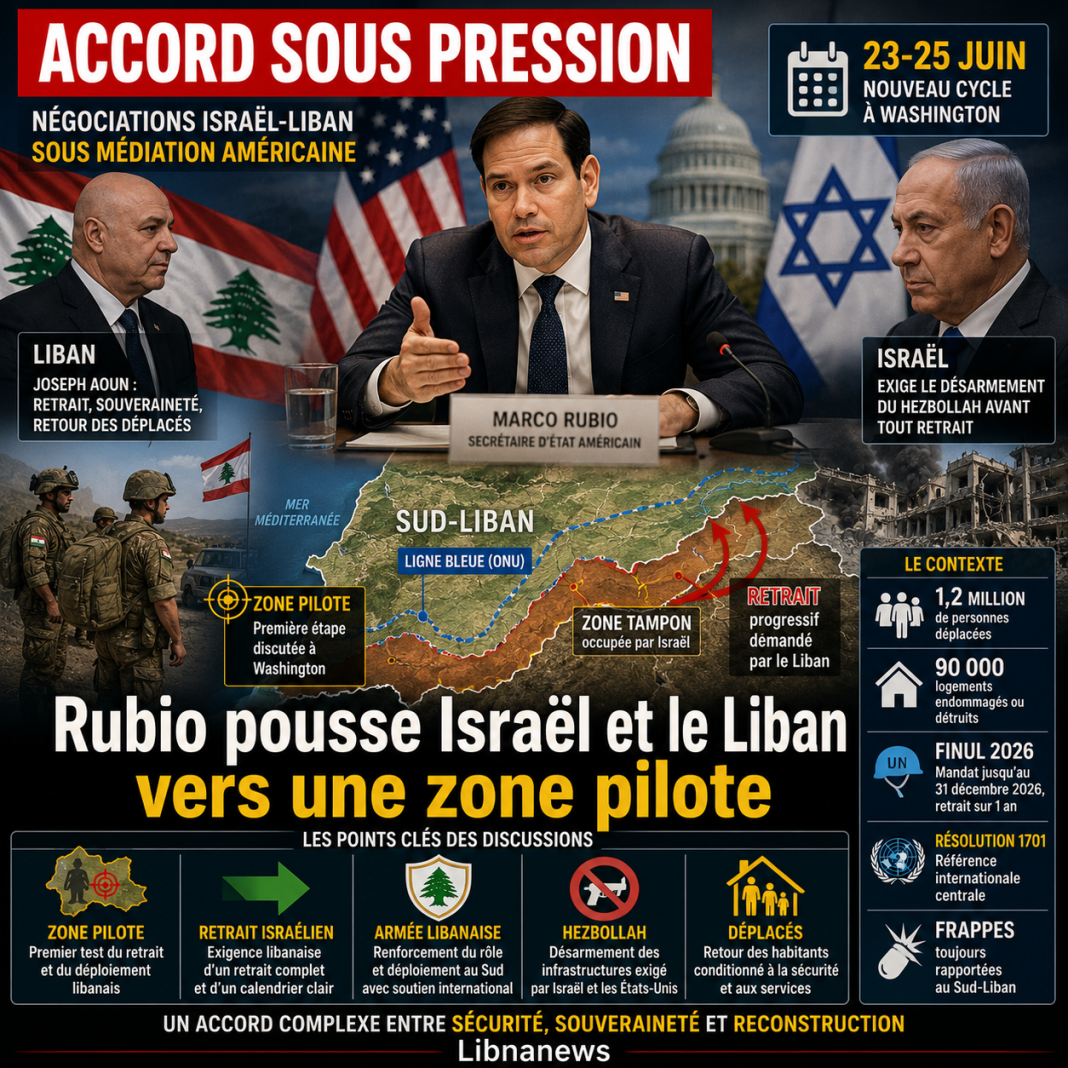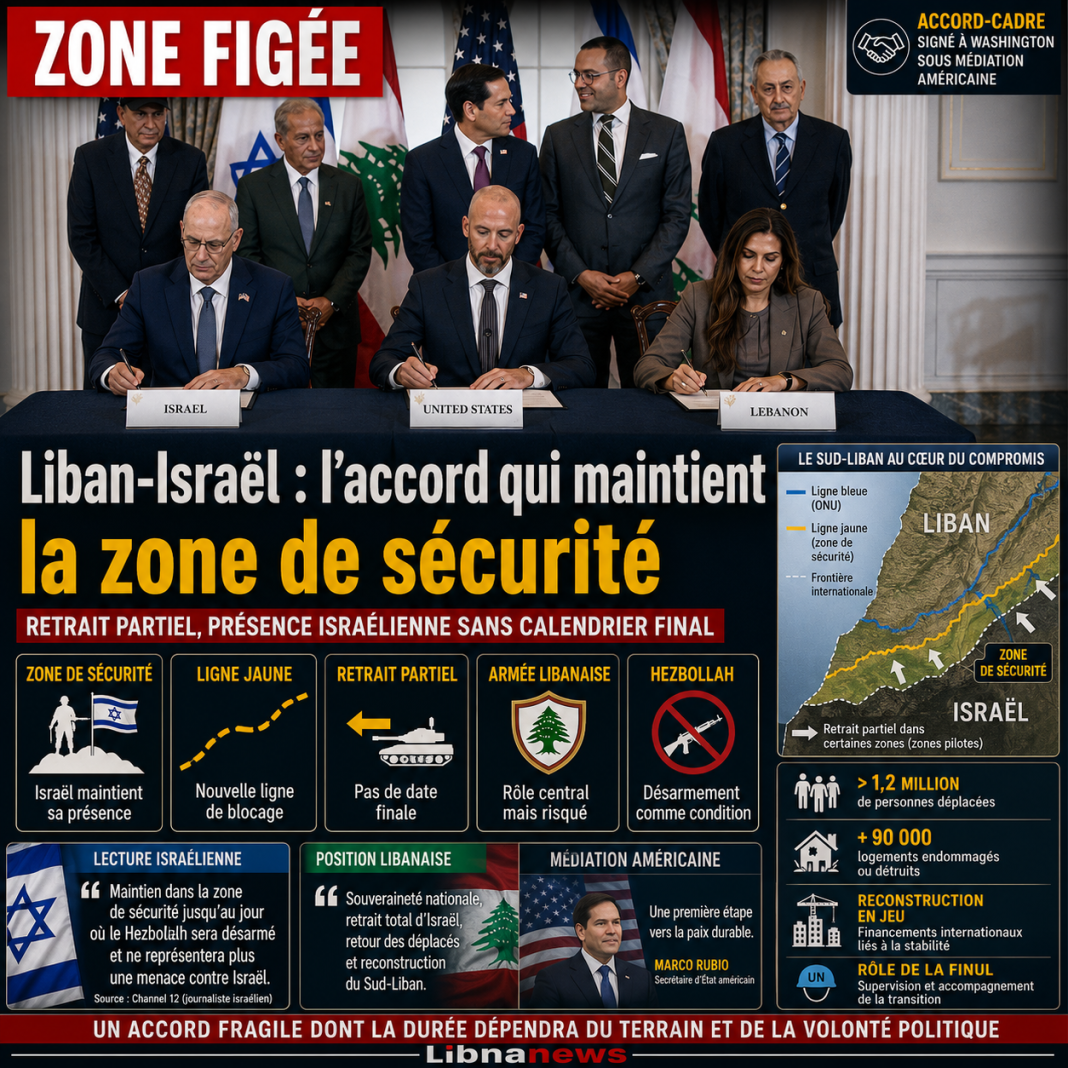






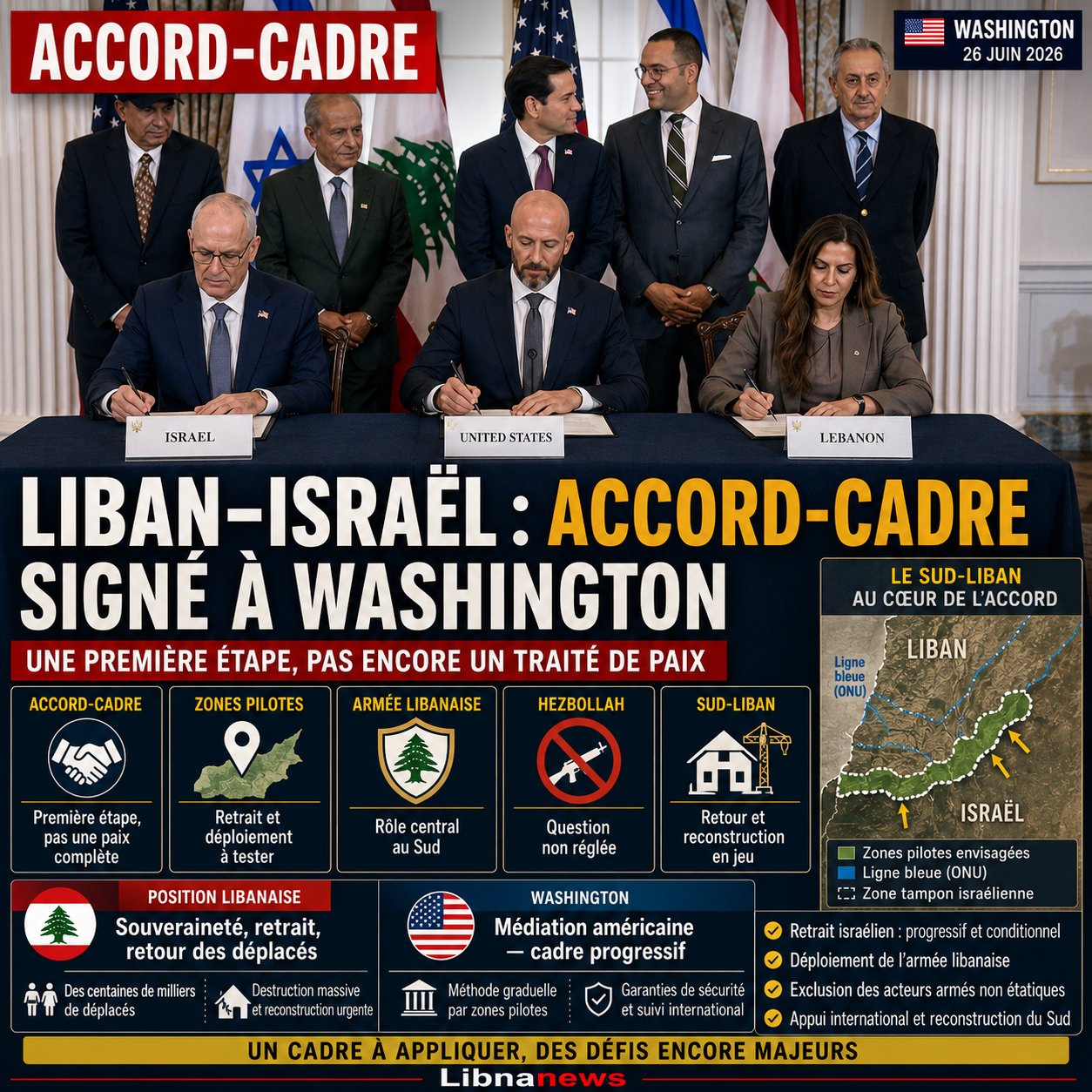
Lebanon and Israel signed a framework agreement in Washington under American mediation, after several days of negotiations with the direct support of the State Department. State Secretary Marco Rubio presented this signature as an important step towards peace between the two countries. However, he acknowledged that the work was still long. The text is not a peace treaty. It opens a sequence of gradual implementation, focusing on southern Lebanon, the partial Israeli withdrawal, the deployment of the Lebanese army and the exclusion of non-State armed actors in certain areas.
A double concession at the heart of the text
The agreement marks a political turning point, as each party agrees to move away from its original position. Israel accepted the principle of partial withdrawal, while its Government had so far stated its desire to maintain its forces in areas deemed necessary for its security. Lebanon, for its part, accepts in practice a residual Israeli presence during the transitional phase, while calling for a full, immediate and complete withdrawal of the occupied areas. This double concession is the heart of the compromise. It also explains the fragility of the text.
The document signed in Washington should be read as a framework, not as a completed solution. Not all the precise details of maps, deadlines and control mechanisms were made public. However, the available declarations make it possible to identify the general architecture. The United States wants to create pilot areas in southern Lebanon. In these areas, the Israeli army would reduce or withdraw its presence. The Lebanese army would take control of the ground. Non-State armed groups, primarily Hezbollah, should be excluded.
The most sensitive point concerns the security of Israeli soldiers still present during the transition. According to the logic of the scheme, Lebanon will have to assume a share of responsibility for the stabilization of the sectors concerned, in order to avoid attacks on Israeli forces until their withdrawal is completed. This obligation may place the Lebanese army in a difficult position. It will have to appear as an instrument of national sovereignty, without giving the image of a force protecting an Israeli presence contested by a large part of Lebanese opinion.
The political risk for Beirut
This ambiguity already weighs on the Lebanese reading of the agreement. The representative of Lebanon in Washington, Nada Mouawad, presented the signature as a first step towards restoring sovereignty. She thanked the American authorities on behalf of President Joseph Aoun and Prime Minister Nawaf Salam. The choice of words is not neutral. Beirut means that the agreement must lead to Israeli withdrawal and the return of the State, not political normalization or recognition of a military fact.
The Lebanese government therefore enters an internal risk zone. He will have to explain why he accepts a partial withdrawal instead of the total withdrawal he required. He should also explain why the Lebanese army could be called upon to secure a phase in which Israeli soldiers remained present in the territory. The authorities can defend this position by stating that it is a necessary step towards complete withdrawal. But their opponents may see this as a major concession or even a form of indirect coordination with Israel.
The Lebanese army is at the centre of this tension. It is supposed to take sole control of the pilot areas. It should prevent the return of Hezbollah fighters, weapons or infrastructure to the sectors concerned. It must also prevent these areas from becoming the scene of attacks against Israeli forces in the process of withdrawal. This mission can strengthen its national role. It can also expose the accusation of collaborating with the enemy, especially if the Israelis continue to strike elsewhere in Lebanon.
The challenge is political as well as military. In the minds of many Lebanese, the army must protect the population, defend the territory and embody national unity. If it is seen as guaranteeing the security of Israeli soldiers still present in the South, its image can be weakened. The government must therefore strictly regulate its mission. He should recall that the goal remains Israeli withdrawal, the return of displaced persons and the restoration of Lebanese sovereignty, not the lasting protection of an area of occupation.
Israel wants to exclude Hezbollah from the South
Israel presents the agreement from a different angle. The Israeli ambassador in Washington, Yechiel Leiter, said Iran and its relays were seeking destruction, while Israel wanted real peace with Lebanon. He added that the text should enable Iran and Hezbollah to emerge from the equation. This reading places the issue of Hezbollah at the centre of the mechanism. For Israel, withdrawal only makes sense if the Lebanese army prevents the Shiite movement from returning to its position near the border.
This condition nourishes tensions. Hezbollah is not a signatory to the agreement, but is directly covered by its provisions. The text seems to seek to circumvent the issue of total disarmament of the movement, starting with limited areas. In these areas, only the Lebanese army would be allowed to control the ground. This method avoids the immediate opening of the national debate on the entire Hezbollah arsenal. However, it imposes a local retreat on the movement, which can be interpreted as a challenge to its military presence in the South.
Hezbollah can therefore challenge the agreement without officially failing it. It may denounce Israeli violations, refuse to recognize the device or maintain indirect pressure. He can also wait to see whether Israel is fulfilling its own commitments. The Lebanese government must avoid direct internal confrontation while proving to Washington and Tel Aviv that the army can exercise real authority. This peak line makes the application of the text more difficult than its signature.
Pilot zones as a compromise mechanism
Pilot zones are the central mechanism of the compromise. They must enable confidence to be tested, sector by sector. Israel is getting a gradual approach, which avoids immediate global withdrawal. Lebanon obtains the principle of an Israeli departure, even if limited. The United States has a verifiable framework to reduce the risk of escalation. But success will depend on the location of the first zone, the timing chosen and the degree of freedom granted to the Lebanese army.
The choice of the first zone will be decisive. If it is located in an area where Israel now retains a visible presence, Beirut will be able to present the agreement as a first Israeli retreat. If it is in a less sensitive area, the Lebanese Government will find it harder to convince its opinion. Israel, for its part, will seek to avoid a withdrawal that would give Hezbollah the image of a military victory. Washington will have to arbitrate between these two imperatives.
The question of verification is also open. Who will see the absence of non-State weapons? Who will verify that the Israeli army has actually withdrawn from an area? What role will the United States, UNIFIL or other international partners have? These technical points are essential. Without a credible mechanism, each party may accuse the other of violating the agreement. With a mechanism that is too intrusive, Lebanon faces the risk of external control over its sovereignty.
A still fragile truce on the ground
The signature comes in a still unstable military context. Israeli strikes continued in southern Lebanon despite the announced lull. Israel claims to target alleged Hezbollah members or immediate threats. Hezbollah denounces ceasefire violations, but has not always responded. This situation weakens confidence. A framework agreement will not survive long if the bombing continues, if the vehicles are targeted or if clashes break out near the villages.
For Lebanon, the return of internally displaced persons is one of the main tests. The southern families will not judge the agreement from Washington’s press releases. They will consider it possible to return to their villages, open roads, find water, electricity, telecommunications and a minimum of security. If the pilot areas remain diplomatic concepts with no effect on the ground, the political scope of the signature will be rapidly reduced.
The Lebanese Government must also organize the recovery. Destruction affects homes, public infrastructure, agricultural land and basic networks. The authorities began to talk about the identification of damage, clearing up and financing of urgent repairs. The framework agreement can facilitate this phase if it reduces violence and allows access to affected areas. It can also complicate it if certain localities remain under Israeli control or in a disputed security zone.
Washington as guarantor and lever
The American dimension remains decisive. Marco Rubio presented the agreement as an important step forward, but he acknowledged that the road remained long. Washington will have to keep pressure on Israel so that partial withdrawal does not remain theoretical. It will also have to support the Lebanese army, financially and logistically, if it has to assume new responsibilities. Without additional resources, the army may be given a mission that is too heavy for its present capabilities.
The agreement also gives the United States a lever on Beirut. Reconstruction assistance, military support and international recognition may be linked to the implementation of the scheme. This logic can strengthen the Lebanese state, but it can also fuel accusations of foreign guardianship. The government will have to maintain a delicate balance. He must have American support without appearing to be executing an American or Israeli agenda.
In Israel, implementation will also be difficult. Government officials refuse any withdrawal that would not guarantee the security of northern Israel. Part of the coalition believes that even a partial departure would be exploited by Hezbollah. The Israeli Prime Minister will therefore have to present the agreement as a security victory. He will probably say that Israel leaves certain areas only because the Lebanese army undertakes to exclude Hezbollah. This presentation will be essential to contain internal criticism.
The compromise can thus be summarized in a simple formula. Israel agrees to step back, but not everywhere and not immediately. Lebanon agrees to wait for full withdrawal, while assuming a security responsibility in the transition phase. The United States guarantees the process, without being able to suddenly remove local tensions, internal opposition and military risks. This architecture allows for diplomatic progress. It also contains the seeds of future crises.
UNIFIL and the legal issue
The text also places UNIFIL in a delicate position. The UN mission remains present in the South until the end of its mandate, but is no longer the only frame of reference. The pilot areas could create a parallel arrangement, politically driven by Washington and implemented by the Lebanese army. The relationship between UNIFIL, the Lebanese authorities, the United States observers and the withdrawing Israeli forces should therefore be clarified. Undefined superposition could result in coordination incidents. It could also weaken the traditional role of the UN mission, at a time when the post-FINUL debate is already open.
The legal question is not secondary. Lebanon should avoid giving the impression that it recognizes a legitimate Israeli military presence on its territory. The authorities will be able to argue that this presence is temporary, time-bound and intended to disappear. But any ambiguity in the text will be scrutinized. Opponents will ask whether the agreement sets a full withdrawal date or whether it leaves Israel to decide the pace. They will also ask who will respond if an Israeli soldier is attacked in a transitional zone. If the Lebanese army intervenes to prevent an attack, it will be criticized. If it does not intervene, Israel may accuse it of failing to fulfil its commitments.
A test period for the framework agreement
The Washington signature thus opens a trial period. The text provides a framework, but it does not yet resolve contradictions. He asked Israel to start leaving without losing its face. He asked Lebanon to accept a transition that did not meet its original requirement for full withdrawal. He calls on the Lebanese army to secure the South without being accused of protecting the occupier. The next few weeks will show whether this equation can hold in villages, on roads and around the first pilot areas.
The follow-up will depend on concrete decisions. The parties shall publish or specify cards, deadlines, withdrawal procedures and control procedures. They will have to identify the first pilot zone. They will have to define the rules applicable to Israeli soldiers present before their departure. Above all, they must prevent a military incident from failing the first stage. The peace announced by Rubio therefore remains a prospect, not an acquired reality.
In Lebanon, the debate will probably begin on the exact nature of the Washington concession. The supporters of the agreement will say that it finally offers a path towards Israeli withdrawal, the return of the state and the reconstruction of the South. His critics will say that he temporarily legalizes an Israeli presence and imposes a politically dangerous mission on the Lebanese army. Between these two readings, the government will need to quickly produce visible results on the ground.