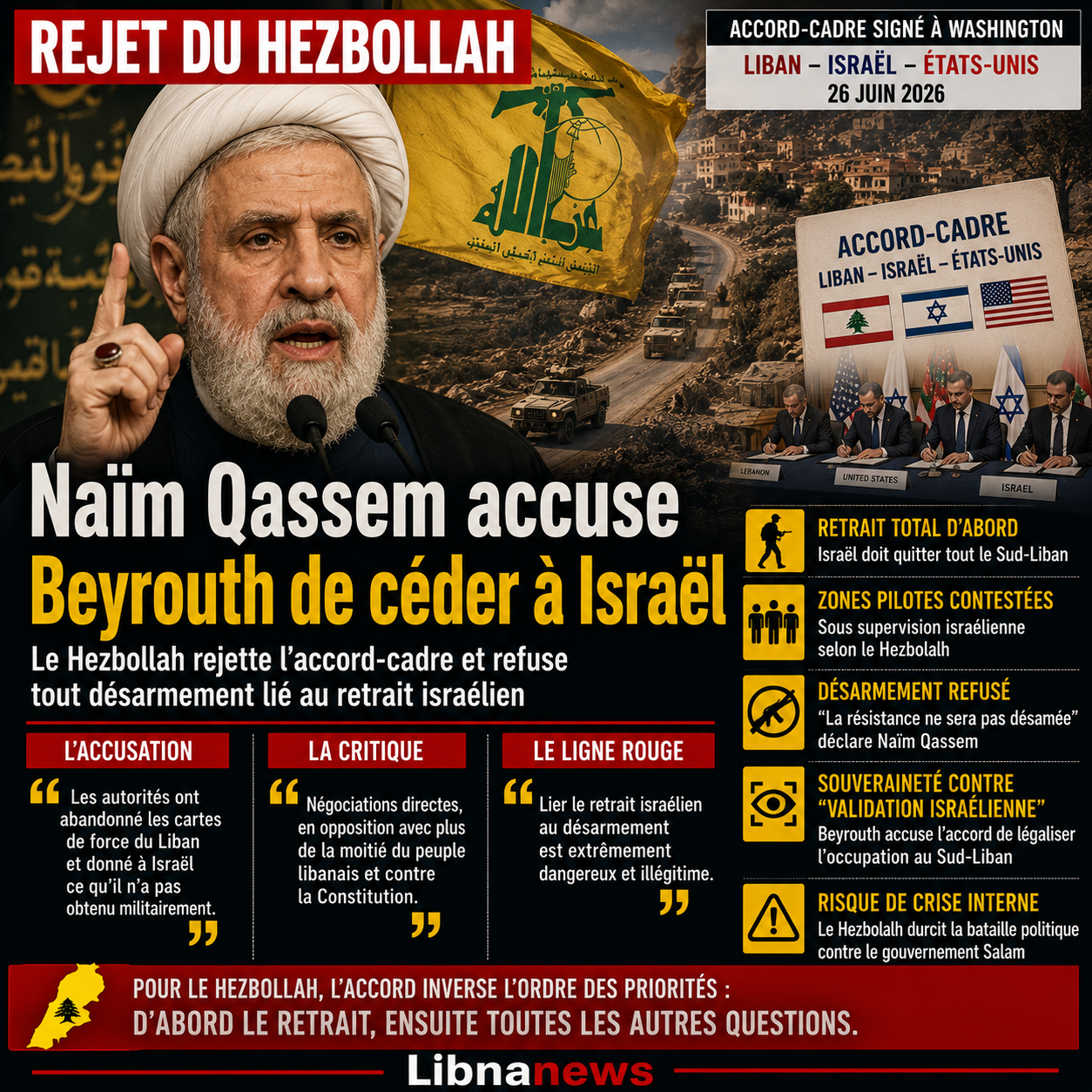







The framework agreement signed in Washington between Lebanon, Israel and the United States was to open a sequence of de-escalation. It was to establish the bases for a progressive Israeli withdrawal from southern Lebanon, a return of the Lebanese army to pilot areas and a state-sponsored reconstruction. But Bezall Smotrich’s positions already weaken this reading. Israel’s Finance Minister, a member of the far right and central player in settlement in the West Bank, continues to defend a territorial vision that transcends Israel’s internationally recognized borders.
Words attributed to Smotrich have been circulating since Friday, referring to a strengthening of colonial expansion in the West Bank, Gaza and South Lebanon. The exact wording of this sentence has not been confirmed at this stage by a reliable primary source or by the main international agencies. But it fits into an already documented line. In March, Smotrich called for the extension of the Israeli border to the Litani River in the heart of southern Lebanon. He also defended the maintenance of an Israeli security zone until Hezbollah was disarmed.
A line incompatible with the spirit of the agreement
The text signed in Washington is based on a logic of gradual withdrawal. It provides for pilot areas in which the Lebanese army should assume security responsibility after the verified disarmament of non-State armed groups. The aim is to allow Israeli redeployment, the return of civilians and reconstruction.
Smotrich’s statements go in another direction. They are part of a sustainable territorial control logic. When an Israeli minister talks about the Litani as a possible border, it is no longer just immediate security. The Litani lies far within Lebanese territory. Such a line would amount to placing a large part of southern Lebanon under Israeli rule.
This contradiction feeds Lebanese critics. The Presidency and the government defend the agreement as a step towards sovereignty. On the contrary, Hezbollah sees it as a text enabling Israel to maintain a military presence under security conditions. Smotrich’s comments reinforce this reading. They give the impression that a part of the Israeli government does not see the agreement as a road to withdrawal, but as a framework for extending the Israeli grip.
An argument offered to Hezbollah
For Hezbollah, Smotrich’s positions are an immediate political argument. The party rejects the agreement because it makes the Israeli withdrawal conditional on the disarmament of non-State armed groups. He claims that Israel must first withdraw completely from Lebanon and cease its strikes. In this reading, any Israeli statement on a lasting presence in southern Lebanon justifies the continuation of the resistance.
The Lebanese government therefore finds itself in a difficult position. To defend the agreement, he must prove that he will lead to a real withdrawal. But if Israeli ministers talk about maintaining a security zone or extending borders, the credibility of the text weakens. The inhabitants of the South, already marked by bombings, destruction and displacement, can see confirmation that the State has not obtained sufficient guarantees.
Washington facing its own contradictions
The United States presents the agreement as a step towards peace and stability. But Smotrich’s line shows the limits of the American guarantee. Washington can push Beirut to accept a mechanism of pilot and disarmament zones. But can he impose on Israel a clear reading of the withdrawal against the toughest ministers of the Benjamin Netanyahu coalition?
This issue becomes central to Lebanon. An American guarantee will not suffice if Israel retains the possibility of extending its presence in the name of a threat defined by itself. It will be even more contested if Israeli officials talk about wider borders or colonization.
An already fragile agreement
The framework agreement has not yet delivered its most important annexes: maps, timetable, verification procedures, the exact role of the Lebanese army and withdrawal guarantees. However, Smotrich’s positions already complicate its implementation.
They reinforce the refusal camp in Lebanon. They weaken the line of the presidency and government. They place Washington before the obligation to clarify publicly that the agreement cannot under any circumstances pave the way for annexation or colonization of South Lebanon.
At this stage, the precise sentence on an extension of the settlements to southern Lebanon remains unconfirmed. But the political problem is real: an influential Israeli minister has already defended the idea of Israeli control up to the Litani. In the context of the Washington agreement, this line is enough to feed the Lebanese suspicion of a conditional withdrawal that could become a lasting presence.