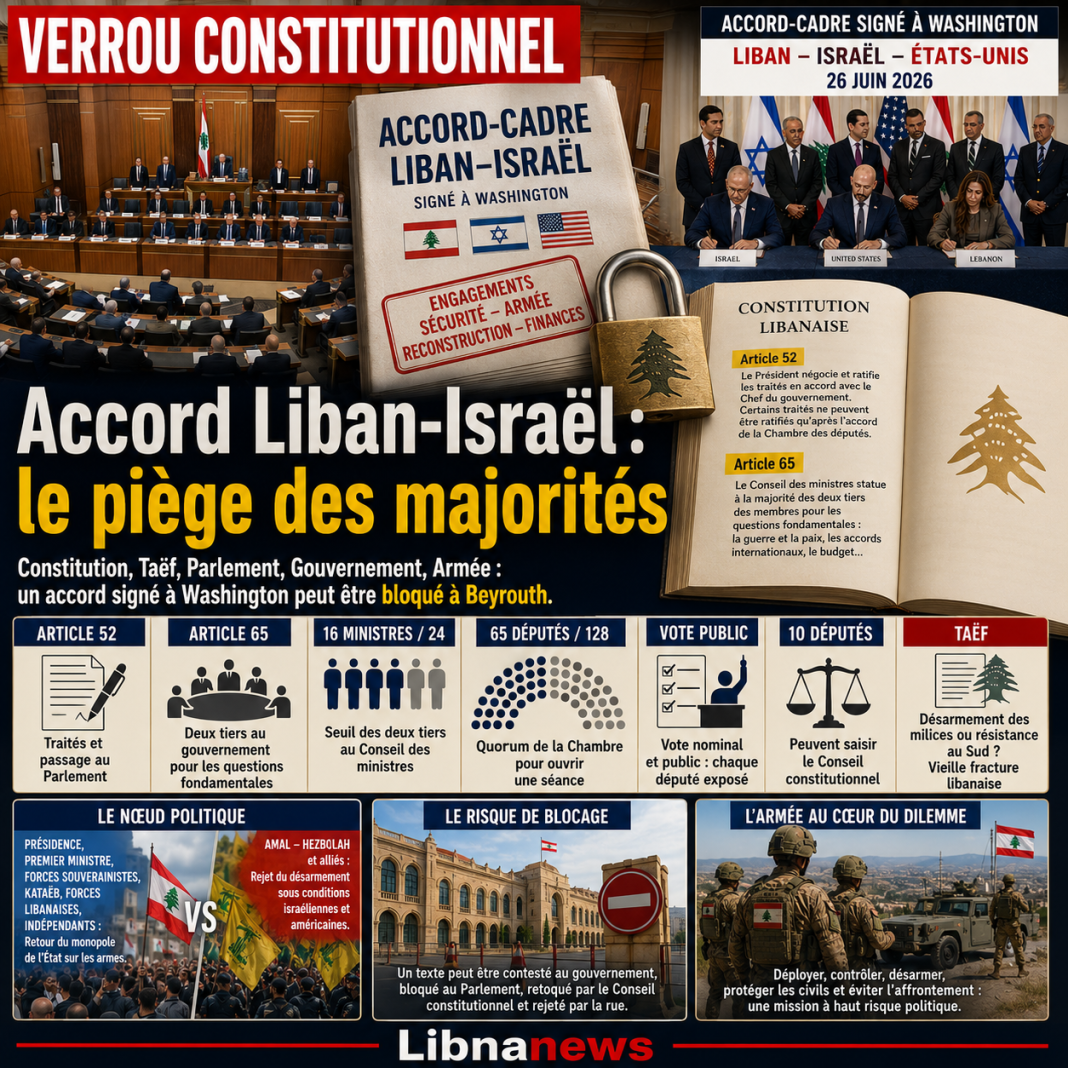






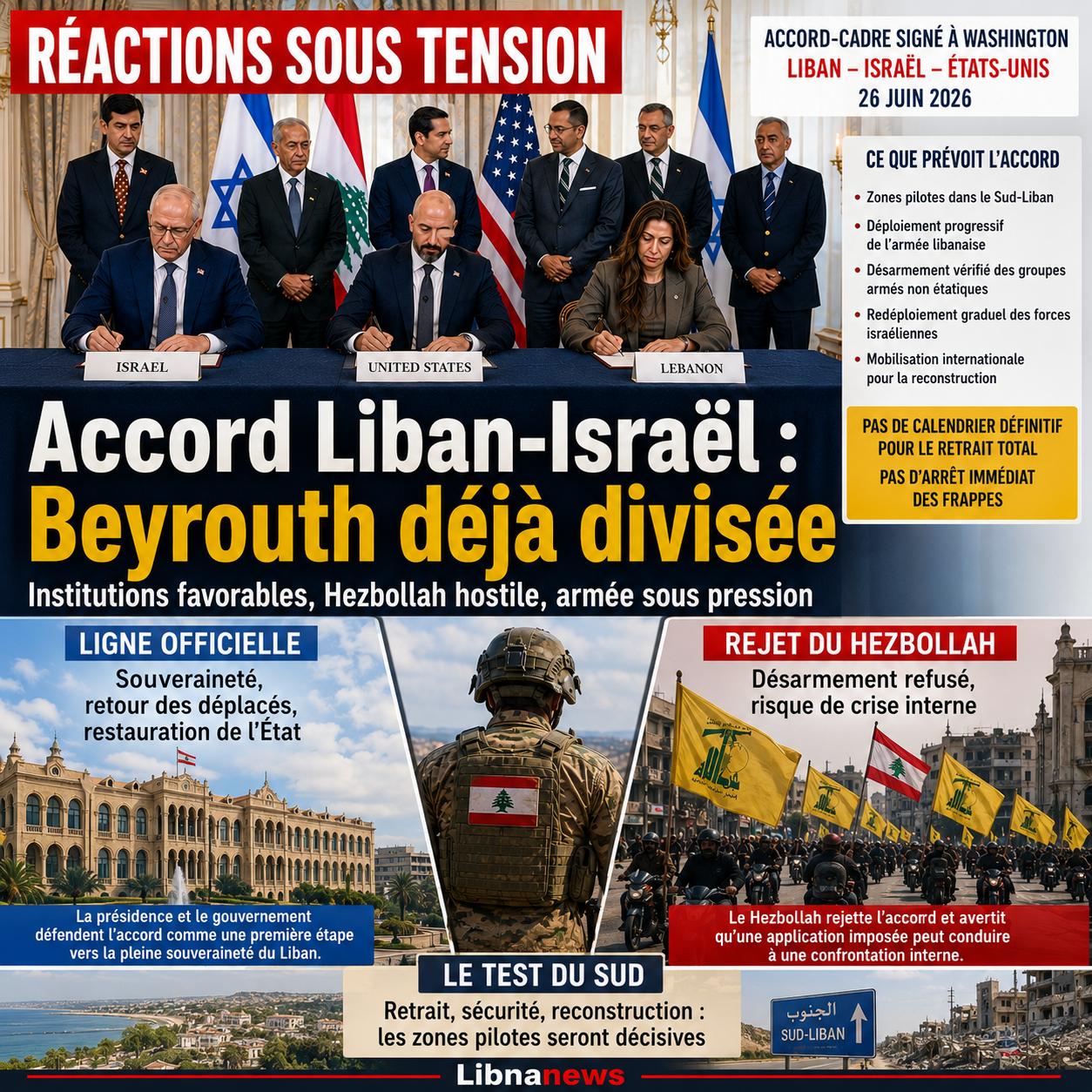
The framework agreement signed in Washington on 26 June between Lebanon, Israel and the United States immediately shifted the debate on diplomacy to the Lebanese political scene. The Presidency and the Prime Minister presented him as a first step towards restoring national sovereignty. Hezbollah strongly rejected it, warning that imposed application could lead to internal confrontation. In the immediate future, verified public reactions remain concentrated around the official institutions and the Shiite party. Other political forces, if they did not react publicly after the signing or the previous day on the final text, cannot be integrated as direct commentators of the agreement.
This methodological choice is necessary. A political official who expressed himself before the signature did not react to the final text, unless he explicitly commented on the same draft agreement in its then known version. Previous statements may shed light on a political line, but they should not be presented as reactions to the signed agreement. In such a sensitive case, to attribute an unverified position would distort the Lebanese debate.
The agreement provides for pilot areas in southern Lebanon, the gradual deployment of the Lebanese army, the verified disarmament of non-State armed groups and the gradual redeployment of Israeli forces. It also promises an international mobilization for reconstruction. But it does not set a definitive timetable for Israel’s complete withdrawal. Nor does it guarantee the immediate cessation of all strikes. It is around this ambiguity that the first reactions crystallize.
The Presidency talks about a first stage
The Lebanese Presidency presented the agreement as a starting point for full sovereignty. Joseph Aoun said, in a French translation of his statement, that « the framework agreement signed today is a first step on the way for the displaced to return to their fully liberated cities and rebuilt houses, under the sovereignty of the Lebanese State, which has no partner on its land and people ».
This formula fixes the Baabda line. The president is not talking about standardization. He talks about sovereignty, the return of the displaced and the exclusivity of the State. The choice of words is intended to respond to the most immediate criticisms. The agreement should not be read, according to the Presidency, as a concession to Israel, but as an instrument allowing Lebanon to gradually regain its authority in the South.
Joseph Aoun also added, according to the translation of his statement: « We swear to continue the work until it is fully accomplished. There will be no more occupation, no more prisoners, no more dependency or guardianship. This sentence seeks to reassure the Lebanese who fear an agreement imposed from Washington. It also aims to prevent the text from being assimilated to the precedent of 17 May 1983, a Lebanese-Israeli agreement signed under American sponsorship and rejected by a large part of the interior scene.
However, the Presidency is taking a political risk. It promises a path towards sovereignty, while Israeli reading insists on maintaining a safe area until Hezbollah is disarmed. If Israeli forces remain long in the South, if the strikes continue and if civilians cannot return quickly, the presidential communication will be challenged. Baabda’s credibility will therefore depend less on the text than on its first visible effects.
Nawaf Salam defends the logic of the state
Prime Minister Nawaf Salam defended the agreement as a tool to secure Israeli withdrawal and restore state authority. According to the language reported after the signature, he presented the text as « to obtain Israel’s withdrawal from all Lebanese territory » and « to restore the sovereignty of the State over it ».
This position is consistent with the head of government. For Salam, Lebanon must be represented by its institutions. The decision on war and peace must be the responsibility of the State, not an armed actor or regional power. The agreement thus provides a framework for defending the primacy of the Lebanese army and the government in the South.
But the Prime Minister is facing a major challenge. The agreement does not immediately give Lebanon the total withdrawal it demands. It is organizing a gradual process, linked to the verified disarmament of non-State armed groups. This condition mainly applies to Hezbollah. It therefore puts the government before an internal question even more explosive than the negotiation with Israel: how can we apply a text that touches the heart of the arsenal of the country’s main armed actor?
Salam will also have to respond to a civil concern. For a large part of the inhabitants of the South, the state has not protected. The army withdrew or could not remain in several exposed areas. The bombing, destruction, displacement and lack of services have affected the population. If the State returns with an agreement that first imposes security obligations without immediately guaranteeing the cessation of strikes and the return of families, it may be perceived as assigning to Israel rather than protecting Lebanese.
Nada Hamadeh Mouawad assumes the signature
Lebanon’s Ambassador to Washington, Nada Hamadeh Muawad, was the official Lebanese voice at the signing ceremony. She said, in a French translation of her remarks, that « signing today is a first step in restoring Lebanon’s sovereignty ». She also thanked the American authorities on behalf of President Joseph Aoun and Prime Minister Nawaf Salam.
This statement gives the diplomatic version of Beirut. She stressed the original nature of the text. The agreement is not presented as a completed peace, but as the beginning of a process. This is important because several clauses remain to be specified in the security annex: pilot areas, verification mechanisms, timing of redeployments, the exact role of the Lebanese army and conditions for reconstruction.
The Ambassador’s message also targets international partners. Lebanon wants to show that it accepts a diplomatic solution, that it wishes to regain its sovereignty and that it is ready to engage its army in a framed process. But on the domestic scene, this signature can be challenged by those who believe that no agreement with Israel can be legitimate without a prior and complete withdrawal.
Hezbollah rejects agreement
The strongest reaction came from Hezbollah. MP Hassan Fadllallah rejected the framework agreement and warned that the Lebanese authorities could not apply it with US support without causing an internal crisis. In a French translation of his comments, he stated that « the Lebanese authority will not be able to implement the framework agreement signed with Israel in Washington ». He added that an imposed application could lead the country « to civil war ».
This declaration sets the party’s red line. Hezbollah considers that the text directly targets its arsenal. He refused to allow Israeli withdrawal to be conditional on the disarmament of non-State armed groups. For the movement, Israel must first fully leave Lebanese territory, cease its strikes and abandon any security zone. The question of arms cannot, according to this reading, be dealt with under American and Israeli pressure.
Hassan Fadallah also summarized the party’s rejection by saying that the deal would remain « ink on paper » if he claimed to impose commitments that Hezbollah refuses. This formula seeks to delegitimize the agreement before its implementation. It means that Washington’s signature is not enough to create a balance of power on the ground.
Hizbullah’s secretary-general, Naïm Qassem, also reaffirmed the party’s line against any prolonged Israeli presence. In a French translation of his position, he felt that Israel had « no choice but to withdraw completely from every inch of our Lebanese land » and that its forces should leave « without condition ». This formula reverses the order provided by the agreement. For Hezbollah, Israeli withdrawal is a prerequisite. For the signed text, it depends on verified security conditions.
Pro-Hezbollah Street Enters the Debate
The demonstrations that took place in Beirut after the signing gave an immediate translation of Hizbullah’s rejection. Partisan supporters drove on motorcycles, blocked roads and denounced the deal as a concession to Israel. The airport road was hit before the Lebanese army intervened. These rallies have not yet formed a national movement, but they have shown the ability to rapidly mobilize the camp hostile to the text.
The street thus becomes an instrument of political pressure. Hezbollah can challenge the agreement without immediately breaking the ceasefire. It can mobilize its supporters, influence the government and point out that any application of the text will have an internal cost. This pressure is all the more sensitive as the Lebanese army is called upon to play a central role in the pilot areas.
The army is already in a delicate position. In Beirut, it must maintain order in the face of demonstrators hostile to the agreement. In the South, it may have to prevent the return of non-State armed actors to areas under its control. In both cases, she may be accused by part of Camp Hezbollah of applying an American roadmap.
Samy Gemayel welcomes the framework agreement
MP Samy Gemayel, leader of the Kataëb party, welcomed the framework agreement signed in Washington. According to statements reported by the Lebanese press on 27 June, he considered that « Lebanon has won ». He added that the importance of the agreement lies in the fact that he has devoted what he has been demanding for years, « not to the service of one party, but to the service of Lebanon and its State ».
In the same statement, Samy Gemayel cited several objectives: « to end the war, to achieve the complete Israeli withdrawal from Lebanese territories, to restore sovereignty, to extend the authority of the State, to devote the exclusivity of arms and the decision of war and peace to the sole hands of legitimate institutions ». This position places the Kataeb among the strongest supporters of the agreement, provided that its clauses effectively produce the Israeli withdrawal and the state monopoly on arms.
A contested US guarantee
The American guarantee is one of the weaknesses of the scheme in the eyes of many Lebanese. The United States is essential to exert pressure on Israel. Without Washington, an Israeli withdrawal, even partial, would be difficult to obtain. But Washington is also perceived as too close to Israeli security priorities.
This perception weighs on the receipt of the agreement. If Israel continues to strike in the name of self-defence, who will decide whether it is a violation? If Israel maintains its security zone, who will impose a timetable? If the Lebanese army fails to disarm an area, who will arbitrate? If the answer remains mainly American, some Lebanese opinion will consider the mechanism unbalanced.
The absence of a central role for France, the European Union or the UN reinforces this criticism. These actors can contribute to the reconstruction, training or support of institutions. But they are not at the heart of the political guarantee mechanism. For Beirut, a more multilateral guarantee could have made the agreement less vulnerable to accusations of bias.
South Lebanon as a political test
The agreement will be received in the South. The people will not judge the text only from the statements of Washington or Baabda. They will judge it from the reopened roads, rebuilt houses, restored networks, the end of the strikes and the return of the displaced.
For some southerners, the state did not protect. This perception is a major political fact. If the Lebanese army returns to the pilot areas with insufficient means, under American supervision and while Israel maintains a neighbouring presence, it may be placed in an untenable position. It will have to prove that it protects the inhabitants, not that it indirectly secures the remaining Israeli forces.
Hezbollah will rely on this contradiction. The government will have to defuse it by acts. A first visible Israeli withdrawal, a rapid reconstruction and a halt to the bombing would be the only arguments that could give weight to the official reading of the agreement.
An agreement signed, a consensus absent
The verified reactions show a landscape still incomplete but already polarized. Joseph Aoun, Nawaf Salam and Nada Hamadeh Mouawad present the agreement as a first step towards sovereignty, the return of the displaced and the end of hostilities. Hezbollah, by Hassan Fadallah and Naim Qassem, rejects him and warns of an internal crisis. Other policy makers should not be included as direct reactions as long as no subsequent or immediate statement related to the final text is verified.
The Washington agreement thus opens up less immediate peace than a phase of political confrontation. He promises a return from the state, but everyone is waiting to see what this will mean on the ground. He speaks of sovereignty, but Israel claims to want to remain in a safe area. It gives a central role to the Lebanese army, but it lacks resources and risks being caught between external demands and internal challenges.
The next step will be decisive. If the security annexes impose obligations on Lebanon without a clear timetable for Israel, the challenge will widen. If the first pilot areas produce a real withdrawal, a return of civilians and a drop in strikes, the official line will gain credibility. In the meantime, the agreement remains suspended on a central question: can the Lebanese State restore its sovereignty without being perceived as applying the terms of an agreement that its opponents already present as favourable to Israel?