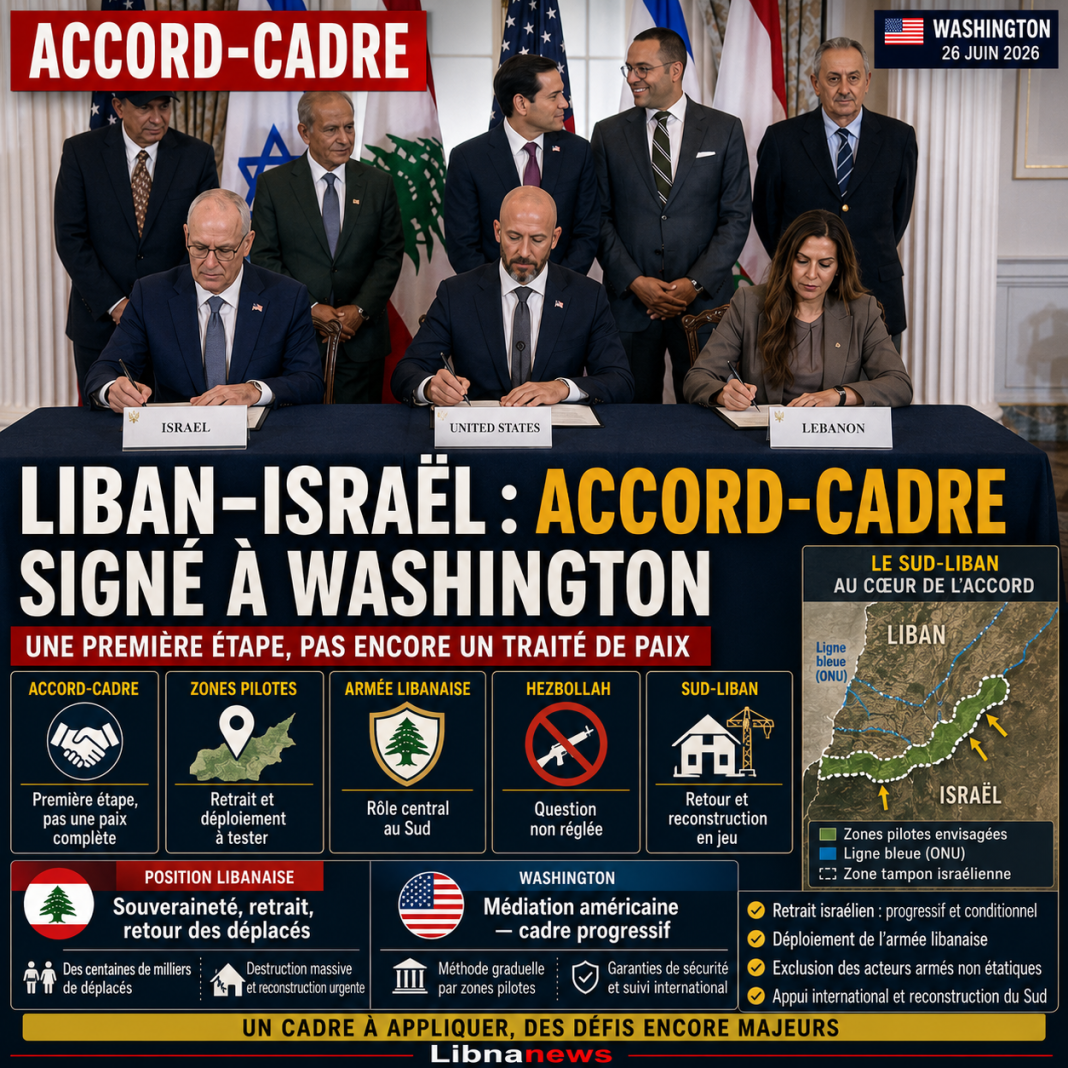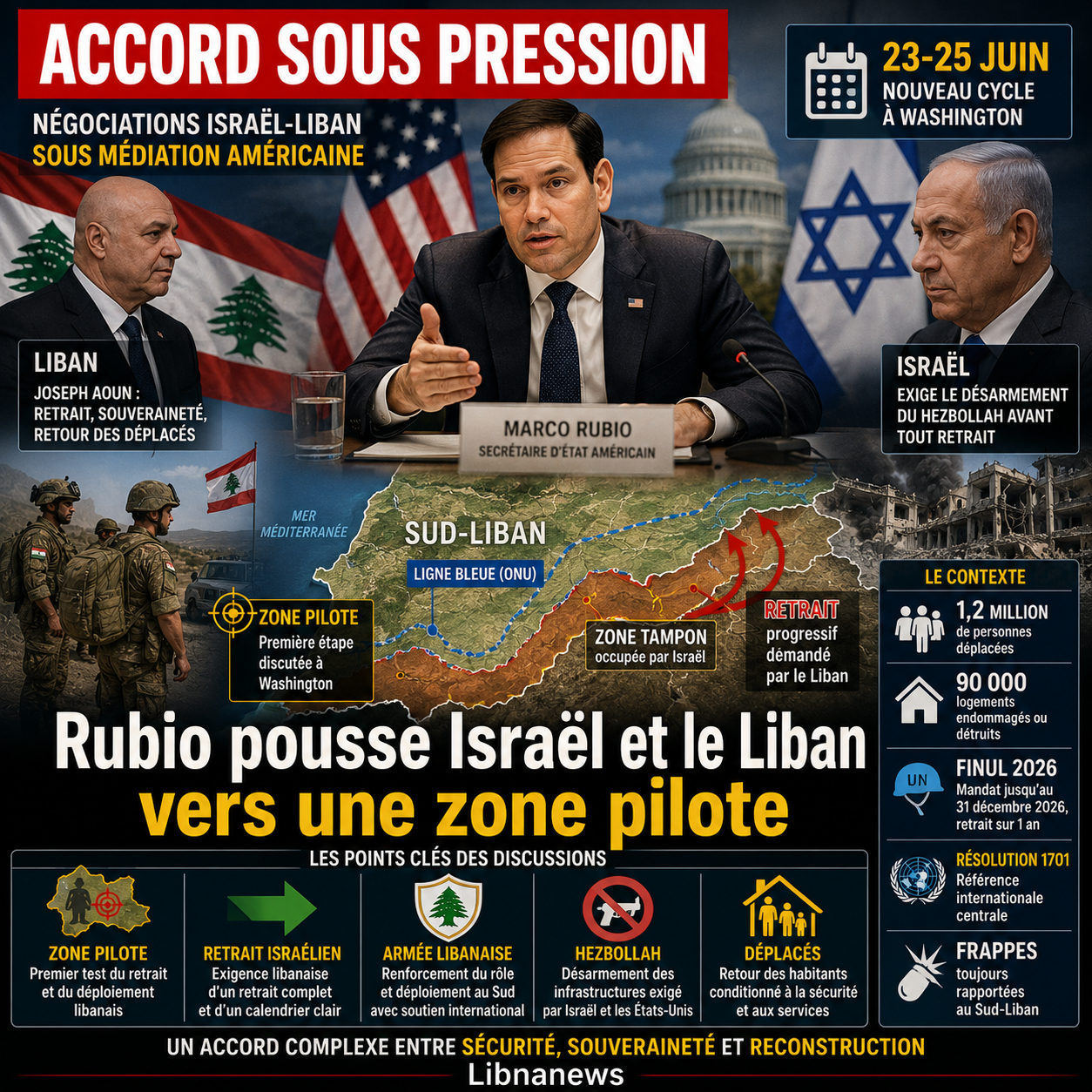
The negotiations between Israel and Lebanon resumed in Washington in a climate of high expectations, but also deep differences. The United States presents this channel as the only realistic way to stabilize the border, enable the reconstruction of southern Lebanon and end the cycles of violence. US Secretary of State Marco Rubio placed these discussions at the heart of Washington’s regional diplomacy. In particular, during an exchange with Lebanese President Joseph Aoun, he felt that bilateral negotiations between the two Governments represented the most feasible path towards reconstruction, economic recovery and lasting peace.
The last cycle, scheduled for 23-25 June, is taking place after several sessions since April. These meetings are direct, but supervised by American mediation. They stand while the terrain remains unstable. Israeli strikes have again been reported in southern Lebanon, while thousands of displaced families cannot return to their villages. Negotiators discuss a withdrawal mechanism, a pilot area, the role of the Lebanese army and the disarmament of Hezbollah infrastructure in the South.
The file thus advances on two parallel planes. In Washington, diplomats seek to transform the ceasefire into a sustainable framework. In Lebanon, the Government must show that negotiations produce concrete results. The Lebanese view is based on four immediate demands: the cessation of the strikes, the complete Israeli withdrawal, the return of the displaced and the restoration of State authority. But this line runs counter to Israeli demands, American pressure, Hezbollah positions and the scale of destruction.
Direct but politically sensitive talks
The current talks are not an ordinary dialogue between two neighbouring States. Lebanon and Israel remain officially belligerent. Lebanon does not recognize Israel. Direct trade remains politically sensitive in Beirut. However, they started in April in Washington, after several weeks of preparatory contacts. The international press presented them as the first direct exchanges of this level in several decades.
Marco Rubio wants to make it a diplomatic precedent. According to the State Department, the meeting on 2 and 3 June was described as the fourth high-level trilateral meeting between Israeli, Lebanese and American representatives. Washington insists that two sovereign governments are now discussing under American mediation. The American message is clear: the Lebanese issue must no longer go through armed actors or regional powers speaking instead of Beirut.
This approach responds to a Lebanese concern raised several times by the authorities. The Beirut government wants to avoid Lebanon being treated as a map in a broader negotiation between Washington, Tehran and Tel Aviv. Prime Minister Nawaf Salam has already rejected the idea that Iran can negotiate on behalf of Lebanon. The Lebanese Presidency emphasizes national sovereignty, the role of the State and the implementation of international resolutions.
The difficulty lies in the relationship between principle and terrain. The Lebanese government can accept direct negotiations to defend Israeli withdrawal and reconstruction. It cannot appear as assignor on the question of sovereignty or on the rights of the inhabitants of the South. This constraint affects each formulation. A diplomatic advance that is not accompanied by a visible withdrawal could be attacked in Lebanon as a concession without compensation.
The « pilot zone », the core of the blockage
The latest most sensitive development concerns the American proposal for a « pilot zone ». According to reports from a news agency, Israel and Lebanon are discussing a Washington-backed plan that would see areas currently occupied or controlled by the Israeli army return under the responsibility of the Lebanese army. The American idea is to test a local model: Israeli withdrawal, entry of the Lebanese army, verification of the absence of non-State weapons and the gradual return of the inhabitants.
Washington presented this model as a possible demonstration of good faith. A State Department official even claimed that Israel had already withdrawn troops from part of the buffer zone. This claim was immediately denied by Israeli and Lebanese officials. A Lebanese military official said that developments on the ground showed, on the contrary, that there was no withdrawal. The Israeli army also stated that the location of its soldiers had not changed.
This denial illustrates the main blockage. For the Lebanese, the pilot zone must begin in the area occupied by Israel, in order to prove that the mechanism is leading to withdrawal. For the Israelis, the first ground clearance should take place in areas north of the Israeli security line, without touching the heart of the buffer zone. Both approaches lead to different policy outcomes. In the first case, Israel is beginning to retreat. In the second, it retains its military depth.
The method is also debated. Israel wants to negotiate each sector separately, without a general timetable. Lebanon calls for a comprehensive road map towards full withdrawal. This difference is not only technical. It determines confidence in the process. A sector-by-sector negotiation can take a long time and leave communities uncertain. A road map gives a perspective, but it obliges Israel to announce from the start the final objective and the steps of withdrawal.
Israel demands disarmament before withdrawal
The Israeli view is based on a priority requirement: to prevent Hezbollah from rebuilding a military presence near the border. Israeli officials claim that any redeployment will depend on the demilitarization of southern Lebanon and the disarmament of Hezbollah. Israel justifies the maintenance of a buffer zone of approximately 10 kilometres by the security of the northern localities, which suffered fire and displacement during the clashes.
This position creates a difficult chain. Israel wants the Lebanese army to enter verified areas and dismantle Hezbollah’s weapons. Lebanon replied that its army could not exercise its full authority if Israel still occupied part of the territory and prevented access to certain areas. The Lebanese officials therefore request that the withdrawal precede or accompany the Lebanese deployment, in accordance with the spirit of resolution 1701.
Resolution 1701, adopted in 2006, remains the central international reference. It provides for the cessation of Hezbollah attacks, the cessation of Israeli offensive operations, the deployment of the Lebanese army and UNIFIL in the South, and the withdrawal of Israeli forces in parallel with this deployment. It also called on the Lebanese Government to prevent the entry of unauthorized weapons into its territory and requested international assistance for the return of the displaced.
The current disagreement lies in the order of operations. Israel wants security assurances before withdrawing. Lebanon wants the withdrawal in order to establish State authority and facilitate the return of the inhabitants. The Americans are trying to build an intermediate sequence. The pilot zone must prove that a limited withdrawal can be followed by verifiable control by the Lebanese army. But until both sides agree on the place of departure, the mechanism remains blocked.
Rubio wants to make the Lebanese army the pivot
Marco Rubio plays a central role in this phase. He received or supervised delegations in Washington and spoke directly with Joseph Aoun. The Department of State reported that the Secretary of State had referred to the talks scheduled for 23-25 June and stressed that both Governments must make progress towards lasting peace. In his public statements, Rubio presents the negotiations as a historic moment, because representatives of the Lebanese and Israeli governments speak directly under American auspices.
The Secretary of State also linked US support for Israel to the strengthening of the Lebanese army. This joint is important. Washington wants to reassure Israel about Hezbollah, while giving Beirut the means to regain control of the South. The American objective is to make the Lebanese army the main security actor. This requires assistance in equipment, training, logistics and financing. This also requires the Lebanese Government to maintain sufficient political space to act.
Rubio has adopted a firm tone on Hezbollah. He has already claimed that peace between Israel and Lebanon would be possible quickly if Hezbollah’s obstacle were lifted. This formula summarizes the American perception: the territorial dispute would be treatable, but the presence of a pro-Iranian armed actor prevents a lasting agreement. In Beirut, this reasoning is understood by a part of the executive, but it remains politically explosive.
Hezbollah refuses to treat disarmament as a mere technical requirement imposed from outside. The party presents its weapons as linked to the Israeli presence, attacks on Lebanon and the defence of the territory. His allies and some of the political class are calling for guarantees on Israeli withdrawal before any internal discussion on the future of the arsenal. This divergence explains why the talks can move forward on maps and mechanisms, but to counter the Lebanese political equation.
The Lebanese perspective: withdrawal, sovereignty, return
The Lebanese Government is in a narrow position. Joseph Aoun and Nawaf Salam seek to restore a state line. They want Lebanon to be represented by its institutions, not by an armed faction or by a regional sponsor. They also want a funded reconstruction and stabilization of the South. But their margins depend on tangible results. Without an Israeli withdrawal, a reduction in strikes and a return of civilians, negotiations can become politically costly.
The most immediate Lebanese priority remains the return of internally displaced persons. According to data reported by a news agency, more than 1.2 million people were displaced during the fighting. More than 103,000 were still living in shelters prior to the 20 June ceasefire, and some 14,000 had left those shelters a few days later. The Lebanese National Council for Scientific Research reported more than 90,000 homes damaged or destroyed between 2 March and 12 June.
These figures give the measure of social pressure on Beirut. For the families of the South, the negotiations are not judged by the photo of the delegations in Washington. It is judged by the opening of a road, the possibility of returning to a village, the presence of a roof, water, electricity and the absence of drones. Many communities near the border remain inaccessible or partially destroyed. Some families no longer have houses to find.
The Salam government has begun to hold follow-up meetings on return and recovery. The ministries concerned must identify damage, clear roads, re-establish networks and prepare emergency financing. But these efforts remain suspended from security developments. If Israel maintains its buffer zone and access restrictions, public teams will not be able to work anywhere. If the strikes continue, the inhabitants will hesitate to return.
Reconstruction as a diplomatic lever
The question of reconstruction gives the negotiations an economic dimension. Rubio Ia explicitly linked to the bilateral channel. For Washington, international aid and economic recovery require a clear security framework. Donors will not finance areas exposed to an immediate resumption of fighting on a sustainable basis. Lebanon, already hit by a long financial crisis, lacks the necessary resources to rebuild the affected villages and infrastructure alone.
This dependence on external financing increases US pressure. The United States can present negotiations with Israel as the gateway to reconstruction. But the Lebanese leadership must avoid this link being perceived as a form of political blackmail. In Beirut, official demand remains focused on sovereignty and withdrawal. Aid cannot be substituted for the right of the inhabitants to return home.
Reconstruction also raises a question of governance. Who will assess the damage? Who will distribute the aids? What role will the Southern Council, the High Relief Commission, municipalities, ministries and foreign partners have? The government wants to centralize data and avoid competition between administrative channels. But the local reality of the South, where political parties and community networks are strongly established, will complicate implementation.
This dimension is of direct interest to US negotiators. A return led by the Lebanese State would strengthen Beirut’s position. A return managed primarily by partisan actors would instead strengthen the structures that Washington seeks to reduce. Security discussions and reconstruction mechanisms are therefore linked. Control of the territory also involves the control of roads, aids, yards and services.
UNIFIL and the constraint of the international calendar
UNIFIL remains another element of the equation. The United Nations mission has been present in Lebanon since 1978 and its mandate was strengthened after the 2006 war. The Security Council extended its mandate one last time until 31 December 2026, before an orderly withdrawal of one year. This deadline obliges diplomats to think not only about the current ceasefire, but also after FINUL.
France and Italy are already discussing an international mechanism that could accompany Lebanon after the end of the UN mission. This perspective overlaps with the Israeli-Lebanese negotiations. If the Lebanese army is to assume more responsibility in the South, it will need external support. But the nature of this support remains to be defined. It can take the form of training, logistics, observation, equipment or reduced international coordination.
The United Nations has repeatedly recalled the applicable principles. At a meeting of the Security Council on 1 June, a UN official found that the Israeli presence north of the Blue Line violated Lebanon’s sovereignty and territorial integrity. This reminder gives legal support to the Lebanese position. However, it does not address the issue of Israeli security, which Washington places at the centre of the mechanism to be built.
The calendar becomes tight. The talks must produce results before the end of UNIFIL creates additional uncertainty. A successful transition would require a respected ceasefire, progressive withdrawal, credible Lebanese deployment and international support. At this stage, each of these elements remains discussed, contested or incomplete.
The shadow of Iran and Hezbollah
Finally, the regional factor weighs on the discussions. The Israeli-Lebanese negotiations are taking place following a memorandum between Washington and Tehran and a series of strong tensions between Israel, Iran and their allies. According to the international press, the announcement of a new round of talks on 19 June came after a renewed ceasefire between Israel and Hezbollah, as the fighting threatened to disrupt American discussions with Iran.
Rubio also held consultations with the Gulf countries. The monarchies of the Gulf Cooperation Council want to be reassured about how Washington deals with Iran, its missiles, drones and allied networks. The Lebanese issue is therefore part of broader regional negotiations. For the United States, reducing the Lebanese front would stabilize part of the regional arrangement. For Israel, the aim is to prevent Hezbollah from becoming a border threat again.
For Lebanon, this regional dimension is a source of risk. Beirut wants an agreement on its territory, but refuses to be absorbed by negotiations between powers. The Lebanese Government seeks to maintain a principle: decisions concerning Lebanon must be taken by the Lebanese State. However, this line remains exposed to power relations. Iran maintains political influence through Hezbollah. The United States controls some of the diplomatic and financial levers. Israel controls the issue of withdrawal on the ground.
There are therefore many difficulties. The pilot zone mechanism is not yet fixed. The denials of an alleged Israeli withdrawal showed the fragility of American communication. Strikes and incidents continue to undermine confidence. Hezbollah is not directly involved in the talks, while its arsenal is one of the main topics discussed. The Lebanese Government must negotiate under humanitarian, budgetary and political pressure. Israel refuses to set a full withdrawal schedule. The United States wants to go fast, but has to deal with a slower and more conflicting local reality.
Points that can unlock the suite
The next few days should show whether Washington can turn the discussions into an operational document. The expected points are known: location of a first pilot zone, Lebanese Army entry schedule, verification modalities, Israeli withdrawal, treatment of non-State weapons, return of civilians and monitoring mechanism for violations. Each point can block the whole.
Lebanon calls for a sequence that begins with visible Israeli actions. Israel first calls for safeguards against Hezbollah. The United States proposes a gradual approach. This architecture can work if each party agrees to take a limited risk. It can also collapse if the first step is interpreted as a unilateral concession. The denial of Israeli withdrawal shows that even the description of a military movement can become a subject of crisis.
In Beirut, the government will also have to manage the internal scene. An agreement presented as restoring sovereignty, paving the way for the return of internally displaced persons and strengthening the army can gain wider support. An agreement perceived as imposing disarmament under Israeli occupation would provoke immediate opposition. The choice of words, maps and calendars will therefore be of decisive importance.
In Washington, Rubio needs a measurable diplomatic outcome. Lebanon needs verifiable withdrawal and financed reconstruction. Israel calls for a secure border and weak Hezbollah south of the Litani. The people of the South are mostly waiting to return home. The next step will be less in the statements than in the negotiators’ ability to define a first area where the Lebanese army can actually enter, and where families can see that the war is receding.