





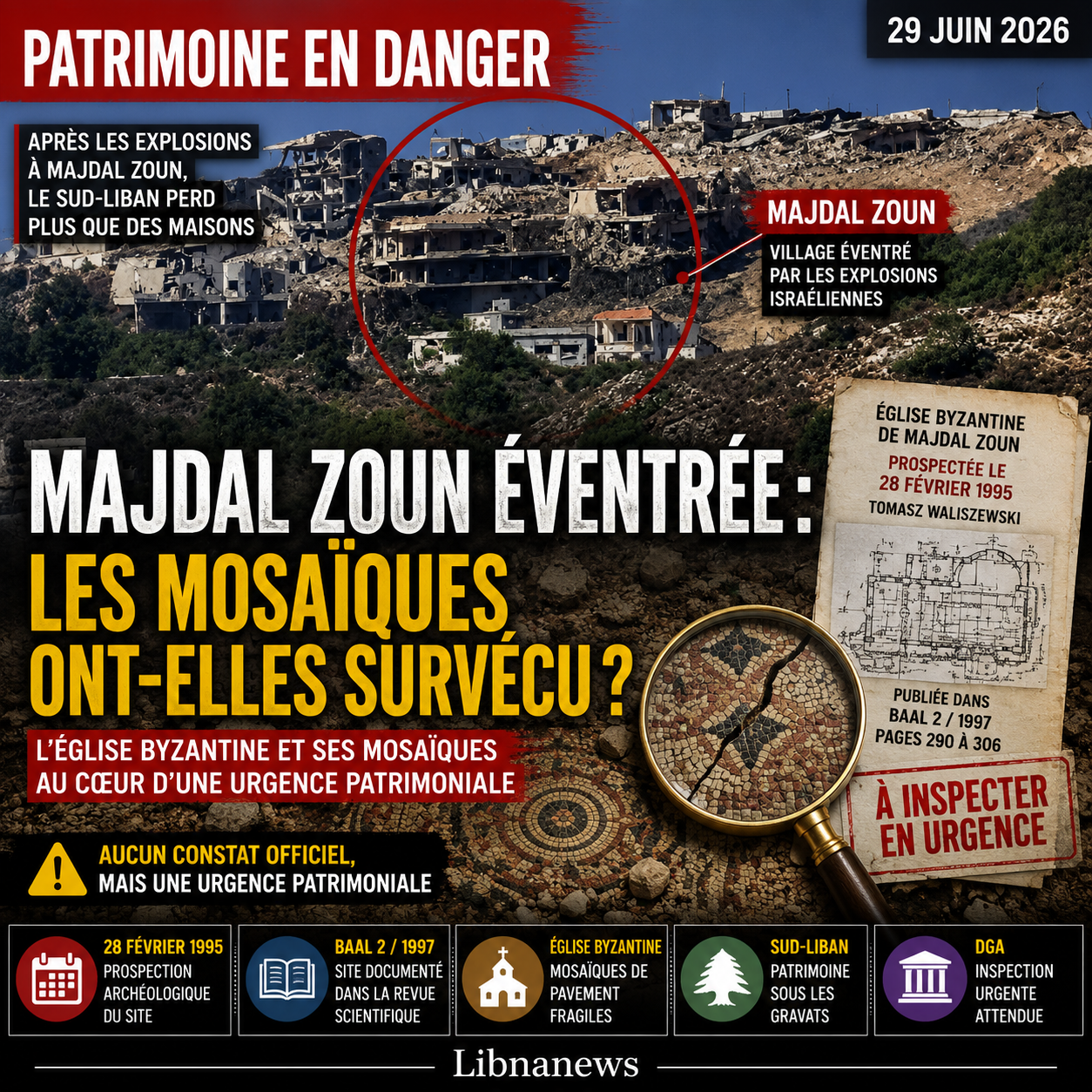
Majdal Zoun, in southern Lebanon, is no longer just a name added to the long list of locations affected by the war. After the explosions caused by the Israeli army in this area of the Tyre Caza, the village appears literally ventilated. Israel claims to have targeted and destroyed an underground infrastructure attributed to Hezbollah. But beyond the military narrative, another question arises, more silent and yet essential: what became the Byzantine church of Majdal Zoun, with its pavement mosaics?
The question is not secondary. Majdal Zoun is not just a military zone on a map. It is also a place inscribed in the archaeological geography of Lebanon. A Byzantine church was documented there in the 1990s. Its pavement mosaics, already described as fragile and partially preserved, bear witness to an ancient Christian presence in this region of southern Lebanon, a Byzantine rural landscape today too often forgotten, and a heritage that does not benefit from the visibility of major sites such as Tyre, Baalbeck or Byblos.
But an explosion of this magnitude not only destroys what is in its immediate axis. It shakes soils, cracks structures, weakens mortars, moves archaeological layers and can damage old pavements without such damage being immediately visible. A mosaic on the ground does not need to be directly affected by a projectile to be lost. Vibration, collapse, ground movements, gear passage, rubble or uncontrolled excavations may be sufficient to break it, dissolve it or bury it under rubble.
At this stage, we must remain rigorous. There is no public evidence that Majdal Zoun’s Byzantine church was destroyed. There are no recent archaeological findings, no detailed official inspection, no public land surveys yet to conclude. But lack of evidence should not become an excuse for indifference. The site exists in the scientific documentation. He’s been prospected. It was published. He is therefore known. And when a locality with such a vestige is evaporated by explosions, the heritage question must be asked immediately.
That is precisely what is often lacking in the war records in Lebanon. There are houses destroyed, roads cut off, targeted infrastructure, the dead and displaced. This is essential. But too often we forget the ancient layers, rural churches, pavements, graves, shrines, inscriptions, displaced stones. South Lebanon is seen as a front. It is rarely seen as a territory of history. Yet it is fully. Majdal Zoun, like other southern localities, preserves the traces of a historical depth that cannot be erased on the pretext of military news.
The Antiquities Directorate General should therefore list Majdal Zoun among the sites to be inspected as soon as security conditions permit. It is not just about going to see visible destruction. It is necessary to locate precisely the Byzantine church, compare the 1995 prospecting data with the current state of the land, check the pavement mosaics, photograph any damage, protect exposed surfaces, prevent wild excavations and document any damage that may be related to explosions or military work.
This work is urgent because archaeological heritage is often lost after the strike, not only during the strike. A bare mosaic can be destroyed by rain, rubble, rubbish or looting. A displaced fragment without a survey loses much of its scientific value. An archaeological layer moved without documentation becomes silent. In a war-affected village, heritage can disappear in the post-destruction phase of chaos.
Protection of cultural property in times of armed conflict is not a luxury. It is provided for in international law, including the 1954 Hague Convention. This protection does not only concern famous monuments or UNESCO listed sites. It also concerns rural churches, modest mosaics, published remains, places known to archaeologists but ignored by the general public. A Byzantine church in Majdal Zoun may not have the symbolic power of Tyre, but it belongs to the same Lebanese heritage.
So the problem is simple: if Majdal Zoun has been evaporated, you have to know what has been broken up with her. Houses, of course. Infrastructure, no doubt. But perhaps also part of the ancient memory of southern Lebanon. The question must be asked publicly: What is the status of the Byzantine church reported to Majdal Zoun? Are his mosaics still in place? Were they cracked, covered, displaced, destroyed or looted? Was an inspection conducted? If not, when will she be?
Lebanon cannot afford to lose its heritage by omission. Ancient stones don’t scream. Mosaics do not give interviews. They crack, detach, disappear under dust, and slowly exit inventories. Thus a country loses its history: not only by bombs, but also by the following silence.
Majdal Zoun must therefore be treated as an urban destruction file, but also as an archaeological record. The war in southern Lebanon does not only threaten the present of the inhabitants. It also threatens the long traces of Byzantine, Christian, rural, Mediterranean and Lebanese territory. The church of Majdal Zoun and its pavement mosaics today deserve a clear answer. Not tomorrow, when the rubble is moved. Now, before the memory of the place is permanently buried.