





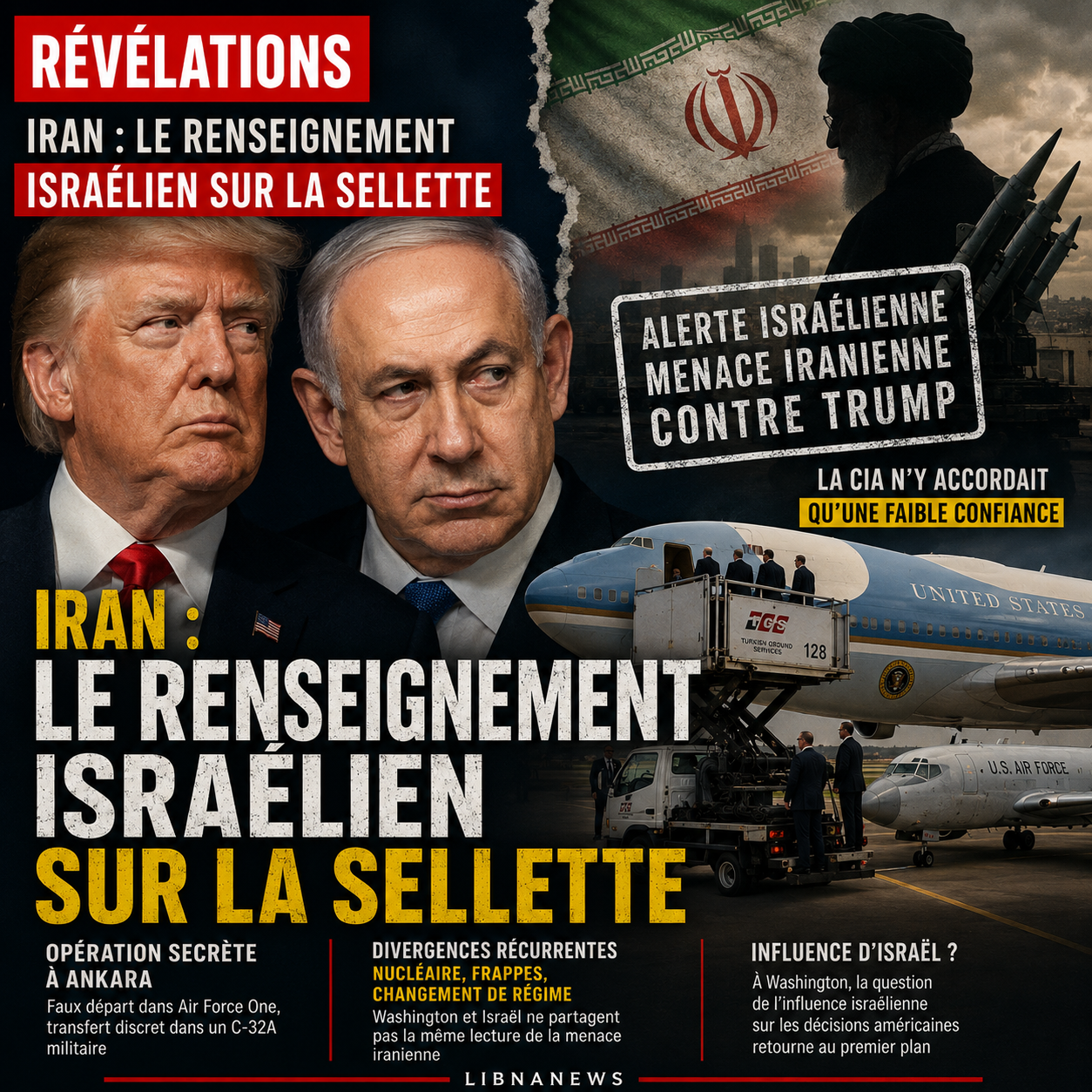
The US intelligence services had little confidence in the Israeli alert about an Iranian project targeting Donald Trump on his trip to Turkey. Despite CIA reservations, the Secret Service organized an exceptional operation in Ankara on 8 July: the president publicly boarded Air Force One before secretly leaving the aircraft in a catering truck and joining a military C-32A to win the UK.
The revelation now exceeds the only security of a presidential move. It revives in Washington an issue that has become sensitive since the outbreak of the war against Iran: what confidence can be given to information provided by Israel when it is used to assess an Iranian threat and can influence an American military decision? Since 2025, several assessments by American agencies have diverged from those defended by the Israeli government on key issues, including Tehran’s nuclear intentions, the results of the bombings and the prospects for regime change.
These differences do not lead to the conclusion that Israel systematically transmits false information. On the contrary, Israeli services have demonstrated a remarkable ability to penetrate the Iranian military and security apparatus, locate officials and identify sensitive facilities. The problem arises especially when turning this information into strategic conclusions: does a nuclear capability mean that the decision to make a bomb has been made? Does a vulnerability of Iranian power mean that the regime can be overthrown by strikes? Is suspicious activity evidence of imminent attack?
The Ankara case puts these questions at the forefront. Israeli information directly related to the life of the President of the United States led to exceptional protective measures while American analysts attributed him a low level of confidence. It intervenes mainly after several episodes in which Donald Trump publicly retained a reading of the Iranian danger closer to Benjamin Netanyahu’s than prudent conclusions of his own services.
This accumulation now feeds a politically explosive accusation in the United States. Opponents of the war, as well as personalities of the American right, claim that Donald Trump has allowed himself to be drawn into a conflict that corresponds to Israel’s strategic priorities. Some talk openly about manipulation. The facts available establish a significant Israeli influence and divergence with American agencies, but they do not demonstrate that Israel knowingly fabricated false information to provoke war.
The alarm against Trump deemed fragile by the CIA
The information transmitted by Israel concerned the displacement of Donald Trump to Ankara for the NATO summit. Prior to his departure from Turkey on 8 July 2026, the US authorities were warned of a possible Iranian project targeting the president or his aircraft. The scenario was of sufficient concern for the Secret Service to prepare for a clandestine change in the return journey, but US analysts examining the alert did not have the elements to consider it firmly established.
The CIA gave him « low confidence. » In the vocabulary of intelligence, this formula does not mean that information is considered false. Rather, it indicates that the available evidence is insufficient, fragmentary, difficult to corroborate or from sources whose reliability does not permit a firm conclusion. US analysts therefore clearly distinguished the existence of Israeli information from its independent US validation.
The Secret Service reasoned according to another logic. His job is to protect the President, including against scenarios whose probability remains uncertain. When a potential threat directly affects the life of the Head of State, the consequences of an error may justify disproportionate precautions in relation to the degree of confidence in intelligence. Presidential security officials therefore chose to change the trip.
Donald Trump publicly boarded the aircraft that observers thought should carry the president. He then came out discreetly through another door and was placed in an airport catering truck. The vehicle drove up to a C-32A from the US Air Force, a military version of the Boeing 757 used to transport senior American officials. Donald Trump left Turkey in this plane to win the UK.
Meanwhile, the other plane continued its journey with American officials and journalists, some of whom were unaware that the president was no longer on board. The operation was thus a real diversion device intended to conceal Donald Trump’s location. Its spectacular character now contrasts with the limited level of confidence that American analysts gave to the threat that contributed to its organization.
Suspicion of an alert also intended to influence Trump
It is on this point that the case takes on a political dimension. According to information published in the United States, some current or former officials wonder whether the Israeli alert was intended solely to protect Donald Trump or whether it could also reinforce the perception of a permanent and directly personal Iranian threat to the President. However, there is no public evidence that Israel has invented this threat for this purpose.
This distinction is essential. An allied service can convey information in good faith that it is of concern, while American analysts give it a lower value. It can also select the information it shares according to its own strategic priorities, without falsifying the data. In an alliance as close as that between Washington and Israel, the border between intelligence sharing, strategic persuasion and political influence can become difficult to establish.
The problem is all the more sensitive because Ankara’s alert is not the first issue on which Washington and Israel have diverged about Iran. Since 2025, disagreements have focused on the most important issues: the willingness to make a bomb, the real proximity to the nuclear threshold, the effectiveness of strikes against Iranian installations and the possibility of causing the Islamic Republic to fall.
Nuclear program: Washington did not see a decision to make the bomb
The nuclear issue is the most important precedent. On March 25, 2025, the National Intelligence Director, Tulsi Gabbard, presented to the Senate the collective assessment of American agencies. It indicated that Iran was not then building nuclear weapons and that the Supreme Guide Ali Khamenei had not allowed the resumption of the weapons programme that Washington considered to be interrupted in 2003.
That conclusion did not mean that the American services considered Iran’s programme harmless. Instead, they noted a worrying increase in the country ‘ s nuclear capabilities. Iran had accumulated a considerable amount of enriched uranium at 60 per cent, much higher than the usual requirements of a civilian nuclear programme and relatively close to the 90 per cent required to obtain military grade material.
United States agencies were also a worrying political development in Tehran. The taboo surrounding the possible acquisition of a nuclear weapon seemed to weaken, while some Iranian personalities spoke more openly about the possibility of changing the country’s doctrine. But Washington continued to distinguish an advanced technical capability from a formal political decision to make a bomb.
Israel attached much less importance to this distinction. For Benjamin Netanyahu, waiting for evidence that Ali Khamenei had explicitly ordered the manufacture of a weapon could mean waiting until Iran already had the material, centrifuges and knowledge to quickly cross the threshold. The threat therefore lay not only in the existence of a assembled bomb, but in the possibility for Tehran to produce one within an ever shorter time frame.
Trump publicly dismissed analysis of his own services
The divergence became public in June 2025. Asked about the evaluation presented by Tulsi Gabbard three months earlier, Donald Trump had claimed that Iran was, in his view, very close to possessing a nuclear weapon. Faced with the fact that his national intelligence director had declared the opposite about Iran’s decision to build a bomb, the president had publicly dismissed his assessment.
This episode is now a central element of the debate on Israeli influence. Donald Trump had an evaluation produced by his own intelligence community, but he chose an interpretation that was more alarmist and closer to that defended by Israel. This does not prove that he was deceived. This, on the other hand, shows that when two readings of the threat diverged, the president could give priority to the one that justified faster action.
The distinction between capacity, intent and imminence is fundamental here. A State may have the centrifuges, uranium and knowledge necessary to rapidly approach a weapon without having yet decided to build it. Nor does a decision to make a bomb mean that an operational weapon can be produced immediately, as it is still necessary to enrich the material at the required level, design a reliable device and possibly adapt it to a vector.
However, Israel considers that this analytical distinction can become dangerous when an opponent is too close to the threshold. The US services are seeking to establish what can be demonstrated on the real intentions of the Iranian leadership. Both approaches can be based on the same technical data and lead to radically different political conclusions.
A decided war despite more conservative American assessments
The question took on a completely different dimension with the American decision to go directly to war against Iran. Donald Trump’s critics today argue that the president accepted an Israeli reading of the danger that went further than that of his own agencies. They point out, inter alia, that American intelligence had not established that Tehran was about to dispose of an operational nuclear weapon.
On the contrary, Israel pleaded for urgency. Benjamin Netanyahu’s government considered that an exceptional strategic window had opened: Iran’s regional capabilities had been weakened, its military apparatus had suffered losses, its economy was under pressure and its nuclear programme could still be hit before reaching a level that made any intervention much more difficult.
Donald Trump finally chose the military option. However, it is fully responsible for this decision. The US President had the CIA, NSA, Defense Intelligence Agency, State Department, Pentagon and National Security Council. He therefore had access to assessments different from those provided or defended by Israel.
That is why the claim that Israel simply « manipulated » a private president of contradictory information does not correspond to the facts known. A more precise formulation is that Netanyahu sought to convince Trump, that some Israeli analyses were more alarmist than those of American agencies and that the president chose to give more weight to some of these arguments.
Can we talk about wrong Israeli intelligence?
The accusation that the war was triggered on the basis of false Israeli intelligence requires the same caution. The US services did not consider Iran a fictitious threat. They confirmed the existence of an extremely advanced enrichment programme, significant ballistic capabilities and military networks that could target American interests in the region.
Washington also accused Iran of supporting or preparing projects targeting former US officials, including Donald Trump. The existence of a general Iranian threat against certain American personalities therefore does not depend on the Israeli alert transmitted before the trip to Turkey.
The differences mainly concern the degree of certainty and the conclusions drawn from the available information. The United States services did not necessarily validate the idea that Tehran had already decided to make a bomb, that an attack should be carried out immediately or that a military campaign would quickly cause the regime to collapse. These nuances became politically essential as the war continued.
There is no public evidence at this stage that Israel knowingly fabricated false information to push the United States to attack. There are, on the other hand, sufficient documented differences to ask another question: have Israeli information sometimes been presented or interpreted in such a way as to promote Netanyahu’s strategic objectives to an American president who is already willing to focus on the most alarming scenarios?
Nuclear damage had already caused controversy
The differences do not concern only Iranian intentions. They also concern the real effectiveness of military operations. After the American strikes against Fordow, Natanz and Ispahan in June 2025, Donald Trump had claimed that Iran’s nuclear capabilities had been « destroyed ».
A first assessment of US military intelligence had been much more cautious. It considered that some elements of the programme could only have been delayed by a few months and that the exact extent of destruction remained to be determined. One of the main unknowns concerned the enriched uranium stock, whose full location was not immediately known.
This divergence did not mean that the bombings had failed. The facilities had suffered significant damage and some infrastructure had been destroyed. But the term « annihilation » implied a lasting loss of Iranian nuclear capacity, a conclusion that the first available data did not necessarily provide a basis for establishing.
The debate illustrates the difference between military outcome and strategic consequence. Destroying centrifuges or damaging underground facilities can slow down a program. This does not destroy the knowledge accumulated by scientists, industrial plans, supply networks or the capacity of a state to rebuild certain infrastructure.
Destroying a nuclear program is harder than hitting its sites
This difficulty explains why U.S. services regularly used estimates in months or years rather than definitive statements. The actual effectiveness of a strike depends on the amount of equipment destroyed, the fate of uranium stocks, the survival of specialists, the existence of clandestine installations and the industrial capacity to produce new centrifuges.
A bombardment can even alter the strategic calculation of the opponent. A regime that had not decided to make a bomb before an attack could then conclude that only a nuclear deterrent would allow it to avoid further strikes. Conversely, the destruction of critical capabilities can technically make a program technically impossible for a long period of time.
The information must therefore assess not only the visible damage but also the political consequences of the operation. It is precisely in this area of uncertainty that Israeli, American and Iranian narratives can diverge greatly, each having a political interest in presenting the results from a particular angle.
The 2025 episode set a precedent: US and Israeli political statements could present a much more definitive result than the first technical intelligence assessments. The current controversy over Ankara’s alert is therefore taking place in an environment where the difference between information, interpretation and political communication has already become a major issue.
Regime change: Americans doubted the scenario
The second major strategic challenge was the future of the Islamic Republic. When the military campaign intensified in 2026, Israeli statements gradually exceeded the only nuclear issue. The possibility of a major political transformation in Iran has become an integral part of the debate on war objectives.
U.S. assessments were much more conservative. Prior to major operations, analysts had studied the regime’s ability to survive the disappearance of its principal leaders. Their conclusion was not that political beheading would necessarily lead to democratization or collapse of the system.
The Islamic Revolutionary Guard Corps was a central factor in this analysis. This organization is not just a military force. It has economic structures, intelligence services, internal security units and an institutional location deep enough to survive the disappearance of individual leaders.
American analysts even envisaged that a weakening of the political summit could strengthen the toughest elements of the Revolutionary Guards. A change at the head of the system could thus produce a more militarized regime rather than a political transition corresponding to American or Israeli expectations.
The weakness of the opposition complicated any strategy of reversal
Another difficulty was the absence of a unified political alternative. The Iranian opposition brings together monarchists in favour of Reza Pahlavi, secular republicans, ethnic movements, left-wing organizations, liberal activists and several other currents who do not share the same institutional project or strategy.
This fragmentation does not mean that the regime has massive popular support. Successive protest movements have shown deep discontent about political freedoms, economic difficulties, women’s rights and the country’s management. But the ability to challenge a government and the ability to take control of a state after its collapse are two different problems.
For American services, the disappearance of the Islamic Republic summit could therefore create a vacuum without ensuring that a pro-Western force could fill it. The risk of internal struggle, increased control by the Revolutionary Guards or fragmentation of power was one of the scenarios to be considered.
These reservations made much more uncertain the reasoning that a sufficiently intense military campaign would rapidly bring about regime change. Again, Washington and Israel did not necessarily differ on the fragility of certain Iranian structures, but on the consequences that it was reasonable to expect.
Khamenei’s disappearance did not bring down the system
The war of 2026 offered a brutal verification of these scenarios. The elimination of Ali Khamenei and several prominent military or security officials was a considerable shock to the Islamic Republic. In the early hours of the campaign, the simultaneous disappearance of a part of the summit might suggest that power was engaged in an existential crisis.
However, the U.S. evaluations released in the following days were much more reserved. They found that the main institutions continued to function, that the Revolutionary Guards kept their chains of command and that no wave of defections large enough to cause implosion of the system was observed. The regime was weakened and disorganized, but that did not mean that it was about to disappear.
This distinction has a direct strategic consequence. If the implicit or explicit objective of a campaign becomes regime change, military destruction must be accompanied by a political mechanism enabling a new authority to take over. In Iran, US intelligence did not see this replacement force clearly, while the Islamic Republic’s coercive apparatus remained capable of preventing its opponents from seizing power.
The survival of the system after the death of Khamenei does not invalidate all Israeli assumptions about its weakening. It shows, however, that spectacular beheading alone was not enough to produce the rapid political rupture that some speeches had suggested.
Israel encouraged revolt while fearing its crushing
Differences have arisen even in the assessment of the chances of an internal uprising. Israeli officials have publicly encouraged Iranians to take advantage of the weakening of power to revolt. The Israeli communication presented the strikes as an opportunity to open a new political period for the Iranian population.
However, information reported in Washington showed that, in private, some Israeli officials themselves were not convinced that this strategy could succeed. In particular, they feared that a mass movement would face extremely violent repression if the Revolutionary Guards and other security forces remained coherent.
The contrast is significant. Publicly encouraging a population to rise does not necessarily mean that those in charge of this appeal feel that their chances of victory are high. Political communication may seek to provoke an event the outcome of which remains highly uncertain by the services or diplomats.
This difference between public discourse and private appreciation is precisely in line with the problem raised by nuclear information. A possible hypothesis can become, in political communication, a perspective presented as likely. For U.S. agencies, whose role is to advise the President on the basis of probabilities rather than objectives, this transformation is a major vigilance point.
Long war weakens promise of a quick result
The duration of the conflict added another dimension to the debate. The first weeks had been dominated by American and Israeli military superiority, the elimination of Iranian officials and the destruction of infrastructure. But the Islamic Republic has retained sufficient resources to continue hostilities and exert pressure on American interests and their allies.
So war did not produce immediate surrender. Iran continued to use missiles, drones and other military capabilities, while the United States had to maintain an important device in the region. The human, military and economic cost of the operation has gradually become an American domestic issue.
This development reinforces the criticisms of those who consider that the pre-intervention assumptions were too optimistic. If Iran were to yield rapidly under the combined effect of the strikes, economic blockade and the elimination of its leaders, the continuation of the war several months later necessarily necessitates a review of these forecasts.
The U.S. assessments had specifically warned that the regime had significant resilience mechanisms. The country’s ability to absorb considerable losses did not mean that it could sustain the war indefinitely, but it made it unlikely that a mechanical collapse would occur after a few weeks of operations.
The accusation of Israeli manipulation wins the American right
It is in this context that the expression « manipulation by Israel » began to emerge from the traditionally critical circles of the Israeli-American alliance. Part of the political movement surrounding Donald Trump had been built around the rejection of « endless wars », regime changes and costly interventions in the Middle East. Iran’s silencing therefore directly affects an ideological contradiction of trumpism.
The harshest critics believe that Benjamin Netanyahu managed to convince Donald Trump that Israeli and American strategic interests were entirely identical. According to this reading, Washington would have gradually accepted objectives ranging from the destruction of the nuclear program to the weakening of the regime, and eventually to its transformation, when the US president had long stated that he wanted to avoid nation building or regime change companies.
Officials and commentators close to the Republican camp have also challenged the idea that the United States should continue the war as long as Israel deems it necessary. The debate is less about the alliance with Israel than about who defines the objectives and when they are considered to be achieved.
The charge of manipulation nevertheless has an important limit. Benjamin Netanyahu can influence Donald Trump, present information, defend an interpretation and exert political pressure. It does not have the constitutional power to trigger an American war. This remains the decision of the President of the United States and its administration.
Trump had contradictory assessments
This presidential responsibility is all the more clear as Donald Trump was not dependent on Israeli intelligence. The United States has the largest collection and analysis apparatus in the world, with satellites, electronic interceptions, human means, the CIA, the NSA, the DIA and the armed forces’ own capabilities.
When US agencies diverged from Israel over Iran, these disagreements were therefore accessible at the top of the state. The March 2025 assessment of Iran’s failure to make a bomb was not even secret: it had been publicly presented to Congress.
Donald Trump chose to challenge it. This choice turns the issue of manipulation into a broader issue of decision-making. Why did the president place more weight on Israeli assessments than on the reserves of his own analysts? Was it due to other classified information, political calculation, the relationship with Netanyahu or a different conception of the acceptable level of risk?
Public considerations do not allow a definitive answer. On the other hand, they show that the President was not confronted with a consensus of American intelligence demanding an immediate war to prevent a bomb whose construction had already been decided.
The shadow of the Iraqi precedent
The controversy has a particular resonance in the United States because of Iraq’s precedent. In 2002 and 2003, statements about Saddam Hussein’s weapons of mass destruction had gradually gained a higher level of certainty in the political debate than several available information warranted. The announced weapons were not recovered after the invasion.
However, the comparison with Iran has important limitations. The Iranian nuclear programme is real and documented by the International Atomic Energy Agency. Iran has indeed enriched uranium at very high levels and developed significant ballistic capabilities. Nor are Iranian threats against American interests an invention.
Rather, the parallel focuses on the process that transforms information into political justification. A technical capacity can become a certain intention. A potential threat may be presented as imminent. A strike that delays a program can be described as having annihilated. A weakened regime can be considered close to collapse while the structures defending it remain intact.
This succession of slips explains why the degree of confidence associated with information is essential. A « low confidence » does not prevent the Secret Service from protecting the President. On the other hand, it prohibits presenting the existence of this threat as a definite fact without specifying the uncertainties surrounding it.
Israeli intelligence remains a major source for Washington
The proliferation of differences does not mean that the United States can do without Israeli intelligence about Iran. Israel has a geographical proximity, human networks, linguistic and cultural knowledge and particularly important operational experience on this issue. Several operations in Iran have shown that its services have very accurate information.
However, this tactical effectiveness must be distinguished from strategic forecasting. Locating a commander is an intelligence operation. Determining the political consequences of his death is a much more uncertain analysis. Identifying a nuclear facility is not equivalent to knowing the political decision of the Supreme Guide. To detect an activity that may correspond to the preparations for an attack does not automatically mean that the operation will be carried out.
The US services can therefore consider some of Israel’s intelligence as excellent while challenging the conclusions drawn from it. This distinction is crucial to understanding the current situation: there does not necessarily exist a general crisis of confidence in Mossad or other Israeli structures, but greater vigilance over the strategic use of their information.
This vigilance becomes even more important when both countries pursue objectives that do not fully coincide. Washington may want to neutralize a specific threat and end a war, while Israel may seek to prolong the pressure until it achieves a much deeper transformation of the regional environment.
Washington now also monitors Israel’s intentions
The relationship between the two intelligence devices has thus evolved. American agencies no longer seek to understand what Iran is preparing; They must also determine what Israel could do when the Netanyahu government’s choices could jeopardize the White House’s strategy.
During the war of 2026, American assessments focused on the possibility that Israel might take initiatives that might complicate negotiations or prevent a de-escalation sought by Washington. This monitoring illustrates the existence of shared but not identical interests between the two allies.
Israel wants to prevent Iran from regaining a military or nuclear capability that could threaten its territory. It may therefore consider that an agreement allowing certain Iranian capabilities to remain is insufficient. Donald Trump, faced with the costs of a prolonged war, may on the contrary judge that an imperfect compromise is preferable to a clearly defined confrontation.
In this configuration, intelligence becomes inseparable from strategy. Information on an Iranian threat can be accurate while reinforcing the arguments of those who wish to continue the war. On the contrary, a more cautious assessment can support those who want to negotiate. The challenge then is to prevent the analysis from being subordinated to the desired political outcome.
A fundamental difference between error and manipulation
That is also why the current accusations must distinguish three very different situations. The first is intelligence error: a service sincerely believes in information that proves to be false. The second is the divergence of analysis: two services have similar data but do not give them the same meaning. The third would be deliberate manipulation: knowingly convey false or misleading information in order to provoke a specific decision.
The evidence on Iran clearly documents several differences in analysis. They also show information that has not been corroborated to the level expected by the CIA, such as the Donald Trump alert in Turkey. They do not publicly demonstrate, at this stage, the third hypothesis.
This precaution does not detract from the seriousness of the debate. War can be influenced by excessively alarmist assessments without explicit falsification. A decision-maker can also favour information that reflects his or her convictions and remove those who contradict them, a phenomenon long known in the history of international crises.
The heart of the problem is therefore less whether Netanyahu has personally deceived Trump than to determine how the differences between American intelligence and Israeli appreciations were arbitrated at the top of the US administration.
The case of Ankara becomes a credibility test
The July 8 alert now concentrates all these questions. It concerns an extremely serious threat, directly directed against Donald Trump, but for which the CIA expressed little confidence. The Secret Service had every reason to choose maximum caution; However, this protection decision does not transform the original information into confirmed information.
The case therefore raises several concrete questions. What exactly did Israel transmit? What sources were they based on? Did American agencies subsequently find evidence to corroborate the threat? Why did their level of confidence remain low? And did the Israeli officials know that Washington considered the alert fragile?
The most sensitive issue is the intention behind sharing. Some American officials wonder if information could have a political effect by strengthening Trump’s belief that he was personally threatened by Tehran. This is a question, not an established fact. In the absence of evidence of intentional manufacture, it must remain presented as such.
But the very existence of this suspicion is significant. It shows that part of the American apparatus no longer automatically considers an Israeli alert on Iran as information that is sufficient to integrate as is into the decision-making process.
The main points of disagreement between Washington and Israel
The differences that have emerged since 2025 now draw a coherent whole. On nuclear, American agencies recognized an advanced Iranian capability but did not consider that Tehran had decided to manufacture a bomb. Israel saw the rapid approach to the threshold as a danger that could justify action even before such a decision was detected.
After the strikes of 2025, the first U.S. evaluations were more cautious than the political statements about the « annihilation » of the program. The question was not about the existence of destruction, but about its duration and the possibility for Iran to rebuild certain capabilities.
On the change of regime, American analysts doubted that a military campaign was sufficient to bring about the collapse of the Islamic Republic. They insisted on the resilience of the Revolutionary Guards, the fragmentation of the opposition and the risk that a beheading of the summit would ultimately strengthen the toughest elements of the system.
Finally, on Ankara’s alert, the divergence directly concerns the credibility of operational intelligence provided by Israel. The CIA did not have sufficient evidence to give it a high level of confidence, even if the potential threat justified security measures.
Taken separately, none of these episodes demonstrate Israeli manipulation. However, they end up explaining why the way Washington receives and interprets Israeli intelligence about Iran has become a political issue.
For Trump, a question of political responsibility
The US president ultimately had controversy. Donald Trump has often presented himself as a leader who decides according to his own judgment and refuses the recommendations of the Washington establishment. This position makes it difficult to argue that he would simply have been trained despite him in a strategy designed in Jerusalem.
While he preferred Israeli assessments on some cases, this choice was political. If he publicly rejected an assessment of his National Intelligence Director, he cannot then be considered to have ignored the existence of the disagreement. And if war objectives have gradually exceeded the nuclear issue alone, the US administration will have to explain how these objectives have been defined and how their achievement should be measured.
However, Israeli influence remains a legitimate issue because Netanyahu had privileged political access to Trump and a clear strategic interest in maintaining maximum pressure on Iran. American responsibility and Israeli influence are therefore not exclusive: both can coexist.
The real issue is whether the US decision-making process has sufficiently distinguished intelligence from persuasion. This question no longer concerns only the events that preceded the war. It now concerns future decisions on its pursuit, its objectives and the conditions for a possible exit.
American doubt now focuses on how to interpret Israel
The revelation concerning Ankara therefore does not destroy the credibility of Israeli intelligence. It reveals something more precise and perhaps more important: Washington does not necessarily treat the Israeli interpretation of the Iranian threat as a shared truth.
Both allies can observe the same centrifuges and not draw the same conclusion on a bomb. They can see the same political fragility in Iran and diverge on the probability of a collapse. They may receive guidance on an attack project and assign different levels of confidence. These differences become crucial when they are used to decide a military operation or to determine the duration of a war.
Air Force’s false departure case One is now a particularly revealing case. The United States took all possible precautions to protect its president, but its main intelligence agency was not convinced of the soundness of the alert that contributed to that decision. This difference between operational prudence and analytical certainty is now at the centre of questions.
The next step will be to determine whether new American elements have, since July 8, strengthened or weakened the scenario of an Iranian project against Donald Trump. In Washington, this re-evaluation will be followed far beyond the Secret Service: it will also weigh on the credibility given to future Israeli information about Iran, while the two allies still have to decide how far to continue their confrontation with Tehran.
References and links
Washington Post, August 12, 2026, investigation into the low level of confidence given by US services to the Israeli alert about an Iranian project against Donald Trump in Turkey:
https://www.washingtonpost.com/national-security/2026/08/12/cia-had-low-confidence-iranian-threat-before-trump-switched-planes-turkey/
Office of the Director of National Intelligence, Annual Threat Assessment, March 2025, evaluation of Iran’s nuclear program and lack of known decision to manufacture a weapon:
https://www.odni.gov/index.php/newsroom/congressional-testimonias/congressional-testimonias-2025/4059-ata-opening-statement-as-prepared
Reuters, June 2025, public divergence between Donald Trump and Tulsi Gabbard on Iran’s proximity to a nuclear weapon:
https://www.reuters.com/business/aerospace-defence/trump-contracts-his-spy-chief-irans-nuclear-program-2025-06-17/
Washington Post, March 2026, U.S. assessments of the low probability of causing a change in Iranian regime by military campaign:
https://www.washingtonpost.com/national-security/2026/03/07/iran-intelligence-report-unlikely-oust-regime/
Reuters, March 2026, U.S. assessment that the Iranian government was not in an imminent collapse after the operations began:
https://www.reuters.com/business/media-telecom/us-intelligence-says-iran-government-is-not-risk-colapse-say-sources-2026-03-11/
Washington Post, March 2026, information on Israeli private assessments of the risk of crushing an Iranian revolt:
https://www.washingtonpost.com/national-security/2026/03/17/israel-iran-cable-revolt-slaughtered/
Reuters, June 2025, First American Assessments of Damage to Iranian Nuclear Facilities:
https://www.reuters.com/world/midddle-east/intercepted-iranian-communications-downplay-damage-us-attack-washington-post-2025-06-29/
Washington Post, June 2026, US intelligence warnings about the risk of Israeli actions undermining a negotiated outcome with Iran:
https://www.washingtonpost.com/national-security/2026/06/19/us-intelligence-warns-israel-is-likely-undermine-iran-peace-deal-officials-say/