





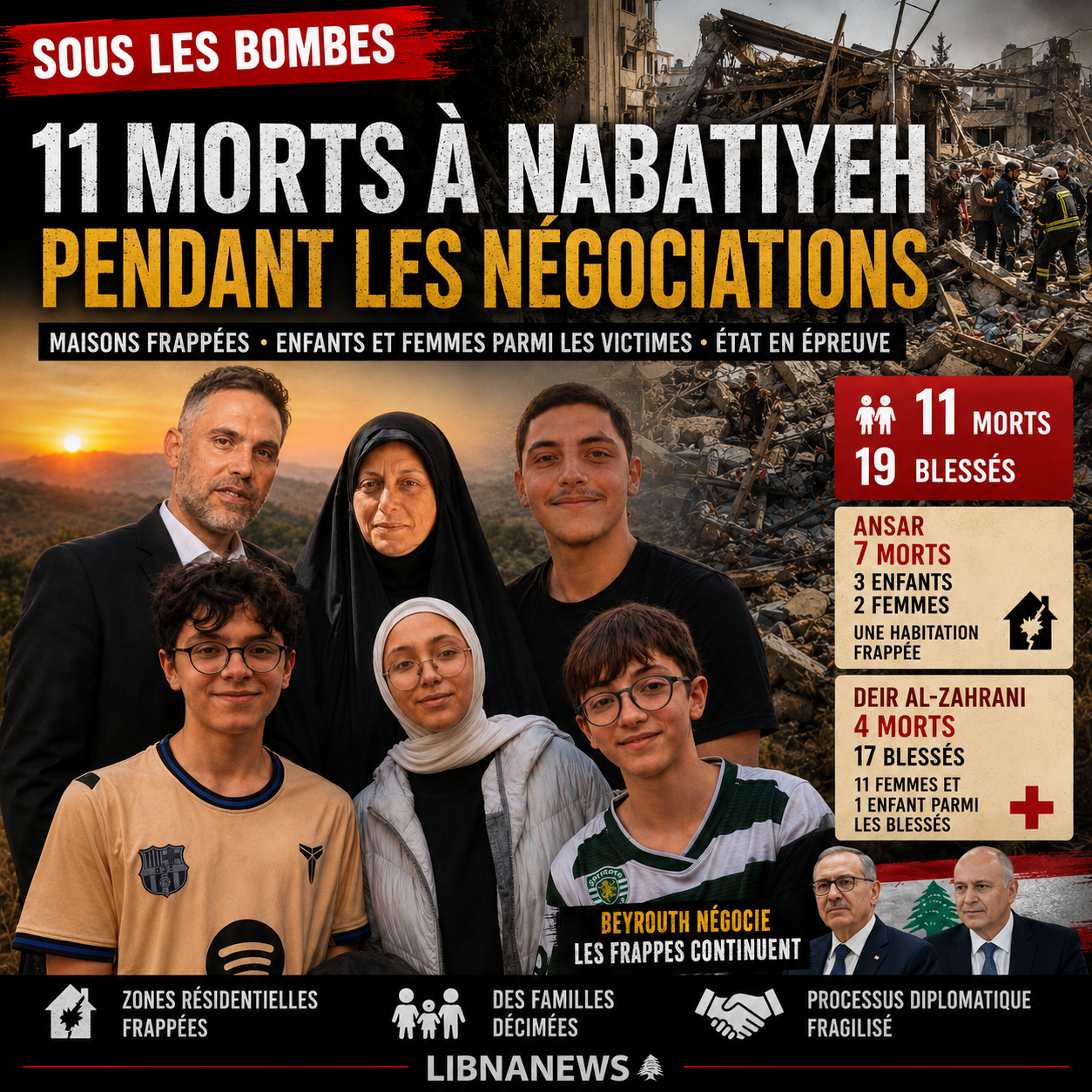
Eleven dead, including children and women, and 19 wounded: Nabatiyah Caza lived on Saturday 15 August 2026 another bloody day under Israeli strikes. In Ansar, a house was hit and seven people were killed, including three children and two women. One mother and several of her children are among the victims reported on the spot. A few hours later, four more people died in Deir al-Zahrani. This carnage in Nabatiyah also causes a profound political malaise in Lebanon: Israel continues its bombings at the very moment when Beirut agrees to negotiate, under American mediation, an agreement supposed to lead to Israeli withdrawal and the stabilization of the South.
In Ansar, a house hit and a family decimated
The most deadly strike of the day hit Ansar, in Nabatiyah District. Israeli aviation bombed a house, causing a collapse and mobilizing rescue teams to search for victims under the rubble.
The Lebanese Ministry of Health reported seven deaths. These include three children and two women, which establishes the strong presence of civilians among those killed and immediately places the nature of the target at the centre of questioning.
Reports from Ansar indicate that a mother and several of her children died in the bombing. The strike affected the same family home, far from the image of an operation limited to an isolated military objective.
However, the full identities of all seven victims were not yet published Saturday night in official documents allowing independent verification. In these circumstances, names circulating on social networks or in local publications should still be considered with caution.
This is already sufficient to measure the gravity of the balance sheet. Three children and two women were killed in a home strike, while Israel claims to have targeted Hezbollah’s « military infrastructure » in the area.
This contradiction immediately provoked the anger of Lebanese officials. Prime Minister Nawaf Salam directly challenged the Israeli presentation of the attack and placed the victims at the centre of his response.
» The seven victims are not military infrastructure »
Nawaf Salam stressed that the seven people killed in Ansar did not constitute « military infrastructure ». The head of government also insisted on the presence of children and women among the dead to challenge Israel’s justification.
His reaction goes beyond the usual condemnation of an Israeli strike. It raises a question that has become central to the Lebanese government: can Israel continue to decide alone what constitutes a military target on Lebanese territory, even though Beirut claims to be gradually regaining security control of the country?
The Prime Minister defended a clear position. If illegal military infrastructure exists in Lebanon, their treatment is the responsibility of the Lebanese State and its institutions, not of Israeli operations carried out unilaterally in Lebanon.
This position allows Nawaf Salam to distinguish two often confused files. The government can defend the state’s arms monopoly and work to resolve the issue of Hezbollah’s arsenal without accepting that Israel freely bomb Lebanon.
However, the carnage of Ansar makes this balance much more difficult. For part of Lebanese opinion, the question becomes concrete: if Lebanon negotiates, accepts security commitments and discusses the disarmament of Hezbollah, why do southern civilians remain exposed to Israeli strikes?
Deir al-Zahrani hit in turn
The balance sheet increased a few hours after Ansar. A new Israeli attack hit Deir al-Zahrani, also located in Nabatiyah district, causing significant relief operations.
The Lebanese Ministry of Health finally announced four deaths and 17 injuries in the strike. Among the injured are eleven women and one child, again confirming the direct impact of the operation on the population.
With the seven deaths of Ansar, the results of these two attacks reached 11 dead and 19 wounded. This is one of the most deadly days in the South since the lull that came into effect in June.
The strikes were not limited to Ansar and Deir al-Zahrani. The Israeli army also conducted operations in several areas around Nabatiyah, including towards the heights of Ali al-Taher.
This increase in attacks has revived fear in an area already deeply affected by the bombings of previous months. June had reduced the intensity of the fighting, but it had never given the South full security.
Israel invokes Hezbollah, civilian record remains
The Israeli army claims to have targeted Hezbollah-owned infrastructure in the Ansar and Ali al-Taher sectors. It presents the strikes as a response to an action against its soldiers and maintains that it will continue to intervene against any threat against its forces or the Israeli population.
This version does not erase the field record. In Ansar, three children and two women were among the seven people killed in the bombed housing, while in Deir al-Zahrani the wounded included eleven women and one child.
There is no independent information available on Saturday night to establish that the children killed in Ansar had a military role. The possible presence of Hizbullah infrastructure in the sector alone does not make it possible to determine the status of each person killed.
It is precisely on this distinction that the Lebanese authorities insist. They refuse that the Israeli assertion that an area is home to Hezbollah infrastructure automatically transforms all those present into military targets.
Unease in negotiations becomes impossible to ignore
The Nabatiyeh massacre takes on a particular political dimension because of its timing. Since June, Lebanon has been participating in a diplomatic process supported by Washington to build a more lasting settlement with Israel.
A framework agreement was announced on 26 June. In particular, it must pave the way for an Israeli withdrawal from Lebanese territory, an extension of State authority in the South and the settlement of the issue of Hezbollah weapons.
The Lebanese Government has therefore agreed to enter into an extremely sensitive negotiation. This choice is subject to internal criticism, in particular because the disarmament of Hezbollah directly affects the country’s political and security balances.
In return, Beirut expects tangible results. The reduction of Israeli strikes, the withdrawal of Israeli forces and the return of lasting security to the South are essential conditions to give political credibility to this approach.
But the strikes of 15 August have the opposite effect. They give the image of a Lebanon that is being called for heavy commitments, while Israel retains the possibility of striking its territory and causing civilian casualties.
Joseph Aoun sees it as a message to the diplomatic process
President Joseph Aoun did not separate the bombings from the negotiations. His reaction focused precisely on the political signal sent by the Israeli strikes as the United States tried to advance the discussions.
The Head of State considered that the Israeli escalation, particularly in the Nabatiyah region, was a « clear message » to the negotiating process. He also put Washington ahead of its responsibilities by referring to American efforts to enforce the agreement between the two parties.
This statement reveals the malaise that is gaining in Lebanese institutions. The government has chosen the diplomatic path, but this strategy becomes difficult to defend when Israeli bombing continues to kill in Lebanon.
Joseph Aoun has been committed since he came to power in favour of the state monopoly of armed force. This approach, however, requires that the State be able to provide security that Hezbollah precisely justifies its weapons by the need to guarantee.
Each Israeli strike against Lebanese territory therefore complicates this equation. When these strikes kill children and women, their political effect goes beyond the bombing scene.
What does Lebanon gain by trading?
This is the embarrassing question that is now facing Beirut. Lebanon is discussing measures that directly affect its internal military architecture, while the immediate outcome of the negotiations — a reduction in the Israeli threat — remains difficult to see on the ground.
This contradiction feeds a crisis of confidence. It allows opponents of the process to ask why Lebanon should continue to make progress on its own obligations if Israel does not simultaneously reduce its military operations.
The problem is particularly sensitive for Nawaf Salam and Joseph Aoun. Both defend the strengthening of the state and refuse to allow Hezbollah indefinitely to retain an autonomous capacity to decide war and peace.
But this position is based on an implicit promise: a strengthened State must be able to better protect the Lebanese. The bombings of Ansar and Deir al-Zahrani weaken this demonstration as it becomes politically essential.
The government is therefore facing double pressure. It must move forward on the issue of weapons without giving the impression that Lebanon is disarming under bombs, and it must continue negotiations without suggesting that they offer Israel a free military action without compensation.
Strikes give Hezbollah an argument
For Hezbollah, the day of August 15 provides a directly exploitable argument. The movement refuses its disarmament under the current conditions and affirms that the persistence of the Israeli threat justifies the maintenance of its arsenal.
Nabatiyah’s strikes enabled the party to confront the government with this contradiction. If Israel can still strike houses, kill children and conduct raids north of the Litani River, Hezbollah can ask what would guarantee the protection of Lebanon after its disarmament.
The movement denounced the attacks and promised an « appropriate » response. Such a response would, however, pose another risk: a new military spiral in which an attack would lead to Israeli reprisals and a new response.
It was precisely this mechanics that the diplomatic process had to interrupt. The strikes of 15 August show how far this goal remains despite the negotiations that have been under way for several weeks.
Washington faced with weakened credibility
The United States is central to this crisis. Washington has supported the framework agreement and is the main mediator between two countries that do not have normal diplomatic relations.
American credibility therefore depends in part on its ability to obtain commitments on both sides. While the focus of pressure is on Lebanon and the disarmament of Hezbollah, while Israel continues its strikes, the balance of the mechanism becomes politically difficult to defend in Beirut.
Joseph Aoun’s statements can be understood in this context. By pointing out that the strikes send a message to the US negotiating process and efforts, the Lebanese President indirectly questions Washington.
The question is no longer just to convince Beirut to honour its commitments. The Lebanese authorities now expect the United States to demonstrate its ability to also obtain from Israel an effective limitation of its operations.
Without this reciprocity, the process may be perceived in Lebanon not as a balanced negotiation, but as a succession of demands addressed to a single party. The death of Ansar makes this perception even more difficult to fight.
Disarmament under bombs, a political red line
Hezbollah’s weapons file becomes even more explosive. It is no longer just an institutional debate on the state monopoly of force, but a matter directly associated with the immediate security of the people of the South.
For disarmament supporters, the Hezbollah arsenal exposes Lebanon to wars that the state does not decide. For his opponents, Israeli strikes show, on the contrary, that abandoning this arsenal without solid guarantees would leave the country vulnerable.
The 15 August bombings mechanically reinforce the second argument. They therefore complicate the political work of the government at a time when it is trying to move the first forward.
The paradox is particularly heavy for the Lebanese state. The more Israel strikes Lebanon during the negotiations, the more politically it weakens those in Beirut who defend the strengthening of the state at the expense of autonomous military structures.
This result far exceeds the power ratio between Israel and Hezbollah. It directly affects the ability of Lebanese institutions to convince their own people that a negotiated solution can bring more security than the logic of confrontation.
Nabatiyah had already paid a heavy price
The Nabatiyeh caza does not approach this new escalation as a territory previously spared. Since the beginning of the new phase of the conflict in March 2026, the region has suffered numerous strikes, destruction of homes and losses among civilians and State institutions.
On 10 April, an Israeli strike against the Nabatiyeh Serail had resulted in a heavy impact. Members of the Lebanese security services were among the dead, already giving the attack a scope beyond direct confrontation with Hezbollah.
Over the months, the strikes also affected residential areas and civilian infrastructure in the South. Whole families were killed in some documented attacks, while children were repeatedly among the victims.
This accumulation explains why the term « carnage » used in Lebanon does not only refer to the number of deaths on 15 August. It also reflects the feeling of a people who see the same communities repeatedly hit despite truces, mediations and diplomatic announcements.
Eleven dead and an even more fragile truce
The 15th of August is the most deadly episode since the June 20th. It had significantly reduced clashes without completely halting Israeli military operations or incidents involving Hezbollah.
Tension had already increased in early August after the death of two Israeli soldiers in an explosion in South Lebanon. Hezbollah had not claimed responsibility for this incident, but Israel continued to invoke threats against its forces to justify its operations.
Saturday’s strikes now raise fears of a bigger break. If Hezbollah carries out its threat of response, Israel could launch new operations and lead both parties into a series of reprisals.
Beirut is precisely trying to avoid this scenario. But its margin of manoeuvre is reduced when negotiations that are supposed to drive war away coexist with such deadly strikes.
In Ansar, victims put civilians back in the centre
Beyond diplomatic calculations, Ansar’s balance sheet remains the central fact of this day. One house was hit and seven people were killed, including three children and two women.
Their death poses a question to which the only statement of the presence of Hezbollah infrastructure does not answer. The Israeli authorities still have to explain how an operation presented as a military resulted in such a review in a family home.
This issue is all the more serious as the Lebanese Government now claims to want to deal with the military infrastructure beyond its control. By continuing to unilaterally strike Lebanese territory, Israel is weakening precisely the State to which the international community is simultaneously calling for the extension of its authority.
The Nabatiyah carnage thus exposes the fragility of the strategy currently defended in Beirut. Lebanon is called upon to consolidate the state’s arms monopoly, while Lebanon is still struggling to prevent a foreign power from hitting its territory.
On Saturday night, the relief teams continued to work after the bombings, while the families of the victims began mourning. The results were now 11 dead and 19 wounded in Ansar and Deir al-Zahrani, and the next question was already about the reaction