






A 2% to 3% levy that took everyone short
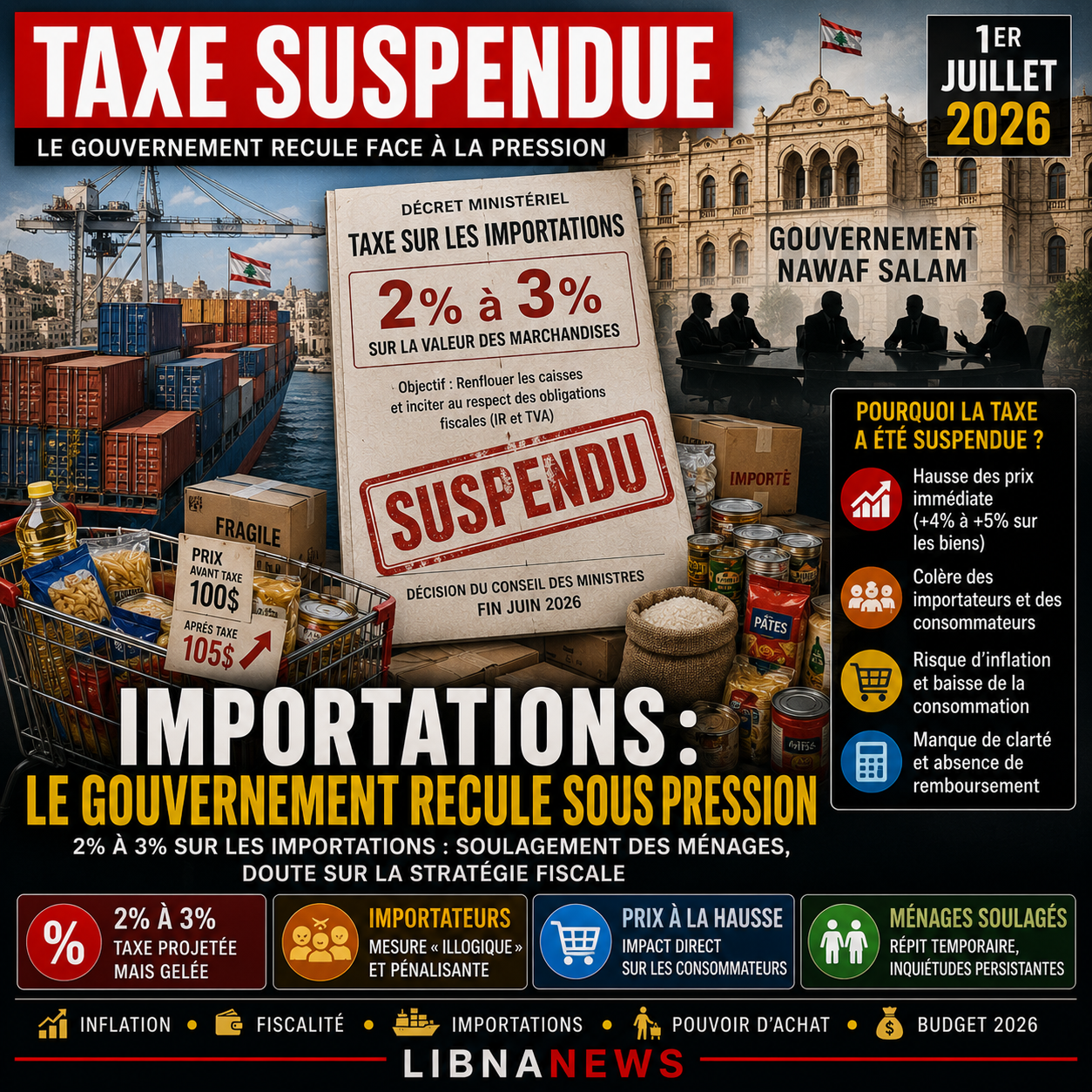
In the early summer of 2026, Lebanese importers learned, through a ministerial decree, that a new tax would apply to their operations. According to the text, a levy ranging from 2 to 3 per cent was to be charged on the value of most goods entering Lebanon. According to official information, the scheme had two objectives: to bail out State funds and to encourage companies to fulfil their tax obligations with regard to income tax and VAT. The Ministry of Finance explained that this contribution would be claimed from operators who had not submitted their tax returns for three consecutive years, but the modalities remained unclear. Employers’ organisations, on the other hand, denounced an « illogical » measure, applied without consultation and liable to penalise societies that respect the rules.
In Article 31 of the draft budget for 2026 , approved by the Council of Ministers at the previous re-entry , the tax was presented as a refundable » advance payment » after regularisation of tax returns . Many importers have explained that they have never received a refund in previous years. The mechanism was therefore tantamount to a real increase in taxation. Economists pointed out that Lebanon already had one of the region’s largest tax systems for formal enterprises; The introduction of this levy could increase pressure on an exsangue economic fabric.
An immediate effect on prices and inflation
The first reactions to the tax announcement were alarmist. The importers’ union, which includes agri-food companies, indicated that a 2% to 3% surtax on imported products would instantly impact the labels. « This will have a direct and immediate impact on prices, » said the union president, referring to a new surge in inflation. Retailers have calculated that the increase in duties would lead to an increase in the final price of goods , including basic foodstuffs , from 4 % to 5 % . Consumer organisations quickly alerted the risk of increasing household poverty, which was already faced with the fall in purchasing power.
For industrialists and wholesalers, fears were no less strong. In a press release, several employers warned against a vicious circle: the tax would lead to price increases, reduce consumption and push more companies to reduce their imports, thereby reducing customs revenues. The employers pointed out that companies that comply with tax laws would be penalized, while the informal economy, which largely escapes VAT and income tax, would continue to prosper. For these organizations, the priority should be to fight fraud and broaden the tax base rather than create an additional levy.
However, the bread sector provided a nuance. The Mont-Lebanon bakers’ union claimed that the price of the miche would not move despite the 3% tax, citing the decline in world wheat and energy prices. The purpose of this statement was to reassure consumers of a particularly sensitive product, but it was not sufficient to address concerns.
A retreat from criticism by the government
Faced with the anger of importers, household concerns and criticism of political parties, the government of Nawaf Salam has declined. At the end of June 2026, following an extraordinary session of the cabinet, the authorities announced the suspension of the application of the Customs Tariff Decree. The Minister of Information explained that the government wanted to « review the scale » and that it had decided to freeze the measure immediately because of the economic situation. The suspension covers the most sensitive goods, but the budget text remains in force. The Prime Minister recalled that Lebanon must find tax resources to pay civil servants’ salaries and finance social programmes, but he recognized that the way to validate the tax should be reassessed.
The cabinet’s backtrack was hailed by trade unions and consumer associations, which saw it as a victory for the mobilization. « It’s a temporary relief, but it shows that the government is sailing on sight, » one analyst said. The business community notes that the authorities have rarely consulted prior to announcing new levies, resulting in a climate of uncertainty. Several political parties accused the government of improvisation and lack of economic vision. For them, the decline proves that the tax had been decided hastily, without impact assessment.
According to one government official, the suspension is intended to « allow a technical review » in order to exclude certain basic necessities and to define fairer ways of distinguishing companies in good standing from fraudsters. It states that the measure should be reworked to target only companies that do not meet their tax obligations, in order to encourage reporting rather than penalise the whole sector. But he didn’t give any calendar.
A consumer angle: precariousness and fiscal fatigue
For Lebanese consumers, the succession of taxes and price increases has become unbearable. Since the collapse of the pound in 2019, the population has suffered multiple increases, from bank charges to electricity prices. Wages in the public sector do not follow and social assistance is exhausted. The introduction of an import surcharge was seen as a new attack on the household portfolio. Many Lebanese supply imported products due to lack of local production. Supermarkets offer goods from Europe or Asia, which are essential for many of the population.
In Beirut markets, several housewives expressed their exasperation. « We can’t buy meat anymore, everything has become too expensive, » complained one woman. Others feared that the situation would deteriorate further if the state applied the surcharge. The most optimistic welcomed the government’s suspension, but remained sceptical. « They’re going to invent another tax tomorrow to compensate, » said a Tripoli trader. For many, trust in tax policy is broken.
The import ratio is paradoxical: on the one hand, the economy depends heavily on foreign goods, on the other, the population is attached to local production and the idea of a relative tariff. However, economists point out that, for lack of infrastructure and capital, it would be unrealistic to do without imports. The rise in entry duties on goods therefore risks penalising consumers without offering an alternative. Some suppliers are already considering reducing import volumes or turning to undeclared circuits to escape sampling.
A debate on the government’s tax strategy
The import tax episode questions Lebanon’s tax strategy. For several years, successive governments have been trying to compensate for the collapse of revenues by creating one-off taxes. The increase in VAT, the fuel tax, the charges on public services and, now, the customs surcharge are all sometimes cancelled, sometimes reintroduced in another form. Opponents see it as proof of permanent improvisation and a lack of coherent plan. Instead of thoroughly reforming the tax administration and fighting fraud, leaders seem to resort to short-term solutions.
The experts stress that the Lebanese tax base is narrow. Much of the economy is informal, exempt from VAT and corporate tax. Businesses in good standing feel unfairly targeted by new taxes. International donors, which are conditional on structural reforms, are calling for a broadening of the tax base and modernisation of the administration. Proposals are circulating: strengthening controls, digitizing declarations, harmonizing rates. But they struggle to materialize, for lack of political consensus and investment.
The banking crisis further complicates the situation. Capital is blocked, the state struggles to raise funds and the currency continues to depreciate. In this context, any tax measure is perceived as a drop in the ocean of debts. However, the state has no choice but to provide resources to finance salaries and essential services. The authorities thus find themselves caught between the need to increase revenues and the fear of aggravating poverty. The suspension of the import tax is merely a stay; It reveals above all the lack of a comprehensive strategy.
Prospects and uncertainties
The suspension of the import tax raises new issues. Will the government return to the burden with a more targeted device? Will companies have a credible repayment mechanism? Will consumers be spared further increases? In the absence of clear communication, observers question. For the moment, the debate remains open and no structural reform seems to be under way. Negotiations with the International Monetary Fund are continuing, but the conditions imposed by the institution – restructuring the banking sector, fighting corruption, reforming taxation – are difficult to apply in a country where the majority of the political class benefits from the status quo.
Some voices offer alternative avenues: tax large fortunes, limit subsidies to the most polluting sectors, promote local production to reduce the import bill. But these measures imply a change in the economic model. Without a clear vision, the government risks replicating the mistakes of the past: multiplying temporary taxes, suspending them under pressure from the street, and indefinitely delaying the necessary reforms. In the meantime, traders and households look at advertisements and tailor their budgets to changing tax policies.
Without a lasting response, the Lebanese economy remains fragile and the population continues to dissociate between anger and resignation. The hasty withdrawal of the import tax testifies to the difficulty in reconciling the state’s financial imperatives with the reality of an exsangued country.