





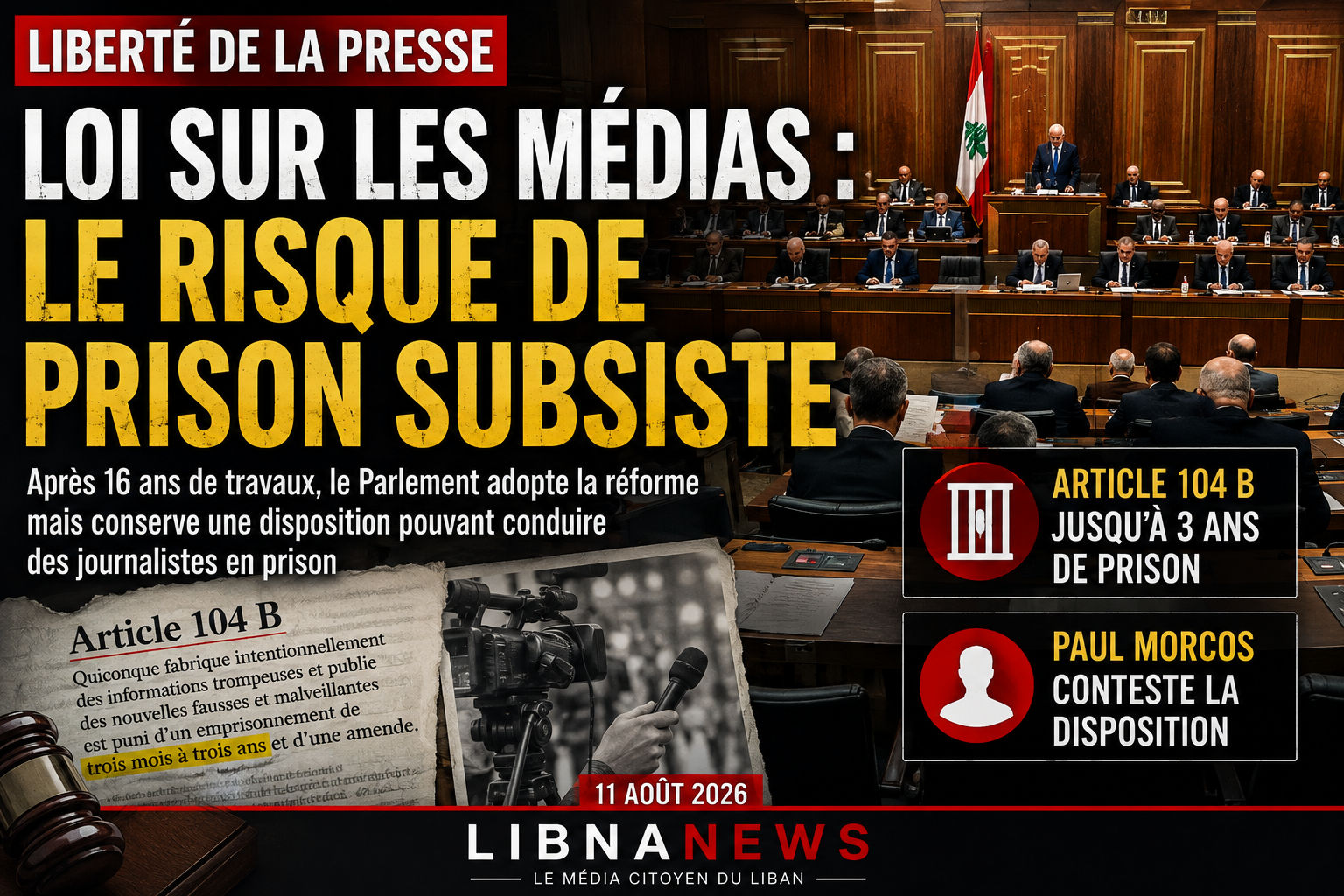
On Tuesday, 11 August 2026, the Lebanese Parliament adopted the new media law without changing the text submitted to the vote, despite the reservations expressed a few hours earlier on several of its provisions. The Minister of Information, Paul Morcos, confirmed the adoption by stating that he had officially recorded his opposition to the article which maintains a criminal offence against journalists, while announcing that he would seek to amend the law after its promulgation. The vote ended more than 16 years of discussions on the modernization of the Lebanese media framework, with several expected advances on digital regulation, source protection and the organisation of the sector. However, there is also a major risk that professional and freedom organisations are denouncing: the possibility of imprisoning a person for the intentional publication of information considered false or misleading.
The law passed without the changes discussed
The law was finally passed in the evening, after a first debate interrupted in the afternoon. Members then requested time to consider several amendments distributed during the session, including those relating to the National Media Authority. Gebran Bassil, Jamil Sayyed, Ibrahim Moussaoui and Georges Adwan were among the parliamentarians who asked not to vote immediately without sufficient time to study the proposed changes.
On resumption of work, however, Parliament approved the text without the changes mentioned during the day. Paul Morcos confirmed after the vote: « The media law was passed without any change. The minister added that he had registered his objection to the provision criminalizing journalists and that he would seek to introduce amendments later.
This declaration immediately places one of the contradictions of the new law at the centre of the debate. The text had been prepared for years with the stated aim of reducing the use of criminal law against journalists and replacing, for the most part, criminal sanctions linked to publication with civil liability mechanisms. A provision retained in the voted version, however, reintroduces a sentence of imprisonment in certain cases of dissemination of information considered false or misleading.
Up to three years in prison under article 104
Article 104, in its version discussed before the vote, provides in paragraph B for a term of imprisonment of three months to three years, with a fine or one of those sanctions, for anyone who intentionally produces misleading information and publishes false and malicious news. It was this provision that already concentrated the main critics before the session.
The risk lies less in the principle of sanctioning voluntary manipulation than in the definition of the terms used and how they can be interpreted by the judicial authorities. In particular, organizations specializing in media freedoms have noted that notions such as « deceptive information », « false news » or « malignant » may receive broad interpretations if the law does not set specific criteria.
The question of intent is also a sensitive one. The text must make it possible to distinguish a voluntary manufacture from a journalistic error, from information which is still incomplete at the time of its publication or from the resumption of data which subsequently prove to be inaccurate. Without this distinction, the risk is that a provision created to combat misinformation will be used in disputes involving ordinary journalistic work.
This danger is particularly important in Lebanon, where journalists, activists and commentators have been regularly summoned or prosecuted on the basis of criminal provisions relating to defamation, insult or other offences related to expression. The reform had been specifically presented as a means of reducing this judicial exposure and transferring the bulk of publishing litigation to civil rather than prison logic.
Why did Parliament vote anyway
Why, in these circumstances, did Parliament adopt the law anyway? The first reason is his seniority. Work on a comprehensive reform of media law began in 2010. The text then had many versions, passages in subcommittees and committees, as well as consultations with professional actors, lawyers, organizations defending freedom of expression and international institutions.
Maintaining the old cadre had itself become difficult to defend. The Lebanese sector continues to be governed by texts designed prior to the explosion of digital information, including the 1962 Publications Act and the 1994 Audiovisual Act. Meanwhile, news sites, digital platforms and new journalistic production models have profoundly changed the sector without a unified framework being adopted.
The new law seeks to respond to this transformation. The text integrates electronic media into the device, modernises the rules applicable to different media and provides for a new regulatory architecture. It also contains guarantees considered important for journalists, including protection of sources and judicial treatment of media-related disputes.
The draft finalized during parliamentary work included the abolition of the Print Court and its replacement by a specialized civil court for media cases. It also sought to prevent the use of pre-trial detention for offences directly related to journalistic work and to limit custodial sentences. These changes had been hailed as a significant break with the existing system.
A National Media Authority still in dispute
The text also provides for a National Media Authority to play a central role in regulating the sector. In particular, this institution must intervene in the organisation of the media landscape and in the application of certain provisions of the new law. Its creation responds to a desire to separate the daily regulation of the media from the direct administration of the Ministry of Information.
But this authority is also a source of reservations. The main question relates to its real independence: composition, method of appointment, financial autonomy, competence and recourse against its decisions. The more important its powers, the more the guarantees against political or administrative influence become decisive.
In particular, the National Human Rights Commission had stressed before the vote the need to guarantee the administrative and financial independence of this future authority. Other organisations have also called for a balanced representation of professionals and mechanisms to prevent regulation of the sector from becoming an indirect means of pressure on editorial staff.
This had helped to slow down the discussion of the text in the afternoon. Several Members wished to have more time to consider proposed amendments concerning, inter alia, this authority. The final decision to adopt the text without amendment therefore leaves some of these questions open.
A reformer text with a major criminal exception
Parliament has thus voted for a text that combines long-awaited reforms with several still contested provisions. It is this combination that explains why press organisations chose, before the sitting, to request the adoption of the reform while demanding the deletion of Article 104b rather than the return of the whole project to square one.
After 16 years of work, the text could have been sent back to the committee in full, and a reform could have been postponed again. The choice advocated by some of the players in the sector was therefore to preserve the progress achieved while correcting items deemed dangerous.
This logic now seems to be Paul Morcos’s. The minister did not ask, after the vote, to abandon the new law. On the contrary, he stressed his opposition to the penal provision and announced that he would seek to amend it. The battle thus moves from the adoption of the text to its correction.
The difficulty lies in the contrast between the overall objective of the reform and this exception. The shift from criminal logic to civil logic was presented as one of the main advances of the law. At the same time, a provision allowing up to three years in prison for certain publications creates a regime in which the general principle can be circumvented by specific criminalization.
For journalists, the challenge will therefore be how this provision will be used. An editor investigating a political, financial or security file may publish information contested by the persons concerned. The legal question will then become whether the information was simply wrong or insufficiently verified, or whether it was intentionally manufactured and published with malicious character.
This border is essential. An error may be corrected, giving rise to a right of reply or a civil remedy. A criminal offence, however, exposes the perpetrator to the judiciary and, in the case provided for in article 104b, to imprisonment.
Paul Morcos promises amendments already
The Minister of Information’s statement a few minutes after the adoption shows that the debate is not over. By officially registering his opposition to the criminalization provision, Paul Morcos creates a political trace of his disagreement with the voted version.
Above all, it announces a new legislative stage. The Minister intends to propose amendments to correct the items he considers problematic. It will now be necessary to determine when these amendments can be presented, what wording will replace the contested provision and whether a parliamentary majority will agree to reopen a text which has just been adopted.
Professional organizations will also have to review the official version of the Act. Between the various stages in committee, the proposals presented in the Chamber and the final choice to vote without change, only the publication of the text will make it possible to lay down precisely all the relevant provisions.
The same attention will focus on the National Media Authority. Its real independence will depend not only on the principles enshrined in the law, but also on the manner in which its members are appointed, the means allocated to it and how its powers will be exercised.
The vote on 11 August put an end to 16 years of legislative waiting, but not to controversies. Lebanon now has a new framework to replace largely outdated texts with digital development. However, Parliament has retained a criminal provision that the media minister himself challenges. The publication of the final text and the amendments promised by Paul Morcos will be the next test of whether the new law effectively protects journalists or keeps a door open for them to be imprisoned.